Sept 3, 2025 Community Health & Safety Committee: Homelessness Response Update
STREAMING COPY IN PREPARATION — RECORDING AVAILABLE FROM THE ORIGINAL SOURCE
Sept 3, 2025 Community Health & Safety Committee: Homelessness Response Update
The Everett City Council's Community Health and Safety Committee met on September 3, 2025, at 1:00 PM UTC to receive a comprehensive update from staff on the city's homelessness response. Julie (Community Development Department) and Ben Breden, Homeless Response Coordinator, presented five key focus areas: services and support, housing and shelter, safety, internal collaboration, and engagement/outreach. Councilmembers Tuohy (chair), Bader, and Fosse participated in discussion and questioning.
Discussion Items
- Services and Support: The city partners with nonprofits like EMOTE, Courage to Change, Everett Faith in Action, and the Hot Meals Coalition. The Hot Meals Coalition provided an average of just under 5,000 free meals per month over the past year. The city's CARE Team responded to over 1,800 crises in the first half of 2025. Street medicine and peer support programs were highlighted.
- Housing and Shelter: Ben reported that Snohomish County has 840 shelter beds (683 year-round, 157 seasonal), while the 2025 Point-in-Time Count identified1,140 unsheltered individuals. Since 2018, Everett has added 335 new housing/shelter units. Ongoing projects include the VOA shelter (pallets installed; grand opening fall 2025), New Start shelter (72 emergency bridge housing units, taking clients by end of 2025, managed by Salvation Army), and Everett Gospel Mission expansion (aiming for cold weather shelter occupancy by December 2026). The city increased cold weather shelter capacity from 49 to 84 beds last year and is seeking a South Everett location. Day shelter efforts have stalled; $2 million in ARPA funds set aside in 2021 did not result in a project. Interfaith Family Shelter's Madison Family Shelter (8 pallet units, 32 beds for families) opened in April 2025.
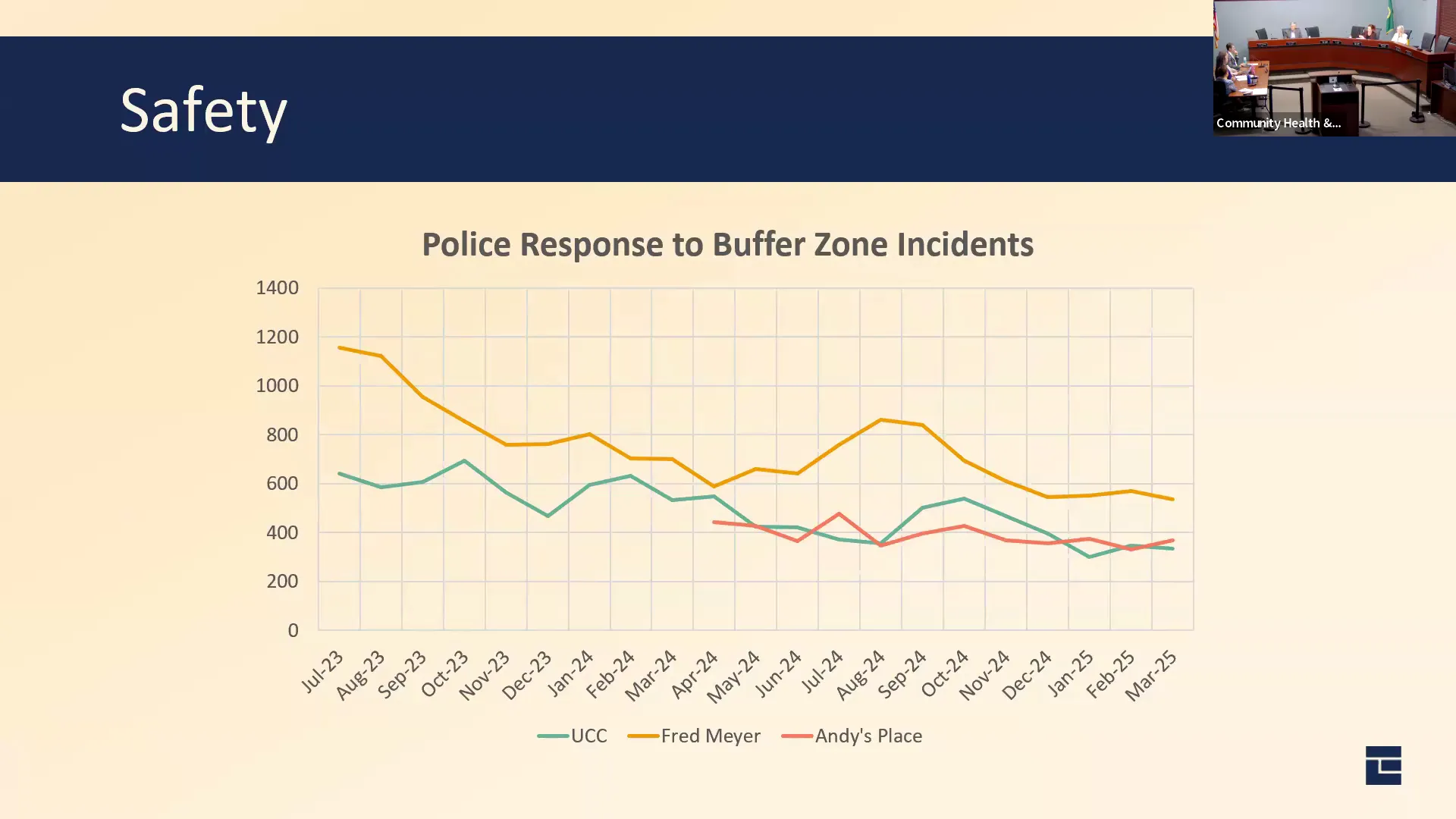
- Safety: The buffer zone ordinance (approved 2023) was presented. Data from three buffer zones (Fred Meyer, 2020 shelter at UCC church, and a newer zone) show an average 51% decrease in police call-outs. The Andy's Place buffer zone showed a 17% decrease, but councilmembers noted ongoing neighborhood frustrations. Ben discussed encampment removal: since 2023, nearly 700 camps cleared; standard72-hour notice for cleanups, immediate cleanup for critical infrastructure. Management plans with service providers (including CPTED reviews) are used to mitigate neighborhood impacts. The buffer zone ordinance sunsets at end of 2025; staff will recommend continuation.
- Internal Collaboration and Outreach: Ben acts as a conduit among departments for homelessness-related concerns. He works with churches, WSU medical residency (street medicine), and community groups to align efforts and avoid duplication. Events like a screening of “No Place to Grow Old” were hosted.
- Future Agenda Items: Councilmember Fosse requested a future presentation on CPTED (Crime Prevention Through Environmental Design) applications citywide. Councilmember Tuohy suggested inviting the health district to present on vaccination rates. Other pending items include legislative impacts briefing, mayor’s youth violence directive, transportation safety, crime statistics update, county update on transitional/cold weather shelter, streetside vendors, and fentanyl exposure penalties.
Key Outcomes
- No formal votes were taken. Staff provided a status update with no action items for council.
- The buffer zone ordinance will return to council for continuation before end of 2025.
- The CARE Team’s next presentation is anticipated.
- Councilmembers directed staff to explore a CPTED presentation (possibly video format) for broader community education.
- Federal funding uncertainty was noted; a no-cost extension for a SAMHSA grant was granted through September 30, 2025, and the county secured Continuum of Care funds to avoid a $15–17 million cliff.
Meeting Transcript
And myself, Councilmember Tui. Tonight we have one main issue on our agenda, which is homelessness response update from staff. So we'll dive right into that. And I believe Julie and Ben are here to present. Thank you and welcome. Thank you, Councilmember Toy. Good afternoon. I'm very happy to be here. You might recall several months ago we were here and we shared with you our opioid response plan. It gave us some guidance, gave you some information. It gave the community clarity of what we're doing or where we're headed. And it sparked that idea of this this is something similar that we want to do with homeless response. And we hope to come back in the future and bring our care team to you as well to make sure that you have an update on that program. In addition, the community development team is working on a number of data sets so that you'll have ready access data around all of the different work that we do within our department. We've been around since 2019, but we've never really formalized kind of the open data portal and how to use the dashboards and the great resources we have within our own IT department. So that's kind of been a fun uh opportunity. We used our summer interns this year, and they were spectacular in really diving into the different data sets that the community might want to have available to them. And then they even created the Excel spreadsheets that then can go into the data portals that the IT department will help us to orchestrate. So that's the future work, uh, some of the future work just to kind of help um everybody understand what's going on or try to help better tell the story of the work that we're doing. And certainly the work that we're doing regarding uh the homeless population, oftentimes, you know, it's not just that easy. A homeless population isn't just people who are are on the streets that we see that are visible to, you know, or concerning, maybe unwell. Some of those people are housed. Some of the people that are unhoused are employed or parents, you know. So it's a very complicated and nuanced um system. So everything that we're sharing with you today is kind of broad with some details, but it really is the best part of our work is that we've been able to continue to grow and be amenable to the population and certainly by adding alternative response, adding uh medication on the streets with our street medicine program is really also helping this population as well as the population who are unwell who are housed. So Ben Breden is here. He is our homeless response coordinator. He's been doing this work since 2021. Uh, you may remember 2021 was a time when our downtown core uh was struggling with um a lot of individuals that were living unhoused. Uh it was after COVID, so many things that are during COVID and so many things had shut down. So Ben came on board to really help us to continue to have our balanced approach where we ensure that we have services and resources, but also that we address the impacts that businesses and residents are experiencing related to safety and all the other things that might go along with some of that negativity. So I'm going to pass it on to him. He'll share a kind of continued balanced approach. Um, and we'll be here to answer questions. Great. Thank you so much for allowing me to be here. Um, did you all get the printouts that I provided already? Great. So wonderful. Uh, thanks so much. Uh it's it's a real privilege to be here sharing with you. Um excited to to talk about the good work. I'm I feel very grateful to be part of the community development department. Um, this evening I'm going to share some of the areas of focus that community development is working on regarding homelessness. Uh, and I really hope that you'll hear that we are emphasizing safety and security and also services, resources, support. Um I believe that we're developing a balanced approach that has compassion and accountability. Um, and that really can reduce homelessness and improve the quality of life for all of our residents. So I'm going to share five areas of focus that that I've been working on services and support, um, housing and shelter, safety, internal collaboration and engagement and outreach. So I've provided the slides for you, but also the one page are here. This is available on our community development webpage.
openpublica.com