Parks & Built Environment Committee: Manufactured Home Overlay and Park Safety Briefing - Sept 10, 2025
STREAMING COPY IN PREPARATION — RECORDING AVAILABLE FROM THE ORIGINAL SOURCE
Parks & Built Environment Committee: Manufactured Home Overlay and Park Safety Briefing - September 10, 2025
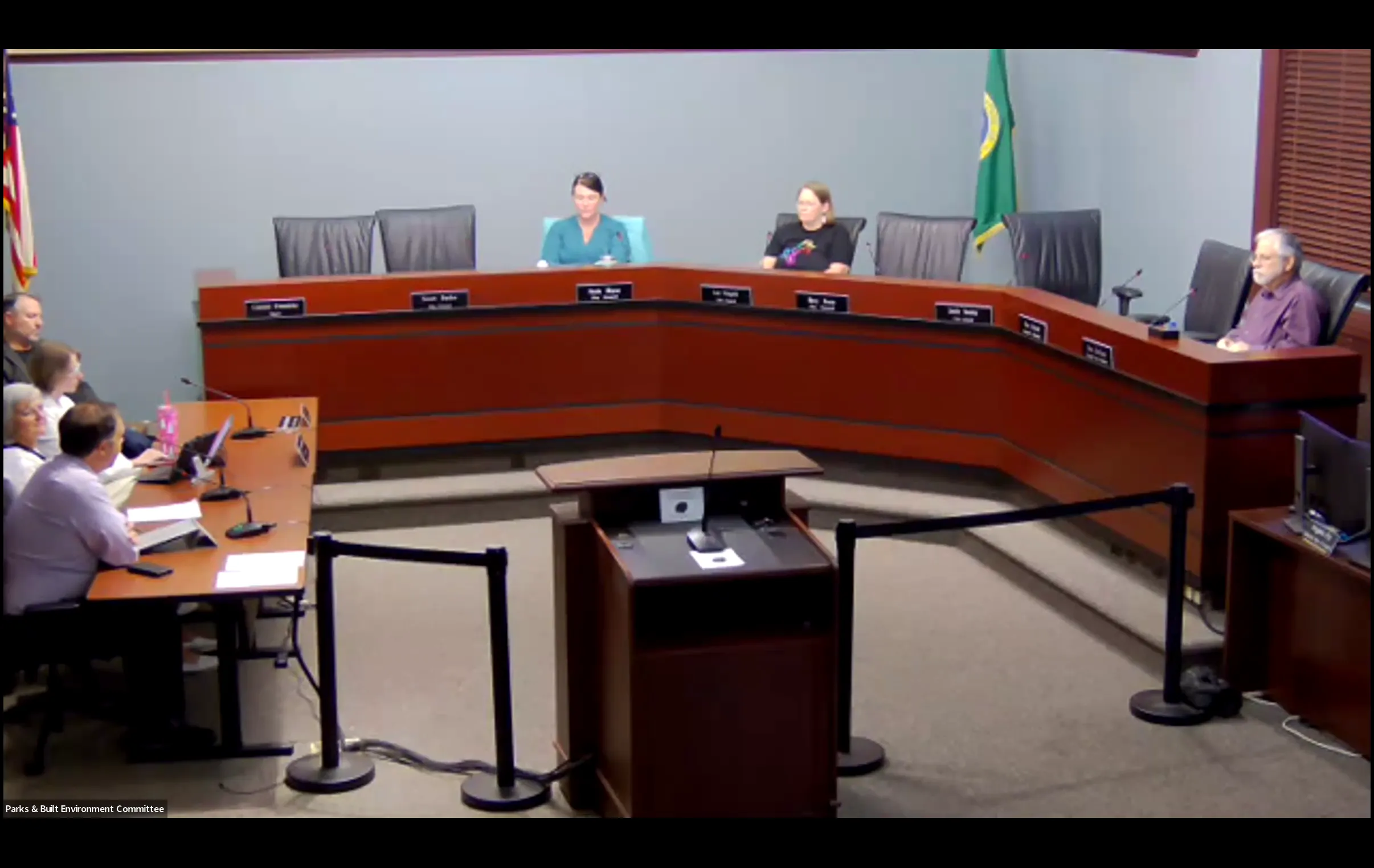
The Parks & Built Environment Committee of the Everett City Council met on Wednesday, September 10, 2025, at 5:00 PM in City Council Chambers. The agenda included an update on the Manufactured Home Overlay Zone Ordinance and a briefing on park safety. Councilmembers Rhyne (chair), Vogeli (arriving late), and Zarlingo were present. Staff from the Planning Department and Parks Department presented. No formal votes were taken; discussion focused on gathering input for future actions. (Note: The meeting date is provided as 2025-09-10 13:00:00+00:00 per the instruction, though the agenda shows 5:00 PM local time; the discrepancy is noted but does not affect the summary.)
Manufactured Home Overlay Zone Ordinance Update and Discussion
- Planning Director York Stevenswatch, Long-Range Planning Manager Alice Ann Wetzel, and Special Projects Manager Frank Hong presented an update on implementing a mobile home park overlay or zone, as identified in the Comprehensive Plan. The city has 10 manufactured home parks with approximately 1,050 dwellings; two in District 1, two in District 3, three in District 4, and three in District 5.
- Staff outlined two primary options: an overlay zone (maintains underlying zoning with a sticky-note designation) or a dedicated manufactured home zone (replaces underlying zoning). A previous voluntary overlay had zero participation and was removed during Rethink Zoning. The current effort aims to protect residents from redevelopment, especially given the housing shortage.
- Councilmember Rhyne expressed a preference for a dedicated zone, arguing it provides stronger, permanent protection and forces owners to petition council if they wish to change use. Councilmember Vogeli supported a dedicated zone to avoid the perception of impending change. Councilmember Zarlingo asked about the underlying zoning and the potential for tenant purchase of land, referencing state programs and the work of ROC Northwest.
- Staff discussed exit strategies: a dedicated zone would require a future rezone process; an overlay with an automatic repealer (e.g., 20 years) would revert to underlying zoning. They also noted that some parks (e.g., Broadway Terrace) are not leasing new sites, raising the question of whether all 10 parks should be protected. Outreach efforts include a meeting with Fairway Estates on September 25; staff have few contacts for eight of the ten parks.
- Next steps: Staff will return to the committee in November with feedback from outreach and the Planning Commission. A public hearing before the Planning Commission is expected in late October, followed by a council public hearing in December or January.
Park Safety Briefing
- Assistant Parks Director Kimberly Moore and Parks Director Bob Leonard, joined by Deputy Chief Hendrickson from Everett Police, presented a status update since the departure of the park ranger team. The small ranger team had been unable to cover all 45 park properties effectively. New strategies include automated restroom locks (with light/sound deterrents), improved lighting at Kiwanis, Lions, and Jackson Parks, installation of flock cameras at Lions, Walter Hall, and Jackson Parks, and increased bike patrols (six officers plus a sergeant funded by a COPS grant).
- Crime in parks has decreased 23% year-over-year, and calls for service are down 12%. Staff attributed this to better partnership with EPD, emphasis patrols, and activation projects such as a new dog park at Clark Park, a skate dot at Lions Park, and community volunteer adoption programs. The Care Team continues outreach to unsheltered individuals and helps clear encampments.
- Councilmembers discussed the importance of activation for safety, the need for adequate garbage receptacles (staff acknowledged challenges on busy weekends), and the potential for more formal food truck opportunities. Deputy Chief Hendrickson noted that park gate closures are not handled by EPD, but bicycle officers patrol trails and parks. Councilmember Vogeli confirmed the bike unit now rides the new trail from the dog park to Cash Park.
- When asked about reinstating the park ranger program, Bob Leonard said it is not recommended at this time given the effectiveness of current partnerships, though he did not rule it out for the future.
Next Meeting Agenda Topics
- Councilmember Rhyne requested a discussion on vacant storefronts and façade maintenance, expanded to include vacant big-box stores across the city, for the next committee meeting. Councilmembers Vogeli and Zarlingo concurred.
Key Outcomes
- No formal votes were taken. The committee offered direction favoring a dedicated manufactured home zone over an overlay. Staff will continue outreach to park residents and owners and return to committee in November with updated analysis and community feedback. The park safety briefing provided an update with no action required; the committee accepted the report and noted the improved metrics. The next meeting agenda will include a discussion on vacant storefronts and big-box stores.
Meeting Transcript
Good afternoon, late afternoon, uh residents of Everett. Uh, welcome to the parks and built environment council committee meeting today is September 10th. It is 5 p.m. and we are here in council chambers. Uh, we have an exciting uh agenda this evening, if I do say so myself. Uh, first, we're gonna have an update on some work that was started during our comprehensive plan update. Uh council and staff had identified a need for a potential new overlay zone, specifically for manufactured homes. Uh, and so essentially what's such a large body of work. Uh uh staff has been working on it separate from the comp plan. So it's now coming back to a committee for our first hearing, I guess. Well, not technically a first hearing, but uh we're gonna be briefed on it and uh hear more about uh different elements that were identified and um just get a sneak preview into uh what that could look like for the city. Uh so I'll turn it over to uh York, uh, if you don't mind taking uh the uh mic from here and uh just for uh public uh councilmember Vogley will be joining, but she's just running a little bit late. Thank you. Thank you, committee chair Ryan. I'm York Stevenswatch, the planning director with me is Alice Ann Wetzel, uh, long-range planning manager. We also have Frank Hong, special projects manager for housing. Uh Alison and Frank have been doing the bulk of the work on this project. Uh, as you mentioned, it is to uh our first implementation action that we have underway from the comprehensive plan, uh, which reads implement a mobile home park zoning overlay. And there are some policies that go with it that refer to uh protecting manufactured and mobile home communities from redevelopment into other uses. So we're implementing both the policies and the actions. We've brought this to the planning commission for a first briefing and workshop with them uh three weeks ago, and um have been working it internally with staff and have done a little bit of outreach. But I will let Alice An uh give a little summary of where we're at and some of the points that we're looking for, perhaps some early feedback from the council uh uh or committee members. Otherwise, we'd be happy to just give you an update on where we're at. So um as York said, we have been researching this and looking at the where the parks are, what what they consist of, how many acres, how many dwellings in them, what the type of residents are, whether they're 55 plus or all ages, um, whether they are manufactured home parks or RV parks, we have a combination across the city. We have 10 parks and about a little over a thousand and fifty in those 10 parks. The 10 parks are located two in Councilmanic District One, two in Councilmanic District Three, two, three in Councilmanic District Four, and three in Councilmanic District Five. Councilmember Ryan, you're the odd person out of this equation. So we are looking at what their underlying zoning is, what the potential for land use changes and what the development opportunities may or may not be on those sites, whether they what the underlying zoning is. And so what we took to the planning commission was essentially the same conversation and showed them the maps of where they were located, what the underlying zoning was, and we provided a few questions to them. And the biggest question we asked them was the preference for an overlay zone or a preference for an actual zone for manufactured housing. So with the overlay zone, it would be a manufactured housing overlay. It would still keep the underlying land use. And then because we look at the comprehensive plan every 10 years, we're looking at it for being in place for 10 years, it could then move on. One of the things that we discovered in this process was that there used to be a manufactured home park overlay zone. It was entire vol entirely voluntary for a manufactured home park to take advantage of that zone. Um, I'll give you three guesses as to how many took advantage of it, and probably the first two don't count. The answer was zero. So during rethink zoning, the planning department and council said we're going to try and pair down the number of zones, the number of overlays that exist in the city. And let's look at the ones that are functional and doing something versus those that are not doing something. And at that point in time, it was determined that since zero percent of the manufactured home parks were not taking this option up, that would go away. And it did. So we're not introducing something entirely new, but we are not necessarily thinking of making it voluntary because of the nature of the housing shortage at the moment, the nature of the demand for land potentially for doing that. So the options with an overlay versus a zone. An overlay would keep the underlying zoning so that if for some reason it was economically infeasible to operate a park at some point and there would be exit ways out that it would revert to the underlying zoning, which potentially could put more pressure on the potential for conversion to not be a manufactured home park, because we are saying that this is what could go there. If we went with a zone, it would be a manufactured park zone. And that would be the zone with some uses that would be associated with the zone being allowed there. If they for economic reasons determined that it was no longer economically viable or feasible to be a manufactured home park, then council and planning and planning commission would all have the opportunity to put forward what would be the appropriate zone at that time. So we wouldn't be going back three years, five years, nine years, whatever, to look at it. We would be looking at it in current time. So those are the two differences.
openpublica.com