Community Health and Safety Committee Meeting - October 2, 2025: CARE Team Briefing and Police UAV Update
STREAMING COPY IN PREPARATION — RECORDING AVAILABLE FROM THE ORIGINAL SOURCE
Community Health and Safety Committee Meeting - October 2, 2025
The Community Health and Safety Committee, chaired by Councilmember Tuohy and attended by Councilmembers Fosse and Bader (virtually), received briefings on the Community Alternative Response Everett (CARE) Team and the Police UAV (Drone as First Responder) program. No public comments were heard, and no formal votes were taken.
Community Alternative Response Everett (CARE) Team Briefing
Kelly, the social worker leading the CARE team, presented a detailed history of the program, which began in 2015 with social workers embedded in the Everett Police Department. The CARE team officially launched in September 2024 using a $4.5 million SAMHSA grant. Key statistics for 2025 (through October 2):
- Served 2,000 unique individuals
- Responded to 900 911 calls for service
- Received 731 referrals from police and fire partners
- Sent over 1,500 referrals to community partners (e.g., Conquer Health's MOAT program, Evergreen Recovery, Everett Gospel Mission)
The team operates six days a week, 10 hours a day, with five crisis responders, a care specialist, a prevention specialist, and MSW interns. Funding: SAMHSA grant extended through September 2026 (no-cost extension), and COVID recovery funds expected to last through 2027. The team also developed a Microsoft Power App platform for data tracking, featured in a Microsoft article. Councilmember Fosse asked about outreach in buffer zones; Kelly confirmed proactive outreach and connection to services. Councilmember Bader asked about opioid funding eligibility; Kelly noted that opioid dollars could potentially be used for alternative response in the future. Councilmember Bader thanked the team for their work.
Police UAV Program Update
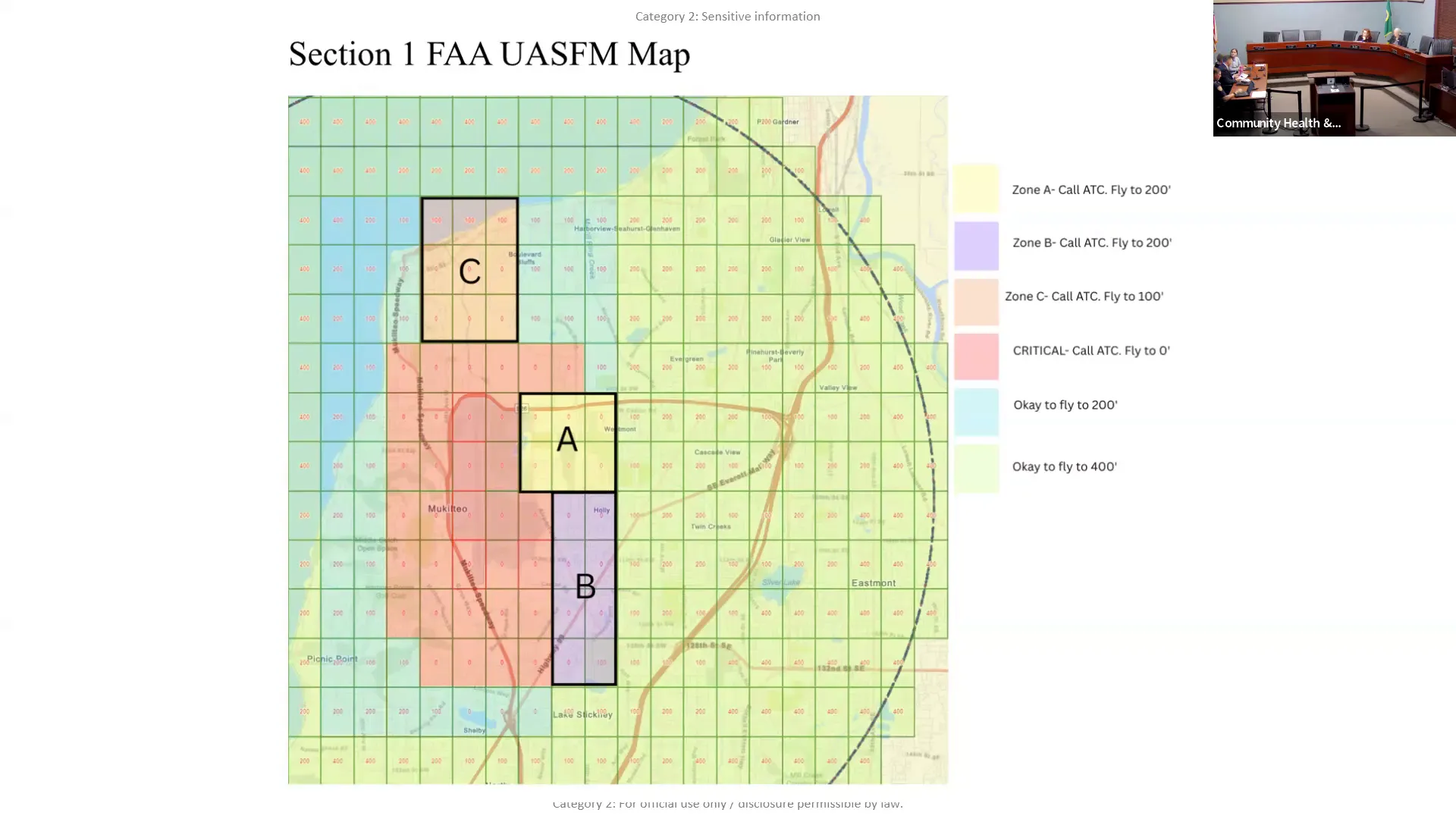
Robert Getz and Lieutenant Jeff Albright provided an update on the Drone as First Responder (DFR) program. Originally planned with two drone docks, the program now includes six Flock Safety drone docks at no additional cost to the city. Two docks have been installed at the South Precinct, with training flights starting October 2, 2025. Two additional docks will be installed on top of Everett Municipal Building (EMB) by the end of October, with flights expected by mid-November. The final two docks will be in the central area pending feasibility studies; all six are expected operational by mid-to-late November. The contract is a two-year agreement starting when the sixth dock is operational, with a one-year opt-out after the first year. The drones will be flown remotely from the South Precinct, with the ability to launch additional pilots from other locations. FAA airspace waivers are being pursued to allow flights up to 400 feet in certain areas near Paine Field. A public-facing dashboard will be launched when missions begin, showing flight locations, mission types, and outcomes. Video retention policies mirror body-worn camera footage: 90 days for non-evidentiary video, indefinite for evidence. The program is the first of its kind in Snohomish County. Councilmember Fosse asked about data sharing (none) and the FAA agreement (a memorandum of understanding). Councilmember Bader asked about the contract and budget; the cost remained the same despite the expansion. Tours of the DFR center will be offered to the public once pilots are fully trained, likely by the end of October.
Key Outcomes
- No formal votes or decisions were taken; the items were briefings only.
- The CARE team will continue operations under existing funding through 2027, with potential future use of opioid settlement dollars.
- The Police UAV program is on track for full deployment by mid-to-late November 2025, with training and FAA coordination ongoing.
- Public tours of the DFR center will be announced in the coming weeks.
Meeting Transcript
All right, good afternoon, and welcome to the community health and safety council committee meeting for October 1st, 2025. I'm Councilmember Tue, and with me tonight is Councilmember Fosse and Councilmember Bader is online. Tonight we're gonna have a couple of a briefing and an update, and we're gonna start with our community alternative response Everett Care team briefing. And I believe it starts with Kelly. Is that right? Great. Welcome, Kelly. I'm just gonna start real quick to remind you that Kelly started as our one of our social workers in our community outreach and enforcement team and has been with us for the last several years, growing this team into really an amazing now third response to public safety. So I'm super happy to have her here today and share with you the good work that she's been building alongside of our teams. I can get my presentation to work. Hey. Well, I um thank you for having me here, Council. I I want to invite you to walk with me through a journey through time, is what I call it of how we got to where care is today. And I feel that this is a story of collaboration and the commitment to our community's well-being. The story began in 2015 when our Everett Police Department first added social workers to its landscape. Um this was a partnership between law enforcement and social work, uh, forming our community outreach and enforcement team coet. And coet was formed to address the growing needs of our unhoused neighbors and therefore blending social work with empathy. In 2018, people have uh people were interested in our work. They wanted to shadow and learn from us. Sorry. They wanted to shadow and learn from us, and we were really lucky that we were able to establish our very first master in social work MSW internship. Uh, our in our very first intern is sitting in the room with me, and she's our field supervisor. So that's a really cool story of it's a pivotal moment of developing uh relationships with schools and furthering our work here. By 2021, our public library reached out to us asking also for support around the social complexities they too were facing. And that began a pivotal moment for us to partner with the University of Washington and the city of Everett to place an MSW intern in our public library. Um, as we continue to listen to what our community needed. In 2023, we were lucky to receive COVID recovery funds in which we were able to expand uh social work support full-time to our library and um in the for the first time ever into our fire department, uh, which I feel is a very pivotal moment for us as social workers here as it further intro integrated us into our emergency response system. Uh by September of 2024, uh the need for behavioral health uh support had become undeniable. At the recommendation of the mayor's drug crisis task force, Everett secured a 4.5 million dollar SAMHSA grant in which we were able to launch care. And care is our comprehensive behavioral health initiative designed to respond to substance use, mental health crises, and the broader social challenges facing our everyday residents. So why care? Care is transforming how Everett responds to crisis by expanding the toolkit available to our emergency responders, fire and police. We ensure that every situation can that they encounter can receive the right kind of support, whether whether it's a behavioral health emergency, a substance use crisis, or a moment of vulnerability. We provide specialized crisis intervention. We're trained in uh crisis de-escalation, trauma-informed care, behavioral health, and our care responders meet people where they are both physically and emotionally. We tried really hard to preserve those critical resources by diverting behavioral health and other appropriate calls to our team so that we can alleviate those traditional responders to focus on other safety and life threatening emergencies. We provide community centered support as trust is the heart of our care program. We offer compassionate and competent care, and our team builds meaningful relationships with our vulnerable populations by creating pathways to healing and stability. We provide integrated follow-up crisis response, and it's just the beginning of what we do. We provide unhoused outreach, short-term care management, and we help individuals connect to supportive services. So we don't just respond at the call, we stay connected to people in need. So who are all of these people? This care the care team is oops, sorry, went too far. The care team is obviously powered by a dedicated multidisciplinary staff of licensed professionals. Um who are who are dedicated dedicated to being reliable and responsive to community need. This includes myself, our field supervisor in the room. I have five crisis responders who deploy two 911 calls for service. I have a care specialist who provides short-term care management, navigating people towards long-term solutions, a prevention specialist in our library who focuses on upstream solutions and community education. And I still maintain MSW interns who support our overall care delivery. So what do we do?
openpublica.com