Everett Budget & Finance Committee Meeting – February 18, 2026
STREAMING COPY IN PREPARATION — RECORDING AVAILABLE FROM THE ORIGINAL SOURCE
Everett Budget & Finance Committee Meeting – February 18, 2026
On February 18, 2026, at 5:30 PM in the Everett City Council Chambers, the Budget & Finance Committee held an informational meeting. Interim Finance Director Mike Bealey presented a primer on city budgeting and fund accounting, followed by a preliminary review of the 2025 year-end financial highlights. The meeting focused on building foundational understanding for council members and discussing the city's fiscal health.
Discussion Items
-
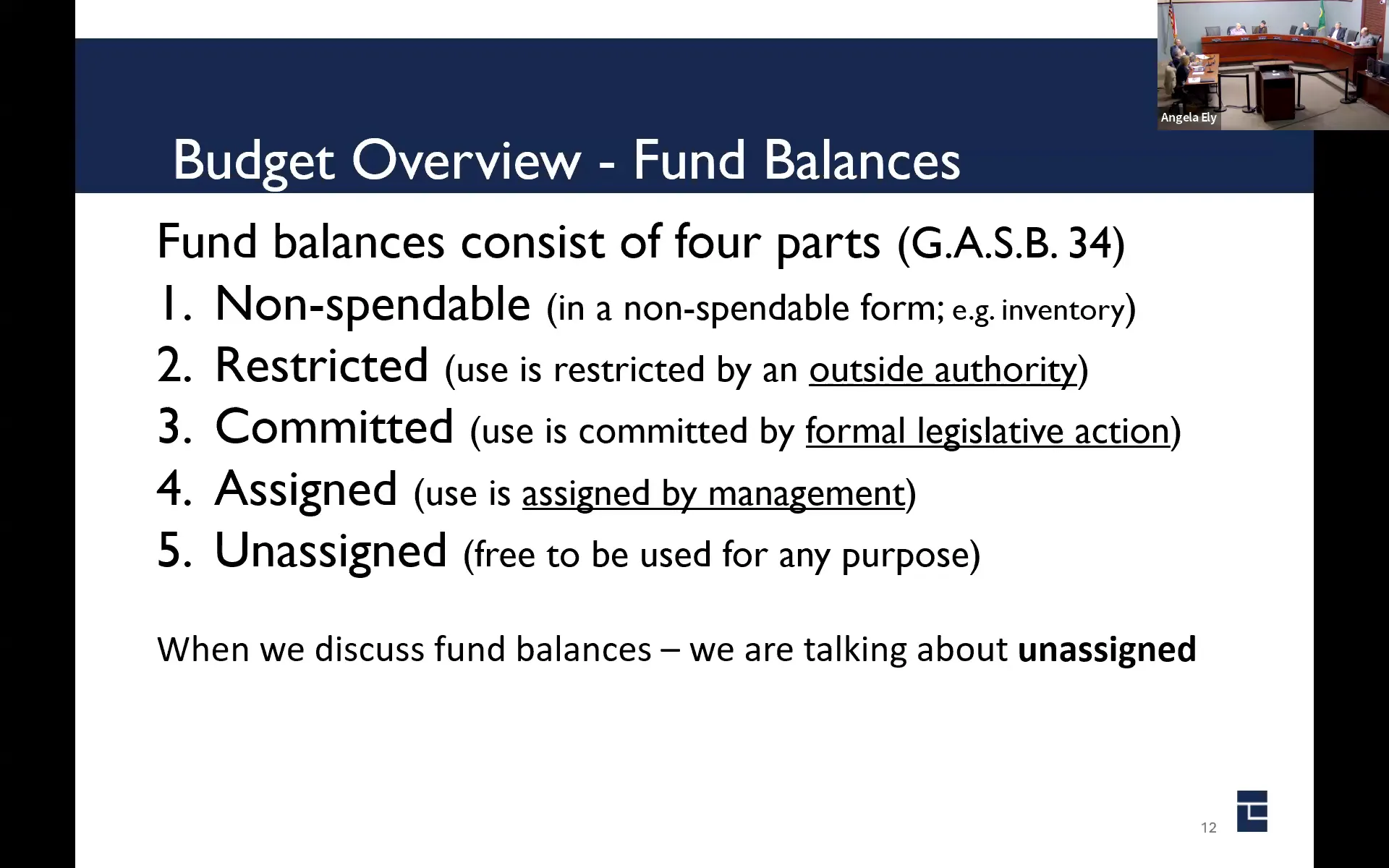
Budget Overview (Primer): Mike Bealey, interim finance director, explained the legal framework for city budgeting, including state laws, the Washington State Auditor's Office BARS (Budgeting, Accounting, and Reporting System), and the city's charter. He introduced fund accounting (general, special revenue, proprietary, fiduciary), fund balance categories (nonspendable, restricted, committed, assigned, unassigned), and the importance of unassigned fund balance as a measure of fiscal health. He noted that the city currently has a unique “general government” grouping that mixes fund types, and the administration will recommend consolidating funds to align with GAAP for the 2027 budget.
-
2025 Year-End Finance Report Highlights (Preliminary): Bealey presented preliminary unaudited results for the general government funds. The amended 2025 budget anticipated a fund balance drawdown of $10.6 million, but actual results showed a drawdown of only $3.8 million—a $6.8 million improvement. Revenues came in 0.3% below expectations (about $0.5 million), while expenditures were 5% below budget (about $8.8 million less than authorized). Bealey attributed this to careful department spending. Specific revenue sectors: retail sales tax struggled early in 2025 but recovered later; construction sales tax lagged, consistent with regional trends.
-
Council Questions: Councilmember Delvingo asked about the difference between budget director and finance director (currently combined) and whether county budgeting is similar (counties are more reliant on property taxes). Councilmember Vader expressed concern about sales tax performance, particularly competition from neighboring malls and Boeing's influence; Bealey noted that retail sales tax, the largest sector, recovered in the latter part of the year. Councilmember Larz Zarlingo asked about handling one-time revenues from asset sales (e.g., alley vacations); Bealey advised using one-time revenues for one-time expenditures to avoid ongoing commitments.
Key Outcomes
- Budget Committee agreed to set a meeting schedule for the remainder of 2026 at the next meeting (within the next month).
- The administration will return at the next committee meeting with next steps and recommendations for addressing the projected $15 million deficit in the general government fund (excluding pension), based on feedback from the council retreat.
- No formal votes or budget amendments were made; the meeting was informational.
- A preliminary December 2025 financial report was distributed but remains subject to audit completion by the State Auditor's Office, expected by June 2026.
Meeting Transcript
Well, hello, those who are viewing here online and those in the audience. This is February 18th, 2026. We are in the Everett City Council chambers. Today is the Everett City Budget Council Committee. So on the agenda items, we have we're going to cover a budget overview. And then our second item is 2025 year end finance report highlights. So at this point, I'll hand it over to Jennifer Gregison, our administration and our representative from the mayor's office. Thank you. Well, I'm just gonna pass it off to our interim finance director who's got a briefing for you. So Mike. Thank you. Could I just hand it off to you? No. Thank you. Again, I am Mike Bealey. And to introduce myself, which I didn't do last time we had a chance to meet, uh, I'm acting as the interim finance director of the city's recruiting for finance director. And um, and I'm glad to be able to serve the city in this way. I actually was the finance director in the 90s. And so uh for those who are uh new to the city council, that's kind of a bit about my history. I also did a lot of training for the association of cities and uh worked with the municipal research and services center or MRSC. And so with that, um, I thought what might be helpful for the council is uh this evening uh for my first budget committee back uh with you, um, and for some of you, your first here uh to create a bit of a foundation uh about the way the cities have to manage budgets and why that's the way it is, and kind of what the implications of that are. And so, with that idea in mind, uh I'll proceed. If you have questions about how, you know, something I've said or whatever as we go along, uh please feel free to get my attention and I'd be glad to uh clarify. So cities have to follow a variety of laws or rules and a variety of uh, you know, uh uh with respect to their businesses that they conduct. Certainly that's true of finance and budget as well. Uh on the slide is uh some of those that we have to follow. There are a number of state laws. Uh cities uh are prescribed a number of requirements in state law, whereas many other small uh local governments, uh there's very little in state law about their budget and finances. One of the things that happens in state law is that the Washington State Auditor's Office is delegated the responsibility of prescribing the rules for cities to follow. And uh, and uh so the Washington State Auditor's Office has created something called the budgeting and accounting reporting system, commonly known as BARS, uh, to do that work with. So you'll hear the term bars, and that's the Washington State Auditors rules and regulations, which the cities have to follow in conducting their finance and budget work. Uh, since the city of Everett is a charter city, its own charter helps inform uh requirements as well. And the charters can uh call for any requirements that are not um precluded by state law. So in the city of Everett's um case, there's not a lot about finance and budget in the charter. Therefore, the city primarily relies on state law and the Washington State Auditor's guidance. Uh, there's other um practices and principles as well. Uh we follow governmental accounting standards board or gap generally accepted accounting principles. You hear that in the private sector. In the public sector, we have the same generally accepted accounting principles. Those are prescribed by the government accounting standards board. And so that's another one of the agencies that uh dictates how we conduct our business. And then there's a number of best practices. Uh the GFOA, Government Finance Officers Association, MRSC, and others provide uh guidance with respect to best practices. And so the city uh follows those uh uh prescribed best practices as well. And I've been doing this work for a long time, and and I provide um uh advice and and support to a number of cities. Um and in my experience, um, one of the things that I often like to share is that this work is always challenging. It's difficult to do, and and that's um the way it should be in my mind. Um we're spending other people's money uh to provide them services, and so it's difficult. And and we need to do it thoughtfully and and uh and carefully. And the best way we do that is when we work together, uh, you know, in partnership, uh, both uh policymakers and administration, department directors and whatnot.
openpublica.com