Parks & Built Environment Committee Meeting – April 8, 2026
STREAMING COPY IN PREPARATION — RECORDING AVAILABLE FROM THE ORIGINAL SOURCE
Parks & Built Environment Committee Meeting – April 8, 2026
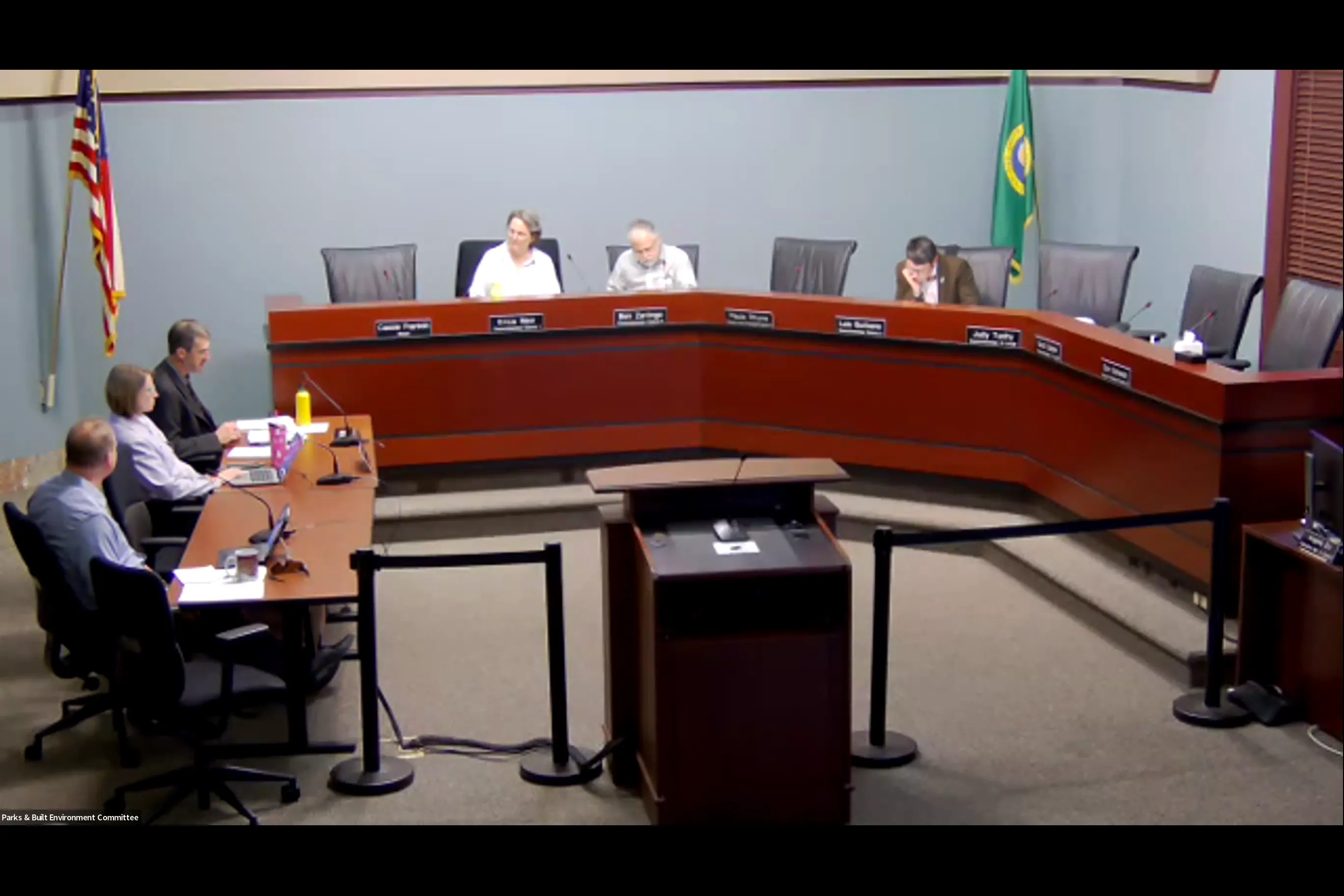
The Parks & Built Environment Committee of the Everett City Council met on April 8, 2026, at 5:00 PM in the City Council Chambers. Councilmember Rhyne was absent; Councilmember Weir attended in her place, and Councilmember Burbano was present. The committee received two staff briefings: an update on the Bike Master Plan implementation and a presentation on proposed e-bike regulations. No public comment was taken.
Bike Master Plan Update
- Tom Hood, City Engineer, reported that the 2011 Bike Master Plan (30-year plan) is about 50% complete after 15 years. The city has built 23 miles of off-street bikeways and completed 25 projects; 16 more projects are anticipated by 2030.
- Key completed projects: north-south corridor on Hoyt connecting Legion Park to Interurban Trail, Everett Station to 41st Street connection, bike lanes on 112th Street, and Milltown Trail on West and East Marine View Drive.
- Recent additions (since 2023): 28 miles of wayfinding signage, West Casino Road bike lanes, Madison Street buffered bike lanes (with tubular markers and channelization curbs at intersections), and Fleming Bicycle Boulevard.
- 2026 projects include Edgewater Bridge bike lanes, 19th Street overlay with a bike box at Broadway, two signal projects on East Marine View Drive (half-signal at Jackson Park and RRFB at 10th Street), and Fulton bike/pedestrian corridor.
- Future projects: North Broadway pedestrian bridge, Milltown Trail extension south, and California Street bike corridor (design starting on west side; east side already designed but unfunded).
- The city earned a Bronze designation from the League of American Bicyclists (renewed recently). Staff noted only 17 Washington communities have designations; most are Bronze. The League provided a report card to reach Silver, including building low-stress network, bicycle parking, plan update, and school safety education.
- Councilmember Burbano raised concerns: missing bike route on Google Maps (Hoyt Avenue not shown), safety of 112th Street bike lanes (high-speed road), lack of traffic calming on 4th/5th Avenues in South Everett. Acting chair responded that speed humps are ineffective on higher-volume roads and that a Vision Zero briefing will be scheduled. Councilmember Burbano also questioned low League scores in engineering (49/78), education (38/92), encouragement (57/89), evaluation/planning (37/84), and equity (38/75). Tom Hood noted scoring is a 'black box' and that Bronze is significant.
E-Bike Code Development
- Hill Cayman from the legal department presented a framework for regulating e-bikes and electric micro-mobility devices, citing a four-fold increase in e-bike use and doubling of e-bike-related emergency room visits annually since 2017.
- Proposed class definitions (based on state law): Class 1 (pedal-assist, no throttle, up to 20 mph); Class 2 (throttle, up to 20 mph); Class 3 (pedal-assist, up to 28 mph). Also defined 'personal powered transporter' as an umbrella term for new devices.
- Key policy recommendations:
- Helmets: Required for devices exceeding 20 mph and for all riders under 16.
- Age restrictions: Under 16 prohibited from Class 3 (already state law); 11-15 limited to devices under 20 mph with helmet; 10 and under require direct adult supervision.
- Sidewalk use: Prohibited for all bikes and e-bikes in the central business district (parking area A). On shared-use paths (e.g., Interurban Trail), Class 3 prohibited unless all jurisdictions agree; Class 1 and 2 allowed.
- Speed and location: Devices under 20 mph can operate where bicycles can; over 20 mph restricted to streets.
- Equipment: Lights, noise limits, labeling requirements to prevent illegal modifications (e.g., removing speed regulators).
- Penalties: Civil infractions, possible impoundment, and a gross misdemeanor for reckless endangerment. Parental responsibility for violations by minors.
- Councilmember Burbano appreciated the classification approach, noting that other municipalities sometimes ban all e-bikes. Councilmember Weir noted the challenge of balancing safety with practical use (e.g., lime scooters on sidewalks) and enforcement limitations. The acting chair thanked staff, noting the regulations are ahead of fast-moving technology.
- The committee agreed to have Hill Cayman return in 2-3 months with a more developed ordinance after broader council input.
Key Outcomes
- No formal votes were taken.
- The committee will follow up on e-bike regulations at a future meeting.
- Staff will provide a Vision Zero briefing at a later date.
Meeting Transcript
Good afternoon, Everett residents and interested parties. We got an extra speaker on, or shall I just go ahead? Oh, there it goes. This is the Parks and Built Environment Committee of the Everett City Council meeting the second Wednesday of each month, usually at 5 p.m. Committee chair Ryan is away, and Councilmember Weir will be attending in her place. I'll be chairing this meeting. And Councilmember Burbano is our third committee member. The public is welcome to attend these meetings in person or view them live or recorded on YouTube at the City of Everett channel. We do not take public comment during the committee meetings, but public comment is welcome on these and other topics in the regular city council meetings, which start here in this room in 90 minutes. We'll cover two topics today, Everett's bike master plan and also code development for e-bike regulations in Everett. And I think first we'll start, I guess, Jennifer Gregerson. Do you have anything to say or shall we start with Tom Hood? No, we can well, we'll let Tom get his presentation shared. And uh yeah, I don't have anything to add. Just looking forward to this update. So great. All right. Well, Tom, if you'll note your role with the city and we're ready whenever you are. Great. Thank you. Uh good evening, counsel. Tom Hood, City Engineer with Public Works. Uh, thank you for having me here tonight uh to give you an update on the bicycle program and the bike master plan. There we go. Thanks. Okay, so my agenda tonight uh for this uh presentation is uh a little bit of background on our current bicycle master plan. Uh I'll then spend the bulk of the time talking about the implementation and the projects that we've done and are doing and will do in the future uh as part of the BMP. And then I'll also touch on some of our education and outreach efforts uh in uh for the bicycle community. So the bicycle master plan uh was adopted in 2011 by City Council. Um it was designed to uh create and enhance a uh safe and convenient uh bicycling network throughout the city. Uh we had a robust uh public outreach process as part of the development of the plan that included uh a host of public comments, city council administration uh was involved as well as uh quite a few city staff. Um, as a an additional note, um as the plan is now about 15 years old. We do have an update of the bicycle master plan um beginning later this year. We're actually going to combine the BMP with our existing pedestrian plan uh and put them together into what we will be calling an active transportation plan as part of the update. Uh and again, that will be getting uh that process underway later this year. So in the uh bicycle master plan, um, what we have was an analysis of the existing conditions as of 2011. Uh, we didn't have a whole lot of uh bike facilities in those days, but nevertheless, uh, we needed those existing conditions analyzed so that we could come up with uh proposed facilities where we needed uh connections. Uh, some of our um our bigger bicycle generating areas uh that needed to have network uh connections and additions to make those work. Um we also had uh a number of outreach and education recommendations uh to enhance the non-project part of cycling in Everett. Uh we also uh brought about uh brought into the BMP quite a few design standards, and then for the projects that we enumerated in the BMP, we have descriptions of those, and those can be found in there, as well as some funding strategies, um, which uh some of which are still uh relevant today, some of which are getting a little long in the tooth and need to be updated and will be as part of our active transportation plan. So, really, the this slide uh really shares kind of the three uh guiding principles of the bike master plan. Um connectivity, which I mentioned a little bit, um, you know, putting those those places uh and people that need connections, giving them connections, um, suitability, which is really speaks to for a given street or route, what is the appropriate treatment for bicycles? Um, obviously, bigger, busier roads will have different criteria or different recommended treatments than a quiet neighborhood street, for instance. And then community need, which really um speaks to our outreach efforts um during the the master plan development, uh hearing what the community had to say and what they wanted. So, as of this year, um we are essentially on track um for the implementation of our 30-year plan. Um, it was originally developed for a 30-year timeline, and 15 years in, we're roughly half complete uh with building out the bike master plan. Um, you can see some statistics there about uh the number of miles of bikeways we've built on street. We've also built uh 23 miles of off-street bikeways, trails and such, um, a total of 25 projects completed, and 16 more are anticipated to be completed by 2030. So, some of the highlights of what we've done in the last 15 years. Um we created the north-south bicycle corridor that connects uh Legion Park to the Interurban Trail through the downtown core on Hoyt.
openpublica.com