Everett City Council Budget & Finance Committee Meeting – April 15, 2026
STREAMING COPY IN PREPARATION — RECORDING AVAILABLE FROM THE ORIGINAL SOURCE
Everett City Council Budget & Finance Committee Meeting – April 15, 2026
The Budget & Finance Committee of the Everett City Council met on April 15, 2026, at 5:30 PM in the City Council Chambers. Interim Finance Director Mike Bailey presented a monthly finance update for March 2026 (preliminary) and a 2027 outlook addressing the city's structural deficit. Council members discussed revenue trends, expenditure savings, and long-range forecasting assumptions. No votes were taken; the meeting was informational.
Discussion Items
- Monthly Finance Update (Preliminary March 2026): Mike Bailey reported that general government revenues were about 2% ahead of budget year-to-date. Sales tax showed a rebound, slightly ahead of both budget and prior year, reflecting December 2025 holiday spending (two-month lag). B&O tax was tracking below budget due to quarterly payments (April is the key month). Utility taxes (outside utilities) were ahead, and miscellaneous revenues (mostly interest earnings) were outperforming conservative forecasts. General government expenditures were underspending by about 7% on a pro-rata basis, consistent with prior years. Bailey noted that the city's dependent on sales tax has increased, reducing resiliency in an economic downturn.
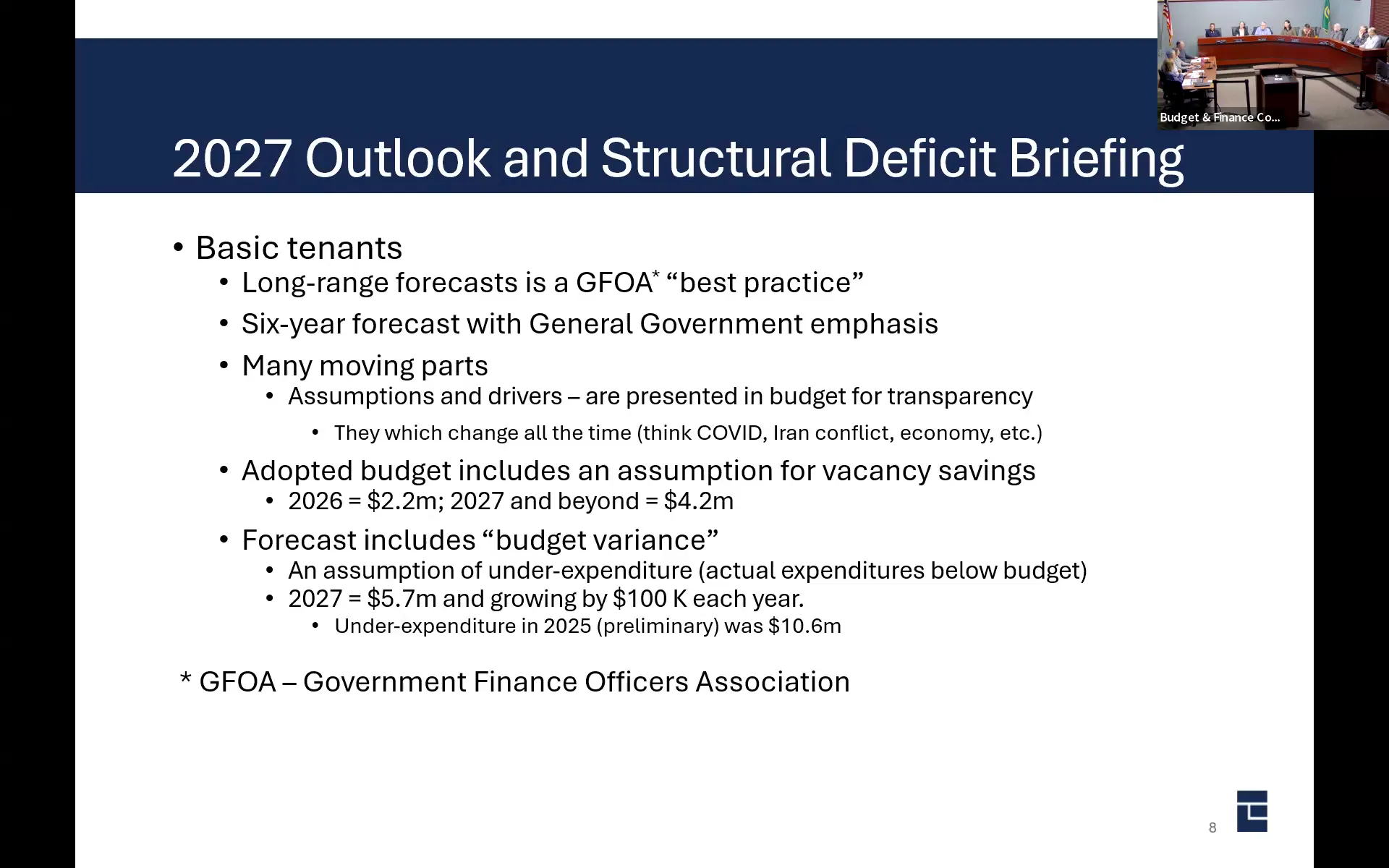
- 2027 Outlook and Structural Deficit Briefing: Bailey reviewed the city's long-range forecast, which projects a structural deficit exceeding $15 million in 2027 without corrective action. Key assumptions include a vacancy savings budget (contra account) and a budget variance factor reflecting expected underspending (e.g., $5.4 million for 2027). He contrasted the 2025 anomaly (intentionally lowered variance to fund retroactive pay) with typical levels. Council members questioned forecasting methods (percentage-based, informed by history), fund balance targets (20% for general government plus a cumulative reserve fund), and comparisons to other cities. Mayor Zarlingo emphasized that the forecast is a planning tool, not a plan to run a deficit. Bailey affirmed the city ended 2025 with about $50 million in general government fund balance due to careful spending, but costs continue to outpace revenue growth.
Key Outcomes
- No formal decisions or votes were taken; the meeting was advisory and informational.
- Council members directed staff to provide further details on the percentage used for conservative budgeting and vacancy forecasting.
- Interim Finance Director Bailey committed to publishing the full March 2026 monthly report and the 2025 annual financial report by mid-May, in time for the state auditor's May deadline.
- The committee acknowledged the need to proactively address the structural deficit, with discussions to continue in future budget sessions.
Meeting Transcript
Well, hello, everybody. This is April 15th, 2026. We are in the city of Everett Council Chambers to begin our budget council committee. Um at this time we have two things on our agenda. We have a monthly finance update, and then we'll be our next agenda item will be 2027 outlook and structural deficit briefing. So I like to begin with the introduction of Mike Bailey, our interim finance director. Thank you, uh Council President Schwab. As you said, there are two items on the agenda, and it's being brought up on the screen now, so we can speak to we can move to the third slide, uh, please, Angie. So the first item on the agenda is an update as to where we are uh so far this year. Um, as I have said in the past, I typically like to provide the first monthly update, if you will, at the end of March, it's the end of a quarter. Uh, there's been a little bit of activity worth reporting on, and and we get a little bit a bit of a sense of of how things are shaping up. Uh, we are in early April, mid-April actually. And so um, this uh report is is uh presented to you uh in a preliminary sort of fashion. Well, we'll be closing the books for the month of March, um, probably Friday this week. So there's still some adjustments being made to some of the accounts and things of that nature. And once we do close the books, I'll go ahead and put together and publish the full month of report that the council is used to seeing with a cover letter with any highlights that kind of jump out at me uh that might be of interest to you as well. So you can expect to see that next week. But tonight we'll take a preliminary look at some of the numbers as they've uh shaped up so far uh again this this year. Um the uh the along the same lines, the um finance staff continues to work on the annual financial report for last year, 2025. Of course, all cities in Washington in their fiscal years at the end of December. So we're busy working on wrapping that report up. Uh, there's been a number of additional new standards that have been imposed by the government accounting standards board and and therefore also by the Washington State Auditor's Office, that we're working to understand and and uh accommodate them in our annual financial report as um for 2025. So that along with the fact that we do have three, I think new staff members who are going through this year in close and producing a report for the first time, uh, causes to push the report uh publication date uh out into May. Typically, we're hoping to publish a report toward the end of April. We'll probably be closer to or earlier middle May in terms of publishing our our financial report for last year. And of course, um each uh larger city in Washington is annually audited by the Washington State Auditor's Office. Those audits are published by on their website. So anybody that's interested can look and see how the city's doing, both financially and from an accountability standpoint. That audit will start once we have completed a report. Um the state auditor's office calls for us to have that report done and submitted to them by the end of May. And we will uh certainly anticipate meeting that deadline. So um we don't uh see any problem with meeting the deadline for the annual financial report. But with that being kind of an update on where we are in terms of the business uh of you know the reports themselves. Uh let's go ahead and move to the next slide, Angie, and talk a bit about how things look so far uh for 2026. I thought we might just start with a little bit of orientation. As you recall, uh, you know, the the revenue uh revenues that make up the general government of the city, and tonight we'll be focusing on the city's general government, um uh represent a pretty good um uh balance of different major sources. And and tonight I'm just gonna talk about the major sources uh of revenue. Um of the smaller sources, uh, you know, you could double or triple them, and they wouldn't really affect the outcome. So we focus in on the major sources. That's the best place for us to spend our time. So on the next slide, you can see that so far in uh 2026, uh in the again, just in general government, uh we're looking uh to be slightly ahead of budget. There's hundreds of different you know accounts and in each account, such as for instance, sales tax represents thousands of taxpayers. So there's a whole lot of stuff that's kind of summarized at a very, very high level to say that we're uh you know almost uh just two percent uh ahead of budget at this point. I liken it to used to work in a winanche. I would say it's like the Columbia River on the surface, it looks nice and smooth. Underneath, there's a lot of stuff going on, and that's kind of what's happened um in city revenues as well. So in sales tax, one of the nice things uh so far about this year is we're seeing a bit of a rebound in our sales tax. Uh as you might recall, sales tax underperformed last year. Um, and in fact, after uh ironically, uh toward the end of COVID represented a bit of a peak in sales tax. And but we're we're now recovering like again, like many cities in the Pisa Sound, recovering um you know the decline after that peak, uh, and we're beginning to see a bit of an increase, which which is good news.
openpublica.com