Parks and Built Environment Committee Meeting – June 11, 2026
STREAMING COPY IN PREPARATION — RECORDING AVAILABLE FROM THE ORIGINAL SOURCE
Parks and Built Environment Committee Meeting – June 11, 2026
The Everett City Council Parks and Built Environment Committee met on June 11, 2026, to receive updates on the Vision Zero safety initiative and proposed changes to the Multifamily Tax Exemption (MFTE) program. No public testimony was taken, as committee meetings do not include a public comment period. Councilmembers discussed project timelines, program effectiveness, and policy details.
Vision Zero Update
- Staff presentation: City Traffic Engineer Corey Hertz presented the Vision Zero Everett plan, concluding its funding at the end of June 2026. The plan, funded 80% by a federal Safe Streets for All grant, produced a crash analysis, speed-setting policy, safety toolbox, and a list of projects added to the six-year Transportation Improvement Plan.
- Key commitments: Prioritize pedestrians and active transportation, engage the community, strengthen engineering and enforcement partnerships, build redundant systems, and adopt a “zero deaths” vision.
- Speed management: A planning grant will evaluate all 79 arterials (about 200 segments) for possible speed reductions, including a 20 mph downtown speed limit and residential speed limits. A resolution is expected early 2027.
- Active transportation plan: A separate grant will update the bicycle master plan, identifying gaps in pedestrian and bicycle networks. Consultant selection begins summer 2026.
- Evergreen Way corridor: Nearly $1.2 million in grants will support a long-term redesign of Evergreen Way as a high-capacity transit corridor with enhanced crossings, wider sidewalks, and bike facilities. The effort may take 15 years to construct, similar to projects in Shoreline and Edmonds.
- Current implementation: Photo enforcement has reduced crashes by over 50% in school zones and at red-light intersections. Revenues exceed expenses and are used for traffic safety. New education and outreach campaigns will launch summer 2026, including a Vision Zero dashboard.
- Enforcement and policy: Funds support overtime for targeted enforcement (distracted driving, DUI, speed, street racing). Staff are revising the photo enforcement ordinance to align with state law and drafting an ordinance to address e-motos and e-bike safety.
- Infrastructure projects: Hawthorne Elementary will receive five school zone speed flashers with radar signs; Challenger Elementary will get two flashers on Holly Drive. Enhanced crosswalks (RRFBs) at 13th and Colby are being finalized.
- Council discussion: Councilmembers asked about expansion of red-light and speed cameras (no immediate plans), leading pedestrian intervals (LPIs) – 25 installed, 15–18 more planned by year-end, focusing on high-pedestrian areas. A constituent reported LPI timing issues at Pacific and Grand; staff will investigate. Councilmember Burbano requested better online mapping of bike lanes and noted crashes at Airport Road; staff are working with Google and will have an intern update data. Councilmember Zarlingo noted the significant reduction in speeding in school zones since photo enforcement began.
Multifamily Tax Exemption (MFTE) Ordinance Update
- Staff presentation: Frank Kong, Housing Policy and Development Lead, joined by Planning Director Yurick Stevensweiser, presented proposed updates to the MFTE program, which has operated since 1999 and contributed to over $850 million in construction and 3,700 housing units.
- Proposed changes:
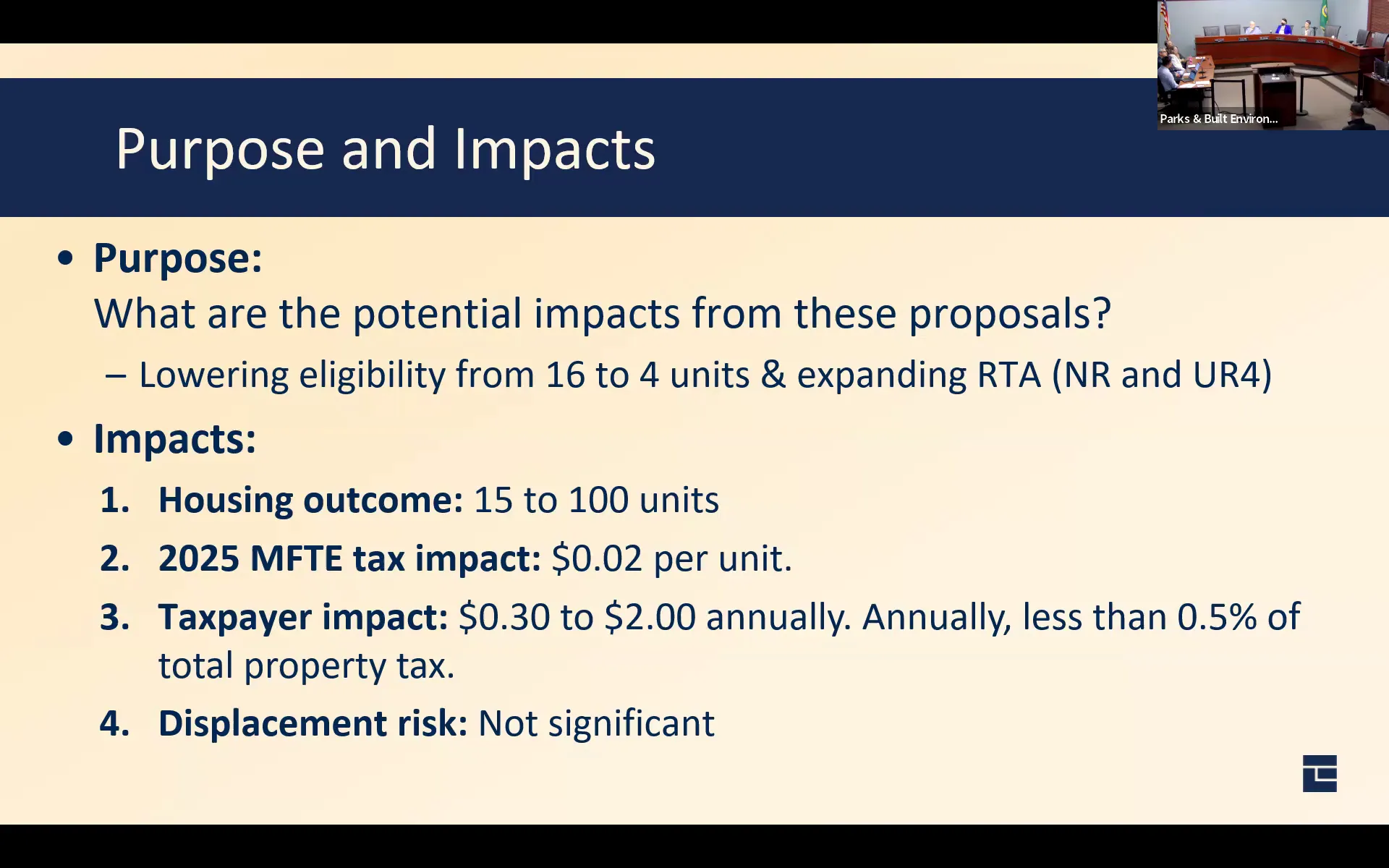
- Reduce the minimum eligible units from 16 to 4 (state minimum) to encourage small and middle housing projects.
- Expand the Residential Targeted Area (RTA) to include NR (neighborhood residential) and UR4 (urban residential) zones, effectively opening all residential zones (except constrained) to the program.
- Increase income limit for ownership units from 80% AMI to 115% AMI to make the program more attractive, though staff noted the ownership option is rarely used because the tax benefit goes to the buyer, not the developer.
- Clarify that the program applies to detached and attached units, not just buildings.
- Incorporate state-required updates (HB 1494) allowing tenants earning up to 150% of the income limit to remain in affordable units.
- Financial analysis: Staff estimated the changes would generate 15–100 new housing units per year in the expanded zones, with each unit costing taxpayers about $0.02 annually. Total annual tax impact would be $0.30 to $2.00 per average household ($4,700 annual property tax bill). Displacement risk was assessed as low.
- Council discussion:
- Councilmember Zarlingo expressed frustration at the modest unit projections and asked about other incentives to boost infill. Staff noted that pre-approved ADU plans may help but sales prices remain high ($500k–$600k).
- Councilmember Rhyne suggested a tiered approach: reduce minimum to 8 units in current RTA areas and to 4 in expanded areas, to encourage higher density along transit corridors. Staff countered that higher land values and construction costs already push developers to build more units, so a lower threshold could help feasibility.
- Councilmember Burbano asked about expected capacity; staff noted the NR and UR4 zones could accommodate about 8,200 units over 20 years under the Comprehensive Plan.
- Councilmember Zarlingo highlighted condo liability reform as a key to enabling ownership options and noted Mayor Franklin’s priority on that issue.
- Next steps: The ordinance will go to the Planning Commission for a recommendation, then to City Council: first reading June 24, second reading July 1, and action July 15.
Key Outcomes
- No votes were taken; the committee received the presentations and provided feedback.
- Staff will consider Councilmember Rhyne’s suggestion of tiered minimum unit thresholds and report back.
- The MFTE ordinance timeline remains as presented: first reading June 24, second reading July 1, action July 15.
- Future agenda items include an economic development update (July, tentative), Climate Action Plan update, downtown storefronts listening session, and other housing and safety topics.
Meeting Transcript
Good afternoon, everyone. Welcome to the Everett City Council's Parks and Built Environment Council Committee. Monthly meeting for this committee of the subcommittee of the Everett City Council. This public is welcome to our meetings to attend in person or remotely. We don't take public comment at these committee meetings, but we do take it at every regular city council meeting, the next one of which will be 6 30 p.m. tonight. For our agenda this afternoon, oh, I'm joined by Council members Luis Barbano and Paula Ryan, our regular chair of this meeting. And our agenda this evening, two main items. First, a Vision Zero update, and then an update on the multifamily tax exemption ordinance. So let's start first with uh Corey Hurt and uh update on Vision Zero efforts. Great. Thank you, Council Members Arlingo and uh for the record, Corey Hertz, City Traffic Engineer. I want to say thank you for inviting me to come uh provide an update on our Vision Zero effort. So Vision Zero effort as a plan is wrapping up at the end of the month when the funding runs out. It started back in September of 2024, funded 80% by a federal Safe Streets for All grant as a sub-recipient of the Puget Sound Regional Council grant. After a good deal of public outreach, the steering team made up of staff and a transportation advisory committee member and a data driven safety analysis. The final report and technical memoranda were formalized in December of 2025. It included a detailed crash analysis, a policy for setting posted speeds, and a toolbox for safety strategies and countermeasures. It also produced a list of projects that have been added to the six-year transportation improvement plan that can be used to apply for funding, future funding from outside sources. Without a vision zero process, the city would have been overlooked for further federal funding that we've received. Here's the five big commitments that came out of stuff out of the study. Ideas that will produce long lasting results to improve transportation safety in our community. They include pedestrians and active transportation users as our top priority going forward. It also engages with the community on safety, strengthens our partnerships between engineering and enforcement to solve the real safety issues our drivers and pedestrians face every day. Also, we're committing to build redundant transportation systems that protect our most vulnerable users, building infrastructure that puts people first, but at the same time, not snarling the city with traffic congestion. The zero deaths vision acknowledges that even one death on our transportation system is unacceptable and focuses on safe mobility for all road users. The wheel you see to the right is a graphical representation of the safe system's approach. Reaching zero death requires an implementation plan, which is founded on the principles that humans make mistakes and that human bodies have limited ability to tolerate crash impacts. In a safe system, those mistakes should never lead to death. Applying the safe systems approach involves anticipating human mistakes by designing and managing road infrastructure to keep the risk of mistakes low. And when a mistake leads to a crash, the impact to the human body doesn't result in a fatality or serious injury. There are six principles that form the basis of a safe system approach. Deaths and serious injuries are unacceptable, that humans make mistakes, that humans are vulnerable, responsibility is shared, that safety is proactive, and redundancy is crucial. During the initial work on Vision Zero Everett, it was recognized that speed plays a role in serious and fatal crashes. The first federal grant application during our vision zero effort was in 2024 and keys in on one of the five principles of the safe systems approach, safer speeds. The plan was funded by the Safe Streets for All program and is going to evaluate every arterial in Everett in logical segments. That's 79 arterials and about 200 logical segments where the speed change might be considered. It'll evaluate a 20 mile per hour residential speed limit in one of three ways. We'll look at maintaining the status quo, which is a 25 mile an hour residential speed limit. The possibility of a 20 mile per hour speed limit on bike boulevards where cars and bikes and pedestrians mix, or maybe a citywide 20 mile per hour statutory speed limit on residential streets. We'll also consider a 20 mile per hour downtown speed limit where pedestrian crossings are the highest in the city. One comprehensive resolution is expected to come before council early next year. Data will be collected and land use will be part of the process following our new speed limit setting policy. The public will be asked for recommendations through simple online mapping tool and public outreach sessions. The transportation advisory committee will hold workshops to discuss the recommendations that come out of the study. And finally, a team from staff that'll be the city traffic engineer, the city engineer, and police will screen the results to make sure the speed limits are both practical and enforceable. The second planning grant, uh, I think council's already been briefed on, and we we've secured so far is for an active transportation plan. It's an update to the bicycle master plan and is funded again by this federal safe streets for all program. The plan will identify gaps in pedestrian and bicycle networks and propose solutions to guide our future investments. It'll prioritize safety focused projects that improve walkability and rideability in Everett.
openpublica.com