Frederick Mayor & Board of Aldermen Workshop – April 3, 2024
STREAMING COPY IN PREPARATION — RECORDING AVAILABLE FROM THE ORIGINAL SOURCE
Frederick Mayor & Board of Aldermen Workshop – April 3, 2024
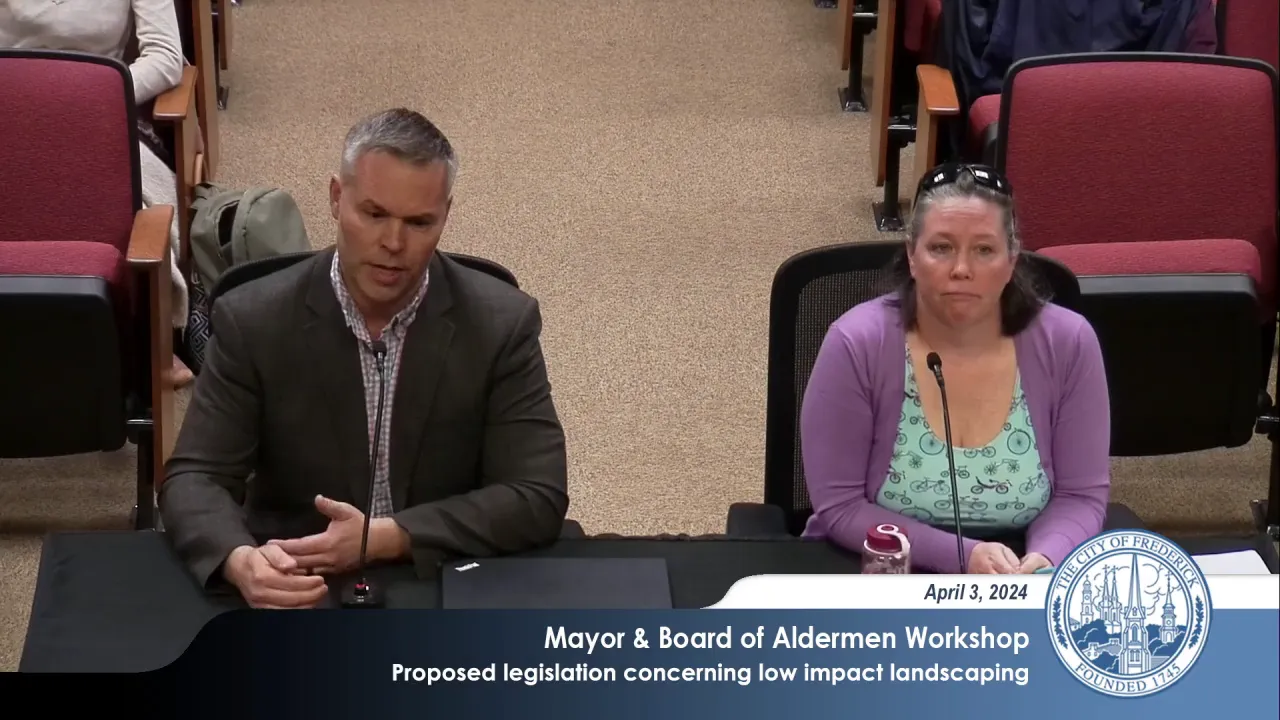
The Mayor and Board of Aldermen held a workshop on April 3, 2024, at 3:00 PM. The meeting included recognition of employee service milestones, a discussion of proposed low-impact landscaping legislation, and a request from the Frederick Police Department to expand automated enforcement cameras. No formal votes were taken on either workshop item.
Consent Calendar
- Approval of the minutes from March 20, 2024, was deferred and not considered.
- Employee Years of Service Recognition: Employees were honored for 5, 10, 15, 20, 25, and 30 years of service. The list included 12 employees at 5 years, 11 at 10 years, 23 at 15 years, 9 at 20 years, 1 at 25 years, and 1 at 30 years.
Public Comments & Testimony
- No public comments were offered on either agenda item.
Discussion Items
- Proposed Low Impact Landscaping Legislation: Jenny from the Sustainability Department presented a draft ordinance to define and regulate low-impact landscapes. The proposal includes requirements for managed plantings with at least 85% native species, prohibition of noxious and invasive plants, and a ban on unmanaged vegetation. Meadows under one contiguous acre would be prohibited unless accompanied by a management plan. Enforcement would rely on subject matter experts from city departments. Aldermen raised concerns about aesthetic subjectivity, potential for attracting rodents or other vermin, and the need for clear neighbor engagement. Staff recommended a six-month education and outreach period before enactment. The Board directed staff to develop educational materials and engage community stakeholders, including those with reservations, and to bring back a refined proposal after six months.
- Expansion of Automated Traffic Enforcement: Lt. Justin Thomas and Stephanie Kaiser of the Frederick Police Department presented a request to add three red light cameras and three speed cameras. Proposed red light camera locations: Thomas Johnson Drive at Opossumtown Pike (east/west directions) and Ballenger Creek at Ballenger Center Drive. Proposed speed camera locations: 1700 block and 7900 block of Opossumtown Pike (northbound and southbound). Data from crash reports, citizen complaints, and vendor surveys supported the need. Each camera costs $4,400 per month, to be added to FY25 budget via amendment. Aldermen discussed complaint processes, court challenge rates, and the ability of civilian personnel to review violations. The department affirmed that automated enforcement improves safety. The Board expressed support and directed staff to proceed with a budget amendment.
Key Outcomes
- Low Impact Landscaping: No formal vote; staff will prepare educational materials, consult with homeowners’ associations and neighborhood advisory councils, and return with a final proposal after at least six months.
- Automated Enforcement Expansion: No formal vote; the Board supported the request and authorized staff to work with the Finance Department to amend the FY25 budget to cover the ongoing cost of the six additional cameras ($4,400/month each). The project will proceed pending budget approval.
- The meeting concluded with a reminder of the budget public hearing at 7:00 PM that evening.
Meeting Transcript
Good afternoon and welcome to the Mayor and Board of Alderman Workshop for the third of April. We begin with the Pledge of Allegiance. I pledge allegiance to the flag of the United States of America. Which is changed one nation under God, indivisible liberty, liberty and justice. We expect to see Aldram McShane. We do have some employee years of service recognition to do. The individual in-person presentation of certificates and pins is now happening at employee work sites as opposed to here at the workshop, but we do want to take uh the public opportunity to recognize those employees who have hit uh five-year milestones in their career with the City of Frederick. So with five years of service, we recognize Jennifer Hammond, Etenosa O'Dia, Andrew Moore, Guyan Sampson, Peter Buckley, Irish Castro Cobb, Louise Andre, Isaac Bonneville, Evan Krupa, Brandon Miller, Gary Statler, and Dave Will. With 10 years of service to the city, Robert LeBaron, Stephen Speake, George Bentley, William Boxall, Joseph Connolly Jr., Michael Liston, Ethan Schreuer, Patrick Wharton, Benjamin Wilson, 15 years of service, Carrie Ann Eiler, Dustin Neosbaum, Maurice Boyd Jr., Sean Carpenter, Janice Dorcas, Tiana Doyle, William Fritz, Bradley Grimm, Kyle Jones, Deborah Kidwell, Gary Kuype, Paul Malatesta, Dave Masser, Doug Pochran, Ramona Ridgely, James Smith II. 20 years of service, Jennifer Martin, Raymond Bednar Jr., Matt Carrado, Jeffrey Gunder, Douglas Stevenson, Shannon Stream, Joseph Wheeler, Michael Winpigler. 25 years of service, Ryan Dinsmore, and 30 years of service, Kenny Ott. Congratulations to all of our employees on their employment milestones. But I suppose when you get into that 2025-30, we probably shouldn't be expecting many, many more. But for those at five, we expect many, many more. Approval of the minutes, we cannot do that right now. We will move on to our workshop topics, two of them. Item number one is discussion of proposed legislation concerning low impact landscaping. This item is being brought forward by our sustainability department. Good afternoon. And following suit, we would like to allow them as well. But right now our code sort of excludes them in our weed ordinance. So there's not really a whole lot of language. So we wanted to add some things in there, get some definitions, clarify what was and wasn't allowed. In keeping with the state regulation, we'd like to follow those same kind of standards where they sort of define things. We want people to adopt these kinds of landscapes within reason. So we do want to put a few a few little um definitions out there and some guidelines on what we what we can expect. So the first thing that you see on the document is just an introduction to what low impact landscapes are. And of course, they are becoming more favorable. You've probably seen a lot more of them as opposed to turf uh landscapes. Um so we know that they're becoming more popular. People don't want to spray a lot of pesticides, they don't want to have to mow, they want to attract more wildlife, all those kinds of things. So uh in attempting to get ahead of it, that's that's what this is for. So we have existing uh legislation, which is um 1532 and this section 302.4 weeds, and it really just had some very basic language. This is some a little bit of suggested language about weeds, uh, what is noxious, what is not. There is a new ordinance or or a new piece of legislation coming in front of the state about um tier one, tier two invasive plants, and they're gonna get rid of that and just call them all prohibited. So we may be looking for that legislation and trying to incorporate that into ours as well. I think that would be an important thing to recognize that those would not be allowed for us either, if they're not they won't even be allowed to be sold, but um, you know, we really want to discourage them. Uh when you go farther down, you see um the purpose. I I added a purpose statement for us, uh, which is you know, low impact landscaping legisl or specifications are described here in all that sort of good stuff. And then we get to the definitions. Um what is a managed low impact landscape? It's a planned intentional and main maintained planting. And what is a native plant, what is a noxious weed, um, and then we'd go into what prohibited and noxious weeds are, invasive plants. What is a pollinator garden? I think that's important to describe rain gardens, meadows, and xeriscapes. And I did provide some exceptions down below where I think that these should apply. Um any low impact landscape excluding meadows that differs from a conventional landscape. We're just trying to establish that's what it is. We'll get into meadows in a minute. Um it has to, you know, at least 85% native species and no noxious or invasive species.
openpublica.com