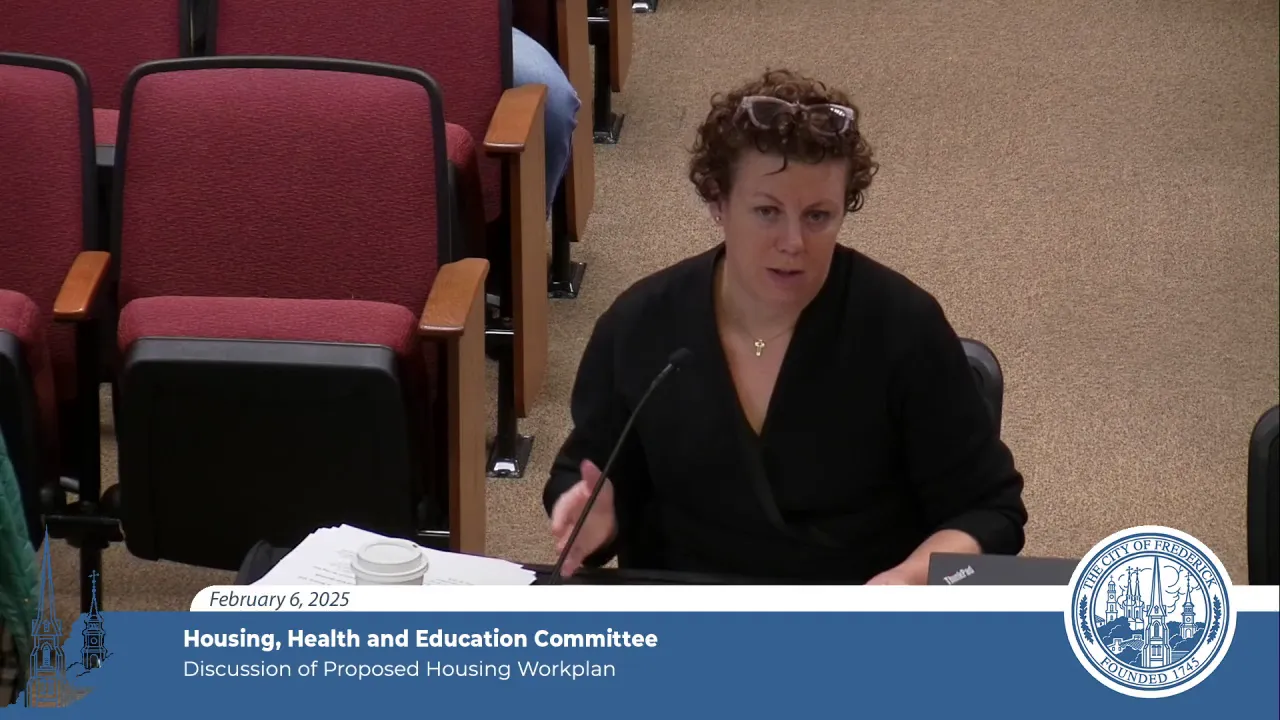
Housing, Health and Education Committee Meeting - February 6, 2025
STREAMING COPY IN PREPARATION — RECORDING AVAILABLE FROM THE ORIGINAL SOURCE
Housing, Health and Education Committee Meeting - February 6, 2025
This was the first meeting of the Housing, Health and Education Committee, chaired by Councilmember Donald Kazemchuk. The primary discussion centered on a proposed housing policy work plan presented by Council President Katie Nash, which outlined policy solutions across five income groups. Committee members and public speakers provided input on priorities, emphasizing quick, high-impact actions. The committee agreed to request additional data and to compile priority lists for the next meeting.
Public Comments & Testimony
- Nick Brown (Executive Director, Beyond Shelter; Chair, Continuum of Care): Highlighted the success of case conferencing and coordinated entry, noting a 93-year-old shelter resident placed into housing. Stressed the growing crisis of senior homelessness (15% increase year-over-year) and lack of subacute/respite care. Warned of a potential humanitarian crisis due to defunding of refugee and asylum resettlement programs, with at least 50 individuals (14 families) at risk. Urged city insulation from federal funding cuts, noting his organization alone could lose $150,000 in direct federal dollars.
- Ann Ryan (Frederick Housing Solutions Task Force): Noted that zero percent of housing in Frederick is affordable for a senior on Social Security ($23,000/year). Proposed using private money and church partnerships to expand single-room occupancy (SRO) units and a tiny home village for vulnerable seniors. Requested city land and an incentive fund for developers.
- Hugh Gordon (Chair, Frederick County Affordable Housing Council; CEO, Frederick County Association of Realtors): Expressed frustration that the council has struggled to produce substantive results. Suggested a comparative analysis of permitting processes with other jurisdictions to identify bottlenecks. Recommended adaptive reuse of properties and consolidation of nonprofit efforts to avoid duplication.
- Fourth speaker (name unclear, from Frederick Housing Solutions Task Force): Thanked the committee for addressing the housing crisis and stated that housing should be a human right.
Discussion Items
- Presentation of Proposed Housing Work Plan: Council President Nash presented a five-group framework (homelessness/emergency shelter, below 30% AMI, 30-60% AMI, 70-120% AMI, and affordable homeownership). She assigned time, cost, staff, and impact ratings to each policy solution, noting that many items require budget legislation or policy changes. Key categories included coordinated entry, transitional housing, inclusionary zoning, zoning reform, rent stabilization, ADUs, and homeownership programs.
- Committee Member Reactions:
- Council Vice President Shackelford: Emphasized need for partnerships, streamlined funding, use of city-owned properties (short- and long-term), urban planning for affordable housing, and preventing displacement.
- Councilmember McShane: Favored prioritizing policies that incentivize private development (zoning, permitting, gap financing) over city-operated programs, due to faster timelines. Expressed skepticism about city-led projects like repurposing city properties within five years.
- Chair Kazemchuk (Councilmember): Supported homeless services and generational wealth through homeownership. Noted the importance of smart growth, infill development, and ending the demonization of developers.
- Staff and Data Requests: Chair Kazemchuk asked for information on senior housing across all income groups. Council Vice President Shackelford requested a list of all housing services and organizations (noting Nick Brown's offer from the Continuum of Care) and asked that housing staff and a mayor's office representative attend the next meeting. He also requested information on federal funding threats.
Key Outcomes
- Committee members will submit their priority lists (from the work plan or new ideas) within one week to the chair.
- Staff will prepare information on senior housing needs and existing services.
- The next meeting will include housing staff and a point person from the mayor's office.
- The committee expressed intent to focus on low-time, low-cost, high-impact items (under one year, within existing budget/staff) while also pursuing longer-term strategies.
- The chair will continue to use the work plan as a living document and incorporate feedback from members and the public.
Meeting Transcript
I'm calling to order the meeting of the housing, health, and education committee. If we could all rise to say the Pledge of Allegiance. I pledge allegiance to the flag of the United States of America and to the Republic for which it stands. Indivisible with liberty and justice for all. Thank you, everyone. This is the first meeting of this particular committee. Um the members of this committee are um councilmember Shackelford, Councilmember McShane, who is here with us. Committees serve uh two primary purposes. One, they are the main venue for discussing workshopping policies, proposed uh, and general ideas for legislation and other items requiring council member input and feedback and development. And two, they review and provide initial feedback and recommendations regarding drafted legislative items, for example, ordinances that have been formally submitted to the city council and are undergoing the legislative process. Committees, except for the com city council work session consist of three council members appointed by the council president. Other council members not appointed to the committee may attend committee meetings and participate in discussions, but are not permitted to vote or contribute to the committee's quorum. There are four standing committees, however, the city council president may call for the formation of temporary special committees to address emergent policy public issues and policy topics as needed. This particular committee, the Housing Health and Education Committee, um meets the first and third Thursdays of each month at ten from ten AM to twelve PM. Members, as previously stated, include Councilmember Donald Kazemchuk, who is the chair of this committee, Council Vice President Derek Shackelford, and Councilmember Ben McShane. The scope of this committee uh includes policies, departments, and commissions in the city related to community wellness, housing, community care, natural resources, and sustainability in public health. Yeah. Thank you. Um, so to today, our discussion is going to uh uh be centered around the council housing policy work plan. We are hoping to move forward with some um ideas that will make a difference in how we help those in our city who are in need of housing and um policies that may have um hopefully some low time and cost and high impact. Um thank you to everyone who is here just to set us up for for what's going to happen. Um council president Katie Nash is actually going to be doing the presentation today. After the presentation, um we may have some questions during the presentation. Certainly um committee members are welcome to ask questions at any point in time. I'd ask those of you who plan on speaking to um maybe take some notes and we'll give you a minimum of three minutes at the end of the discussion to you know give us your thoughts on anything that has been discussed, depending on the amount of time that we have. Um we may extend that time frame to five, but again, it's gonna depend on how much time we have within the um meeting parameters, if that's okay with everybody. So um President Nash, thank you. Thank you, Madam Chair. A special note of thanks to our staff that made it in today. The city is on liberal leave, but when we as a council compressed to our Thursdays, that made Thursdays pretty darn important for us to be here. So I very much appreciate the staff, especially that that did make it in. Just a little bit about a history of how we got to this point. Uh we had previously discussed um the context of price appropriate housing, affordable housing, known by many different names. Uh we had a work group meeting or work uh session meeting, excuse me, uh in September. We then had another meeting in October. And so I want to just make sure that if you're just joining us and you're excited about this conversation, you can go back to uh on our website. We have City Council, or excuse me, yeah, city council work sessions, and if you go to 2024, if you go to September and October, you can see those presentations as well as the conversations that we had. Where we are, as the chair mentioned now, is we are in this space where we have identified possible policy solutions using a variety of resources previously discussed. By no means are the items that are going to be listed today uh exhaustive. There are so many good ideas, so many things that communities are doing. Uh, certainly, you know, there were this is the opportunity to bring all ideas forward, but we need to start somewhere. Also worth mentioning uh that in this fiscal year, the city and the county made the commitment to do a housing study, and so that is in process right now. The county is taking the lead on that, and so we're certainly following that work, and we want to be mindful that that's going on uh while we're having these conversations. But as we set the stage in October, we said that we wanted to move forward and say, okay, how can we get ourselves ready for when that housing study becomes available? So just a couple of parameters in our conversation, things that I think that we all agree on. We know that our residents are concerned about growth, yet we also know that we have a housing shortage. We know that the county has limited housing uh development. They have put a pressure on the city. We can talk about the goods and the bads, but that's just the way that it is. Um, but we also know that constraining supply does hurt affordability.
openpublica.com