Housing, Health, and Education Committee Discusses Housing Work Plan on April 3, 2025
STREAMING COPY IN PREPARATION — RECORDING AVAILABLE FROM THE ORIGINAL SOURCE
Housing, Health, and Education Committee – April 3, 2025
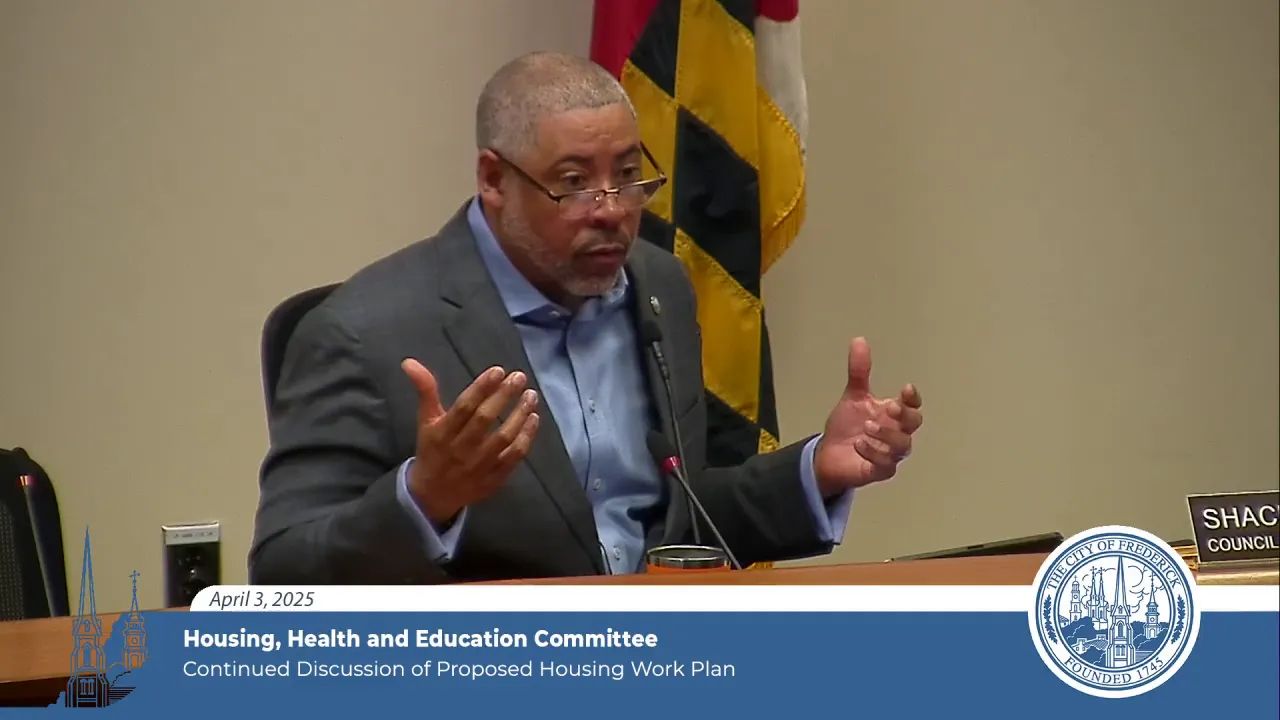
The Housing, Health, and Education Committee of the City of Frederick met on April 3, 2025, to continue discussions on the proposed Housing Work Plan. The meeting focused on three key policy areas: Accessory Dwelling Units (ADUs), Single-Room Occupancy (SRO) housing, and affordable housing zoning options. Committee members sought to establish a timeline for receiving concrete policy options and advancing legislation, emphasizing the need for timely action.
Consent Calendar
- Approved the minutes from the March 20, 2025, committee meeting.
Public Comments & Testimony
- No public comments were made during the meeting.
Discussion: Accessory Dwelling Units (ADUs)
- Director Gabrielle Collard presented a fact sheet on ADUs, identifying specific issues with the current ordinance: parking requirements, the 800-square-foot maximum size limit, owner-occupancy requirements, and fees.
- Committee members expressed frustration with slow progress and demanded a clear list of policy decisions rather than broad overviews. Councilmember Shackelford requested that by May 15, staff present specific options for changes to parking, size, and other ADU regulations, not just general concepts.
- Director Collard suggested a spectrum of options for parking, from elimination to reductions near transit. She also noted that tying ADU size to a ratio of the principal dwelling could replace the fixed 800-square-foot cap.
Discussion: Single-Room Occupancy (SRO) Housing
- The committee recognized that Frederick lacks a formal definition or land-use classification for SROs. The current code does not permit SROs as a distinct use.
- Members discussed the typical SRO model: individual lockable rooms with shared kitchen and/or bathroom facilities. Director Collard referenced HUD’s definition: “a unit that provides living and sleeping space for the exclusive use of the occupant, but requires the occupants to share sanitary and/or food preparation areas with others.”
- Concerns were raised about livability standards, including bathroom-to-bedroom ratios and building code compliance. The committee asked staff to investigate existing building code requirements and whether additional regulations are needed.
- Council President Nash and others agreed that SROs should be considered a policy priority and that a framework for them should be developed. It was requested that a model ordinance or clear policy options be ready by May 15, with a follow-up on June 5.
Discussion: Affordable Housing Zoning Options
- Director Collard outlined three potential approaches to incentivize affordable housing (targeting 30–60% AMI): a floating zone, incentive zoning, and overlay districts.
- A floating zone would allow the council to rezone specific projects on a case-by-case basis. Incentive zoning would grant by-right density bonuses or other allowances for developments meeting affordability standards. Overlay districts could focus on specific areas, such as transit-oriented development (TOD).
- Councilmember Shackelford and others strongly advocated for a by-right approach that allows affordable housing anywhere in the city, stating that “affordable housing should be everywhere” and that concentrating poverty must stop. Councilmember Shackelford emphasized the need for “bold” policy measures given the housing shortage.
- The committee reached consensus that staff should return with a concrete proposal that allows developments meeting affordability criteria to receive by-right zoning benefits, accelerating the process.
Key Outcomes
- Timeline Established: The next meeting (April 17) will focus on the budget. Subsequent meetings on May 1, May 15, and June 5 will be dedicated to the housing work plan. May 15 is set for detailed policy options on ADUs and SROs; June 5 for follow-up and potential refinement.
- ADUs: Staff will prepare a list of policy decisions (parking, size, owner-occupancy, fees) and provide options for the committee to choose from, aiming for a legislative proposal by summer.
- SROs: Staff will develop a model ordinance or policy framework for committee review by May 15, with the goal of introducing a text amendment by June.
- Affordable Housing Zoning: The committee directed staff to craft a by-right incentive zoning option that would automatically apply when developments meet defined affordability standards, avoiding site-specific rezonings. The proposal will reflect the consensus that affordable housing should be permissible citywide.
- Process Note: Council President Nash acknowledged that shepherding text amendments through the Land Management Code is a new process for the council and will require coordination with staff and the planning commission.
Adjournment
The meeting adjourned at approximately 11:30 AM.
Meeting Transcript
Welcome to the April 3rd meeting of the housing health and education committee. We'll start with Pledge of Allegiance. I pledge allegiance to the flag of the United States of America and to the Republic for which it stands. One nation. Thank you. First is the approval of the March 20th committee meeting minutes. Move for approval. All those in favor. Okay, we're good. We have I have the wrong thing sitting in front of me, is what I have. So we have continued discussion on the housing work plan. And the next steps, I believe that is President Nash. Yes, good morning, Madam Chair, Council Vice President. We are today continuing our conversations regarding the well, this this conversation really encompasses uh the kickoff of several different policy items within the housing work plan. Um specifically, I'll turn your attention to the backup. We have multiple documents provided by uh our director of planning, Gabrielle Collard, who's gonna speak to us, just sort of um providing today a very high-level overview of some of these items. Um we've begun our work uh on the single room occupancy ordinance, and um Gabrielle has graciously put together information regarding that ordinance, regarding that policy. We expect that these conversations will continue. We've uh designated to additional follow-up conversations. So certainly uh wanna emphasize that this is the beginning of the conversation regarding some of these topics. Um they're pretty dense. They're pretty uh there's gonna be a lot of uh back and forth, I would expect information gathering that we need to do uh to prepare ourselves for decision making. But we did want to move forward, uh, get you know, invite Gabrielle to come speak uh to some of these items. Um, specifically the policies before you today are primarily going to address uh zoning concepts regarding or excuse me, um policy concepts that address the 30 to 60 percent AMI uh sector. So if you're following along uh at home and you see that housing work plan document that we have posted in our backup, that's what we're starting our focus on. Um I believe both uh council member Shacklford and Councilmember McSheen had expressed an interest in doing what we could to bring the private sector to the table, make sure that we were involving them. So certainly um Gabrielle works very closely with our um development industry, but also we will be reaching out and making sure that they're aware of these conversations so that they can weigh in as well. So um Gabrielle, if you are good to go, you can um I'll turn it over to you, but I uh the conversation we had sort of asked Gabrielle to be ready for was kind of a recap. If you remember, we had started this conversation way back. We had had a work session sometime last year. Um, so we figured let's just go ahead and sort of recap the policies that we had presented to you then and the information that Gabrielle had pulled together then so that we could begin to move forward. Good morning, everyone. Thank you so much. So um, as Council President Nash said we have you know kind of three different policy topics that we've provided some backup on. Um I think what would be helpful for for me um to understand from the committee um is what are is our top priority at this point. Um, you know, I think there are a couple of things to consider in terms of um speed and um ability to move things, you know, certain items faster than the others, maybe um, some are bigger topics. Um, for example, we have the accessory dwelling unit ordinance is already part of our code. Uh, we have several years of implementing that and if um and and have learned some lessons and have some ideas about improvements that need to be made to it. So that might be an item that the council feels can be fairly quickly remedied. Um conversations about the affordable housing zoning options. We've discussed, I guess Council President Nash said we had a great discussion on it a couple months back about how to develop specifically targeted zoning regulations to um facilitate and promote uh those private development projects that are are looking for um low-income housing tax credits and um the deficiencies in our existing codes that would maybe facilitate that a little bit better. So that may be a bit of a broader conversation. Um and then of course the single room occupancy um provisions, which we don't have any framework for currently. Uh what we provided in the fact sheet was kind of just an analysis of what we do have in the code, what different things kind of dance around it, but don't really get at it specifically. So just kind of a baseline of what provisions, what types of um housing alternatives we currently allow for in our code. Um that's usually the first step in my process of thinking about new regulations is kind of taking stock of what we have now and and how that relates. Um with that said, is there an area you'd like me to specifically focus on in one of those three to just provide a little more background? Council member, do you need specific background on any of the three? Well, in terms of what you stated in regards to some remedies, I would like to look at those. I know we've talked about the immediate in terms of things that we could change um quickly.
openpublica.com