Housing, Health, and Education Committee Workshop: SROs, Public Art, and Climate Resiliency - May 15, 2025
STREAMING COPY IN PREPARATION — RECORDING AVAILABLE FROM THE ORIGINAL SOURCE
Housing, Health, and Education Committee Workshop: SROs, Public Art, and Climate Resiliency - May 15, 2025
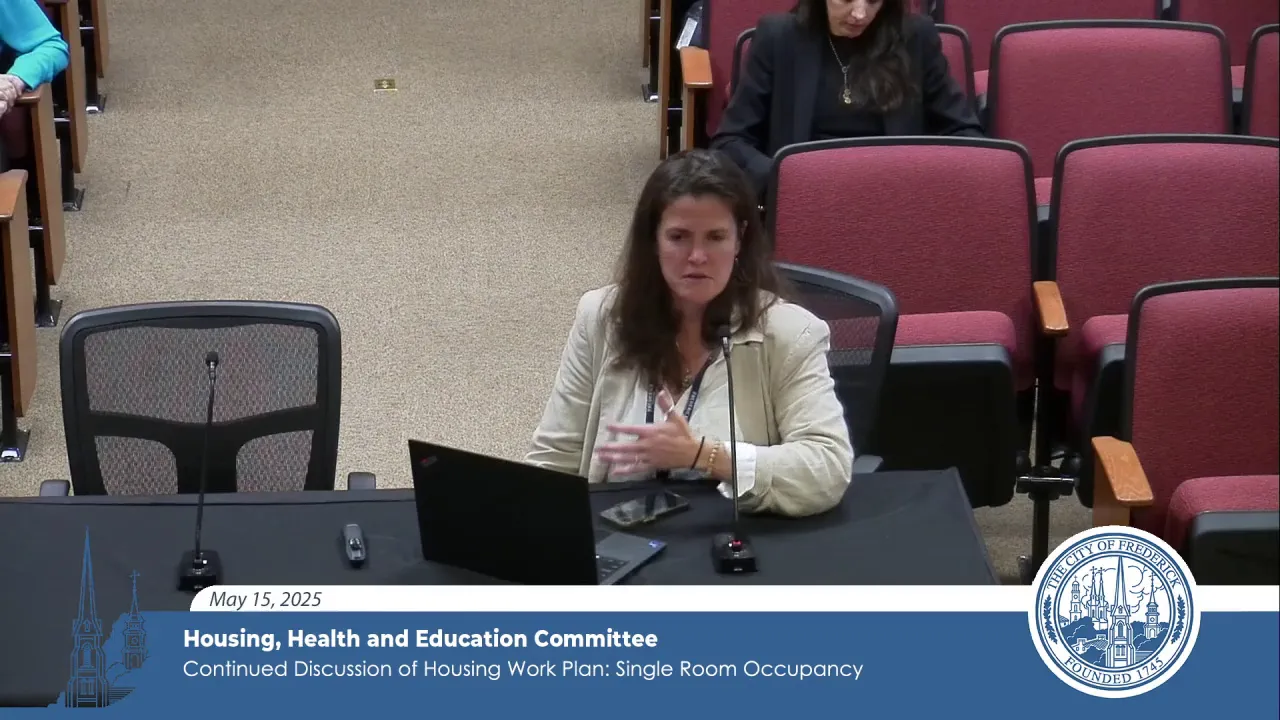
The Housing, Health, and Education Committee of the City of Frederick met on May 15, 2025, beginning shortly after 10:00 AM in a workshop format. The meeting covered continued discussion on single-room occupancy (SRO) housing — referred to as personal living units (PLUs) — a public art work plan, a proposed sculpture donation honoring former Mayor Ron Young, and a draft climate resiliency work plan. Due to the length of the agenda, the climate resiliency item was briefly introduced without detailed deliberation. Public comments addressed both SROs and Accessory Dwelling Unit (ADU) parking requirements.
Public Comments & Testimony
- Anne (Frederick Housing Solutions task force): Expressed strong support for SRO/PLU development, emphasizing the need for housing for residents earning under $20,000 per year. She highlighted a potential demonstration project with a downtown church and invited the city to invest rental licensing fees into such projects.
- Sandra Blake: Addressed the committee regarding the ADU ordinance. She owns a property with a 450-square-foot small house (built before the ADU ordinance) rented for $1,000/month. Code enforcement is forcing the tenant to vacate because the property cannot meet the three-parking-space requirement (only two spaces exist). She urged the city to revisit parking rules, as the tenant may become homeless. She offered to show her property as an example.
- Peter Bram: Commented on the public art work plan, recommending affordable housing and studio space for artists; consultation with neighborhood advisory councils and community groups (e.g., Golden Mile Alliance, East Frederick Rising, Central Hispano de Frederick, ARCH, Frederick Center); and distribution of public art throughout the city rather than concentration in one area, to create an art trail.
Discussion Items: Single-Room Occupancy / Personal Living Units (SRO/PLU)
Staff (Gabriel Collard, Planning Department) led a discussion on establishing a regulatory framework for SROs/PLUs. The current code has a vague definition of SRO (from 2003) but no regulation; the closest tool is a rooming house limited to two permanent lodgers. Key policy questions raised included: defining a PLU (living quarters with either bathroom or kitchen, but not both); whether to cap unit size or number of rooms; mixing PLUs with traditional dwelling units in the same building; parking requirements (e.g., one space per PLU vs. matching multifamily rates); parkland dedication and impact fee applicability; and partnerships with non-residential uses (churches, nonprofits).
- Councilmember McShane expressed strong support for mixed-use buildings and cautioned against over-regulating PLUs compared to single-family homes, where bedroom counts and parking are not limited.
- Councilmember Shackelford argued that the council should avoid value-laden fears about demographics and focus on safety and fairness.
- Committee Chair Nash confirmed that the next step is for staff to bring a draft ordinance back to the committee on June 5, 2025, for a yes/no decision on specific provisions.
Discussion Items: Public Art Work Plan
Layla (Public Art Manager) presented recommendations to develop formal public art policies, including: community engagement; a percent-for-art program; a public art database (not yet launched publicly, though work is ongoing); and updating the Public Art Commission membership to include expertise such as architects and developers. She noted that previous efforts in 2020 did not pass under the Board of Aldermen. Councilmember Kissamchuk expressed disappointment that the database is not yet public.
Discussion Items: Public Art Donation (Ron Young Sculpture)
Toby (staff) and artist Morgan Keller presented a proposal for a seven-foot bronze sculpture of former Mayor Ron Young to be placed near the amphitheater on Carroll Creek Linear Park, with a wayside exhibit honoring all mayors who advanced the creek project. The project has received unanimous approvals from the Public Art Commission, Parks and Recreation, and Historic Preservation Commission. The draft Memorandum of Understanding (MOU) was not yet provided to the committee.
- Councilmember Shackelford opposed placing the sculpture within the amphitheater, arguing it would obstruct views for some audience members during events. She supports the sculpture elsewhere on the creek.
- Councilmember McShane supported moving forward to a public hearing, noting the committee could review the MOU in the meantime.
- Chair Nash expressed frustration about the timing, as the MOU was only recently received, and noted that the committee needed to prioritize more urgent housing matters. Next steps: leadership will decide whether to schedule a hearing or bring it back to committee.
Discussion Items: Climate Resiliency Work Plan
President Nash introduced the draft work plan, explaining that it was developed by identifying existing recommendations from prior studies and prioritizing them through a stakeholder meeting. The document includes both easy and difficult actions. No detailed discussion occurred due to time constraints; the committee will review and come back for agreement.
Key Outcomes
- SRO/PLU ordinance: Staff will draft an ordinance based on the committee’s policy direction and present it for decision at the June 5, 2025 committee meeting.
- ADU parking requirement: Chair Nash proposed a six-month enforcement pause to allow time for a comprehensive review and a targeted amendment to eliminate the additional parking requirement. The committee agreed to pursue both the pause (pending legal advice) and a limited code change.
- Ron Young sculpture: The committee did not take a vote; the MOU must be reviewed and a decision on placement remains. The matter may be heard at the June 5 public hearing if leadership schedules it.
- Public art work plan: Noted; further deliberation expected.
- Climate resiliency work plan: Committee members will review the draft; a follow-up discussion will be scheduled.
Meeting Transcript
Again, I apologize. We thought it was better to start late than nothing to cancel the meeting. Are you ready in the back? We're going to go ahead and get started with the um meeting of the housing health and education committee. Again, we are expecting Councilmember McShane momentarily, so we'll go ahead and um do the pledge and um bring people up for the first discussion on um the housing work plan. Again, we are expecting council member McShane momentarily, so we'll go ahead and um do the pledge and um bring people up for the first discussion on um the housing work plan lab the pledge of allegiance I pledge allegiance to the flag of the United States of America and to the republic for which it stands one nation undergrowing indivisible with liberty and justice for all thank you all um I'm gonna ask I I believe um Gabrielle So this is part of our conversation on um affordable housing or um as um council member Shackelford likes to call it uh price appropriate housing, single room occupancy is one of the ways of doing this. I know that we have um people here who would like to comment on not just single room occupancy but maybe other parts of the affordable housing plan. I'm going to allow that during public comment. Um so if you want to go ahead, we have sure. Good morning, thank you. Thank you so much. Good morning, Gabriel Collard with the planet. And and again, if Councilmember McShane was not well versed on all of this, I would hold off, but but he really is well versed on this, so this is more for the public than us. Um and I would imagine this will probably be the start to to a more robust conversation moving forward. Um so this will not be the last you've heard of this conversation. Um so thank you very much. Um our topic today was to start thinking about concepts for SROs or single room occupancy units. Um we started with establishing a baseline of what our existing regulations are, uh, then looked at some alternatives from other communities, um, came up with a basic framework of the types of regulatory standards we should evaluate. Um I think it's important to preface this conversation with um with probably the the feedback that we'll get from from our community in terms of really trying to hone in as much as we can on the specific need. Um that to a certain extent is going to dictate the regulatory framework that we want to create. Um the types of opportunities that are out there for this type of dwelling unit, understanding those a little bit more in terms of scale, um, you know, we're talking about large scale facilities, small scale, what are the um the housing options that people are looking for right now to help inform this a little bit more. I think we will want to as a community also think about the long run, though. We don't want to just say, okay, well there's a specific opportunity now for this type of arrangement, because in the future there that may evolve. So we want to be balancing understanding our current needs with looking into the future when we we start to um set our regulatory framework. All that said, uh broadly looking at our code right now, it's kind of interesting. We have um our land management code, many of you know was adopted in 2005. There have been a number of amendments since, uh, but one of the initial concepts in that was a definition of an SRO. However, there was no regulation. It was just this definition in there that was not applied anywhere throughout the code. The definition was taken from Comar um in 2003. And very broadly, I don't understand, I don't know the context that it was in at that time, but it describes a building of single room dwelling units uh being either newly constructed or converted space. Um this concept of the types of facilities that they include. So when we talk about a dwelling unit, we're automatically thinking of a unit with a bathroom, sanitary facilities, and kitchen. So full full opportunity to live within that space, whether it's an apartment or a single family home. Um the concept of SROs starts to break that down a little bit and imagine a living arrangement where maybe you are living in one room or maybe two room space that doesn't have the full fit out of a dwelling unit. That some of the the facilities we need for for everyday living are shared within a building. Uh the definition we have is kind of wonky because it it talks about having food preparation facilities or sanitary facilities or maybe both. I just want to point out that if you had both, we would consider you a dwelling unit for all the purposes of our code. So what what I think we really wanted to find is this living arrangement where you don't have both of those things in one unit, because that's a that's a house, whether it's an apartment house or a um townhouse or multi or a single family house. Um, this concept is more looking at a living space where sanitary or kitchen facilities are shared amongst the the residents living in that space. So we need we need to do some work on our definition. Uh so part of this would be redefining that. Gabrielle, can you talk about um the the living space in these? So our definitions actually only talk about I'm gonna uh uh a sleeping area, right? Um sanitary facilities and kitchen. So they don't have it doesn't have to have a separate um living area, that can actually be part of the uh um sleeping area. Correct. And the the presence of all three, whether it's a bedroom or a one combined space, a big loft kind of apartment, right? Um that would be a dwelling unit. If you've got all of those facilities, your your unit and we're gonna treat you like one for purposes of everything.
openpublica.com