Ethics and Defensive Decision Making Training for Historic Preservation Commission - June 30, 2022
STREAMING COPY IN PREPARATION — RECORDING AVAILABLE FROM THE ORIGINAL SOURCE
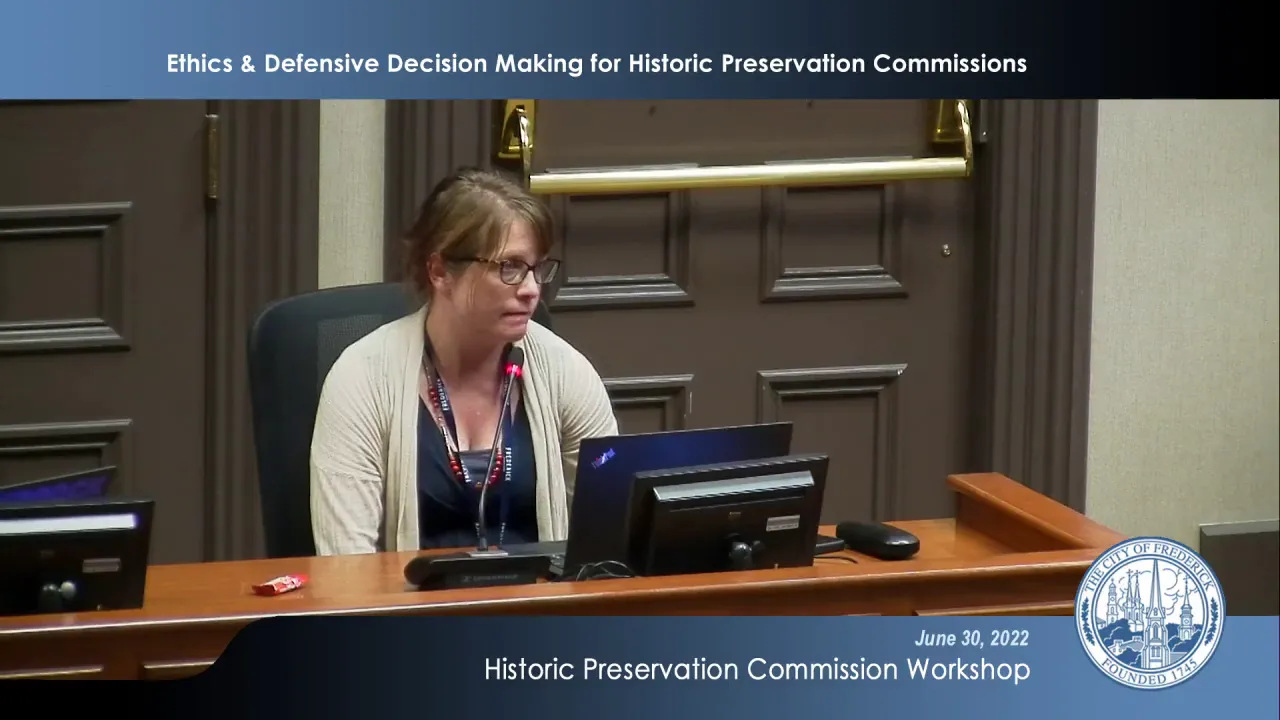
Ethics and Defensive Decision Making Training for Historic Preservation Commission - June 30, 2022\n\nThe Historic Preservation Commission (HPC) of Frederick, Maryland, held a training session on ethics and defensive decision making on June 30, 2022. The training was presented by Kirsty O'Neill of the Maryland Association of Historic District Commissions (MAHDC) and supported by grant funds from the Maryland Historical Trust. The session covered ethical dilemmas such as conflicts of interest, bias, ex parte communication, and the importance of due process. Commissioners participated in discussing nine scenarios to test their understanding of ethical standards. The meeting also included a discussion about interacting with the press and the Open Meetings Act. The training was attended by commissioners in person and virtually, along with staff and legal counsel.\n\n### Discussion Items (Scenarios and Responses)\n- Scenario 1: Honorary Chair of Fundraiser – Commissioner Gomez declines to be honorary chair after learning the event organizers might request city council actions. Commissioners generally agreed that perception of conflict matters; some would recuse, others would seek input. The presenter noted that while no real conflict may exist, the higher ethical standard of avoiding appearance is prudent.\n- Scenario 2: Window Restorer Commissioner – Commissioner Anderson, a window restorer, is hired by a district resident and then recuses herself when the application comes before the commission. All commissioners agreed recusal was the correct ethical choice. The presenter highlighted that conflicts of interest must be disclosed and the commissioner should leave the room.\n- Scenario 3: Free Meal from a Developer – Commissioner Jones receives an apparent free meal from a property owner who will soon apply for projects. Commissioners unanimously agreed that the full bill should be paid to avoid any appearance of impropriety, and that even if a gift is under a legal threshold, it should be refused if it creates a perception of bias.\n- Scenario 4: Behind-the-Scenes Tour for Friend – Commission chairperson Young arranges a tour of the planning department for a college friend who plans to bid on a future RFP. Opinions were mixed: some saw it as unfair access or insider information, while others saw no serious ethical problem if no RFP details were shared. Legal counsel noted that the nexus between the tour and the RFP is unclear, but perception must be considered.\n- Scenario 5: Friendly Neighbor Asking for Favor – Commissioner Lee’s neighbor asks her to sway other commissioners on a potential addition. Lee correctly avoids discussing the case and directs the neighbor to the preservation planner. Commissioners agreed this was the proper response. A follow-up discussion addressed whether a commissioner who is also a neighbor should recuse if the project directly affects their property; the consensus was to recuse if they cannot be impartial.\n- Scenario 6: Planner and Commissioner Close Relationship – A commissioner meets monthly with the planner to get advance information on agenda items and strategies to sway other commissioners. Commissioners and staff identified this as problematic, especially the behind-the-scenes coordination. The line was drawn at discussing specific upcoming cases or attempting to influence colleagues outside public meetings. The presenter noted that while informal conversations with staff are acceptable, “machinations” to build majority support cross ethical boundaries.\n- Scenario 7: Conference Discussions – Four commissioners attend a conference, discuss general process improvements, and later talk about a slate roof case study almost identical to an upcoming application. Commissioners and legal counsel distinguished between discussing process (acceptable) and discussing specific pending cases (violation of Open Meetings Act). The presenter emphasized that any discussion of a pending application among a quorum outside a public meeting violates the Open Meetings Act.\n- Scenario 8: Overwhelmed Commissioner – Commissioner Alyssa, due to family crises, has not reviewed applications or made site visits, but plans to vote with the majority. Commissioners agreed she should either disqualify herself or provide a statement of eligibility explaining she cannot vote. They noted that if her absence affects quorum, she may need to consider resignation. The presenter tied this to accountability and competency as ethical requirements.\n- Scenario 9: (Bonus) Speaking to the Press – Commissioner Carrie asked about handling press inquiries. Staff and legal counsel advised never speaking on behalf of the commission without explicit permission, and if forced to comment, to clearly state it is a personal opinion. They recommended deflecting to staff or the city’s communications director to avoid misquotation or premature commitments.\n\n### Key Outcomes\n- Commissioners gained a clearer understanding of ethical standards for conflicts of interest, bias, ex parte communication, and accountability.\n- The training reinforced the importance of due process, both procedural and substantive, and the need for decisions to be based on evidence and design guidelines.\n- Commissioners were reminded to always consult legal counsel when in doubt, and to consider how actions might appear on the front page of a newspaper (the “Marksula Center” test).\n- It was noted that Frederick has an ethics commission and an ethics ordinance, though ethics training is not currently required for commissioners.\n- The presenter committed to sharing a link to the Markkula Center video on ethics.\n- Commissioners were advised that the Open Meetings Act training is available and encouraged to take it.\n- No formal votes were taken; this was an educational session.\n
Meeting Transcript
I I wait I give you the signal. All right, so we're gonna get started. Uh six o'clock. Um we were expecting um some other commissioners and and maybe they'll trickle in. Um but this is the um ethics and defensive decision making for historic preservation commissions training. Um it is being presented by the Maryland Association of Historic District Commissions. Um we are um and supported by grant funds from the Maryland Historical Trust. Um I when the presenter will who I'll have do um her own introduction here in a minute um when she's presenting. If everybody else could have their cameras off, and then when we get to a point if we have questions or discussions, um then you can turn them on at that point. Um so with that I want to turn it over to Kirsty and she can go ahead and introduce herself and get started. Thank you, Kirsty. Thank you all for having me in this evening. You can hear me okay, I take it. That was a question. Okay. First if if Christy, if you want to hold on a second, we can just barely hear you. Okay. I hope it's not on my end. Are we still testing here? And and this is Christina Martin Koske. I will know that I hear her just fine online. Okay, thank you. I don't want to shout in your ear, Christine. Oh, thank you. Although I'm eager to hear what you have to say. Well, not that eager. Oh, I'm eager. Can you can you hear if you listen there? Okay. I I think we're all good now. You can go ahead and get started. Okay. Thank you. Uh may I share my screen. Uh you should be able to. I need permission. Okay. It's forbidding me from doing that. I suppose I could do the interpretive dance version of this presentation, but uh I I'm I'm not sure it fulfills the credit requirement. Okay, you should be. I I switched you to a presenter, so you should be good. Excellent. Okay. Well, I think this is the right one. There, you can all see that, I presume. I just want to start with a a brief introduction about the Maryland Association of Historic District Commissions. We are a statewide 501c3 nonprofit established more than 40 years ago. Uh we uh have served the state historic preservation commissions across the state through training and program support. In addition to this uh to this training. Please note that the uh that we have other other trainings available, including some brand new ones, like uh archaeology, for example, and they're soon to become a opening a new one on ARC archiving.
openpublica.com