OPENPUBLICA · PUBLIC MEETING RECORD
Record of Proceedings
Grand Junction Housing Affordability Task Force Meeting Summary - October 30, 2025
City Council — Thursday, October 30, 2025
BodyGrand Junction, Colorado
SessionCity Council
DateThursday, October 30, 2025
StatusFILED
Video Record
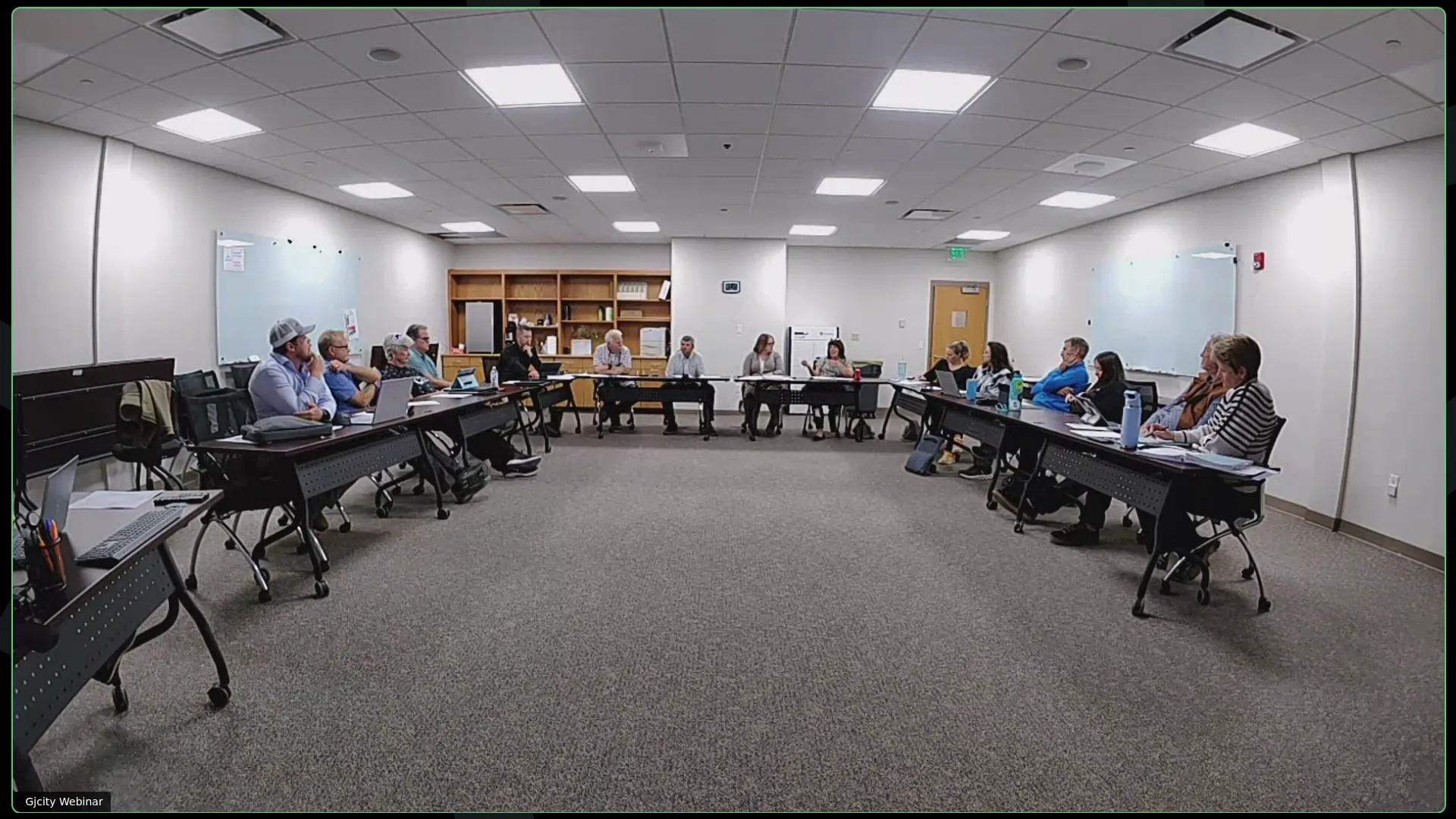
STREAMING COPY IN PREPARATION — RECORDING AVAILABLE FROM THE ORIGINAL SOURCE
Transcript — Verbatim
Speaker numbers apply only to this recording.
Discussion Breakdown — Share of Meeting
Engineering And Infrastructure29%
Zoning And Development20%
Affordable Housing19%
Water And Wastewater Management13%
Environmental Protection5%
Procedural4%
Policy Development4%
Procurement Policies3%
Public Engagement3%
Summary of Proceedings
Grand Junction Housing Affordability Task Force Meeting Summary - October 30, 2025
The Grand Junction Housing Affordability Task Force met on October 30, 2025, at 15:30 UTC to continue developing code and policy recommendations aimed at lowering housing costs. Members reviewed pending proposals, assigned new work on transportation engineering design standards (TEDs), approval expirations, and staff review practices, and discussed how to handle commercial code issues without losing focus on residential affordability.
Discussion Items
Task force scope and commercial code
- Mayor Kennedy asked the group to keep its primary focus on residential housing affordability, while allowing adjacent commercial items to be referred to another avenue when they overlap with multifamily or other housing work.
- Several members supported forwarding a recommendation that City Council create a separate avenue or subcommittee for commercial code improvements, rather than letting those issues disappear.
- Some members noted commercial code crosses over into multifamily, so relevant commercial items should still be considered where they affect housing costs.
TEDs consultant scope
- Ivan said TEDs are a major cost driver and proposed hiring a consultant, perhaps around $100,000 rather than $200,000, to review street-section standards and multimodal requirements.
- Mark and Ivan agreed to draft a narrow scope or RFP for a TEDs consultant by the Monday before the next meeting so the committee could decide whether to request funding.
- Staff noted the city faces a 14% operational budget cut, so any consultant funding would likely require a one-time fund-balance decision by Council.
- Keith cautioned that TEDs are tied to other adopted policies and codes; Ivan responded that the TEDs standards themselves set unnecessarily high costs, citing the FNFO Parkway at $33 million per half mile.
- A member also suggested creating an administrative committee when a project receives a certain number of review comments, at the applicant's choice, to avoid endless review cycles.
Certified irrigation design requirement
- Ivan and Mark presented a proposal to remove the certified irrigation designer requirement from the landscape code, saying the certification does not exist in practice and landscape architects should be able to stamp irrigation designs within their licensure.
- Members agreed the recommendation was directionally sound, but asked Ivan to verify the correct code section because his draft cited an unrelated section (21.06.040) from an AI search.
Bicycle parking/storage
- Mark and Mike presented a previously submitted recommendation to remove long-term bicycle parking/storage requirements from the code, including for multifamily projects.
- The group confirmed this recommendation was already forwarded to staff.
Landscaping and irrigation for properties without water access
- Ivan and Mark discussed a proposal to reduce or waive landscaping/irrigation requirements where irrigation water is not available or a tract has historically not been irrigated, noting costs of $15,000-$25,000 or more on affected projects.
- Speakers stressed that the solution should be a clear code flexibility, not a variance, and that no-irrigation landscaping standards should be developed.
- The item was sent back to Ivan and Mark for further work, with input from Kevin and others.
Local agency referrals and staff review authority
- Mark described repeated instances of city staff adding requirements outside the code, such as directing developers to pipe irrigation ditches and collect signatures from all downstream users, and said staff should cite code sections and refer outside agencies without enforcing risks that belong to the developer.
- Members agreed to send a recommendation to staff asking them to outline and define planning staff's review role, including code-citation requirements and how referral-agency comments are handled.
- The group also identified survey department demands, such as perfect title requirements, as a related problem needing urgent intervention; Ron, Mike, and Ivan agreed to work on it.
Approval expirations
- Mike and Keith discussed a proposal to lengthen approval expirations to a five-year minimum, allow multi-year extensions, and prevent approvals from expiring while a project is under construction.
- They agreed to draft a recommendation for the committee, including a requirement for city action or notice before an approval expires.
Other items discussed
- Detention-pond aesthetics: members questioned a mandate to make detention ponds amenities, asked for a status update from city staff, and noted concerns about final acceptance and drainage issues.
- Cottage courts: a member said the current code is well-intentioned but does not work in practice; if he proceeds with a potential cottage-court project, he will share the case study.
- Inclusionary zoning: one member noted the housing strategy still lists inclusionary zoning even though only one of 100 stakeholders surveyed supported it; others responded that the housing strategy is already being reviewed by the housing division and may be better addressed separately.
Key Outcomes
- The task force confirmed its focus on residential housing costs and will refer commercial-code items through a separate avenue.
- Mark and Ivan will prepare a narrow TEDs consultant scope/RFP for review before the next meeting.
- The certified irrigation design repeal will be finalized with a corrected code section and then forwarded as a recommendation.
- The bicycle parking/storage recommendation remains forwarded to staff.
- Ivan and Mark will continue developing landscaping/irrigation flexibility language, including no-irrigation planting standards.
- A request will be sent to staff to define planning staff's review procedure and code-citation expectations.
- Ron, Mike, and Ivan will work on survey-related intervention, and the group will seek a city status update on detention-pond requirements.
- Mike and Keith will draft approval-expiration recommendations for the next meeting.
Meeting Transcript
Quick recap of the last meeting. We are making some progress supported along some recommendations to see staff. You'll see infrared views some additional recommendations for Mike. Thank you. Um that we will hopefully be forwarding along today. So I think we don't need to do introductions. Everybody knows everybody. Mayor Kennedy did ask for a couple minutes. So we just make sure the work. Thank you. So just a couple things. I um I really am liking what I'm hearing coming out of this group so far. I think that we're going in a great direction. One thing that I did want to point out that kind of struck a little bit of a core life last time. I think there are there are important changes that can be made to the commercial code. And I understand that this, I think I can't remember if it was Mike or Gavin or somebody was talking about how hey, if we improve, you know, our commercial code, then we'll have more people build and we'll have better jobs. I don't disagree with that. My hope is, and I have talked on the front side of uh as we're developing this this group is that we really focus on residential. I think that we also adjacently can be talking about commercial, but I just don't want to make this like all code everywhere. If there's overlap, absolutely. But I just my hope is that we really drill down and find that low, not just looking improved, let's find all the programs, right? Let's really work and find that. Um the other thing, I think there had been I I talked with Mike about um the potential of what it would take to like hire consulting, like redo code. And there was there's concern about the cost, right? If we're gonna be like higher consultant, um so my my thought is that as we approach this, let's try to do what we can first, right? Not saying that that won't happen or shouldn't happen. I think I've had a conversation about everybody pay attention and online about um where changes can and should be made. And so I'm optimistic we can, and I think there's a lot we can do, and if we get through this process and still feel like there's work important work that needs to be done, then let's let's continue to talk about that. But in the meanwhile, what I'm hopeful is like with preap and some other things we've getting done, what can we get done sooner? And there are things that we're maybe gonna tie into that are you know we streets policies or something that maybe they that might be cited work that we that might overlap again, you know, with our transportation engineering design standards that's gonna overlap whether you're building a commercial you know delay it or your building residential, but that's that's my hope. That was just that one thing that kind of stood out as we were talking about justifying making it broader um beyond residential because of you know attracting companies to come and paying different pages and but I just don't that that's my hope.
SUMMARIZED BY OPENPUBLICA AI
TRANSCRIPT VIA PUBLIC VIDEO
openpublica.com
openpublica.com