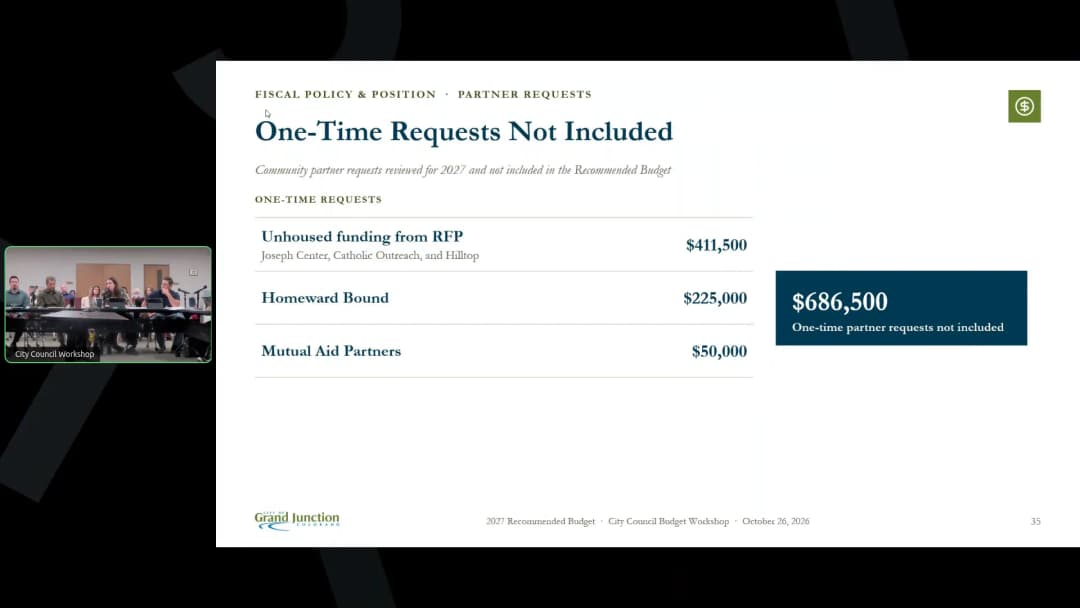
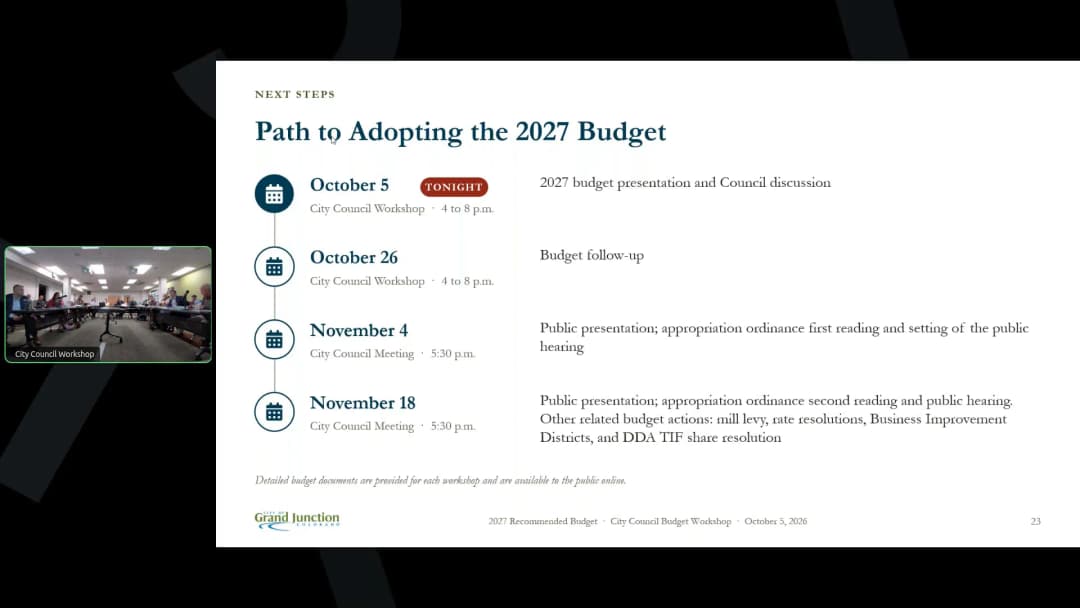
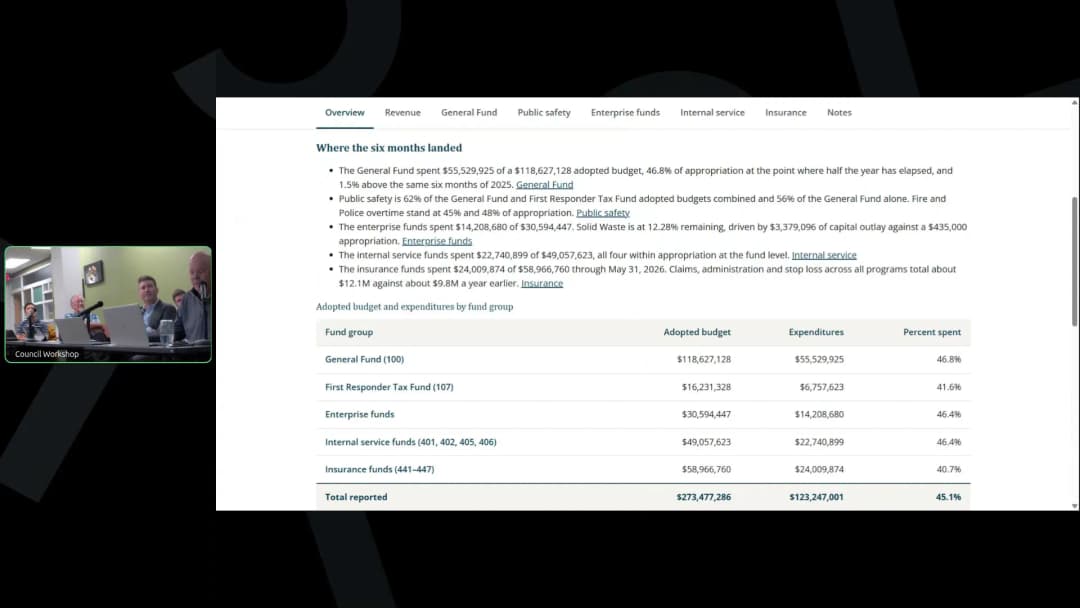
The City Council held a workshop on October 26, 2026, to continue detailed review of the proposed 2027 budget, focusing on enterprise funds, internal service funds, capital projects, one-time funding requests, and future steps. Staff from multiple departments presented, and council discussed financial strategies, rate increases, and funding for community partners. Key decisions included support for continuing homeless service RFP funding, approval of funding for Mutual Aid Partners, and direction to postpone a decision on Homeward Bound pending revised request. Council also discussed the need for public engagement on ALPR/flock cameras and approved appointments to the Visit Grand Junction and Planning Commission boards. Discussion Items - Budget Overview and Structural Deficit: City Manager Mike presented the process, noting the starting structural deficit of $6 million if operations continued unchanged, which grew to $21 million with requests, then narrowed to $9.8 million through prioritization. The proposed budget fills the gap via vacancy adjustments, operational cuts, insurance changes, and use of fund balance. Fund balance is projected at $42.8 million, $13 million above the minimum reserve of $29.8 million. - Internal Service Funds: CFO Jay Ballantine reviewed the IT fund ($13.77M expenses, 56% from general fund), equipment fund (fleet; average age 14 years; $4.87M for replacement), facilities fund ($1.43M for preventive maintenance), and communication center fund (city pays 57%; new positions funded by E911 surcharge for first time). Council discussed fleet sharing and facility deferred maintenance. - Enterprise Funds: - Water Fund: Revenue $20.5M, expenses $16.4M, capital $8.2M. Key projects include Riggs irrigation pump replacement and dam raise design. Water rate increase of 12.8% adds $9.07/month to typical household bill (water, sewer, trash). Drought response reduced water revenue by 9% in 2026. Council discussed availability charge structure and tap fees vs. affordability. - Solid Waste/Recycling: New recycling program reduces 48-gallon rate by $2/month due to producer responsibility act reimbursement. Yard waste optional service at $16/month (April-October). - Golf Fund: Lincoln Park and Tiara Rado both profitable; Lincoln Park rates increase from $12 to $18 (50%) but remain below regional market. Council debated rate increase; staff noted it covers actual costs without subsidy. - Parking Fund: Non-subsidized; only boot warrant fee increase for 2027. Fund balance projected at $147,000. - Capital Projects: $93.5 million capital program for 2027, with joint sewer 50%, $19.9 million from 3/4-cent sales tax. Highlights include: North Avenue Enhanced Transit Corridor ($1.25M from Mesa County for sidewalks), B & ½ Road river trail gap, 29 Road interim improvements ($5M city/$5M county), Police Annex design (est. $33M facility, but only design phase funded). Police Chief explained space needs for evidence and vehicle storage. - One-Time Funding Requests: - RFP for homeless services: $411,500 for Joseph Center, Catholic Outreach, and Hilltop (continuation of second year of three-year commitment). Council reached consensus to fund. - Homeward Bound: Request pending revised figure; council agreed to wait for written request before deciding. - Mutual Aid Partners: Requested $50,000 for staff salary and operations. Council approved 4-3 after discussion, noting it supports services previously provided by city staff. - Commission on Arts and Culture: $30,000 one-time addition in 2026 not included in 2027; council decided not to fund due to budget constraints. - Revenue Discussion: Sales tax audit conducted by external vendor; focus on use tax compliance. No dedicated sales tax auditor. Public Comments & Testimony - No formal public comment period; however, Stephanie from Mutual Aid Partners was invited to speak during council discussion, clarifying the organization's role and request. Key Outcomes - Consensus to continue RFP funding: $411,500 for homeless service providers for 2027, subject to annual appropriation. - Approved Mutual Aid Partners request: $50,000 for 2027, tied to one-time fund balance (4-3 vote). - Deferred Homeward Bound: Council requested a revised written request with updated dollar amount before further discussion. - No additional funding for Commission on Arts and Culture: Council adhered to staff recommendation to not provide the $30,000 one-time supplement from 2026. - Direction on FLOCK/ALPR cameras: Council directed staff to organize a public forum/education session (not a formal workshop) to present policy, share data, and listen to community concerns, with council available for public comment at regular meetings. - Appointments: - Visit Grand Junction Board: Reappointed Minosa; appointed Dustin (new). - Planning Commission: Reappointed Sandra Weckerly; first alternate Kelsey Ellsworth Heath; additional alternates Kevin Cole and Karen Trouster. - Future Workshop Schedule: November 2 workshop canceled; items (norms of conduct, workshop guidelines, boards/commissions bylaws) moved to November 16. November 30 workshop on Dos Rios; December 14 workshop on Salt Flats update with Brickwell. - Budget Adoption Schedule: First reading November 4; final adoption November 18.
Public Meetings - Grand Junction, Colorado
Public Meetings - Grand Junction, ColoradoThe Grand Junction City Council held its regular meeting at 5:30 p.m. on Wednesday, October 21, 2026, in the City Hall Auditorium at 250 North 5th Street. The mayor presided; Councilmember Stout attended virtually and Councilmember Ballard was absent. The six voting members present approved each item requiring a vote by 6-0, including a supplemental budget appropriation, a data center moratorium, a property rezone, and a wastewater treatment plant engineering contract amendment. City Manager Report - City Manager Mike Bennett, moved ahead of proclamations and public comment, announced that his recommended budget for the November council hearings will continue to provide the current facility rent-free to the nonprofit that operates the Senior Recreation Center. He said the earlier proposal was too abrupt, apologized for the communication, and credited civil, constructive feedback rather than personal attacks for changing the decision. - Bennett described a structural deficit that began in 2021 and required hundreds of decisions across a budget of more than $300 million. He added that Community Recreation Center programs, while adding services and more than 2,300 senior sign-ups, do not replicate what the senior center offers. Proclamation - Councilmember Kennedy read a proclamation recognizing October 10, 2026, as the 100th anniversary of Lincoln Park Golf Course. The course opened October 10, 1926, is the oldest golf course in Grand Junction and one of the oldest on Colorado's Western Slope, and has hosted the Rocky Mountain Open since 1939. A course representative accepted the proclamation and invited the community to a Saturday centennial celebration. Boards and Commission Liaison Reports - Council liaisons reported on the Business Incubator's 40th anniversary and the fact that more than 30% of local businesses have worked with it; the Grand Junction Economic Partnership's unanimous endorsement of D51 ballot measure A; the airport authority's 28,000-plus air show attendees, $30 million in runway improvement approvals, 44 consecutive months of passenger growth, and roughly $50 million terminal expansion planning; and a Colorado water roundtable discussion about conservation and $20 million in statewide water project grants. - Other reports covered the homeless coalition's REACH program, which has already registered more than 500 students this year versus roughly 300 at this time in past years; urban trails walk audit results; Colorado Municipal League priority topics including ALPR technology and data centers; and Downtown Development Authority work on phase zero of the Terminal project, which includes 112 units of affordable housing. Consent Calendar - The council adopted the consent agenda, items 1-5, by a single 6-0 motion: approval of the October 5 workshop summary and October 7 regular meeting minutes; setting a November 4 public hearing for a Terminal Project bank loan ordinance; setting a December 2 public hearing for Redlands 360 Annexations No. 2, 3, 4, and 5; a North Avenue Enhanced Transportation Corridor MOU with Mesa County; the Ridges Irrigation Pump Motor Control Center Replacement procurement; a resolution authorizing a DOLA HB-1152 ADU grant application; and a resolution transferring a 0.14-acre city parcel to Mesa County for a Grand Valley Transit transportation hub. Public Comments & Testimony - The majority of public comment concerned the Senior Recreation Center. Speakers expressed relief and gratitude for reversing the closure recommendation, but several asked for a permanent commitment rather than a one-year reprieve. Speakers said the center is a social and psychosocial lifeline, especially for isolated seniors, and described the Community Recreation Center as not a substitute; some noted many seniors cannot afford the $30 per month rec center fee, and one speaker said Silver Sneakers was not free because his Medicare plan cost $100 more per month. - Carol Rathbun questioned the decision's durability and listed prior city spending she said helped create the budget problem, including $1.03 million in riverfront debt service next year, an $866,000 general fund subsidy, $1.7 million in zip line/Bonsai building incentives, and $1.2 million in city funds for a child care center. - Donald Hunger blamed the former city manager and previous council for the structural deficit, naming Greg Keaton and council members Anna Stout, Abe Herman, Randall Rice, and Rick Taggart. He cited failed incentives, closed businesses, and spending on homeless programs and road pilots that were later reversed, and said the current council and city manager did not create the mess. - Other senior center commenters offered help raising $100,000 through a 501(c)(3), called for repairs to the center after bingo had been halted and the kitchen shut down, and compared Grand Junction unfavorably to Las Cruces, New Mexico, which funds six senior centers with no membership fees. One board member said she felt threatened with criminal charges over bingo and described the emotional toll on seniors. - On surveillance, Carl Doji asked the council to schedule an open agenda discussion of Flock cameras and related systems, citing over 250 cameras, roughly $140,000 paid in 2025 to Flock, Motorola, and Project NOLA, more than $100,000 in recurring subscriptions, and over 300,000 Flock searches per month in early 2026, about 90 percent from agencies outside Colorado. Additional speakers opposed the camera network, cited security vulnerabilities and facial recognition capture of children, and asked for public forums and data-sharing and retention rules. - Kristen Hartman requested changes to the VRBO/Airbnb approval process to treat neighbors as impacted stakeholders and consider neighborhood appropriateness, saying more than 500,000 square feet of housing had been converted to short-term rentals during a housing crisis. - Other comments addressed Orchard Mesa pool fees for county residents, including a retired nurse who said a recreation center membership would cost $492 a year, $276 more than she pays for the pool; street-sweeping boundaries; and requests to place the surveillance issue on a future council agenda. Discussion Items Supplemental Appropriation (Ordinance 5344) - Chief Financial Officer Jay Valentine requested $3.5 million in additional spending authority for the self-funded health insurance fund because 2026 claims were trending 20-25 percent above budget, offset by a $4 million reinvestment from participating funds; the General Fund share is about $2.9 million. Brown and Brown analysis showed about $5.8 million in savings since the city moved to self-insurance. The supplemental also covered grant-funded programs, police and fire equipment, water debt service, and a $1 million no-net-impact Visit Grand Junction reclassification. - Council discussion covered stop-loss coverage of $175,000 per claim in 2026, increasing to $225,000 in 2027; the fund being restored to only 50-75 percent of recommended reserves; and an average citywide employee premium increase of 34 percent. No public hearing comments were offered. The ordinance passed 6-0. Data Center Moratorium (Ordinance 5345) - Interim Community Development Director Thomas Lloyd presented the ordinance. The city code does not currently define data centers, so the moratorium would pause acceptance, processing, and approval of data center applications for up to 365 days or until Title 21 amendments are adopted. It applies to facilities with a projected, designed, or requested electrical load of 1 megawatt or more, excluding accessory server rooms, specified telecommunications facilities, and minor utility facilities. - Staff will study zoning, development standards, and impacts and coordinate with Mesa County and Fruita, which are taking related actions. Council discussion addressed model codes, changing technology, and whether off-grid power could circumvent the threshold; the definition applies regardless of power source. Public hearing speakers urged water-use caps, grid cost offsets, performance bonds, and bans on non-disclosure agreements; some opposed AI data centers entirely. A few asked for an indefinite extension. The ordinance passed 6-0. Rezone (Ordinance 5346) - Senior Planner Lily Sutton presented a request to rezone 2.88 acres at 2324 Highway 6 and 50 from I-1 (Industrial Light) to CG (Commercial General). The property has an existing auto sales use; the owner wants future redevelopment flexibility. The site is within the 24 Road corridor overlay and complies with the Comprehensive Plan's commercial designation and infill principles. No public testimony was given. The ordinance passed 6-0. Persigo Wastewater Treatment Plant Phase 2 Contract Amendment - Interim Utilities Director Ashley Frell requested authorization for a $950,000 contract amendment with AE2S to accelerate design and permitting of a new secondary clarifier, clarifier 3, and evaluate the long-term viability of clarifier 4 after recent failures. Clarifiers 1 and 2 date to 1984, clarifier 4 was added in 2000, and clarifier 3 has never been built. The plant normally operates two clarifiers with a third standby as a permit requirement. - Clarifier 4 is out of service due to mechanical and structural concerns; clarifier 1 suffered an influent pipe obstruction, a tire, that caused a reportable overflow and was repaired. The plant currently has no standby clarifier and has notified the Colorado Department of Public Health and Environment. Design completion is targeted as early as December and construction is estimated at about nine months. - Council discussion covered accelerated construction at risk, the procurement basis of itemized task hours and rates under a not-to-exceed amount, and capacity: the plant is currently permitted at 12.5 million gallons per day, averages about 8 million gallons per day, and the incoming 15-million-gallon-per-day permit will still require three clarifiers. The motion passed 6-0. Non-Scheduled Comments and Other Business - No non-scheduled public comments were made. - Under Other Business, Councilmember Kennedy praised the city manager's handling of the senior center decision, noted the city charter limits council involvement in operational matters, and credited city staff. The mayor raised a concern about a council member's communications regarding staff and said a further discussion is needed; other council members agreed. Key Outcomes - The city manager will include continued senior center space in the recommended November budget. - The consent agenda was adopted 6-0, including approved minutes, public hearing dates, an intergovernmental MOU, a procurement, a grant application resolution, and a property transfer resolution. - Ordinance 5344, supplemental appropriations to the 2026 budget, passed 6-0. - Ordinance 5345, the data center moratorium, passed 6-0; staff will study code amendments and return with proposed Title 21 changes. - Ordinance 5346, rezoning 2.88 acres at 2324 Highway 6 and 50, passed 6-0. - The $950,000 AE2S contract amendment for Persigo clarifier work was authorized 6-0. - Staff will coordinate with Mesa County and Fruita on regional data center regulations.
The Grand Junction City Council held its regular meeting on Wednesday, October 7, 2026, at 5:30 PM in the City Hall Auditorium, 250 North 5th Street, with virtual participation options. The Council proclaimed October 2026 as Arts and Humanities Month, ratified three appointments, heard public comments, approved the consent agenda, adopted the 2026-2027 Legislative Policy, and agreed to consider a future workshop on room-rental housing rules. Mayor Lutz and Councilmember Ballard participated remotely; Councilmember Belfast was absent. All votes passed 6-0. Proclamations - Councilmember Kennedy read a proclamation declaring October 2026 as Arts and Humanities Month in Grand Junction. Robbie Burrow, Chair of the Arts and Culture Commission, accepted the proclamation. The proclamation cited $13.2 million in government revenue and $28.4 million in economic activity generated by arts and culture in 2022, plus attendee spending beyond admission on meals, parking, and lodging. Appointments - Council ratified David Ranson, Ray Rickard, and Thomas Kronk to the Mesa County Building Code Board of Appeals for full terms expiring December 31, 2029. Motion by Councilmember Kennedy, second by Councilmember Wynne; passed 6-0. Public Comments & Testimony - Teresa Cameron, a resident of low-income housing, reported unsafe apartment conditions including cracking noises, vibrating floors, bending walls, and health concerns. She said she previously won a case against the housing authority for over $20,000 involving asbestos billing and asked for her money back and a safe place to live. - Jill Smith, a 67-year-old retired Grand Junction resident, opposed the proposed closure of the senior center, noting it has operated since the early 1970s and that she paid dues to support it. She said she only has Medicare, not a Medicare Advantage plan, so Silver Sneakers is not free for her, and suggested leasing county-owned Faith Heights Church space or moving the full facility including bingo. - Jesse Milt discussed his use of the Orchard Mesa Pool for rehabilitation and water exercise. He said three of four seniors in his water class were Mesa County residents who would not vote on the proposed city pool tax, and questioned how a sales tax would apply. - Diana Tapp offered a balanced perspective on the proposed data center moratorium. She supported a temporary study period if it led to clear, realistic requirements, and urged collaboration with Mesa County rather than a permanent barrier to data centers. - Janet Wyatt supported the data center moratorium and noted that County Commissioner Greg Moeb encouraged city-county collaboration. She asked for public forums or focus groups to address water use, oil and gas impacts, noise, air pollution, and e-waste. - Becky Clements, an Orchard Mesa resident and water aerobics attendee, said she cannot vote on the Orchard Mesa pool measure. She criticized the Rec Center website and registration system, including broken links and pool schedules that do not match registration options. - Rick Healthy thanked Council for the data center moratorium and requested that ALPR and Flock surveillance camera use be placed on a Wednesday night regular agenda for public conversation. - Cayman Haltoner echoed the request for public ALPR conversation and said future data center discussions should also include public input. - Eric Reckle compared ALPR and Flock cameras to the surveillance state in George Orwell's 1984 and urged caution. City Manager Report and Liaison Reports - City Manager Mike Bennett gave no report. - Councilmember Kennedy reported a sold-out air show over the weekend with traffic congestion on Horizon Drive, on-time airport operations, a Grand Junction Economic Partnership site selectors event, and ongoing financial challenges at the museum board. - Councilmember Stout reported on the Forestry Board and Parks and Recreation Advisory Board: the 2026 Licensed Contractor Day of Service at Sherwood Park donated over $15,000 in tree services; discussions covered notable tree tours, the urban wood network, a facility naming policy, and upcoming Columbine Park improvements. He also attended a Colorado Municipal League District 10 meeting in Delta and met with a Circular Action Alliance representative. - Mayor Lutz had no report. The meeting chair also reported that Congressman Jeff Hurd presented $692,075 to the Grand Junction Business Incubator, Exopower was awarded $1.4 million to commercialize wireless mobile charging, Timberline Ace Hardware donated over $75,000 in materials to the makerspace, and the incubator has impacted more than one-third of local businesses. Consent Calendar - Council approved consent agenda items 1 through 4 by a single 6-0 motion from Councilmember Stout, seconded by Councilmember Wynne, with no discussion. The consent agenda included: - Approval of the September 14, 2026 workshop summary and September 16, 2026 regular meeting minutes. - Setting public hearings for October 21, 2026 on the rezoning of 2.88 acres from I-1 to CG at 2324 Highway 6 and 50, a supplemental appropriation, and an ordinance enacting a temporary moratorium on data center applications; and a public hearing for December 16, 2026 on the 14.88-acre 2911 D 1/2 Road annexation. - Authorizing construction contracts for replacement of compressed natural gas compressors and for street maintenance mill and overlay. - Resolutions supporting a joint Forest Restoration and Wildfire Risk Mitigation Grant application with the Town of Palisade and authorizing reimbursement of joint sewer capital expenditures from future debt financing. Discussion Items - City staff member Johnny McFarland presented the proposed 2026-2027 Legislative Policy. He explained that it establishes roles for Council and staff in the legislative process and aligns with Colorado Municipal League priorities while allowing Council to take different positions when needed. Councilmember Stout noted that the policy does not prevent council members from engaging individually as long as they make clear they are not speaking for the city. Council adopted Resolution 91-26 by a 6-0 vote on a motion by Councilmember Stout, seconded by Councilmember Wynne. Other Business - Councilmember Kennedy requested a future workshop on the city code that restricts renting by the room, which he described as a boarding house issue. He said allowing room rentals could support permanent supportive housing and programs such as the Golden Girls program, potentially lowering housing costs to $500 per month or less. Council signaled comfort with scheduling the workshop after budget season. Key Outcomes - Ratified three Mesa County Building Code Board of Appeals appointments, 6-0. - Approved the consent agenda in one 6-0 vote. - Adopted Resolution 91-26, the City of Grand Junction 2026-2027 Legislative Policy, 6-0. - Scheduled a public hearing for October 21, 2026 on the temporary data center moratorium ordinance and other items. - Agreed to place a future workshop on rent-by-the-room rules on a council workshop agenda.
City Manager Mike and his team presented the 2027 Recommended Budget, focusing on addressing a structural deficit of $6 million by reducing expenses, reallocating costs, and using $4.6 million in fund balance. The budget totals $317.4 million (1% increase from 2026), with a general fund of $120.8 million. Key reductions include closing City Hall on Fridays, reducing hours at the community pool, shifting senior center activities to the new recreation center, eliminating the Ash Tree program and city calendar, and reducing the housing division with partner-led services. Council discussed the financial outlook, the need for a fire district, and plans for future capital projects. Public Comments & Testimony - An email from Mr. Timothy Green was received that morning; the mayor noted it would be part of the public record but not read aloud. Council members are to review it separately. Discussion Items - Structural Deficit Overview: Since 2021 revenues grew 30% but expenses grew 53%, creating a $6 million structural deficit (if no changes were made). The deficit is structural (not cyclical) due to rising salary/benefit costs and increased demand. - Budget Development Process: Directors and budget team reviewed thousands of line items. Reduction decisions were guided by four principles: protect core services and public safety, reduce spending before using one-time funds, no temporary fixes for permanent problems, and match ongoing services to ongoing revenue. - Budget Changes Since August 31 Workshop: - One-time requests: funded $1.1 million (comprehensive plan, fire equipment, OpenGov software). - Position and salary requests: funded $2.7 million for six police officers (including one 80% funded by CMU), three battalion chiefs, and police wage adjustments. - Fund balance use: $2.3 million from general fund and $2.3 million from the first responder fund (to bridge remaining public safety needs while pursuing a fire district). - Health insurance: using $4 million from fund balance to cover overages and proposing plan changes (out-of-pocket max, co-pays) to save $2-4 million annually. - Revenue forecast: upward adjustment of $375,000 since August. - Service Reductions: - City Hall closed on Fridays (low traffic, saves $500,000 in personnel) - Park pool hours reduced by 1.5 hours Mon–Thurs - Senior center operations shifted to the new Community Recreation Center - Ash Tree program eliminated (seeking grants) - City calendar (annual $60,000) discontinued - Housing division: housing manager and housing specialist positions eliminated (partners like Hilltop and Grand Junction Housing Authority to take over programs) - Efficiencies: IT developed in-house tools (budget dashboard, revenue dashboard, report-a-concern, e-ticketing) saving outside subscription costs. - Enterprise Funds: Rate increases for water/sewer (12% annual as per prior study) will be discussed at the next workshop. - Capital Projects: 2027 capital plan totals $20.7 million, focusing on streets (chip seal, river trail, North Avenue corridor), Riverside Parkway, police annex design, and finishing bond-funded projects (B½ Road, 26½ Road). - Affordable Housing Impact Fees: Recommendation to no longer backfill water/sewer impact fees from the general fund; instead waive them for eligible affordable housing projects (per state statute). Council expressed general support for this approach. - Downtown Development Authority (DDA): Reduction of $500,000 in annual appropriation (still receives TIF, but debt-service contribution cut). - Visit Grand Junction: Reduction of $864,000 from prior general fund subsidy (vendor fee elimination); all lodging tax dedicated to marketing remains intact. Councilmember concerns about impact on tourism; city manager noted focus on adding hotel rooms. Key Outcomes - No formal votes were taken; the workshop was for discussion and preparation. - Council directed staff to bring back more detail on enterprise fund rates and capital projects at the next workshop (October 26, 4–8 p.m.). - Staff will bring an ordinance to update the affordable housing incentive policy (including water/sewer impact fee waiver) through the regular council process. - The budget adoption timeline: November 5 (first reading/public presentation), November 18 (public hearing and adoption). - Council will continue budget discussions on October 26, followed by workshops on norms of conduct (November 2) and boards/commissions bylaws (November 16).
The Grand Junction City Council met in regular session on Wednesday, September 16, 2026 at 5:30 p.m. in the City Hall Auditorium, 250 North 5th Street. Councilmembers present were Robert Ballard (virtual), Scott Beilfuss, Cody Kennedy, Jason Nguyen, Ben Van Dyke, and Council President Laurel Lutz; Councilmember Anna Stout was absent. The meeting included presentations, a proclamation, public comment, a consent agenda, and public hearings on zoning, appropriations, housing policy, and the Juniper Grove affordable housing project. The meeting adjourned at 8:39 p.m. Presentations and Proclamations - Candace Carnahan, Grand Junction Area Chamber of Commerce president and CEO, presented the BestSlope NEXTGen 2026 award to Council President Lutz and highlighted the Young Entrepreneur Academy, noting more than 110 new businesses and over $75,000 in startup capital invested since 2013. Roan Baldwin, the 2026 Saunders Scholar and 12-year-old founder of Munch Mode Machines, spoke about his experience in the program. - Colorado Department of Transportation representatives Hannah McCutcheon and Mark Bunnell presented an update on the US 6 Access Control Plan and a proposed amendment to accommodate a future CDOT project from west of Pine Street in Fruita to 22 Road in Grand Junction. No action was taken; CDOT said the plan would go to public meetings and one-on-one property owner reviews before returning to local governments. - Councilmember Kennedy read a proclamation designating September 17-23, 2026 as Constitution Week in Grand Junction. Annette Raley, Vice Regent of the Mount Garfield Chapter, Daughters of the American Revolution, accepted the proclamation. City Manager and Liaison Reports - City Manager Mike Bennett announced the Community Recreation Center grand opening on September 25, 2026, and noted budget workshops on October 5 and 26, 2026 at 4:00 p.m., following discussion of a multi-year structural deficit. - Councilmember Beilfuss reported on Hispanic Heritage Month, an Avalon Theater ribbon cutting, a low-vision group tour of the Recreation Center, and City Council outreach at the Farmer's Market. - Councilmember Kennedy reported on Oktoberfest at Cross Orchards, a CMU water seminar, Grand Junction Economic Partnership projects, and airport growth including 44 consecutive months of passenger growth. - Councilmember Van Dyke reported on the downtown car show and Recreation Center soft opening. - Councilmember Nguyen reported on the Urban Trails walk audit, Horizon Drive Business Improvement District budget, and air show parking changes. Consent Calendar - Council approved the Consent Agenda (items 1-3) by a 6-0 voice vote: approval of the August 31 workshop summary and September 2 regular meeting minutes; a contract with Nalco Water for cationic polymer; a resolution of intent for partial police pension affiliation; a resolution authorizing purchase of 354 Bonny Street for a new sewer lift station; and a resolution supporting Moffat Tunnel passenger rail slots with Grand Junction as the western terminus. Public Comments & Testimony - General public comment: Dennis Simpson alleged that a canceled workshop replaced by a meeting elsewhere violated the spirit of open meeting law. Brenton Carlson, a traumatic brain injury and stroke survivor and former unhoused resident, asked Council to support suicide prevention and disability advocacy. Tim Dolby (per the minutes) raised safety concerns about a missing left-turn arrow at North Avenue and 28 1/2 Road. Jim Hargas commented on road changes and said he would speak later on the Housing Action Plan. - During the Galley Lane rezone hearing, nearby resident Susan Woodberry expressed concern about traffic, blind spots, speed, and lighting but acknowledged the proposal appeared to meet rezoning criteria. - During the Housing Action Plan hearing, Jim Hargas asked whether state housing benefits could incentivize property owners to give up rights. Mike Morea, a realtor and property manager, commended the plan and said more supply was helping stabilize rents. - During the Salt Flats affordable housing hearing, Keith Pierce, a young prospective homebuyer, asked Council to take a leap of faith and approve the project. Emily Powell of Housing Resources of Western Colorado clarified that her organization had no down-payment assistance agreement with the project and currently had no funds available. Jim Hargas argued that the free market and good jobs, not subsidies, should determine housing affordability. Diane Schwenke, representing the HBA Governmental Affairs Committee, said the HBA had no position but raised questions about whether the price point would compete with private builders who receive no subsidies. Discussion Items - Rezone (Ordinance 5341): Senior Planner Kate Kirk presented the request to rezone 13.04 acres at 2590 Galley Lane and 675 26 Road from R-1R to RL-4. The Planning Commission had recommended approval 6-0. Council adopted the ordinance after the public hearing. - Inland Avenue right-of-way vacation (Ordinance 5342): Senior Planner Lily Sutton presented the vacation of about 2,236 square feet of unneeded cul-de-sac right-of-way. She noted an incorrect exhibit in the packet and said the correct sketch was included separately. Council adopted the ordinance with staff corrections. - Downtown Development Authority supplemental appropriation (Ordinance 5343): CFO Jay Valentine and DDA Director Brandon Stam requested a $1,153,000 supplemental appropriation, including a $500,000 inter-fund transfer and $153,000 in new DOLA Strong Communities grant funds. The funds support Phase Zero of the Terminal Project, including a shift from geo-piers to screw piles with vibration monitoring to protect nearby buildings. Council adopted the ordinance. - Housing Action Plan (Resolution 70-26): Housing Programs Specialist Paul Stahlke and Mollie Fitzpatrick of Root Policy Research presented the plan, which addresses supply, affordability, stability, and preservation over six years. Councilmember Kennedy noted the plan is aspirational and does not affect private property rights. Council adopted the resolution. - Salt Flats purchase and sale agreement (Ordinance 5337): Interim City Attorney Jeremiah Boies presented the agreement to convey 3.3 acres at zero cost to Grand Junction Homes, LLC for Juniper Grove, 48 deed-restricted for-sale units serving households at or below 100% AMI. David Ware, president and CEO of Rural Homes, answered questions about pricing, CHAFA's Drive-it-Home 3.5% fixed-rate mortgage, a 40-year deed restriction, and an interested-party list of about 400 people. Councilmember Kennedy asked for a full capital stack and per-unit price breakdown; Councilmember Beilfuss said affordable housing is the community's top economic issue and favored moving forward; Councilmember Ballard emphasized stewardship of taxpayer funds. Council adopted the ordinance. - Development and Funding Agreement (Resolution 38-26): Boies presented the agreement for the same 48-unit project. City funding includes $156,330 for public improvements and $593,340 for water connection and sewer plant investment fees, for a total of $749,670, with performance requirements including building permit applications and recorded deed restrictions by December 31, 2026. Council adopted the resolution. - Deed restriction administration MOU (Resolution 86-26): Boies presented the MOU designating the Grand Junction Housing Authority as administrator of Juniper Grove deed restrictions. Administration would be funded by a 1% seller fee on resales and a $100,000 set-aside from Salt Flats budget savings, subject to annual appropriation. The Housing Authority board had approved the MOU 5-0 on September 8, 2026. Council adopted the resolution. Key Outcomes - Ordinance 5341 adopted 6-0: rezone 13.04 acres from R-1R to RL-4. - Ordinance 5342 adopted 6-0: vacate portions of Inland Avenue right-of-way, with staff corrections to the exhibit. - Ordinance 5343 adopted 6-0: supplemental appropriation of $1,153,000 for the Downtown Development Authority. - Resolution 70-26 adopted 6-0: Housing Action Plan. - Ordinance 5337 adopted 6-0: authorize City Manager to sign a purchase and sale agreement with Grand Junction Homes, LLC for 3.3 acres at the Salt Flats. - Resolution 38-26 adopted 6-0: development and funding agreement for 48 for-sale units at 450 28 Road. - Resolution 86-26 adopted 6-0: MOU with Grand Junction Housing Authority for deed restriction administration. - No non-scheduled comments were received; the meeting adjourned at 8:39 p.m.
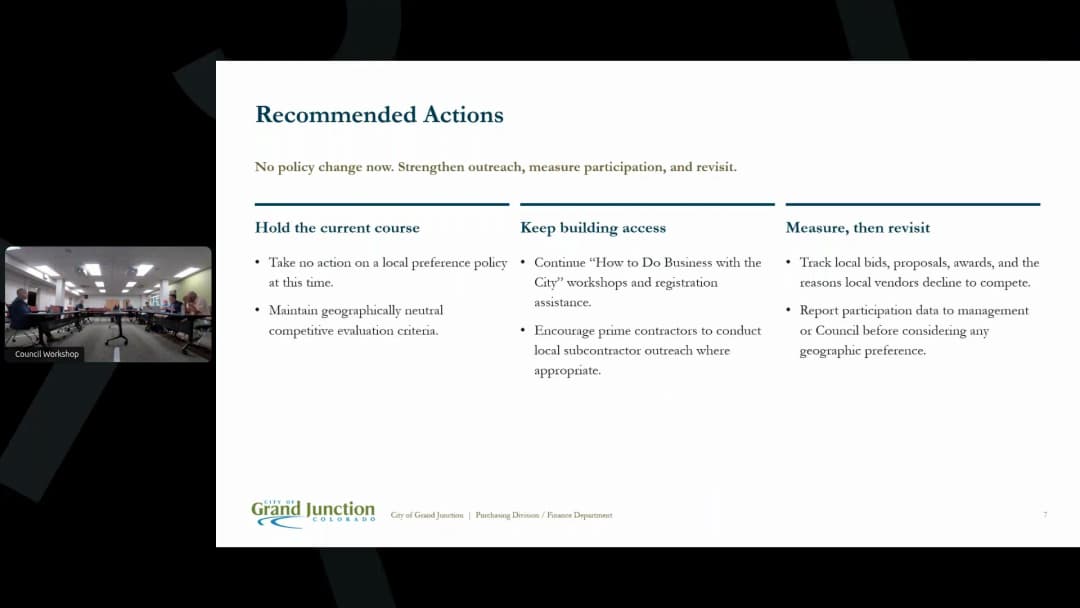
September 14, 2026 | 5:30 p.m. – 6:56 p.m. The Grand Junction City Council held a workshop on September 14, 2026, at the Fire Department Training Room. The meeting focused on three major discussion topics: a new Water Supply Element required by state law, a proposed temporary moratorium on data centers, and a potential local preference policy for city procurements. Council also discussed upcoming budget workshops, a resolution supporting Mountain Rail passenger service, and a request to join the Mayor's Alliance to End Childhood Hunger. No formal votes were taken; the workshop served as a forum for information and direction setting. Water Supply Element – Comprehensive Plan Amendment - Staff presented the Water Supply Element required by Colorado Senate Bill 24-174, which must be adopted by the Planning Commission by December 31, 2026. - The element draws from existing regional water-efficiency and drought-response plans and aligns with the Colorado Water Plan. - Staff reported that current water supplies meet current and projected future needs, and conservation efforts have extended the supply-demand nexus from 2039 to approximately 2049 without significant infrastructure investments. - Council discussed the effects of population growth, demographic shifts, and increasing aridity. Councilmember Scott Beilfuss noted that the outlook improvement is partly due to declining water use per tap and the trend toward an older population. - Staff will consult with local water providers and irrigation districts, incorporate feedback, and then forward the amendment to the Planning Commission. Temporary Moratorium on Data Centers - Staff proposed a temporary moratorium of up to 365 days on large data centers while the City develops appropriate land-use regulations. The current code does not specifically address data centers, creating uncertainty for evaluation. - No applications are pending, but the City has received inquiries. - Council emphasized the need to coordinate with Mesa County, neighboring jurisdictions, and water and energy providers, as a data center outside city limits could still have regional infrastructure impacts. - Council also suggested expanding the review to include other high-water or high-energy industrial uses, such as water bottling or chip manufacturing. - Staff will refine the draft moratorium ordinance and use the moratorium period to evaluate best practices and potential development standards. The moratorium would expire upon council adoption of code amendments or after 365 days, whichever comes first. Local Preference for Procurements - Staff reviewed options for giving local businesses an advantage in city procurement, citing examples from Longmont, Thornton, and Garfield County. Concerns raised included higher costs, reduced competition, administrative complexity, and conflicts with federal grant requirements. - Councilmembers expressed differing perspectives. Councilmember Cody Kennedy noted frustration with local firms losing contracts to out-of-state companies and cited examples of other Western Slope communities with local preference policies. Councilmembers Ben Van Dyke and Jason Nguyen expressed concerns about reduced competition and potential negative impacts on bid quality and taxpayer value. - Councilmember Nguyen suggested exploring a Colorado-based preference rather than strictly local, but the interim city attorney noted potential interstate commerce and constitutional issues. - Council agreed to begin tracking local versus non-local participation and contract awards, bid-price differences, and reasons local businesses may not bid. Staff will also continue outreach and education on how local businesses can compete for city contracts. Council Communication - Councilmember Scott Beilfuss shared information from the Colorado Basin Roundtable regarding statewide water conservation efforts. - Staff clarified that regular meetings among local domestic water-provider managers address operational issues, regulations, supply, and short-term planning. - Council revisited drought-related water rates; staff indicated proposed 2027 rates will address rate structure and potential drought-rate adjustments. - Council discussed supporting additional Mountain Rail passenger service to Grand Junction. A resolution demonstrating support, without committing funding, will be placed on the September 16, 2026, regular council agenda for consideration. Next Workshop Topics - City Manager Mike Bennett confirmed that the next three workshops will focus heavily on the city budget. October workshops will be held on October 5 and October 26 at 4:00 p.m. (instead of the usual first and third Monday). - Staff is preparing a comprehensive review of boards and commissions, including voting structures, bylaws, ordinances, charter provisions, and roles of council and staff liaisons. - Council's norms of conduct will return for discussion following the budget process. Other Business – Mayor's Alliance to End Childhood Hunger - Council reviewed an invitation for Mayor Laurel Lutz to join the Mayor's Alliance to End Childhood Hunger, which involves a pledge to work toward ending childhood hunger. Several councilmembers expressed caution about signing on without understanding specific commitments, noting that Mesa County and School District 51 already lead such efforts locally. - Mayor Lutz decided to hold off on signing and conduct further research before bringing the matter back to council. Key Outcomes - Water Supply Element: Staff will consult with water providers and then submit the amendment to the Planning Commission for adoption by December 31, 2026. - Data Center Moratorium: Staff will refine the draft moratorium ordinance and present it for first and second readings at a future council meeting. - Local Preference: Staff will begin quarterly tracking of local versus non-local procurement data and continue outreach. No policy change was adopted. - Mountain Rail: A resolution of support will be placed on the September 16, 2026, regular council agenda. - Budget Workshops: October 5 and 26 at 4:00 p.m. are confirmed. - Childhood Hunger Alliance: Mayor will research further before deciding to sign.
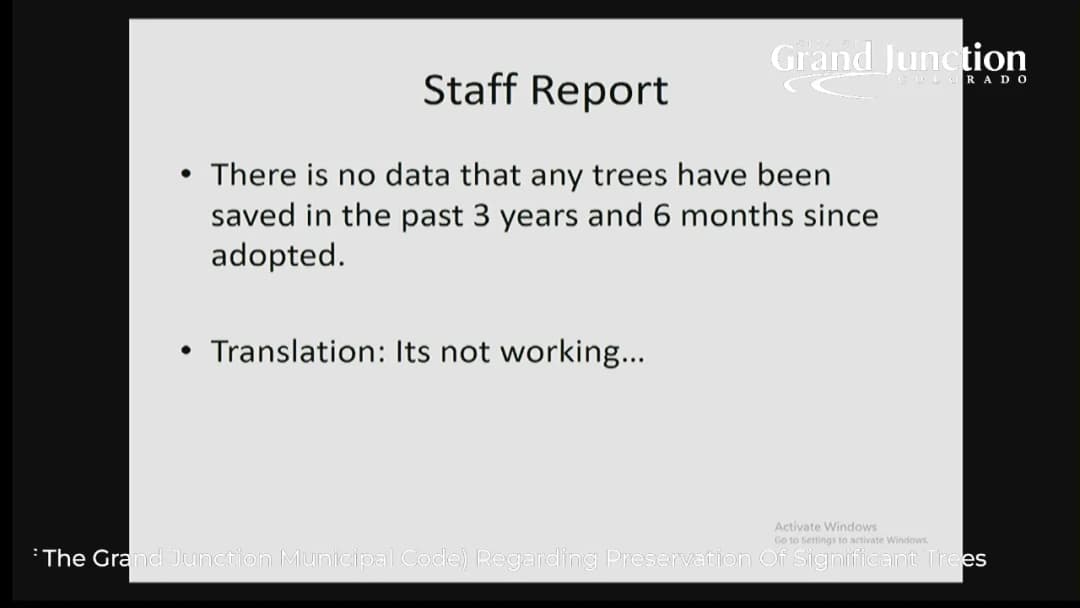
The Grand Junction City Council met on September 2, 2026, at 5:30 p.m. The meeting included a presentation on the 2026 Community Satisfaction Survey, a proclamation for Grand Junction PRIDE Week, appointments to the Housing Authority, public comments, consent agenda approvals, and a lengthy public hearing on an ordinance to amend the Zoning and Development Code regarding preservation of significant trees. The council voted 4-3 to adopt Ordinance No. 5340, which removes the significant tree preservation requirements, and directed staff to develop an incentive-based program. Presentations - 2026 Community Satisfaction Survey Results: RRC Associates presented the survey, which was mailed to 5,400 households and received an 16% response rate (over 880 responses). Key findings: - 53% of residents said Grand Junction is going in the right direction (down from 60% in 2022); 29% said wrong direction (up from 22%). - Top priorities: sustainably managing resources (84%), public safety, homelessness. - Satisfaction with city services overall rated 3.6 out of 5. - Top parks and rec priorities: expand trails, improve river access, address Orchard Mesa Pool. - Regarding Orchard Mesa Pool: 38% favor increasing taxes/debt, 43% oppose, 66% favor putting a ballot question. Proclamations - Proclaimed September 4–6, 2026, as Grand Junction PRIDE Week. The proclamation was accepted by Colorado West Pride representatives. Appointments - Appointed Randall Reitz to the Grand Junction Housing Authority for a full term expiring October 31, 2031. Motion passed unanimously (6-0). Public Comments & Testimony - Dave Lord: Requested that a cleanup area at Matchett Park (50+ acres east of Indian Wash) be named "Hershey's Loop" after his dog, citing extensive volunteer cleanup over three years. - Ed Kowalski: Spoke about optimism and the American dream. - Vicky Vaughn: Expressed opposition to the planned closure and relocation of Cross Orchards, stating the historical buildings must be preserved and that the community was under-informed. - Public Hearing on Significant Trees: Testimony from 12 speakers: - Ray Pilcher, Jim Marshall (chair of Cleantech Business Coalition), Mollie Frelischer (chair of Grand Junction Forestry Board), Tom Ziola (former city forester), Tom McCloskey, Kammie Long (Forestry Board member), Michael Kotee, Caymon Haltiner, and Jane Quimby (developer) urged the council to retain or improve the ordinance, citing tree benefits, community support, and the need for a collaborative process. - Keith Ehlers, Hogan Pederson, Diane Schwenke urged repeal, arguing the ordinance is ineffective, creates perverse incentives (clearing lots before applying), and is an unfunded mandate. Consent Calendar - Approved Items 1–4 (minutes, setting public hearings, procurement of two recycling trucks, resolutions) with the exception of Item 4a, removed for discussion. Motion carried unanimously. - Item 4a: Resolution supporting a Bureau of Reclamation grant for the Juniata Enlarged Ditch Piping Project. Approved unanimously. Discussion Items - Public Hearing – Ordinance to Remove Significant Tree Preservation (Ordinance No. 5340): - Zoning Supervisor Tim Lehrbach presented staff analysis, finding the proposed removal inconsistent with the Comprehensive Plan and code standards, and recommended denial. Planning Commission had recommended approval (5-2) adopting the Housing Affordability Code Task Force recommendation. - Housing Affordability Code Task Force Co-chair Kevin Bray presented in favor of repeal, arguing the ordinance is ineffective (only one tree preserved in three years), creates perverse incentives (lot clearing), unfairly burdens property owners, and does not address housing affordability. He urged repeal with a future non-punitive incentive program. - Council debate included: - Councilmember Stout and Beilfuss expressed concerns about removing the code without a replacement, citing tree canopy benefits and lack of community engagement. Stout advocated for a workshop with the Forestry Board and other stakeholders. - Councilmembers Kennedy, Ballard, Lutz, and Van Dyke supported repeal, arguing the current code fails to save trees, incentivizes clearing, and is a property rights issue. Kennedy raised Fifth Amendment takings concerns. Lutz emphasized stopping the "bleeding" now and developing an incentive program. - Councilmember Nguyen noted the difficulty of choosing between competing values (trees vs. housing) and questioned whether repeal alone would reduce costs. - Council took a break from 7:54 p.m. to 8:09 p.m. - Public hearing closed at 8:39 p.m. Key Outcomes - Vote on Ordinance No. 5340: Passed 4-3 (Ballard, Kennedy, Lutz, Van Dyke in favor; Beilfuss, Nguyen, Stout opposed). The ordinance removes Sections §21.07.040 and §21.09.060(a)(1) of the Zoning and Development Code regarding preservation of significant trees, and orders publication in pamphlet form. - Directive to Staff: Council gave direction to staff to move forward with drafting an incentive program for significant trees, and to explore incorporating this into the current consultant contract for code simplification (expected completion by first quarter of 2027). Council also requested a review of definitions for council liaisons to clarify their roles on boards and commissions.
The Grand Junction City Council held a workshop on Monday, August 31, 2026, from 5:30 p.m. to 7:50 p.m. at the Fire Department Training Room, 625 Ute Avenue, with virtual participation via GoToWebinar. Mayor Laurel Lutz was absent; Mayor Pro Tem Ben Van Dyke presided. Councilmembers Robert Ballard (virtual), Scott Beilfuss, Cody Kennedy, Jason Nguyen, Anna Stout, and Van Dyke were present. Staff included City Manager Mike Bennett, Interim City Attorney Jeremiah Boies, Deputy City Manager Kimberly Bullen, CFO Jay Valentine, Housing Specialist Paul Stahlke, Deputy City Clerk Misty Williams, and City Clerk Selestina Sandoval. The meeting covered the revised Housing Action Plan, the 2027 budget process and structural deficit, new financial reporting and policies, council communications, upcoming workshop topics, proclamation requests, and a Housing Authority appointment recommendation. Housing Action Plan Revised Draft - Root Policy consultant Molly Fitzpatrick (listed as Mollie Fitzgerald in the minutes) reviewed revisions to the Housing Action Plan, reflecting prior council discussion and stakeholder feedback. - The proposed formal Housing Advisory Board was removed in favor of targeted stakeholder engagement. - The strategy to explore additional housing revenue and financing options was moved from years one–two to years four–six of the six-year plan. Staff clarified that “explore” does not commit council to a tax, fee, or dedicated funding source; any future proposal would require separate council direction. - Feedback from the Grand Junction Housing Authority was incorporated, emphasizing stakeholder partnerships and engagement in implementation. - A new annual prioritization framework was added to help council evaluate housing initiatives based on funding availability, grants, staff capacity, and current priorities. It is intended as guidance and does not obligate future councils. - The previous Housing Needs Assessment summary was moved to the appendices as requested. - Councilmember Kennedy sought clarification that the plan would not bind future councils or mandate funding, and suggested strengthening language around evaluating regulatory costs. Councilmember Beilfuss raised the need for emergency and transitional housing; the consultant explained that the plan defers to the regional unhoused strategy under Strategy 5. - Council expressed general support for moving the revised plan forward. Next steps include DOLA preliminary review, continued public comment, and a return to council for a public hearing and formal adoption consideration. Budget Process & Focus Overview - Staff presented the 2027 budget process and the City’s developing structural financial challenges. Departments have completed operational presentations, budget submissions, and line-item reviews. - The current 2027 General Fund structural gap is $6 million before considering approximately $7 million in one-time requests and $7.9 million in requested new personnel costs, including about $5.5 million for public safety. - The deficit is structural, not cyclical: recurring expenditures are increasingly outpacing recurring revenues. The recurring operating margin has declined each year since 2021. - Major budget pressures include rising compensation and benefits, public safety staffing and service demands, growth and annexation, aging fleet (average age 14.2 years vs. 7.5–8 year target) and infrastructure, rising technology costs, unfunded state mandates, Dos Rios debt obligations, and rural fire/EMS service costs. - The First Responder Fund will require General Fund support beginning in 2027 because dedicated revenues no longer cover expanded public-safety costs. - Employee health insurance: the City’s transition to a self-funded model saved an estimated $5.8 million versus remaining fully insured, but the fund was initially seeded below recommended levels and claims have exceeded projections. Staff discussed using a portion of General Fund reserves for a one-time correction, not as recurring funding. - Staff stated they plan to give the Rural Fire District the required two-year notice to renegotiate the agreement, which does not mean discontinuing service but seeking a more financially sustainable arrangement. - Councilmember Stout urged pursuing a study of forming a fire district and also examining a potential public safety tax increase, noting the 2019 ballot measure asked for less than needed. Councilmember Nguyen requested a breakdown of the $6 million gap and a five-year projection. Councilmember Beilfuss asked for more workforce retirement data; staff noted some departments face significant retirements. Councilmember Kennedy cautioned against over-requesting operational detail, and staff acknowledged all options remain under review. - Staff will return in October with specific recommendations for balancing the 2027 budget and addressing longer-term structural issues. Financial Policies & Reporting Overview - Staff presented a new quarterly financial reporting dashboard, designed as a more accessible, high-level view of the City’s financial position. It was scheduled to go live the next day and will be updated quarterly, similar to other City dashboards. - Financial policies have been consolidated into a single document reviewed during the annual audit. A new debt policy was added in response to previous council discussions. - The debt policy establishes a framework rather than rigid limits: debt is generally for long-term capital projects, not for ongoing structural deficits. Staff would evaluate alternatives, financial impacts, debt type, existing obligations, repayment schedules, and budget capacity. - Current debt burden is approximately 7.96% of revenues, or 8.59% when including the Dos Rios obligation the City is paying. Guidance cited during the presentation: below 10% is conservative; 10–15% warrants closer scrutiny; higher levels reduce flexibility. - Council emphasized preserving financing flexibility, including Certificates of Participation. Staff confirmed the policy is deliberately high-level, but future debt recommendations will show the total debt impact. - Councilmember Kennedy praised the transparency and suggested adding projected-vs-actual trend lines to the dashboard; staff said they could incorporate that feedback. Council Communication - Councilmember Stout announced she would be out for the September 16, 2026 regular meeting due to work obligations. - Councilmember Kennedy reported his appointment by Mesa County Commissioners as the Colorado Basin Roundtable Municipal Representative, and shared highlights from a riverfront ride-along with police. - Councilmember Beilfuss requested more information on Flock Cameras. - Councilmember Van Dyke updated council on the Downtown Development Authority Terminal Project: vibration concerns from vibratory rollers led to a switch to helical piers, adding approximately $500,000 to the project, likely requiring a supplemental appropriation. He also noted the Business Incubator may receive land from the RTC for leverage after the Department of Energy moves out. Next Workshop Topics - September 14: Water Supply Element of the Comprehensive Plan, Local Preference for Procurements, and Data Centers discussion. - Council agreed to move the October 19 workshop to October 26 to allow more time for budget balancing and presentations. October 5 and October 26 workshops will start at 4:00 p.m. Other Business - Approved issuance of a social proclamation for International Overdose Awareness Day. - Approved issuance of a social proclamation for White Cane Day. - The interview team for the Grand Junction Housing Authority recommended appointing Randall, citing his social work background and the current board’s composition; the recommendation will proceed. Key Outcomes - Housing Action Plan moves forward pending DOLA review, continued public comment, and a future public hearing and formal adoption. - City staff will return in October with 2027 budget balancing recommendations and longer-term structural solutions. - Quarterly financial reporting dashboard was released on September 1, 2026, with planned enhancements based on feedback. - Council approved the October 19 workshop move to October 26 and the earlier start times for October 5 and 26. - Social proclamations approved for International Overdose Awareness Day and White Cane Day. - Grand Junction Housing Authority interview team recommended Randall for appointment. Note: The minutes spell the consultant’s name as “Mollie Fitzgerald,” while the transcript uses “Molly Fitzpatrick.”
The Grand Junction City Council met in regular session at 5:30 p.m. on Wednesday, August 19, 2026, in the Auditorium at 250 North 5th Street. Council President Laurel Lutz presided; members present were Robert Ballard (virtual), Scott Beilfuss, Cody Kennedy, Jason Nguyen, Anna Stout, and Ben Van Dyke. The agenda included a consent calendar, two public hearings on ordinances, an emergency procurement ratification, two Orchard Mesa Pool ballot resolutions, public comments, and other business. The meeting adjourned at 7:45 p.m. after unanimous votes on all action items. Consent Calendar - Approved minutes of the August 3, 2026 workshop, August 5, 2026 regular meeting, and August 14, 2026 special meeting. - Approved a revocable permit for an existing historic encroachment within 19.1 square feet of Colorado Avenue right-of-way at 251 Colorado Avenue. - Approved acceptance of FAA Airport Improvement Program grant offers No. 3-08-0027-091/092/093/094-2026, a resolution supporting future 2026 FAA AIP grants under grant language 92 and 93, and amendments to AIP grant 3-08-0027-089-2025. - Approved unanimously by one motion (7-0). Public Comments & Testimony - A resident raised concerns about identity theft and Social Security fraud, saying authorities should act. - Several residents spoke in support of preserving and repairing the Orchard Mesa Pool. A retired District 51 science teacher argued the pool gives youth healthy options and noted the new recreation center is about four miles from the 29 Road bridge and difficult to reach by bicycle. A 35-year pool user and Special Olympics coach said he was willing to accept a tax increase to save the pool. A retired Orchard Mesa resident said the pool is his 'happy place,' serves seniors and children, and should be placed on the ballot. - A regular Orchard Mesa Pool user described the facility as poorly maintained, with cold water, broken equipment, and inadequate cleaning, and urged investment in locker rooms and the whole facility rather than only the pool. - One resident supported the pool tax measure, said they were happy to pay the increase, and referenced a Grand Junction Daily Sentinel poll showing 72% opposition to Flock use in the community, suggesting that money could instead support community needs. - Multiple speakers from D Flock Mesa County and other residents opposed automatic license plate readers (ALPRs), including Flock and Axon cameras, citing privacy, Fourth and Ninth Amendment concerns, warrantless data collection, and possible targeting of women, immigrants, and protesters. They noted Denver ended its Flock contract and Fort Collins voted to remove its cameras, and urged the city to cancel ALPR contracts. One speaker said a Sheriff's Office presentation obfuscated AI tracking capabilities and misrepresented constitutionality. - A resident requested safer turning and pedestrian infrastructure at North Avenue and 28½ Road, including a left-turn arrow and painted barriers. - In non-scheduled comments, residents asked how the school district factors into the pool project, requested clearer ballot language communicating the cost as roughly seven cents per $100 and explicitly covering 'complete renovation without expansion,' and thanked council for advancing the measure. Reports and Updates - City Manager Mike Bennett provided a Strategic Plan dashboard update and showed the public how to access it at gjcity.org; he introduced Thomas Lloyd as Interim Community Development Director and thanked Tamara Allen for nearly nine years of service. - Councilmember Beilfuss reported on a Homeless Coalition effort pairing EMS with frequent 911 callers, which reduced calls 20% among those served, and on the Avalon Foundation's sold-out fundraiser. - Councilmember Kennedy reported on a Grand Junction Economic Partnership study identifying aerospace/defense and wind/power transmission manufacturing as the best-fit industries for Mesa County, with housing costs a key retention constraint; the study was funded through OEDIT, which may provide up to another $500,000 to implement recommendations. He also reported on FAA airport improvement grants, including approximately $13.3 million for the next phase of runway replacement, $5 million for air traffic control tower rehabilitation, $2.4 million in internal terminal improvements, and $855,000 for design work associated with navigational aids. - Councilmember Van Dyke promoted APEX Day at the Business Incubator Center, with CFO Jay Valentine as keynote. - Councilmember Stout reported on Colorado Municipal League activities, including her appointment as CML Policy Committee Chair, and on Parks and Recreation and Forestry Board discussions, including a review of the downtown core identifying 181 properties with 373 trees receiving insufficient water; 42% of those properties are rentals, and the city forester measured a 54-degree temperature difference between sun and shaded asphalt. - Council President Lutz updated council on the Grand Junction Housing Authority's rural homes deed restriction work and the new 'The Current' housing project. Discussion Items Certificates of Participation, Series 2026 (Ordinance No. 5338) - Staff requested approval of a second issuance of $9,312,127 in Certificates of Participation to complete the city's Materials Recovery Facility (MRF), covering building and site improvements and equipment installation. CFO Jay Valentine said the estimated par amount is $9.15 million, with a $670,000 premium and about $9.5 million deposited to the project fund; the two issuances would have combined annual debt service of $1.8 million. General Services Director Jerod Timothy said construction is on schedule for operations in late December 2026. - Councilmember Stout commended the project as a game changer and praised the public-private partnership. No public comments were offered. The ordinance passed 7-0 on a roll call vote. Supplemental Appropriation for Solid Waste Fund (Ordinance No. 5339) - CFO Jay Valentine presented a $3,158,341 supplemental appropriation to provide legal spending authority for MRF completion costs, trucks and equipment, single-stream recycling bins, and the 2026 interest payment on the first COP tranche, with some costs reimbursable by Extended Producer Responsibility funding. - No council comments or public comments were offered. The ordinance passed 7-0 on a roll call vote. Emergency Replacement of Aeration Basin Influent Piping at Persigo WWTP - Interim Utilities Director Ashley Firl reported that the 40-year-old A-Basin influent piping at the Persigo Wastewater Treatment Plant has multiple active leaks and severe deterioration, creating an immediate operational risk. The City Manager approved an emergency procurement with Garney Construction for $1,094,157.00; Garney is already on-site and can sequence replacement while maintaining treatment. Parts are expected within six weeks, with excavation beginning around August 29, 2026. - Council ratified the emergency purchase unanimously (7-0). Councilmember Beilfuss asked about consultants who missed the condition; Firl said the pipe could not be inspected while in service. Councilmember Kennedy said he would ask the City Manager for a broader review of similar risks. Orchard Mesa Pool Special Election Resolution (Resolution No. 76-26) - This resolution called a special election on November 3, 2026, coordinated with Mesa County, and authorized the intergovernmental agreement with the Mesa County Elections Department. Interim City Attorney Jeremiah Boies presented it; the deadline for the IGA is August 25, 2026. - The resolution passed 7-0. Orchard Mesa Pool Ballot Title Resolution (Resolution No. 77-26) - After a community survey showed majority support for a ballot question and the council directed staff at the August 3, 2026 workshop, the council set ballot title language asking voters to increase the city sales and use tax from 3.39% to 3.46% beginning January 1, 2027; reduce the rate by 0.04% once the authorized debt is paid in full, with a final step-down date of December 31, 2047; keep the remaining 0.03% for ongoing pool operation and maintenance; and authorize $12 million in bonded debt with a repayment cost of $19 million to repair, renovate, and equip the Orchard Mesa Pool. The measure would not allow expansion beyond the existing six-lane, 25-yard by 25-meter pool configuration. - Boies said the question combines the tax increase, step-down, and debt into one Tabor-compliant question and uses the community recreation center measure as a model. Councilmembers asked whether the hot tub and locker rooms would be covered; Parks and Recreation Director Ken Sherbenou confirmed they are included in the total project cost, with no expansion beyond the current pool configuration. - The resolution passed 7-0. Other Business - Interview teams were assigned: Downtown Development Authority/Business Improvement District - Council President Lutz and Liaison Van Dyke; Visit Grand Junction - Councilmember Stout and Liaison Lutz. - For the Mesa County Regional Opioid Abatement Council (MCROAC), council members discussed appointing the City Manager or a staff designee rather than an elected official. Councilmember Stout supported the staff representative model because it avoids political conflicts and keeps operational expertise in the city's participation. Staff was directed to explore whether a council member is required and report back if so. - Councilmember Stout requested a future council conversation about Automatic License Plate Readers (ALPRs), including Flock and Axon, and a workshop discussion on how council conduct affects staff. Council generally agreed, with some members emphasizing the need to avoid overstepping the City Manager's operational lane and to ensure any discussion is within the city charter. Key Outcomes - Consent agenda approved unanimously (7-0). - Ordinance No. 5338 (COPs for MRF) adopted unanimously (7-0). - Ordinance No. 5339 (Solid Waste Fund supplemental appropriation) adopted unanimously (7-0). - Emergency Persigo WWTP piping replacement with Garney Construction ratified unanimously (7-0). - Resolution No. 76-26 calling the November 3, 2026 special election adopted unanimously (7-0). - Resolution No. 77-26 setting the Orchard Mesa Pool ballot title adopted unanimously (7-0). - Interview team assignments approved for DDA/BID and Visit Grand Junction. - Staff directed to evaluate MCROAC representation; future council discussions on ALPRs and council conduct were requested.
The Grand Junction City Council held a virtual special meeting on Friday, August 14, 2026, at 10:00 a.m. to consider two related affordable housing items involving Grand Junction Homes, LLC. Council President Laurel Lutz called the meeting to order, and Councilmembers Robert Ballard, Cody Kennedy, Jason Nguyen, Ben Van Dyke, and (from 10:02 a.m.) Scott Beilfuss participated; Councilmember Anna Stout was absent. Both agenda items were continued to September 16, 2026, and the meeting adjourned at 10:04 a.m. Public Hearing — Purchase and Sale Agreement (Item 2.a) - The council considered an ordinance authorizing the purchase and sale of approximately 3.3 acres of City-owned property to Grand Junction Homes, LLC for affordable housing, and authorizing the City Manager to sign the agreement pursuant to voter approval. The item had been continued from August 5, 2026. - The development, named Juniper Grove, is planned on a portion of the 21.78-acre "Salt Flats" property and would include approximately 48 for-sale housing units for households with incomes below 100% of Area Median Income (AMI). Completion was anticipated by Winter 2027. The staff summary stated that the project aligns with the City's housing strategies and Prop 123 goals. - No public testimony was heard; the council voted to continue the public hearing. - Councilmember Jason Nguyen moved, and Councilmember Cody Kennedy seconded, to continue the public hearing to September 16, 2026. The motion carried by unanimous voice vote, 5-0, with Councilmember Scott Beilfuss not yet present. Resolution — Development and Funding Agreement (Item 3.a) - The council considered a resolution authorizing the City Manager to execute a Development and Funding Agreement with Grand Junction Homes, LLC for the development of 48 for-sale units at 450 28 Road. - The project would convey 3.3 acres, a portion of Lot 4, Grand View Common Subdivision, within the City-owned Salt Flats property. It would include approximately 48 deed-restricted, for-sale homes serving households at or below 100% AMI, using a fee-simple homeownership model without an HOA to reduce monthly costs. - The agreement would allow the City to provide up to approximately $156,330.00 for public improvements such as roads and utilities, plus $593,340 for water connection fees and sewer plant investment fees approved in the 2026 annual budget through Ordinance 5286. - Councilmember Cody Kennedy moved, and Councilmember Jason Nguyen seconded, to continue the resolution to September 16, 2026. The motion passed unanimously, 6-0, after Councilmember Beilfuss joined the meeting. Key Outcomes - Item 2.a was continued to September 16, 2026, by a 5-0 vote. - Item 3.a was continued to September 16, 2026, by a 6-0 vote. - The meeting adjourned at 10:04 a.m. Record Discrepancy Note - The official minutes attribute the first motion to Councilmember Nguyen and the second motion to Councilmember Kennedy, with seconds by Kennedy and Nguyen respectively. The transcript instead names "Councilmember Wynne" as the mover/seconder for these motions; no councilmember by that name appears in the minutes' attendance list.