OPENPUBLICA · PUBLIC MEETING RECORD
Record of Proceedings
Grand Junction City Council Regular Meeting Summary – November 5, 2025
City Council — Wednesday, November 5, 2025
BodyGrand Junction, Colorado
SessionCity Council
DateWednesday, November 5, 2025
StatusFILED
Video Record
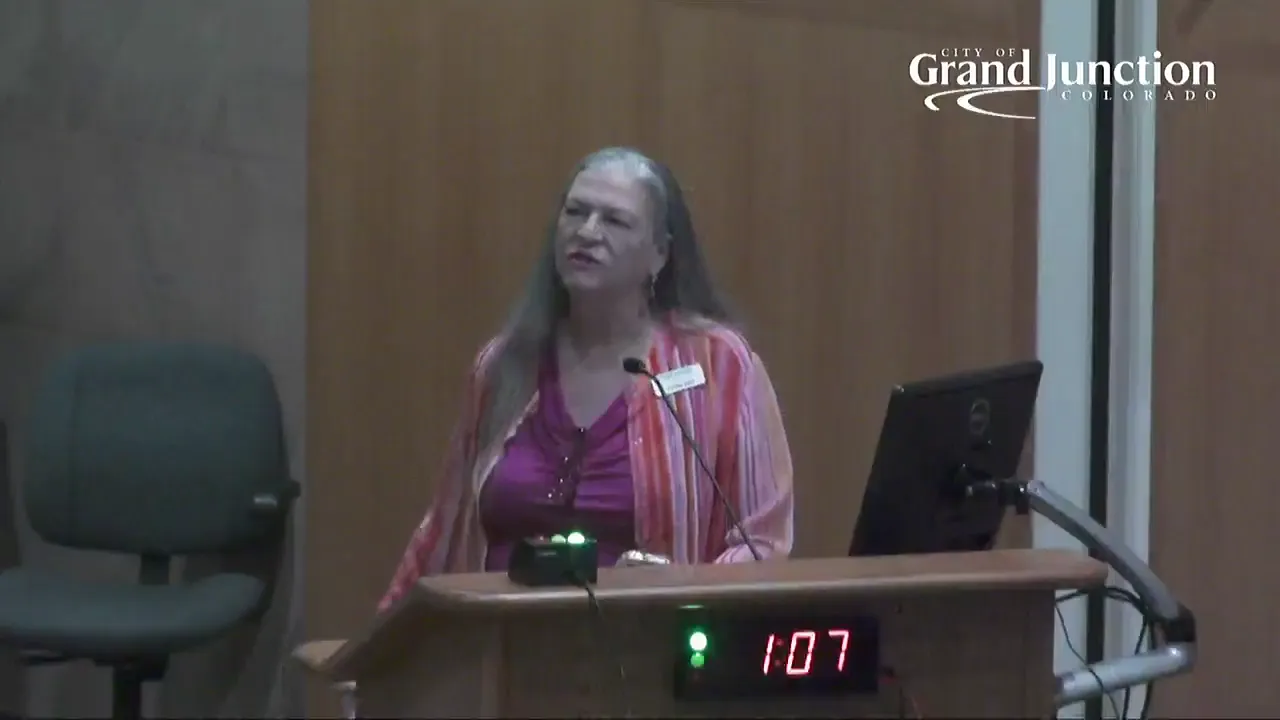
STREAMING COPY IN PREPARATION — RECORDING AVAILABLE FROM THE ORIGINAL SOURCE
Transcript — Verbatim
Speaker numbers apply only to this recording. Names come from transcript evidence. “Possibly” marks uncertain attribution.
Discussion Breakdown — Share of Meeting
Budget Equity Analysis24%
Arts And Culture16%
Public Safety9%
Affordable Housing8%
Economic Development7%
Tourism Management7%
Procedural5%
Homelessness4%
Community Development Block Grant4%
Summary of Proceedings
Grand Junction City Council Regular Meeting – November 5, 2025
The Grand Junction City Council met in regular session on Wednesday, November 5, 2025, at 5:30 p.m. in the City Hall Auditorium, 250 North 5th Street. Council President Cody Kennedy presided. Present were Councilmembers Robert Ballard, Scott Beilfuss, Jason Nguyen, and Ben Van Dyke; Councilmember Anna Stout attended virtually; Councilmember Laurel Lutz was absent. The meeting included presentations from the Business Incubator Center and Sports Commission, board appointments, public comment, consent agenda approval, and public hearings on the CDBG CAPER and the proposed 2026 budget. The meeting adjourned at 8:49 p.m.
Presentations
- Business Incubator Center Update: CEO Dalida Bollig reported the incubator, founded in 1986, has assisted one in three businesses in Mesa County. In 2024 it worked with 526 businesses, helped create 519 full-time jobs, and had 84 businesses on campus; it currently houses 102 startups. It provided $2.02 million in direct loans and leveraged $3.18 million in additional funds, and has invested $4.26 million in 22 businesses year-to-date. Bollig highlighted $1.4 million in nonprofit and $3.5 million in for-profit Enterprise Zone tax credits and warned that downtown and 23-to-29 Road areas are being removed from the Enterprise Zone, with grandfathering available before year-end. She invited the public to the Small Business Holiday Expo on November 21.
- Grand Junction Sports Commission Update: Executive Director Ben Snyder said the commission is in its 10th year. It receives three-quarters of one percent of the 6% lodging tax, with about $577,000 estimated for 2025, and raises about $343,000 from events and sponsors. About $547,000 goes back into community events, including $48,000 in grants. Notable 2025 events included the World Wake Association event at Highline Lake ($427,000 direct spend), USA Cycling collegiate mountain bike nationals at Powderhorn (projected $950,000 direct spend, 462 athletes, 48 schools), the NCAA triathlon, and the Rim Rock Marathon. The commission partners with more than 72 events, owns/operates 8–10 events, and draws about 25,000 participants and over 200,000 spectators annually. Snyder said lodging tax is 62% of the commission's budget, and additional venues are needed.
Appointments
- The Council unanimously appointed Dave Fishell, Adam Nikirk, and Sidney Woods to the Historic Preservation Board for terms expiring December 31, 2029. The 6–0 voice vote included virtual participation.
- The Council unanimously appointed Christina Schultz and Dora Fang and reappointed Julie Shafer to the Visit Grand Junction Board for terms expiring December 31, 2028.
Public Comments & Testimony
- Seth Williams, speaking as a citizen and volunteer, expressed concern about rising housing costs and the impending closure of HomewardBound's shelter, which he said lacks funding after January 5, 2026 and has been closed on weekends since October. He argued the city has no clear plan for unhoused residents and called for policies such as Housing First used in Salt Lake City.
- Ed Kowalski, a 42-year valley resident, said he had been told bikes could ride anywhere on sidewalks but learned that is not true; he urged accurate information.
- Henry Brown criticized the city's housing affordability code task force, saying it felt like a 'protecting developers profit margins task force.' He argued that transportation and car costs affect affordability and asked the Council to consider broader livability and connectivity impacts.
City Manager Report
- City Manager Mike Bennett reported that Standard & Poor's assigned a AA rating to the city's upcoming general fund revenue bonds and a AA- rating to the certificates of participation, and affirmed ratings on existing debt. He quoted the ratings report praising the city's financial management, reserves, and low fixed-cost profile. (The meeting minutes describe both as AA; the transcript reports AA for bonds and AA- for COPs.)
Boards and Commission Liaison Reports
- Councilmember Beilfuss reported on the Historic Preservation Board's tour of a Second Street property, a Business Incubator Center board meeting, the Riverside Technical Corporation meeting, a Hilltop meeting, the affordable housing workshop, and the recent City Council Town Hall.
- Councilmember Ballard and Councilmember Van Dyke reported on the Town Hall; Van Dyke also echoed the need for businesses to apply for Enterprise Zone grandfathering.
- Councilmember Stout reported on Colorado Municipal League legislative positions and an upcoming Parks and Recreation Advisory Board meeting.
- Council President Kennedy reported on the Town Hall, modular housing conversations, Strong Schools/Strong Community, Museums of Western Colorado, and ongoing meetings regarding HomewardBound.
Consent Calendar
- The Council unanimously approved Consent Agenda Items 1 and 2. This approved minutes from October 6 and October 13, 2025 workshops and the October 15, 2025 regular meeting, and set public hearings for:
- The Messick-Dangler annexation of 27.2 acres at 378 30 Road, with a public hearing on December 17, 2025;
- Assignment of a city land lease from Gray Media Inc. to Scripps Media Inc., with a hearing on November 19, 2025;
- Zoning and Development Code amendments on landscaping, buffering, screening, measurements, and definitions, with a hearing on November 19, 2025;
- Wastewater System Code Section 13.04.090 mandatory sewer connection amendment, with a hearing on November 19, 2025.
Public Hearing: 2024 CDBG CAPER Review
- Housing Manager Ashley Chambers presented the Consolidated Annual Performance and Evaluation Report for the 2024 Community Development Block Grant Program Year. The city has been a CDBG entitlement community since 1996. The 2024 year included a $398,577 allocation plus about $80,600 in reallocated prior-year funds, totaling approximately $479,000. Funded projects included $140,000 for Columbine Park, $77,000 for West Lake Park, and safe-routes improvements on Hermosa Avenue and Ellis Street (shown in the raw transcript as $160,004,000, likely intended as a smaller dollar figure). Accomplishments included $672,000 in CDBG spending on affordable housing from 2021–2023, mobile home repairs through Housing Resources of Western Colorado, and $89,000 in pre-development funding for Habitat for Humanity of Mesa County.
- The public hearing opened and closed at 6:35 p.m. with no public comments. No motion was required; the report will be submitted to HUD by November 26 after the 15-day public review period.
Public Hearing: 2026 Budget Introduction and First Public Hearing
- City Manager Mike Bennett presented the proposed 2026 budget of $316.4 million, a decrease from 2025 largely due to the completion of major phases of the Community Recreation Center and Persigo Wastewater Treatment Plant projects and to operational reductions. The council-directed use of $668,443 in general fund reserves for attainable/affordable housing incentives and services for unhoused residents is included. The general fund balance is projected to end 2026 at $46.7 million, with $29.3 million (25%) held as the required minimum reserve.
- The budget includes a 9.7% increase in labor costs, 29 new positions (including 13 in public safety), 10 frozen vacant positions, a reduction of five positions, a 32% drop in capital spending, and $16.1 million in debt service. Public safety investments include five new police officers, a Bearcat tactical vehicle, continued ARCTIC real-time information center build-out, a future police annex using certificates of participation, a community paramedic program, three firefighter EMTs, a battalion chief, and a fire inspector, plus a 2026 fire academy.
- Other budget highlights included $32.1 million in engineering/transportation capital projects, water and sewer infrastructure replacements, the Salt Flats affordable housing project with more than 324 planned units, an accessory dwelling unit incentive program, $100,000 for Joseph Center and $250,000 for Hilltop for unhoused services, and $61,153 in CDBG funds plus about $13,000 for Grand Valley Catholic Outreach. Bennett also noted the proposed elimination of the vendor fee, continued tourism investment because visitors generate up to 30% of sales tax revenue, and utility/rate adjustments including water, sewer, golf, parking, and solid waste/recycling increases.
- Councilmember Beilfuss asked about housing and homeless funding. Bennett explained the budget includes $450,000 in one-time funds for services for unhoused individuals and referenced ongoing discussions with HomewardBound and Mesa County. HomewardBound has announced plans to close the North Avenue shelter on January 5, 2026.
- The public hearing opened at 7:48 p.m. and closed at 8:20 p.m. Speakers included Thomas Copp, Dennis Simpson, Portia Silverberg, Ramona Windkeller, Cynthia Zates, David Kenworthy, Peter Booth, Heather McKim, TJ Smith, Jeff Gustofson, and Andrew Price. Multiple speakers urged the Council to restore Commission on Arts & Culture funding from the proposed $40,000 to the prior $70,000, citing economic returns, community connection, free performances, youth theater, and arts-based tourism. Dennis Simpson, a former councilmember, argued the 0.75% sales tax should be considered available for housing and human needs, estimating about $20.4 million in that revenue.
- Council discussion focused on the arts funding cut. Councilmembers Beilfuss, Stout, Nguyen, and Kennedy supported restoring $70,000; Councilmembers Ballard and Van Dyke expressed reservations, noting other city arts investments including 1% for the arts capital funding, $700,000 in public art at the Community Recreation Center, and $60,000 for the Avalon Theater dressing rooms. Councilmember Stout also read a letter from a disabled resident asking the Council to maintain the $70,000 arts funding level. Councilmember Van Dyke nevertheless made a motion to introduce the appropriation ordinance with an additional $30,000 for the Commission on Arts & Culture grant program, bringing that line to $70,000; the funding source was not specified in the motion and staff was directed to identify it before the second hearing.
Key Outcomes
- Appointments to the Historic Preservation Board and Visit Grand Junction Board were approved unanimously.
- The Consent Agenda, including minutes and setting of future public hearings, was approved unanimously.
- The CDBG CAPER public hearing was held with no public comments; no motion was needed.
- The 2026 Budget Appropriation Ordinance was introduced by unanimous 6–0 vote, with the second public hearing and final adoption consideration set for November 19, 2025. The motion included an additional $30,000 to restore the Commission on Arts & Culture grant funding to $70,000; the funding source was to be identified by staff and reported at the second hearing.
- The meeting adjourned at 8:49 p.m.
Meeting Transcript
Okay, if you'll find your seat, please. Okay, it is Wednesday, Nov November fifth, twenty twenty-five. And it is five thirty PM, and I am calling the Grand Junction City Council meeting to order. If you'll stand and join me on a pledge of allegiance followed by a moment of silence. Hi everyone, I'm Delita Sassum Bolik, the CEO of the Business Incubator Center. Really a pleasure to be here with our partners and everyone in the city of Grand Junction. I would like to just give a quick presentation of what we have been up to in the last 18 months. So the Business Incubator Center is officially Western Colorado Business Development Corporation. We're fondly known as the Business Incubator Center. We're founded in 1986 to help diversify the economy and grow strong local small businesses that can scale and afford and build economic opportunity for long-term sustainable prosperity across Western Colorado. So we do that through economic and business development. We diversify the economy through larger initiatives, macro and micro, and then we build entrepreneurial ecosystems. We work through five pillars business development, innovation and labs, space and tools, business funding and loans, and grants and incentives. Some are partnerships with the federal government, some with the state, some with the city, county, and some our own. So and we do that to create and generate the biggest amount of support that we can for all kinds of businesses, whether they are existing, scaling, exiting, or starting. Our all-time figures can speak for itself. We have helped one in three businesses in Mesa County since our founding. These are direct effect numbers. We don't use multipliers or trickle down effect. And we are extremely proud to have contributed the amount of dollars that we have to the economy and helped bolster the small businesses that still remain today very strong in our community. Some of uh the most important things that we are extremely proud of is that a lot of the businesses that we help uh continue thriving today, and we are seeing 39 years later businesses that we worked with that are selling to new entrepreneurs that are also continuing to build these businesses up and hire people and renovate and build assets for our community. Uh in 2024, we worked with 526 businesses. We helped create 519 full-time jobs, and we had 84 businesses on our campus. So the businesses on our campus are usually startups, and the clients that we work with, the 526, these are businesses existing out in the community. Um it's really important to mention here that uh we also through our business funding and loans pillar, we give out direct funding and we leverage funding to businesses. So indirect uh uh loans, we gave 2.02 million uh dollars in uh direct loans, and we were able to leverage 3.18 million uh dollars in leverage uh funds. Um these funds usually are used to help bolster our economy. These are new dollars in our economy that can help these businesses hire new people, uh, build, renovate, um, and invest in in our community. Um within right now, within our um incubator, we have 102 uh businesses. These are startups. You can see from the pie charts a little bit of um some percentages of the diverse um ecosystem that we have. Um, a lot of manufacturing businesses, a lot of uh services, tech, construction, and ag. Uh we are also seeing an uptick in outdoor rec and aerospace businesses in our community, and that's extremely exciting. So when it comes to uh business funding and loans, so far, year to date, uh we have invested in 22 businesses and funded a total of 4.26 million dollars. Uh, with uh the clients that we have worked with, as I mentioned so far, 700 clients, and uh specifically for Grand Junction and the limit of the city of Grand Junction. We have worked with 398 businesses who have altogether formed 4.7 uh in capital formation. Uh some of our businesses you might recognize from the photo. Uh these are um amazing uh small businesses and entrepreneurs that are in their uh scaling mode, so please help support them and give them shout-outs when you see them. Um with the Enterprise Zone, which is a state tax incentive program that we are able to uh utilize for our and help our county with, um, it is really important to mention that um it's a pre-certification, it has two different portions uh a for-profit portion and a nonprofit portion. The nonprofit portion is to accelerate nonprofit support by helping people who want to fund these nonprofits receive a tax incentive, and then they have to have a driving driver in economic development uh in their mission, and we can help them with all of that. So through those contribution tax credits, we were able to generate $1.4 million in total tax credits received for our community members. And for the for-profit business tax credits, we were able to generate $3.5 million in total tax credits received. Why it is important for me to mention this is because we are right now underway we have just passed a redesignation process. That's a 10-year for this tax incentives to remain. And downtown Grand Junction and 23 Road all the way to 29 road are areas that will no longer be in the enterprise zone. However, we were able to negotiate with the state uh Oedit to uh continue grantfathering in these businesses so that they can continue utilizing these tax incentives. There's a process to do that.
SUMMARIZED BY OPENPUBLICA AI
TRANSCRIPT VIA PUBLIC VIDEO
openpublica.com
openpublica.com