OPENPUBLICA · PUBLIC MEETING RECORD
Record of Proceedings
Grand Junction City Council Regular Meeting - March 4, 2026
City Council — Wednesday, March 4, 2026
BodyGrand Junction, Colorado
SessionCity Council
DateWednesday, March 4, 2026
StatusFILED
Video Record
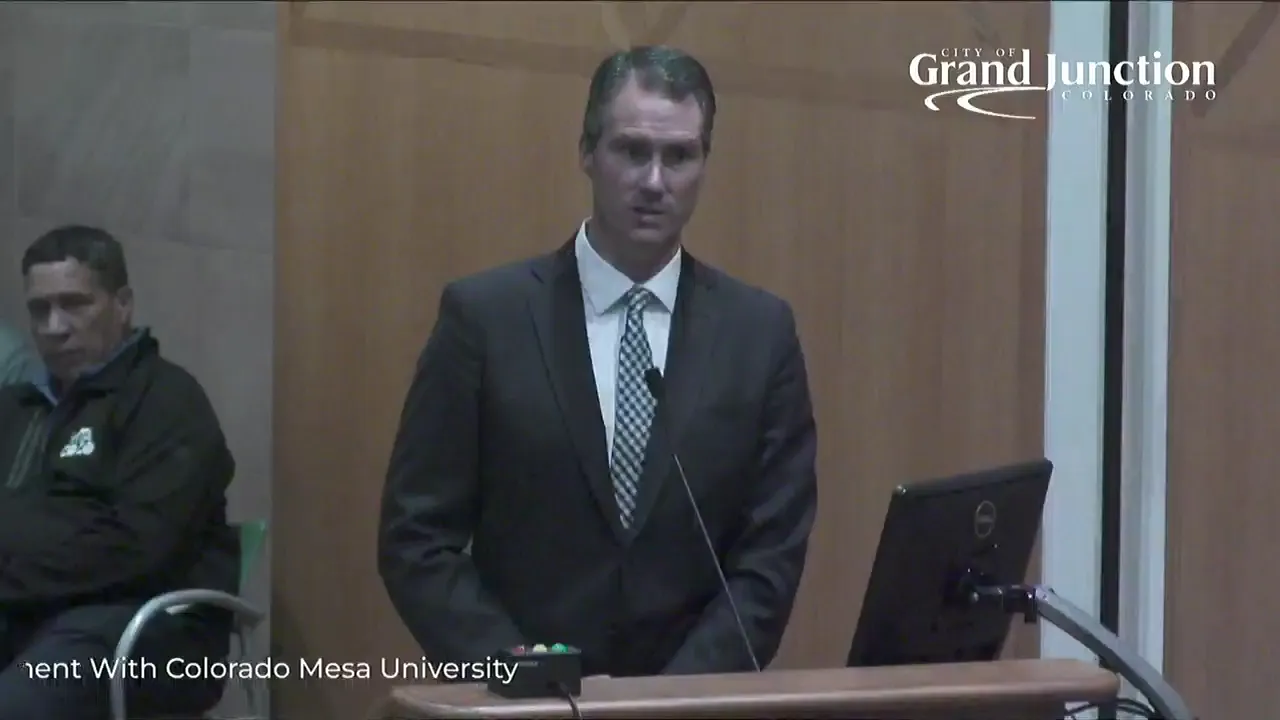
STREAMING COPY IN PREPARATION — RECORDING AVAILABLE FROM THE ORIGINAL SOURCE
Transcript — Verbatim
Speaker numbers apply only to this recording. Names come from transcript evidence. “Possibly” marks uncertain attribution.
Discussion Breakdown — Share of Meeting
Community Engagement31%
Historic Preservation16%
Parks and Recreation12%
Procedural8%
Zoning And Development6%
Transportation Safety5%
Budget Equity Analysis5%
Public Engagement3%
Community Development Block Grant3%
Summary of Proceedings
Grand Junction City Council Regular Meeting - March 4, 2026
The Grand Junction City Council held its regular meeting on Wednesday, March 4, 2026, at 5:30 PM in the City Hall Auditorium. The meeting opened with a Pledge of Allegiance and Moment of Silence, followed by a presentation from the Regional Transportation Planning Office (RTPO), public comments, liaison reports, and a consent agenda. The primary focus was on a resolution authorizing a 25-year ground lease and operating agreement with Colorado Mesa University (CMU) for the Lincoln Park Stadium Complex and Ralph Stocker Stadium, which passed 5-1 after extensive public testimony. Other actions included approval of a $5 million water enterprise loan, two zoning code amendments, and postponement of the Camelback Gardens public hearing.
Presentations
- Regional Transportation Planning Office (RTPO) Update: Director Dana Brosig and Senior Planner Rachel Peterson presented the 2025 annual report. The RTPO coordinates transportation planning across Mesa County, including Grand Valley Transit (GVT). Highlights included: GVT's 25th anniversary, completion of a new fleet maintenance facility, adoption of the Grand Valley 2050 Regional Transportation Plan, 580,000 transit boardings in 2025, a new Route 12 pilot, and 40,000 free rides for District 51 students. The Transportation Safety Task Force (created in 2025) reported that Mesa County sees 23,000–24,000 crashes annually, with 68% within the Grand Junction urban development boundary. Mesa County ranks 4th highest in fatalities among Colorado counties with population >100,000, and Grand Junction has the 3rd highest fatality rate among cities >50,000. Fatal crashes involve speeding (51%), and 15 of 18 pedestrian/bicycle fatalities were in Grand Junction. Upcoming events: Cycle Safety Fest (April 18), Bike Month (May), and the Colorado Traffic Safety Summit (July in Grand Junction).
Public Comments & Testimony
- General Public Comments (prior to consent agenda): Three speakers (Raquel Sienna, Stephanie Deadwong, Bet Bashar, and Cindy Ficklin) addressed Councilmember Robert Ballard's impending deployment to Egypt. They expressed full support for his service but raised concerns about consistent representation for District E, given the 9-hour time difference. They urged the council to consider allowing a temporary replacement or establishing a clear mechanism before his absence leads to automatic vacancy after five missed meetings. They stated that questioning the arrangement is patriotic and not disrespectful.
- Lincoln Park/CMU Resolution Public Hearing (7:28 PM – 8:21 PM): Approximately 25 speakers offered positions. Opponents (including Stephanie Deadwong, John Trailor, Mary Shawcroft, Florence Irene Shields, Bennett Beckenstein, Elizabeth Rowen, Bruce Noble, Kate Hawthorne, Christine Moore) argued that the community is losing access to a historic and centrally located public facility; that 40–46 annual public reservations (birthday parties, yoga, line dancing, community meetings) cannot be adequately replaced at the new Recreation Center; that public engagement was insufficient (no neighborhood-specific meeting); that the lease lacks an escalator on the $300,000 annual payment; that concession and naming rights revenues should be shared; and that alternative locations for the football facility were not fully explored. Speakers also noted potential conflicts with conservation trust fund requirements. Supporters (including CMU students Liu Aumavae, Peyton Wainwright, Noah Gurd, Cole Hansen; Coach Miles Kochevar; Board of Trustees members Tim Fry and Lori Buck; and community member Mike Foster) emphasized that the agreement preserves and improves the barn, relieves the city of $300,000 in annual operating subsidies, provides safety improvements for student athletes, and strengthens a century-long partnership. They stated that CMU has flexibility and that the university is part of the community.
- No other public comments were made during subsequent public hearings (Water Loan, Pedestrian Access, Zoning Amendments).
Discussion Items
Lincoln Park Stadium Complex Ground Lease and Operating Agreement with CMU (Resolution 23-26)
City Manager Mike Bennett detailed the 25-year ground lease (the maximum allowed), under which CMU will construct a $7 million football facility on leased land between the stadium and the Lincoln Park Barn, entirely at CMU’s expense. CMU will also lease the Lincoln Park Barn, making modest internal improvements (HVAC, floor reinforcement) while preserving the historic character and facade. CMU will not take possession of the barn until the new Community Recreation Center opens (expected late 2026). Current annual payments continue ($36,705) plus a new $300,000 annual lease operation fee, offsetting the city’s current net operating cost of $301,172 per year. CMU will cover 80% of field maintenance and 50% of turf replacement costs (estimated $800,000–$1 million every 8 years). All historic uses of the stadium (including District 51 track meets, band competitions, graduations, youth football, Special Olympics) are preserved, and daytime public access to the track will continue. Naming rights require city approval. Concessions will be jointly managed; the city retains baseball-side revenue. The agreement includes default protections and a dispute resolution process. CMU President John Marshall highlighted the university’s 100-year relationship with the city, the need to consolidate football operations currently spread across campus, and a fundraising window in the centennial year. He noted that CMU has experience preserving historic structures (Houston Hall, Robinson Theater). Council discussion reflected strong divisions. Councilmember Beilfuss moved to table the resolution for 30 days to allow further public engagement on the barn, arguing the community was not adequately heard. The motion failed for lack of a second. Councilmember Stout and others supported the agreement, citing financial benefits, preservation of the barn, and partnership enhancement. Council President Kennedy argued that the “park takeover” narrative was false and that the community includes CMU. The resolution passed 5-1, with Councilmember Beilfuss voting no.
Water Enterprise Loan (Ordinance 5310)
Utilities Director Randi Kim presented. The city needs $4.64 million for water line replacements (Linden Avenue, railroad crossing, CDOT-related, Aspen/Palisade/Glenwood streets) and a tank lining project. The Water Fund lacks reserves, so staff recommended a $5 million privately placed commercial bank loan (10-20 year term, indicative 4.15% interest) over a state revolving fund loan due to restrictions (Davis-Bacon, Buy America) and ineligibility of one project. The loan will be repaid through water rates, which are increased incrementally and remain affordable. The public hearing had no comments. The ordinance passed unanimously (6-0).
Pedestrian Access Code Amendment (Ordinance 5311)
Planning Manager Thomas Lloyd presented. The Housing Affordability Task Force recommended changes to reduce development costs and increase flexibility. The amendment narrows pedestrian access requirements to non-industrial zoned development (excluding single-unit detached and duplex dwellings), reduces the minimum width to 4 feet, removes prescriptive design standards, and clarifies crossing visibility standards. Staff developed an alternative that simplified language while preserving intent, which the Task Force supported. The Planning Commission recommended approval 5-0. No public comments. The ordinance passed unanimously (6-0).
Zoning Code Amendments: Right-of-Way Dedication, Acceptable Plant Material, Street Frontage Landscape (Ordinance 5312)
Principal Planner Tim Lehrbach presented. The amendments update procedures for determining fair market value when right-of-way is dedicated beyond what is required, adopt nursery-standard water-use categories for plants (and require 90% low-water plants), and limit street frontage landscape requirements for new subdivisions to collector and arterial streets (removing them for local streets where they create conflicts). Staff found consistency with the comprehensive plan. The Planning Commission recommended approval 7-0. No public comments. The ordinance passed unanimously (6-0).
Boards and Commission Liaison Reports
- Councilmember Lutz (Commission on Arts and Culture): Reported that $70,000 in grant applications were reviewed and dispersed.
- Councilmember Stout (Colorado Municipal League): Noted the Home Act (HB 26-1001) advanced out of committee on a party-line vote; a vacancy property tax bill died in committee.
- Council President Kennedy (Grand Junction Regional Airport Authority): Mentioned early discussions about Air Race X coming to Grand Junction.
- Councilmember Beilfuss (Business Incubator, Historic Preservation Board): Reported that the Small Business Administration in Colorado is on shutdown, affecting economic development funding. Read a letter from the Historic Preservation Board urging preservation of the Lincoln Park Barn, noting its architectural and historical significance.
- Councilmember Van Dyke (Downtown Development Authority): Highlighted a library parking lot and bookstore project, and a proposed food truck hall at 702 Main Street ($3 million investment).
Key Outcomes
- Lincoln Park Stadium Complex Agreement: Resolution No. 23-26 adopted 5-1 (Beilfuss no). City Manager authorized to execute ground lease and operating agreement with CMU. A motion to table for 30 days failed.
- Water Enterprise Loan: Ordinance No. 5310 adopted unanimously (6-0). Authorizes up to $5 million in debt for water capital projects.
- Pedestrian Access Code Amendment: Ordinance No. 5311 adopted unanimously (6-0). Amends Section 21.05.020.
- Zoning Code Amendments: Ordinance No. 5312 adopted unanimously (6-0). Amends right-of-way dedication, plant material, and street frontage landscape provisions.
- Camelback Gardens Development: Public hearing continued to April 1, 2026 (consent agenda).
- Consent Agenda: Approved unanimously (6-0), including minutes, public hearing settings for ordinances (Wildland Urban Interface Code, rezoning of Noland Avenue area and 29 Road), procurement for Crosby Avenue Improvement, and resolutions vacating a drainage easement and authorizing $400,000 for Housing Resources of Western Colorado.
Meeting Transcript
I appreciate everybody quieting as we approach. I mean I know that some of your clocks are saying we're a minute over, but I kinda go by this clock at the back of the room. But before I before I do call us to order, I just I do very much appreciate um decorum. And I can see that you'll you'll all will be very polite and treat each other respectfully tonight, but that's very important throughout this process uh throughout the evening. So we'll talk about that before public comment, but uh that's very important to us on council that we treat each other well here. So um and of course you all will, no matter what side of a conversation you're on. I just thought I'd put that out there for you. So with that, it is 5:30 p.m. on March 4th, and I will call the Grand Junction City Council meeting to order. Please rise for the pledge, and we'll be we'll follow that with a moment of silence. I pledge allegiance to the flag. Please be seated. Okay, I I need to make one quick announcement. Um, and this is regarding the camelback gardens development that was on the content consent agenda for this evening. There's um this is for rescheduling, and if it's adopted, um it will not be held tonight. So um just if you're here for camel back gardens, I just wanted to make sure that that that was on your radar. Okay, and with that, we'll move into our presentations and our initial um presentation is from the RTPO, which is the Regional Transportation Planning Office. We have an update. Um this is the um Mesa County Regional Transportation Planning Office. Uh it's one of the city's partners in oversight and operation of the read of the region's transportation network in operation of Grand Valley Transit. Our TPO director, Dana uh Roslik, is here this evening and will provide an annual community update on the regional transportation planning office as well as the Mesa County Safety Action Plan. Thank you. Thank you for having us tonight. I'm Dana Brosig, the Regional Transportation Planning Office Director, and I'm joined with Rachel Peterson, our senior transportation planner. Um so I just want to give a very brief background on what we do as the Regional Transportation Planning Office or RTPO. Um we are an umbrella organization. We see ourselves as regional government, so we represent all of the jurisdictions in Mesa County, including the city of Grand Junction. Um we we work on all different modes of transportation, including those who drive, walk, bike, and freight. Um, and so that's kind of the purview that we work with in. Uh we are an umbrella organization because we are technically the Grand Valley Transportation Planning Region, which is transportation planning for the more rural area, the Transportation Metropolitan Planning Organization, which is the more urban area, which you can see on the map in orange, and then we also um oversee Grand Valley Transit, our local transit system. Um we do have a board of directors, which is the Grand Valley Regional Transportation Committee, and we have Commissioner Wynne or Councilman Wynn on our uh representing the city on our GBRTC. Uh we also have a number of advisory committees. Um we have a transportation advisory committee that meets about once a month, and this is where staff, engineering and planning staff from all four jurisdictions as well as CDOT meet to talk about different transportation ish issues to make sure we're collaborating in our transportation world. Um as you know, roads don't stop at jurisdiction boundaries, and so it's important to work together and really have a cohesive system that we're all talking about. Uh we also have a mobile Mesa County Alliance, and this group meets um less frequently, but the intent is to make sure that nonprofits and other government organizations are working together to improve transportation for vulnerable populations. Um and so this is important to identify gaps in transportation for different populations and also to make sure that we're not duplicating services. And then lastly, we have the transportation safety task force, which we'll be talking a little bit more about, but is a multi plus multidisciplinary group that's working towards creating safer roads um in our community. Uh we're gonna be talking about two annual reports today. Uh the first is just about the RTPO, and then the second one is more focused on the safety task force. Um on the RTPO uh side, some of the major highlights is we did celebrate Grand Valley Transit's 25th anniversary. So we started in 2000. Um we also completed a new um fleet maintenance facility, which you can see a picture of. Um it's down at the city fleet yard. And then we also adopted our Grand Valley 2050 Regional Transportation Plan, which we are federally required to do every five years. Um I like this slide because it kind of gives a snapshot of transportation across our community. Uh, you can see we had over 580,000 Grand Valley of Transit boardings in 2025. We added a pilot route, Route 12, which connects West Transfer Vacility to North Avenue.
SUMMARIZED BY OPENPUBLICA AI
TRANSCRIPT VIA PUBLIC VIDEO
openpublica.com
openpublica.com