OPENPUBLICA · PUBLIC MEETING RECORD
Record of Proceedings
Greeley City Council Work Session: Culture Boards, Westside Plan, Budget, Wildfire Code (January 27, 2026)
City Council — Tuesday, January 27, 2026
BodyGreeley, Colorado
SessionCity Council
DateTuesday, January 27, 2026
StatusFILED
Video Record
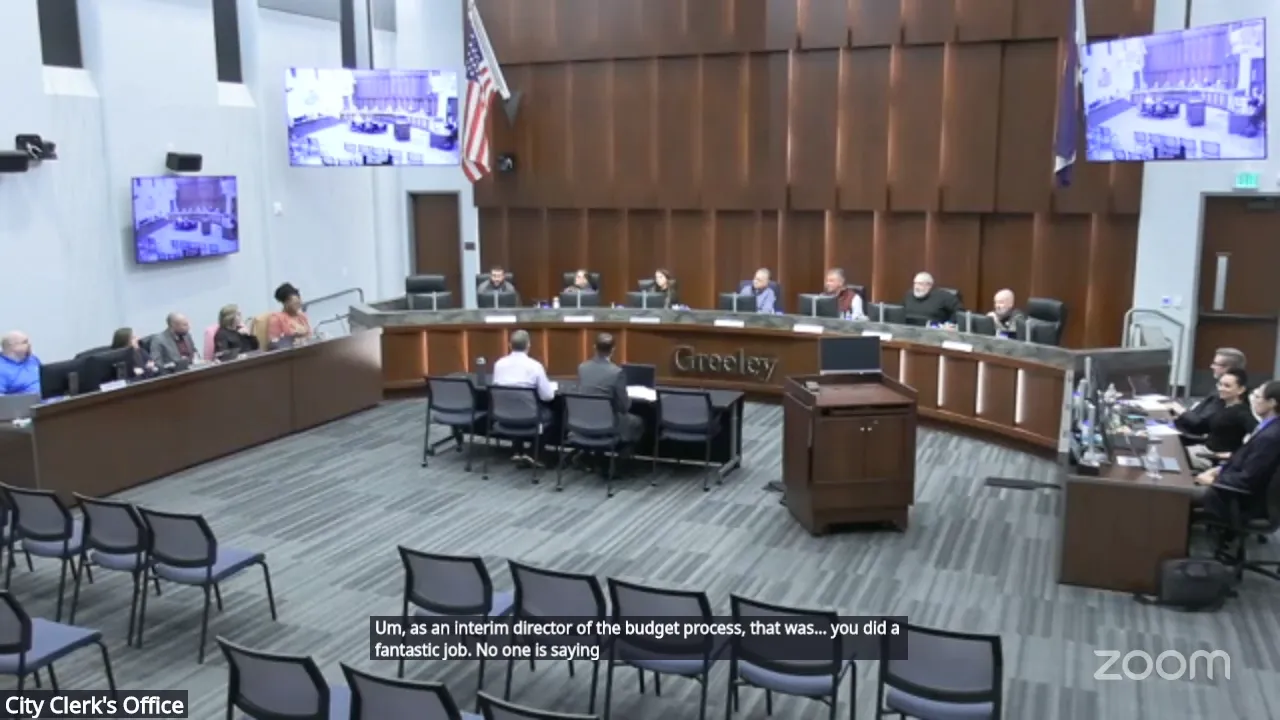
STREAMING COPY IN PREPARATION — RECORDING AVAILABLE FROM THE ORIGINAL SOURCE
Transcript — Verbatim
Speaker numbers apply only to this recording.
Discussion Breakdown — Share of Meeting
Wildfire Resiliency23%
Arts And Culture14%
West Greeley Project14%
Budget Equity Analysis13%
Fiscal Sustainability8%
Zoning Regulation7%
Transportation Safety4%
Federal Grants4%
Public Engagement3%
Summary of Proceedings
Greeley City Council Work Session – January 27, 2026
Mayor Dale Hall called the work session to order at 6:00 p.m. on Tuesday, January 27, 2026, in the City Council Chambers at 1001 11th Avenue, Greeley, Colorado. All seven councilmembers were present, with hybrid participation via Zoom. The work session was for discussion and direction only; no formal ordinances or resolutions were adopted. Agenda items included council reports, a proposed culture board consolidation, the Westside Area Plan and Form-Based Code draft, a grants/financial/budget update, and the Colorado Wildfire Resiliency Code.
Reports from Mayor and Councilmembers
- Councilmember Johnny Olson reported on the US 34 MERGE project, saying Greeley will be the direct federal grant recipient and will pass funds to CDOT through an intergovernmental agreement (IGA) for construction and owner's representation, with an executive oversight committee to control budget and scope. He said the grant had advanced past the first federal review round and signatures were expected in two to four months. Councilmember Tommy Butler asked about TIFIA loan finalization; Acting City Manager Brian McBroom said staff would provide that timeline.
- Olson listed his priorities for the upcoming Council retreat, which he would miss: budget foundations, safety and security, deferred maintenance, the US 34 MERGE project, the downtown stormwater project, the catalyst project, and the downtown civic center.
- Mayor Pro Tem Melissa McDonald reported that Wreaths Across America raised enough money to place wreaths on every veteran's grave in December and that she met with water and sewer staff about Poudre River restoration and flood mitigation opportunities.
- Councilmember Ryan Roth presented at the District 6 Success Foundation Awards event, which recognized 154 nominees among District 6 staff, teachers, and administrators.
Culture Parks & Recreation Department Culture Board Consolidation
- Staff members Diana Frick and Megan Weiler presented a proposal to consolidate the Museum Board, the Union Colony Civic Center Board, and the Art Commission into a single Arts and Culture Commission. They said the goal was not to reduce arts and culture voices but to strengthen advisory work, citing repeated quorum failures and 11 canceled meetings across the three boards in 2025.
- Staff reported 2025 meeting data: the Art Commission had one quorum issue and one cancellation; the Museum Board had five cancellations and one no-quorum meeting, plus one vacancy; and the UCCC Board had five cancellations.
- Staff said they met with each board twice. Board members raised concerns about less focus on specific programs and facilities, while others saw potential for a stronger unified cultural advocacy. Recommendations included maintaining relationships with nonprofit friends groups and preserving the public art process in the municipal code.
- Councilmembers asked about membership selection. Staff said an initial transition could start with the most engaged current members, but the City Clerk noted that creating a new board would require council appointment and a new application process. Councilmember Butler requested a survey of current board members to gauge individual support.
- Council reached consensus on Option 3, the consolidation of the three boards into one Arts and Culture Commission. Staff will develop a transition plan, new membership process, and code changes to return to Council.
Westside Area Plan & Form-Based Code
- Interim Planning Manager Caleb Jackson introduced consultant Jeff Speck (Speck Dempsey Partner) and Jason King (Able City) at 6:41 p.m. The plan area covers 22 square miles on Greeley's west side, mostly agricultural but becoming suburban. Public interest was high: about 200 people attended the kickoff and more than 120 attended the plan unveiling.
- The plan projects Greeley's population to reach about 200,000 by 2055. It emphasizes three components: preserving land through the existing green print, identifying and enhancing transportation corridors, and building complete walkable neighborhoods rather than single-use pods. Bradburn Village in Westminster was presented as a successful local example.
- Mayor Hall noted positive public feedback and asked whether developers were on board. Speck said walkable communities are more profitable for developers, but implementing them requires developers to shift from current practices. He suggested the form-based code could replace the city's PUD ordinance.
- Councilmember Olson expressed support for smart growth but raised concerns about overemphasizing density and about transit viability and costs, citing low Front Range ridership figures. Speck replied that about 50% of Americans prefer walkable urbanism but that the option is not widely available.
- Councilmember Butler supported the form-based code concept and allowing more uses by right without PUD processes. Councilmember DeBoutez encouraged Council to visit Bradburn. Councilmember Rudy asked whether neighborhood restaurants could draw customers from outside the neighborhood; Speck said successful retail is placed along visible corridors.
- Acting City Manager McBroom thanked staff and consultants and recognized former Deputy City Manager Rachel Flynn for bringing the consultants to Greeley.
2025 Grant Update, 2025 Financial Review, and 2027 Budget Update
- Division Treasurer Robert Miller reported that the 2024 Schedule of Expenditures of Federal Awards was completed on December 31, 2025. The city spent approximately $9.5 million in federal grant funds in 2025 and has 81 open grants.
- Sales tax growth was slower than budgeted: 1.8% growth compared with the budgeted 5%. New construction revenues were $5.9 million below the 2025 budget, and severance tax revenues were $2 million below budget. Operational savings, additional oil and gas revenues, and interest earnings partially offset those declines.
- Cash and investments totaled $394 million at the end of 2025, exceeding the adopted budget of $300 million, largely due to the issuance of 2025 Certificates of Participation. Interest earnings were $14.3 million, exceeding the budget by $6 million.
- General fund projections show sales and use taxes $2 million lower than projected, but $4.8 million in expected expenditure savings, producing a projected $2.8 million surplus at the end of 2025.
- Director of Budget and Policy Nathan Mosley said the 2026 budget had a $21 million gap, closed using about $11 million in 2024 carryover, about $3 million in departmental realignment savings, and a transfer from the public improvement fund. Only about $3 million in carryover is expected from 2025, so those stopgap measures will not be available for 2027.
- Mosley announced a target-based budgeting approach for 2027 instead of the traditional incremental approach. Councilmembers will receive preparatory materials and pre-work due by February 9; the Council retreat is February 12–13; the formal 2027 budget kickoff is March 11; and the proposed budget is expected in October.
- Council discussion included requests for return-on-investment information and deferred-maintenance details, concerns that one-time COVID-era programs became permanent, the need for clearer line-item transparency, restricted funding buckets, and whether to pursue a ballot initiative early. Councilmember Olson said the city has a spending problem; Councilmember Butler said the city also has a revenue problem, especially for public safety funding.
Wildfire Resiliency Adoption
- Fire Chief Brian Kuznik presented the Colorado Wildfire Resiliency Code, created under Senate Bill 23-166. The state requires local jurisdictions to adopt the code by April 1, 2026. It applies to new construction and significant exterior alterations within designated Wildland Urban Interface (WUI) areas.
- The code has three key elements: WUI areas classified as low, moderate, or high fire intensity; structure hardening with fire-resistant materials; and defensible space around structures. It is not a retrofit code: existing structures generally must comply only when there is a significant alteration, defined as increasing the footprint by more than 500 square feet or repairs affecting 25% or more of the structure.
- Chief Kuznik noted that more than 4,000 homes and structures have been destroyed by Colorado wildfires since 2010. Affected Greeley areas include parts of West Greeley, Promontory, Poudre River Ranch, and portions of the airport property.
- Chief Building Official Matthew Wagy provided cost estimates: cement-based siding would cost about 16% more than standard OSB lap siding, metal soffits about 32% more, and some higher-end textured sidings about 60% more.
- Councilmembers questioned the state mapping criteria. Interim Deputy Director of Community Development Brittany Hathaway explained a potential ground truthing process that could allow new developments to be exempt once graded and built, but the state has not yet established a clear process for map amendments. City Attorney Bobbier Cranston said if the city does not adopt the code, the state would still enforce it, but Greeley would lose the ability to modify the code, use a local map, or implement ground truthing.
- Councilmember McDonald discussed insurance implications and suggested considering whether the code should apply citywide. Councilmember Olson strongly disagreed, calling the code an unfunded state mandate and expressing concerns about local control, Greeley's tree city status, and housing costs. Councilmember DeBoutez said she was not in favor of making the whole city a WUI district.
- The item is scheduled to return to Council for first and second reading in March, with adoption required by April 1, 2026.
Key Outcomes
- Council gave consensus direction to proceed with Option 3 for the culture board consolidation, consolidating the Museum Board, UCCC Board, and Art Commission into a single Arts and Culture Commission. Staff will return with a transition plan, membership process, and code changes.
- The Westside Area Plan and Form-Based Code will continue as a draft with public comment and Council input; final consideration is expected in spring/summer 2026.
- The 2027 budget will use target-based budgeting. Council pre-work is due February 9, 2026, and the Council retreat will be held February 12–13, 2026.
- The Wildfire Resiliency Code will return for first and second reading in March 2026, ahead of the state's April 1, 2026 adoption deadline.
Note on Record Discrepancies
- The minutes record adjournment at 7:46 p.m., while the raw transcript states the meeting adjourned at 8:24 p.m. The raw transcript also contains an apparent verbal slip referring to January 26, while the agenda and minutes identify the date as January 27, 2026.
Meeting Transcript
We are now violent. Thank you. I call to order the work session of the Great Day City Council this 27th day of January 26. Would you please stand if able and join me in the recital of the plan? I pledge allegiance through the flag of the United States of America. And to the Republic for which it stands. One nation under God, indivisible with liberty and justice for all. Roll call, please. Councilmember Butler. Present. Councilmember Debuty, present. Mayor Pro Tem McDonald, present. Councilmember Olson. Councilmember Rudy. Present. Councilmember Roth. Present. And Mayor Hall. Present. Let the record show that all seven members of council are present. Item number four is reports from mayor and council members. Any reports tonight? I have. Councilmember Olson. Thank you, Mayor. First thing I want to do is give a report. We had a great meeting with uh Federal Highway Administration, CDOT and City Staff and our consultant on uh the merge project uh Monday. That was yesterday. Um really good meeting, came to some resolutions of what we felt is gonna be the best moving forward. Uh C dot and FHWA were at the table helping us get to that solution. The mayor and I were both there. Um Brett and Brian from staff and our consultant were there. Um, but it went really well. We we come to a conclusion we still got some things that we got to get documented, but um first thing is we will be direct recipients. Um we will then work through an IGA with CDOT to pass the money to them to do the construction and to do the owner's rep. So really good solution for us, giving it to the people that know with our current turn of events and staffing. Um also uh we talked a little bit about how that has to be done through an IGA through uh how the invoicing is. CDOT was very gracious, and I feel they're gonna give us a very good deal on managing it, probably cheaper than we could have managed it ourselves. Uh very low percentage. Um
SUMMARIZED BY OPENPUBLICA AI
TRANSCRIPT VIA PUBLIC VIDEO
openpublica.com
openpublica.com