OPENPUBLICA · PUBLIC MEETING RECORD
Record of Proceedings
Greeley City Council Work Session: Budget Deficit, Ballot Planning, and Economic Development Task Force – May 12, 2026
City Council — Tuesday, May 12, 2026
BodyGreeley, Colorado
SessionCity Council
DateTuesday, May 12, 2026
StatusFILED
Video Record
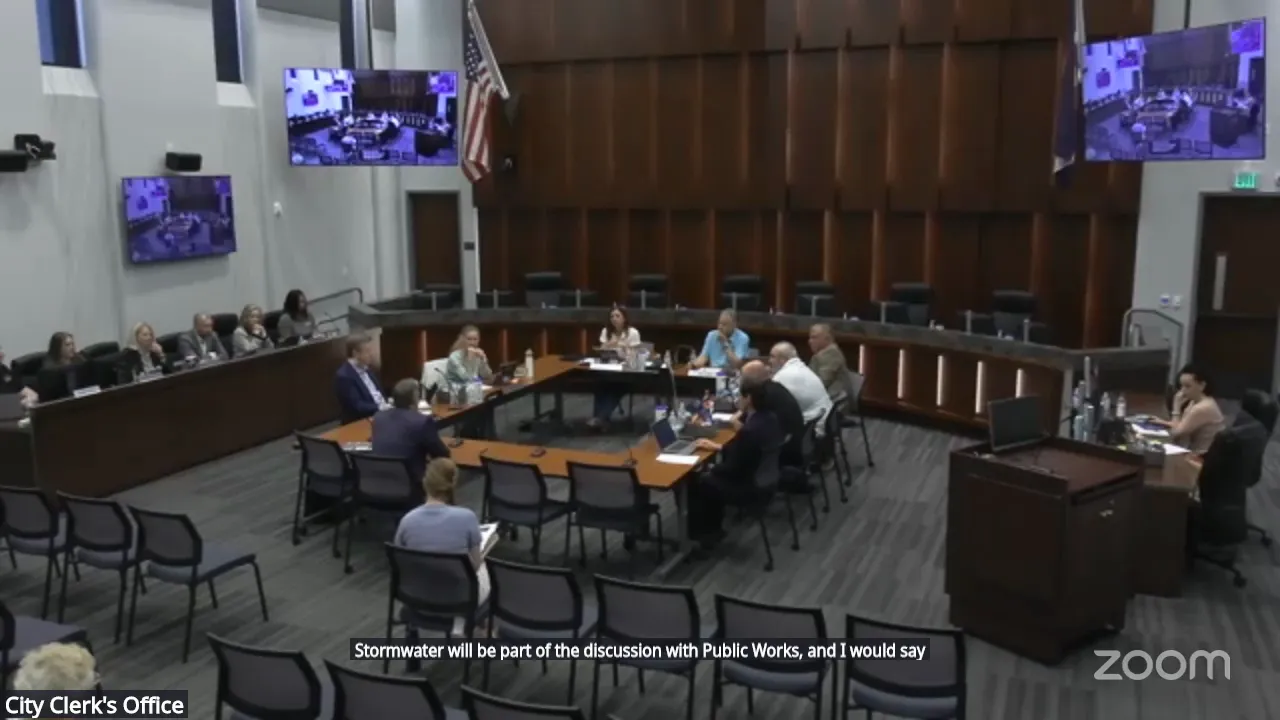
STREAMING COPY IN PREPARATION — RECORDING AVAILABLE FROM THE ORIGINAL SOURCE
Transcript — Verbatim
Speaker numbers apply only to this recording.
Discussion Breakdown — Share of Meeting
Public Safety17%
Parks and Recreation14%
Fiscal Sustainability13%
Capital Improvement Planning13%
Economic Development12%
Homelessness7%
Public Engagement5%
Taxation5%
Procedural3%
Summary of Proceedings
Greeley City Council Work Session: Budget Deficit, Ballot Planning, and Economic Development Task Force – May 12, 2026
The Greeley City Council held a work session on Tuesday, May 12, 2026, at 6:00 PM in the City Council Chambers at City Center South, with hybrid participation via Zoom. All six council members were present. The meeting covered six major items: the Culture, Parks and Recreation Department’s cost recovery framework, the 2027 budget development update, the quarterly Capital Improvement Program update, the Greeley Municipal Court budget proposal, planning for a potential 2026 ballot measure, and an update on the Mayor’s Task Force for Economic Development. No formal votes were taken, but council provided direction and consensus on several items.
Culture, Parks and Recreation Department Cost Recovery Framework and Implementation
Deputy Director Jill Krantz introduced the item, noting it stemmed from the 2025 Master Plan. Consultant Chris Nunes presented the framework, which categorizes programs into three tiers: community benefit, shared benefit, and individual benefit. The analysis included pro forma reviews of over 100 programs and a stakeholder survey of advisory board members (38% response rate). The market was benchmarked against about 10 peer communities in Northern Colorado. Key findings revealed wide and inconsistent pricing, lack of rational criteria linking program type to pricing, and opportunities for efficiency in program design, staffing, and facility use. The framework emphasizes expense management rather than simply raising fees. A phased implementation was presented, starting with park and pavilion fees for the 2027 budget.
Councilmember DeBoutez asked how parks and museums (with less measurable economic return) were weighted. Nunes said the stakeholder survey informed categorization and cultural programs had broad support for subsidies under the community benefit tier. Councilmember Rudy asked why general citizens were not surveyed; Nunes explained that vested stakeholders with operational understanding are better suited. Councilmember Roth urged early and transparent public communication. Councilmember Olson echoed the need for early communication, noted Greeley’s park acreage (23.28 acres per 10,000 residents vs. national average of 15.23), and expressed concern about deferred maintenance and pricing out low-income families and youth. Deputy Director Krantz noted an existing scholarship program of up to $150 per qualifying participant. Council consensus was to support the framework and phased implementation.
2027 Budget Development Update
Nathan Mosley, Director of Budget and Policy, presented an update on the 2027 budget, characterizing a structural general fund deficit requiring significant course correction. The projected deficit is approximately 12% of general fund expenditures, resulting from a reversal in revenue and expenditure trends: from 2017 to 2021 revenues grew 41% while expenditures grew 18%; from 2021 revenues grew 18% while expenditures grew 56%. The fund balance is projected to reach 16.7% of general fund expenditures by end of 2026, equal to the required two-month reserve. The city adopted target-based budgeting with a cohort model: Tier C (police, fire, OEM) at 4% reduction; Tier B at 17%; and Tier A at 25%. The total projected deficit to be solved is over $18.1 million. A voluntary separation process was opened and final selections are due May 15.
Councilmember DeBoutez asked about water and sewer enterprise funds; Mosley confirmed they are not part of the general fund gap but their teams are voluntarily reviewing budgets. She also asked about the budget stabilization fund, estimated at $4.6–$4.9 million. Councilmember Olson noted that grant-funded programs created structural spending and suggested examining the CIP for unspent or long-encumbered funds. Mayor Hall explained that council would be more directly involved in the 2027 budget process.
Quarterly Capital Improvement Program Update
Katelyn Myers, Deputy Director of Budget and Policy, introduced this new quarterly update to provide regular transparency on capital projects. She proposed organizing capital projects into six outcome-oriented categories: Safe and Accessible Public Buildings; Reliable Transportation and Mobility; Clean and Reliable Water, Sewer and Storm Systems; Parks, Recreation and Cultural Spaces; Community Growth and Place-Based Development; and Technology Systems and City Operations. This structure aims to connect investment to community outcomes. Debt financing and utility rates together represent nearly 60% of capital funding, with development fees at 14%. A year-to-date spending chart was presented, showing spending, obligated, and unspent portions. A new practice of reallocation accounts for paused or cancelled projects was highlighted, with three examples: Lincoln Park Master Plan on hold, River Restoration Phase 3 paused, and the Railroad Quiet Zone shifted to 2028. Four projects were featured: Wastewater Treatment and Reclamation Facility upgrades (25% complete), Poudre River Trail narrow section repair ($1.5M, under construction), O Street/59th Avenue intersection (completion expected June), and Union Colony Civic Center orchestra pit lift ($1.2M).
Councilmember Olson requested visibility on unspent obligated dollars to assess idle funds and deferred maintenance progress. Mayor Hall asked about deferred maintenance (addressed in both operating budgets and CIP). Mayor Pro Tem McDonald requested consistent start and completion dates in future reports. Councilmember DeBoutez noted public impatience with the quiet zone delay.
Greeley Municipal Court Budget Proposal
Municipal Court Judge Mark Gonzales and Court Administrator Krista Bagnall presented the court’s budget overview and its response to the reduction targets. The court processed over 17,000 cases in 2025 and projects nearly 18,000 in 2026. The target reduction was 17% of operational expenditure. Judge Gonzales presented scenarios showing that a 17% or 25% cut would require eliminating probation services, reducing court marshals, or cutting clerical staff—each leading to increased recidivism, reduced security, longer wait times, and greater police burden. The court proposed an alternative reduction of approximately $52,000, representing roughly 3% of the total budget or 17% of the general fund support allocation. Eliminating 2.75 of 6.75 clerical positions would likely double check-in wait times and degrade phone response from same-day to 48–72 hours. Judge Gonzales also highlighted unfunded mandates, including a livestreaming requirement for bond hearings and mandated rate increases for court-appointed attorneys (from $100 to $105 per hour, rising to $110 July 1, eventually reaching 75% of the federal rate at $177/hour).
Councilmember Rudy stated he views the court as a public safety entity and believes it should be tiered with police and fire at 4%. Mayor Pro Tem McDonald thanked the judge and supported the alternative general fund reduction. Councilmember Olson noted that the court’s revenue collection nearly covers its general fund support, making the net request small. Councilmember DeBoutez asked about technology for probation; Judge Gonzales explained that physical observation and legal documentation cannot be automated.
2026 Ballot Measure Planning
Deputy Director of Budget and Policy Kalen Myers led the discussion on a potential 2026 ballot measure. She recapped guidance from the February retreat: interest in a combined public safety and homeless solutions measure, a total increase of up to 0.5% (yielding $12–14 million annually), a sunset of 5–10 years for the homeless component, and strong transparency requirements. Council discussion revealed differing views: Councilmember Olson questioned whether the ballot should also address financing for the West Greeley project and downtown civic campus, noting that many residents associate the city’s financial situation with those projects and that combining public safety and homelessness could cause both to fail. Mayor Pro Tem McDonald preferred separate measures but would support a combined if polling indicated favorability. Councilmember DeBoutez suggested that the city’s most pressing obligation may be resolving the West Greeley project and that asking for a public safety or homeless tax before settling that could undermine credibility. Budget Director Nathan Mosley noted that the homeless component is one area where a dedicated revenue source could supplant general fund expenses, freeing up existing dollars.
Staff outlined the timeline and costs: polling in May–June ($38,000–$43,000), program development, and public engagement including a citizen committee (additional $115,000–$135,000). Staff cautioned that polling on too many topics reduces reliability. Council reached consensus to proceed with polling on public safety and homeless solutions. Council directed staff not to initiate polling on the larger capital projects (West Greeley, downtown civic campus) at this time, given the unresolved status of those matters. Staff will develop draft polling questions, conduct the poll in June, and return with results, while beginning preparatory work on the public engagement track.
Mayor's Task Force on Economic Development Update
Interim Director of Community Development Don Threewitt and Interim Deputy Director of Economic Development Derek Jerred presented the proposed structure for the Mayor’s Task Force on Economic Development, requested by Mayor Hall in January. The task force aims to reverse the trend where 68% of Greeley’s workforce leaves the city for jobs elsewhere. The task force will comprise 20–30 members appointed by the mayor, including business leaders, educators, developers, small business owners, and diverse community members. Members will be assigned to one of six Strategic Action Teams: Business and Industry; Small Business and Entrepreneurship; Workforce and Education; Development and Real Estate; Public and Regional Partners; and Community and Equity Voices. Action teams will meet monthly or bimonthly, reporting to a Committee of the Whole that meets quarterly. Deliverables over 9–12 months include short-term quick wins, long-term policy and investment strategies, a performance metrics and accountability framework, and a final Mayor’s Economic Development Playbook to be presented to council for adoption.
Councilmember Olson asked where the full council fits in the process, noting that prior task forces (e.g., the mayor’s homeless task force) did not provide regular updates to non-participating councilmembers. Threewitt confirmed that council will receive regular updates and that the draft playbook will come to council in a work session for feedback before finalization. Councilmember Rudy referenced a data tool from the MPO showing workforce commuting patterns and suggested sharing it with the full council and incorporating it into the task force’s research. Mayor Pro Tem McDonald asked whether Greeley appears on site selector lists. Jerred explained that staff are taking a proactive approach, visiting existing Greeley businesses to identify growth opportunities, and that Upstate Colorado plays a role as an anonymous intermediary in major employer attraction. Mayor Hall stated his expectation that the task force produce tangible results.
Key Outcomes
- Cost Recovery Framework: Council endorsed the framework and phased implementation approach. Staff will proceed with implementing changes to park and pavilion fees and continue developing pricing changes for programs.
- 2027 Budget: Council received the update. The budget process continues with department work sessions scheduled through July. Council will be more directly involved in making trade-off decisions.
- CIP Reporting: Council provided feedback requesting more detail on unspent but obligated funds and consistent inclusion of project start and completion dates. Staff will refine reporting accordingly.
- Municipal Court Budget: Council broadly supported the court’s alternative reduction proposal (approximately $52,000 reduction). The court will continue to refine its proposal ahead of final budget decisions.
- Ballot Measure: Council directed staff to proceed with polling on a potential combined public safety and homeless solutions tax increase measure. Staff will not include West Greeley or downtown capital projects in the polling at this time. Polling will occur in June, and staff will return with results and a recommended path forward.
- Economic Development Task Force: Council provided feedback on the proposed structure. The task force will be formed in June under the mayor’s appointment, with regular updates to council. A draft Economic Development Playbook will be brought to council for review.
Note: No formal votes were taken; all outcomes represent council consensus or direction to staff.
Meeting Transcript
We are now live. Good evening. I call to order the work session of the Greeley City Council this 12th day of May 2026. Please stand if able and join me in citing Pledge of Allegiance. And to the Republic for which it stands. Under God. Roll call, please. Councilmember DeButy. Mayor Proton McDonald. Present. Councilmember Olson. Present. Councilmember Rudy. Present. Council Member Ross. Present. Mayor Hall. President. Let the record show that all six members of City Council are in attendance. Today. Melissa. Thank you, Mayor. Thank you, Mayor. Um Saturday night was the Colorado Dance Collective showcase, and it was night at the movies, and it was a it was a blast. They did a really good job. The city of Greeley donated towards their rising stars. So it was really cool to see those kids come out. They also partnered with the Wild Trust and had some singers that evening, and they were phenomenal. So it was great entertainment. It was great to see the school district, City of Greeley, and the Colorado Dance Collective to come together to make that happen for those um gifted intelligent students. So that was fun. And then today I went to the Fred Tardis School. And I was invited to speak to second graders about city council. It was uh pretty funny. They asked me how much money I made. Um they were interested in that. I said 10 cents an hour, if that. Um, but they had some good questions, and I think they might be coming to speak next week at public comment or at one of our meetings, because they have some stuff that they would like us to talk to us about with um the park restrooms being open at a certain time. So that was uh that was a lot of fun in trying to explain to second graders what an elected official does and how we create uh policy was was fun. So that's all I had. Thank you. Very good. Anyone else? Ryan. Thank you, Mr. Mayor.
SUMMARIZED BY OPENPUBLICA AI
TRANSCRIPT VIA PUBLIC VIDEO
openpublica.com
openpublica.com