Honolulu City Council Meeting: August 12, 2026 – Appointments, Taxes, and Aquarium Ban Resolutions
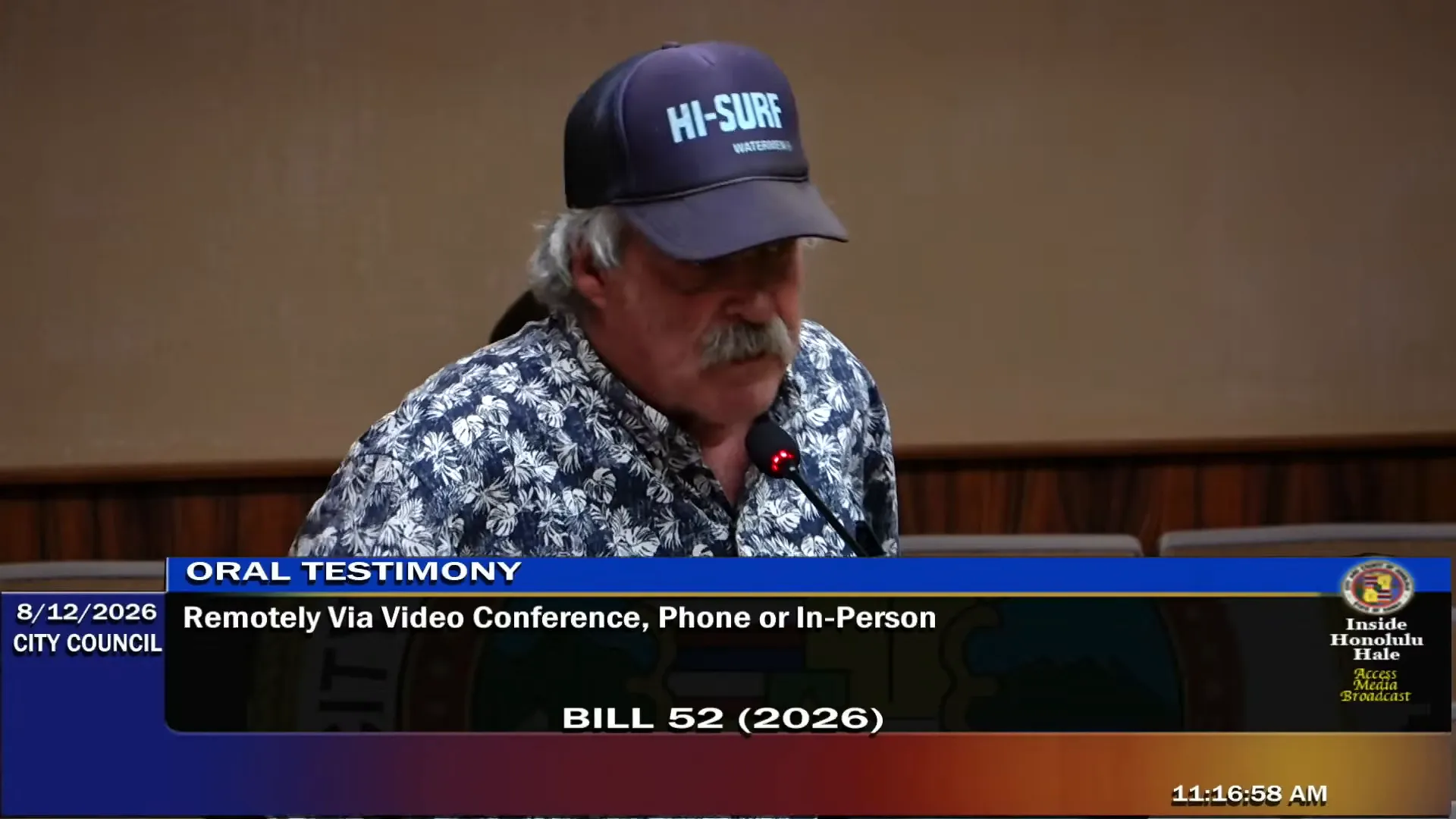
STREAMING COPY IN PREPARATION — RECORDING AVAILABLE FROM THE ORIGINAL SOURCE
Honolulu City Council Meeting – August 12, 2026
This regular meeting of the Honolulu City Council on August 12, 2026, covered a wide range of agenda items including multiple appointments, tax relief measures, first and second readings of bills, and two controversial resolutions urging a ban on commercial aquarium collection. The meeting also featured a message of aloha by Jared Hester of the Polynesian Cultural Center. Eight council members were present; Councilmember Dos Santos Tan was excused.
Consent Calendar
- Minutes Approval: After a testifier raised a sunshine law violation concern regarding the June 3, 2026 meeting, the minutes were approved.
- Shannon Smith (Board of Review for Real Property Tax Appeals) and Shannon Alivado (Grants and Aid Advisory Commission) were confirmed.
- Melanie Islam was reappointed to the Climate Change Commission.
- Krishna Jayram was confirmed as Managing Director on an 8-0 vote (Mayor Blangiardi and several testifiers spoke in support).
- Naalehu Anthony’s reappointment to the Board of Water Supply was referred to committee (nominee absent).
- Hawaii Firefighters Association collective bargaining cost items (total $27.4M over four years) were approved.
- First reading bills (52, 53, 54) relating to peddling fines, shopping cart theft, and trailhead parking restrictions passed first reading with reservations from some members.
Public Comments & Testimony
- P.M. Mazinga demanded correction of alleged sunshine law violation regarding truncated testimony at the June 3 meeting.
- Shelby Billionaire testified on numerous items, often supporting appointments but expressing concerns about property taxes, homelessness, and enforcement issues.
- Natalie Wasa opposed several tax-related bills (Bill 45, 46, 47, 68) arguing they widen affordability gaps or are poorly targeted; she also opposed Bill 53 (shopping carts) as redundant.
- Damian Waikolo opposed tax and fee reductions (Bills 45-47) as insufficient to address cost-of-living, preferring investment in infrastructure.
- Cody Sula (Iron Workers) supported tax relief bills, noting modest savings help working families.
- Dalen Cam (Oahu Transit Riders) supported Bill 41 (e-bike regulation) and asked that transit affordability be considered in relief measures.
- Testimony on Aquarium Resolutions (26-159 & 26-160): Numerous community advocates, Office of Hawaiian Affairs, and environmental groups supported a ban on commercial aquarium collection, citing reef decline and cultural values. Commercial fishermen and industry representatives opposed, citing sustainability data from DLNR and Supreme Court rulings.
Discussion Items
- Bill 52 (peddling fines): HPD and Retail Merchants of Hawaii supported increased penalties to curb scams in Waikiki. Councilmember Kia Aina raised concern about unintended impacts on homeless individuals.
- Bill 53 (shopping carts): HPD and retailers supported; opponents noted theft laws already exist and fines could burden the homeless. Councilmember Tupola expressed reservations; the bill passed first reading.
- Bill 54 (trailhead parking): Supporters said it helps communities manage hiker parking; opponents cited selective enforcement concerns. Passed first reading.
- Bill 68 (homeowner exemption increase from $140K to $160K): Passed second reading 6-2 (Councilmembers Wire and Kia Aina dissenting). Discussion focused on equity and need for broader tax reform.
- Bill 44 (TAT allocation to parks special funds): Adopted 8-0 after debate on special funds versus general fund flexibility. Director Thielen said funds would be used for maintenance and new infrastructure.
- Bill 45 (homeowner exemption for all ages) and Bill 46 (for age 65+): Both passed second reading with reservations from Councilmembers Wire, Toba, and others. BFS opposed, estimating combined revenue loss of ~$10.5M.
- Bill 47 (motor vehicle weight tax reduction by $0.01/lb): Passed second reading 6-2 (Councilmembers Toba and Wire dissenting). DTS Director Morton estimated $39.5M annual revenue loss; council discussed potential exemptions for commercial vehicles or needs-based relief.
- Bill 41 (e-bikes): Passed third reading after an amendment (FD1) removed sales bans on speed modification devices and clarified reclassification requirements. Councilmembers Tupola and Tolba emphasized safety and education.
- Resolution 26-159 & 26-160 (aquarium collection bans): After lengthy testimony, both resolutions were adopted. Councilmember Tupola voted no; Councilmembers Okimoto and Toba had reservations. The resolutions urge DLNR and the legislature to prohibit commercial aquarium harvesting.
Key Outcomes
- Appointments confirmed: Smith, Alivado, Islam, Jayram (all unanimously).
- Collective bargaining agreement for firefighters approved with total cost of $27.4M.
- First reading bills (52, 53, 54) advanced to committee.
- Second reading passed: Bills 68 (homeowner exemption), 44 (parks TAT), 45 (homeowner exemption increase), 46 (senior exemption increase), 47 (vehicle weight tax reduction), 50 (repeal land conservation fund), 16 (dog ordinance), 48 (condemnation).
- Third reading passed: Bill 35 (streets) and Bill 41 (e-bikes, as amended).
- Aquarium ban resolutions (26-159, 26-160) adopted despite objections.
- Other resolutions: Energy vulnerability assessment (26-158), two gift acceptances (26-162, 26-164), art gift (26-163), settlement authorization (CR208), and legal counsel retention (26-175, 176, 177) all adopted.
- Adjourned to September 9, 2026 at 10 a.m.
Meeting Transcript
Good morning, everyone. Welcome. Councilman Okimoto, can you please lead us in the Pledge of Allegiance? Thank you so much. Councilman Wokimoto, would you like to introduce your guest giving us the message of Aloha? Thank you, Chair Aloha, and good morning, everyone. This morning I am so honored to introduce our Message of Aloha presenter, President Jared Hester, who is the recently appointed president and CEO of the Polynesian Cultural Center. Joining him today is his beautiful wife Priya. President Hester previously held the roles of Chief Operating Officer and Chief Financial Officer of the PCC and took on this new responsibility on May 1st. A native of New Zealand, President Hester worked in Auckland for the administration of the church system for the Church of Jesus Christ of Latter-day Saints throughout the South Pacific, which included Samoa, Fiji, Kiribati, and Tonga before coming here to Hawaii. Jared and his family moved here and made Hawaii their home in twenty thirteen. Throughout the center, you will find students who are from Samoa, Tonga, Autoroa, Fiji, Hawaii, and even other parts of the world, like the Philippines, Japan, Korea, Taiwan, and even our council member to Paula, you see an employee of PCC. Local kids are there too. Anyone who steps foot onto the Polynesian Cultural Center will immediately feel the warmth and aloha spirit there. It is like no other place on Earth. Outside of service, you might find Jared spending time with his family, enjoying a friendly competition of pickleball, although friendly is the operative word according to his wife Priya. Aloha, my Kaka Kow. Aloha. It's an absolute pleasure to be here with you today. I'm uh I'm not used to these type of situations. Um, my preference is normally to be in the back of house playing with numbers and spreadsheets. My background is an accounting, and uh recently, three months ago, they've asked me to fill this new role, and so I'm I'm learning to be a little bit more front of house and have to speak with a lot more people and shake a lot more hands and share a lot more of aloha. And uh so it's my my privilege and pleasure to be with you today. Uh I've been asked to share a little message on aloha, and coming from the Polynesian cultural center, uh, that's a little daunting because aloha is very uh precious to us. It's it's what we're about. And so I take that very seriously in terms of sharing that that message. And I've written it out so that I can try and say it properly, so please bear with me. But um, it really is the essence of what the the PCC, the Polynesian Cultural Center exists for. From Aotearoa from the mountains and the waters of the land that shaped me as a as a young man and as a child through to coming here in Hawaii, which is continues to teach and shape me now. Um I have learned that we are bound together by values older and deeper than place. In Olelo Hawaii, aloha is formed from two words, aloh, meaning presence or face to face, and ha, breath of life. And if you take that back, that's it's actually from its roots, if I've understood correctly, it's in the presence of or face to face with face to face with deity. And so it's a sacred word. Um to greet another with aloha is to acknowledge that we share the same sacred breath. It is more than a feeling, it is a decision to see the divine worth and the divine worth in the person before us and to act accordingly. This understanding is shared across all of Polynesia. In different islands, we hear it through but through the same heartbeat. Aloha, if you're from Samoa, or Ofa from Tonga, or Aroha, if you're from New Zealand. Among the Maori people of Aotearoa, that shared breath is made visible in the Hongie. Now you may have seen this a few times, where noses are pressed together and foreheads are pressed together, and then a breath is shared, the breath of life. And in doing so, in that quiet moment, the boundary between self and others is softened, and life is exchanged through that breath. Shared between people. When Olala Hawaii experts speak of living aloha, they reach back to this deeper sense, the practice of recognizing and honoring life in another. Aloha at its core is a spiritual concept. The spirit of aloha is connected to deity. It is not simply a cultural idea or a warm emotion. It is a sacred way of seeing and relating to one another, that reaches beyond the human and toward the divine. It is the quiet courage to seek understanding before seeking advantage, and to treat every person as one who carries that same sacred breath we do. When we have aloha, we have charity. If we substitute the word aloha for charity, we can read, and aloha suffereth long and is kind and envyeth not, and is not puffed up, seeketh not her own, is not easily provoked, thinketh no evil, and rejoiceth not in iniquity, but rejoiceth in truth, beareth all things, hopeth all things, endureth all things.
openpublica.com