The City and County of Honolulu held a meeting on October 26, 2026, to receive a presentation and discuss Charter Amendment No. 2, a ballot measure proposing to rewrite the preamble of the city charter. The proposed new language seeks to recognize the relationship between the people and the ʻāina (land), honor kupuna (elders) and Prince Jonah Kūhiō Kalanianaʻole, and affirm commitments to transparent, accountable government and stewardship of natural, civic, and cultural resources. Discussion Items - Presentation on Charter Amendment No. 2: The body received a detailed briefing on the proposed amendment. The presentation explained that the measure would replace the existing opening statement of the city's constitution with new language emphasizing Native Hawaiian values, cultural heritage, and governmental accountability. - Supporters' Position: The presentation noted that supporters view the amendment as a meaningful recognition of Native Hawaiian history and a clear promise of transparency and public involvement. They see it as a statement of shared responsibility to the land, water, and community. - Concerns Raised: The discussion also highlighted limitations of the amendment, which were presented as typical constraints of a preamble. It was noted that the amendment would not create new funding, impose new duties on city departments, or establish new legal rights enforceable in court. Consequently, passing the amendment alone would not alter land-use decision-making processes or change open government rules. - Framing of the Amendment: The presentation characterized the measure as primarily symbolic and directional, posing the fundamental question for the body's consideration: whether these values belong at the forefront of the city's charter. Key Outcomes - The meeting concluded with the comprehensive information having been presented and discussed. - No formal votes, motions, or referrals were made. The discussion served as a deliberative and informational session regarding the scope and implications of the charter amendment.
Public Meetings - Honolulu, Hawaii
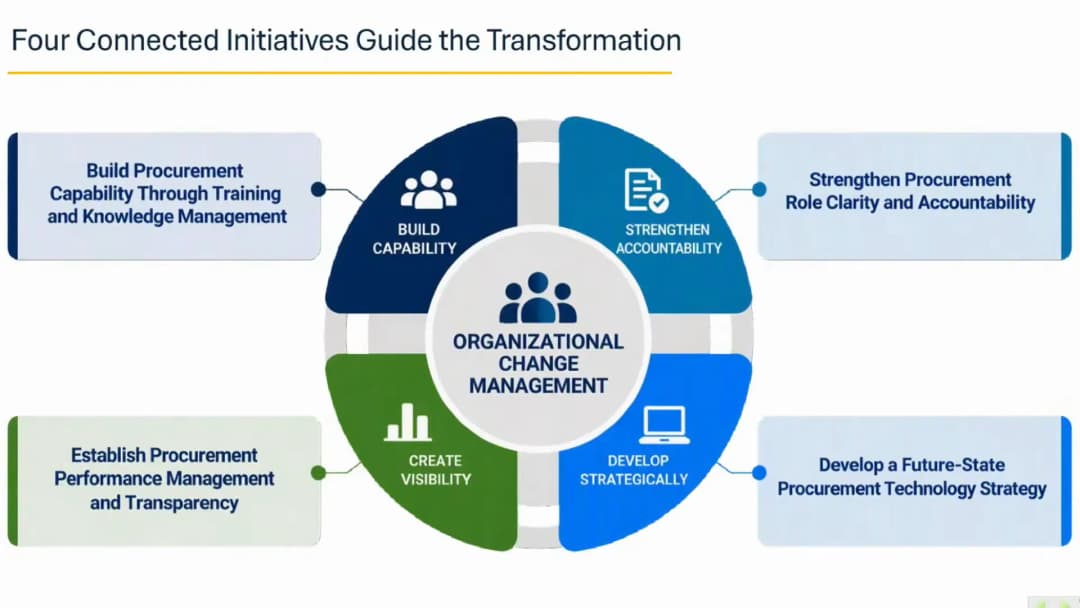
Public Meetings - Honolulu, HawaiiThe Honolulu City Council Committee on Government Efficiency and Customer Services met under the provided timestamp 2026-10-23 00:31:13+00:00; the transcript opens with the local time 2:34 PM on Thursday, October 22, 2026. Chair Dosantos TAM presided, joined by Vice Chair Weyer and Council Members Cordero and Nishimoto. The committee considered Resolution 26-227 and received a report from the Department of Budget and Fiscal Services on its procurement process improvement project. Resolution 26-227 – Gift Acceptance - William Trujillo, DMV Program Administrator for the Department of Customer Services, presented Resolution 26-227. The resolution accepts a gift valued at $3,000 from the American Association of Motor Vehicle Administrators for a Department of Customer Services representative to attend the 2026 AMVA Region 4 Administrator and Law Enforcement Officials meeting in Monterey, California, December 1–2, 2026. - No questions were raised by members, and no public testimony was offered. - Note: at the vote, the chair referred to the item as Resolution 22-227, while the item was introduced as Resolution 26-227. Procurement Process Improvement Project Report - Paula Youngling, Central Purchasing and Contracts Administrator for the Department of Budget and Fiscal Services, presented the report, joined by Deputy Director Carrie Castle, Assistant Administrator Kelsey Imamura, and consultants David Ledbetter Jr. and Abigail Starr of Barry Dunn McNeil and Parker LLC. The presentation was available online as Departmental Communication 660. - Youngling said the procurement improvement effort began in summer 2024 after the mayor challenged the centralized purchasing division to address capacity constraints and long-standing procurement delays. The procurement improvement working group (PIWG) was established and has produced early wins: 10 new staff positions were programmed for FY26 and all 10 are now working; the small-purchase threshold was increased, removing more than 100 transactions from the procurement workflow; a contract administration portal gives departments six-to-nine-month lookaheads of contract end dates; and a procurement one-stop shop and standardized training plan/course catalog are being developed. - Consultant David Ledbetter reported that the current-environment assessment covered technology, people, process, and policy, and documented 72 unique challenges and opportunities across six departments, later consolidated into 25 common items. The project produced nine recommendations, four visioning sessions, and an 18-month implementation roadmap organized around four capabilities: building procurement capability through training and knowledge management, strengthening accountability, creating visibility through KPIs, and modernizing technology through a precise strategy. - Ledbetter said training is the number-one priority and is already underway. A two-hour workshop prioritized eight training areas; the consultant described the rollout as 'three of the way through' and said five packages were expected by the end of the month. - The market research RFI examined contract lifecycle management and e-procurement systems, including implementation timelines, costs, and features, as well as compatibility with the city's ERP system (CHIRPS). Member Questions and Discussion - Councilmember Cordero thanked the presenters and asked how the project handles departments that procure through client departments, such as through the Department of Design and Construction. Youngling responded that the project intentionally looks at the entire procurement lifecycle, not just the purchasing division. Cordero also asked about re-procurements and rebids; Ledbetter and Youngling linked repeated rebids to difficulty developing marketable scopes of work and specifications, and said new training and master agreements are intended to reduce those failures. Cordero also asked a clarifying question about the RFI and implementation timelines; Ledbetter explained that the RFI targeted contract lifecycle management and e-procurement systems, with business process management tools also discussed for internal performance tracking. - Councilmember Weyer asked what made filling the 10 positions successful. Youngling said hiring was made the division's top priority, used DHR's one-day hiring process, and filled most positions by March. Weyer also asked about master agreements; Youngling described a Department of Design and Construction Civil Division pilot with five-year multi-award master agreements, five contractors for each need, allowing delivery orders without returning to procurement. She also cited a Washington state cooperative agreement for buses and handy vans and a pending NASPO agreement for fire apparatus. Public Comments & Testimony - For Resolution 26-227, no registered or remote testifiers appeared, and testimony was closed. - For the procurement report, one registered testifier was not logged on; no oral testimony was given. Key Outcomes - The committee ordered Resolution 26-227 reported out for adoption, with no objections or reservations. - The committee received the procurement process improvement report; no formal action was taken on the report. - The meeting was adjourned at 3:23 PM local transcript time.
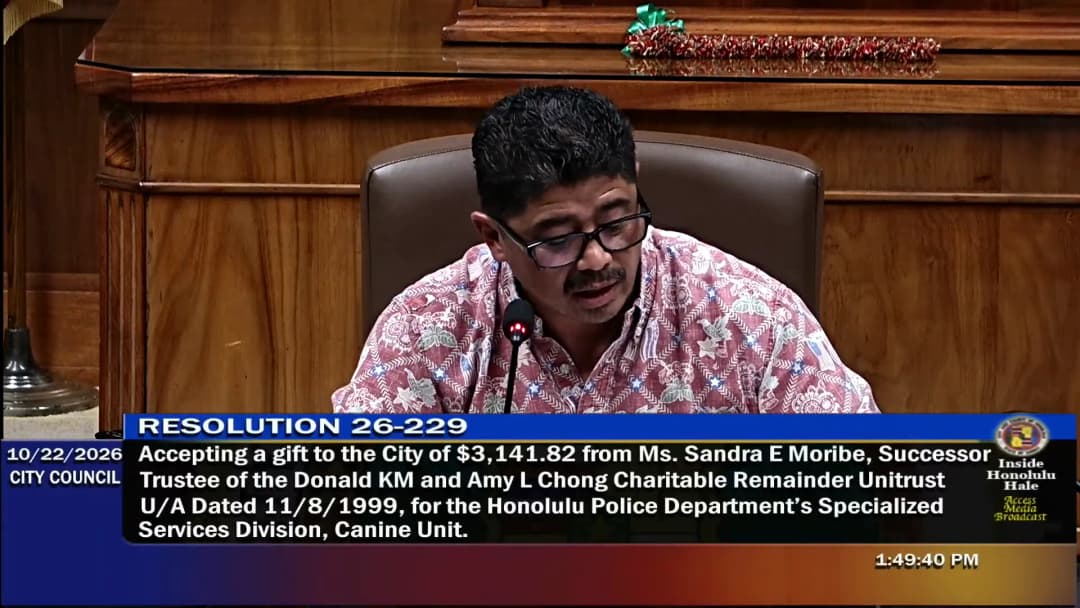
The Committee on Public Safety and Economy met on October 22, 2026, at 1:00 p.m. in a remote meeting format. The committee considered four agenda items: Bill 53 (2026) regulating shopping carts, two resolutions for appointments and gift acceptance, and an informational briefing on the Department of Emergency Management (DEM) reorganization. The meeting included public testimony, deliberation, and roll call votes. Bill 53 (2026) – Shopping Cart Regulation Proposal: The bill requires retailers to clearly mark shopping carts and prohibits moving them off the premises. Two proposed CD1 amendments were considered: one from Council Chair Waters making it a petty misdemeanor with an affirmative defense, and one from the Committee Chair reducing the fine to $1,000. Discussion and Testimony: - Support: Honolulu Police Department Major Paul Komodo expressed 100% support, stating the bill targets theft and that retailers lose $200–$800 per cart, costs passed to consumers. David Erdman (Retail Merchants of Hawaii) supported the bill, calling carts private property. John Dutzman (resident) described public safety incidents involving carts in Waikīkī. Tim Gary (former grocery veteran) supported the bill, proposing a compromise of lower fines and community service. - Opposition: Isis Osborne (Hawaii Alliance for Progressive Action) opposed, arguing the bill criminalizes poverty and does not address root causes. Sergio Alcobilia (individual) opposed, suggesting storage alternatives. Liam Chin (public safety professional) opposed, citing $307/day incarceration costs and noting 37% of incarcerated individuals are homeless. Heather Lusk (Hawaii Health and Harm Reduction Center) opposed, stating criminal records hinder housing placement. Mandy Fernandez (ACLU of Hawaii) opposed, highlighting constitutional concerns with strict liability and disproportionate penalties. - Council Discussion: Council Chair Waters acknowledged the issue but argued the bill provides a tool for police; he supported the CD1 that lowers penalties. Councilmember Kia Aina opposed, saying the bill does not solve the problem. Councilmember Okimoto questioned enforcement. The Chair recommended reporting out the CD1 (OCS 2026-0660) with Waters' amendments. Key Outcome: Motion to report Bill 53 (CD1) for second reading passed on a roll call vote of 3-1 (Councilmembers Okimoto, Nishimoto, and Chair voting aye; Vice Chair Kia Aina voting nay). Resolution 26-213 – Reappointment to Ocean Safety Commission Proposal: Confirms the reappointment of Dr. Richard Kibo to the Ocean Safety Commission for a term ending June 30, 2031. Discussion and Testimony: Dr. Kibo expressed interest in continuing. One public testifier, Tim Gary, supported the reappointment citing progress. No opposition. Key Outcome: The resolution was reported out for adoption without objection. Resolution 26-229 – Gift Acceptance for HPD K9 Unit Proposal: Accepts a $3,141.82 gift from Sandra M. Moribe (successor trustee) to the Honolulu Police Department's Specialized Service Division K9 Unit. Discussion and Testimony: HPD Major Hunter Alu expressed appreciation and requested approval. No public testimony. Key Outcome: The resolution was reported out for adoption without objection. Informational Briefing: Department of Emergency Management Reorganization Update Presentation: DEM Director Randall Collins described the reorganization plan to fill 13 new positions (budgeted for FY27) across six sections: plans and operations, logistics, community partnerships, training/exercise, risk mitigation, and public information. He outlined the hiring process timeline and noted the department previously had only 15 staff, limiting EOC activation to 12 hours. Discussion: Councilmember Kia Aina criticized the presentation as lacking passion and vision, and stressed the importance of pre-disaster planning and community ties. She referenced concerns from a recent NACo event about the EOC. Councilmember Okimoto questioned the necessity of some positions and asked for clearer justification and community engagement. Councilmember Nishimoto asked about three reallocated positions and how the new staff would overcome implementation delays from FEMA and grant cycles. Key Outcome: No action taken; the briefing was for informational purposes only. Director Collins agreed to provide future updates with more strategic context.
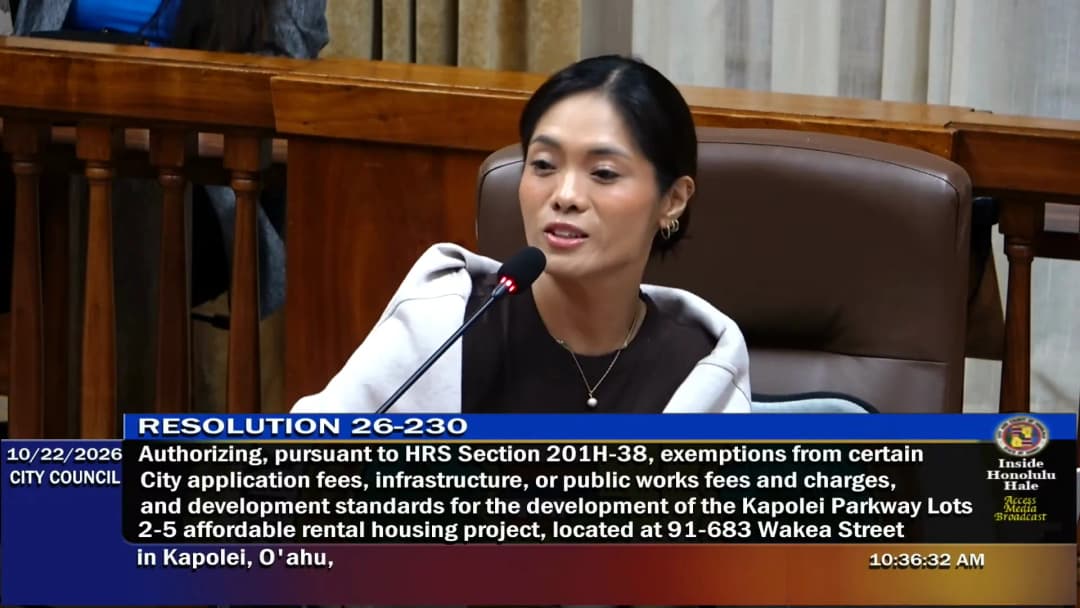
The Honolulu City Council Committee on Zoning and Planning met in person on Thursday, October 22, 2026, at 9:04 a.m. Chair Kia Aina presided. Remote verbal testimony was permitted, with each speaker limited to one minute per item. The committee took action on Resolution 26-236 (Bellows Air Force Station land return), three Special Management Area major permits, Resolution 26-230 (Kapolei Parkway affordable housing), and Bill 55 (2026) (YMCA downzone). Resolution 26-233 was canceled and not considered. Public Comments & Testimony - On Resolution 26-236, testifiers strongly supported returning Bellows lands to the people of Hawaii. Kuike Kamakea Ohelo (Restoration Advisory Board co-chair) called the taking Aihue, said the land was Crown Land, and urged adoption of amendments for parcel-by-parcel review, cleanup without delaying return, and return to the public land trust. Keoni DeFranco cited community restoration efforts and urged co-management, federally funded cleanup, and a timeline. Puohonua Dennis Kanahele (Nation of Hawaii) framed the return as reconciliation following the 1993 Apology Resolution. Lena Ala Le (Office of Hawaiian Affairs chief advocate) said OHA supports return and reexamination of all military-held lands. Brandon Maka Ava (Nation of Hawaii vice president) spoke of Aina readiness and the community's restoration record. Other testifiers, including Leslie Keating, Karen O'Mahony, Pohono Coleman, Isis Osborne, and Kimio Nakane (Waimanalo Neighborhood Board chair), supported return and cleanup. Jodi Mao Kelly, a Bellows employee, asked that employee protections, priority hiring, and continuing jobs be included in any transition plan. - On Resolution 26-230, Sam Kim and Mark Anthony Clemente of the Hawaii Regional Council of Carpenters supported the project and the requested fee waivers, citing the need for affordable homes for local workers. Leslie Keating opposed the park and storm sewer fee waivers, saying the surrounding community already has strains and no recreational space was planned for more than 1,100 total units in the area. Discussion Items Resolution 26-236 – Bellows Air Force Station Land Return Chair Kia Aina introduced a hand-carried CD1 that urges the United States to return lands used by Bellows Air Force Station to the people of Hawaii in consultation with the Native Hawaiian community, the Waimanalo community, and the State of Hawaii Department of Hawaiian Homelands. The CD1 also states that the United States shall bear the costs of unexploded munitions cleanup and chemical contamination remediation. Noelani Kalipi, Senior Advisor with the Hawaii Coordination Cell in the Office of the Assistant Secretary of War for Energy Installations and Environment, attended; she said her office exists to collaborate and that she could not make decisions for the military services. She agreed with the resolution's historical accounting and said there is a pathway for deciding which portions could be returned. The resolution recites that 1,510 acres were set aside by executive order in March 1917, the runways closed in 1958, and in 2000 about 1,049 acres were transferred for Marine Corps training. Testifiers and members noted the land is currently used for recreation rather than the original military purpose. Councilmember Tupola referenced a 1996 federal record of decision identifying 170 acres along the southern boundary for return and a 2021 legislative resolution; she called co-management a first step, citing Makua as a roadmap. Resolutions 26-218, 26-220, and 26-221 – Special Management Area Major Permits - Resolution 26-218 grants an SMA major permit to the Smith Trust for a 14,269-square-foot R-10 shoreline lot at 47-347 Lulani Street in Kaneohe. Laura Ayers of White Space Architects said the proposed home replaces a 1962 house, remains outside the 130-foot SMA setback, and is not expected to be affected by coastal erosion or 3.2 feet of sea level rise by 2100. - Resolution 26-220 grants an SMA major permit to Nicholas and Chris Krista Baum for a 28,392-square-foot R-10 lot at 60 Kaapuni Drive in Kailua. Jim Hayes of Planning Solutions said the development includes two single-family dwellings totaling about 7,000 square feet and a swimming pool, is outside the sea level rise exposure area, and that Kailua Beach is accreting in that area. The CD1 requires submittal of the State Historic Preservation Division's acceptance of the archaeological inventory survey and any needed mitigation commitments. - Resolution 26-221 grants an SMA major permit to Randall and Irene Wong for a 12,754-square-foot R-10 lot at 84-253 Farrington Highway in Waianae. Jim Hayes said the undeveloped coral-substrate parcel would receive a roughly 3,000-square-foot single-family house and a detached garage with an 800-square-foot ADU, with no pool and no variances required. No public testimony was offered on these three items. Department of Planning and Permitting staff supported all three. The committee amended each to its posted CD1 and reported them out for adoption. The verbal amendments revised landowner acknowledgment conditions B2/C2 to retain the first sentence and delete the last two sentences. Resolution 26-230 – Kapolei Parkway Lots 2-5 Affordable Rental Housing Isaiah Sato and Alana Kobayashi Pakala (Kobayashi Group) presented the project for KP 52 LLC. The proposal is approximately 737 affordable rental units and 8 manager units in 16 three- and four-story buildings on a 15.192-acre portion of a city-owned BMX-3 zoning lot in Kapolei. Units would serve households earning 30%, 60%, or 80% of AMI, with an income-averaging approach keeping the overall average at or below 60% AMI; rents remain affordable for at least 73 years. At 60% AMI, a one-bedroom was estimated at about $1,700 and a four-bedroom at about $2,680, including utilities. The CD1 grants fee exemptions and deferrals and relief from joint development and bicycle parking requirements. The developers said a development agreement with the Department of Housing and Land Management is still being negotiated; councilmembers urged DHLM to appear and coordinate. Discussion also covered lessons learned from the adjacent Parkway Village, including larger family units, daycare spaces, and traffic improvements. Bill 55 (2026) – YMCA Central Property Downzone Walter Thames III (YMCA of Honolulu president and CEO) and Alec Harrington presented the request to rezone the 1.77-acre YMCA property at 401 Atkinson Drive from AMX-3 with a 350-foot height limit to A2 with a 150-foot height limit, and to rezone the fronting portion of Atkinson Drive from BMX-3 to A2. The bill also terminates the unilateral agreement recorded under Ordinance 13-34, which was tied to a 128-unit residential tower project approved in 2013 but never built. The current buildings date to 1951 and include a 113-room dormitory operating at about 75% occupancy. Thames said the agreement is an obstacle to future opportunities and that any future redevelopment would need separate approvals. The property is within the Ala Moana TOD plan area. DPP chief of planning Dina Wong said DPP supported the CD1. No public testimony was offered. Key Outcomes - Resolution 26-236 CD1 was reported out for adoption; Councilmember Okimoto noted reservations. - Resolution 26-218 CD1 was reported out for adoption. - Resolution 26-220 CD1 was reported out for adoption. - Resolution 26-221 CD1 was reported out for adoption. - Resolution 26-230 CD1 was reported out for adoption. - Bill 55 (2026) CD1 was reported out for passage on second reading with a public hearing scheduled; a 90-day extension was granted under Miscellaneous Communication 447 (2026). - Resolution 26-233 was canceled and not considered.
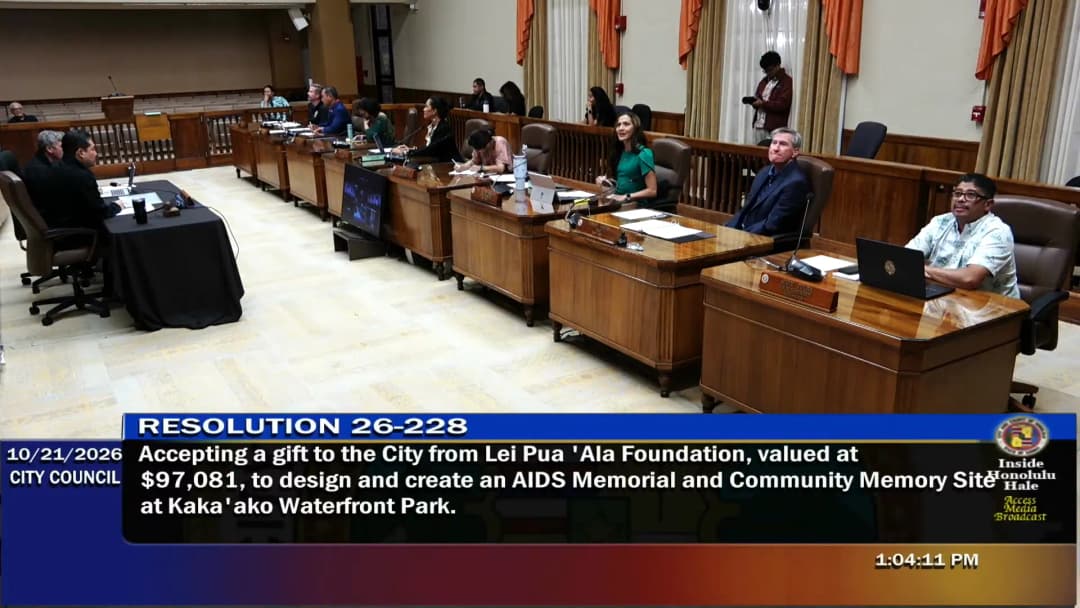
Public Comments & Testimony - Dylan Armstrong, speaking in an individual capacity as an urban advocate and longtime LGBTQIA supporter, expressed support for the gift, noting its appropriateness as a monument near the center of power in Honolulu and its role in beautifying the area and honoring the HIV/AIDS activist community. - Andrew Ogata, representing the Hawaii Health and Harm Reduction Center (the local HIV service organization), offered to answer questions and stated the organization's support for the monument. - The managing director of the city expressed full support for the project and the gift, speaking on behalf of the administration. Resolution 26-228 (Gift) The committee heard testimony and discussed Resolution 26-228 regarding a generous gift for an HIV/AIDS monument in a park. All testifiers spoke in favor. Chair recommended reporting the resolution out for adoption. There were no objections. Executive Session and Agenda Item 2 The committee resolved into executive session pursuant to HRS Sections 92-4 and 92-2-5(a)(4) to consult with attorneys on the settlement case Kim vs. City and County of Honolulu (agenda item 2). After the closed session, the committee reconvened. Chair recommended postponing the item until the next month. No objections were heard. Key Outcomes - Resolution 26-228 was reported out for adoption with unanimous support. - Agenda item 2 (request for authorization to settle the case Kim vs. City and County of Honolulu) was postponed to the next month's meeting.
The recording/meeting is dated October 21, 2026, at 22:46:48 UTC. No agenda or minutes were available, so this summary is based solely on the raw transcription. The session presented a voter-education explanation of Charter Amendment No. 13, which would rename the Clean Water and Natural Lands Fund and expand its allowable uses to include historic preservation. Ballot Measure Overview - Charter Amendment No. 13 would rename the Clean Water and Natural Lands Fund as the Land, Natural Resources and Historic Preservation Fund, and similarly rename the fund's advisory commission as the Land, Natural Resources and Historic Preservation Advisory Commission. - The amendment would expand what the fund can pay for: in addition to protecting land and water, it could pay to preserve, repair, restore, and rebuild historic and culturally important buildings, structures, objects, and neighborhoods. - Some historic projects would be reviewed by the Oahu Historic Preservation Commission, while other proposal reviews would be allocated between that commission and the advisory commission. Positions and Arguments - The explanation noted that the measure is on the ballot because buying land is sometimes not enough; historic and cultural sites on protected land may need repair and ongoing care. - Supporters see the amendment as recognizing that protecting heritage goes hand in hand with protecting land. - Concerns raised: the fund does not get any bigger, so money for historic preservation would compete with protecting watersheds, farmlands, wildlife habitat, and public access. - Another concern: restoring old buildings creates long-term upkeep costs. - The key takeaway presented was that this is more than just a name change; it raises the question of whether historic preservation should share the same funding as land and natural resources protection. Key Outcomes - No vote or formal decision occurred during this session. - The session was an explanatory description of the ballot measure for voters, outlining what the amendment would do and the arguments on both sides.
This meeting consisted of an informational presentation on a ballot charter amendment to establish an Office of OEV Resources and Cultural Stewardship within the Office of the Mayor. The presentation described the proposed office, the reasons for putting the measure on the ballot, supporter positions, and concerns. No agenda or minutes were available, and no formal council action was recorded. Discussion Items - The measure, identified as Charter Amendment No. (number not specified in the transcript), would create an Office of OEV Resources and Cultural Stewardship within the Office of the Mayor. - The office would oversee management of OEV resources in the city, develop related programs, and create a cultural advisory council of kupuna, cultural practitioners, and community representatives. - The Mayor would choose the office's leader, and the City Council would approve that choice. - The office would advise other city departments, report to the public every year, and bring together a council of cultural advisors. - The ballot rationale stated that Native Hawaiian and cultural issues are currently handled by many different departments with no single place in the city to coordinate them. - Supporters expressed support for the amendment, saying a dedicated office could bring cultural knowledge and projects earlier, improve how Hawaiian language and place names are used, strengthen care for resources, and make the city more accountable through yearly reports. - Some people expressed concerns about cost, clout, and overlap. The measure gives the office broad responsibilities but does not specify staffing levels, budget, whether other departments must follow its advice, or how disagreements would be settled. The presentation noted that with clear roles it could help; without them, it could become another layer of red tape. Key Outcomes - No vote, motion, or formal decision was recorded in the source material. - The meeting appears to have been an informational overview of the ballot measure. The agenda and minutes were not available to verify additional proceedings.
On 2026-10-21 at 22:06:30 UTC, the available transcript provided an informational overview of Charter Amendment No. 1, a ballot measure concerning a food security fund on Oahu. No agenda or minutes were available, and no actual board/council deliberation or public testimony was recorded. Discussion Items - The transcript framed the ballot question as whether the city charter should require annual funding for a food security fund without having to simultaneously increase real property tax rates to support programs and grants that provide locally grown or produced food to Oahu residents, with non-local food allowed only in an emergency. - Charter Amendment No. 1 would increase the city's annual property tax set-aside for special causes from 2.5 cents per dollar to 3 cents per dollar, directing half a cent of every dollar to a new food security fund. - The fund would focus on helping Oahu residents afford healthy food, with an emphasis on food grown, raised, and caught in Hawaii. Non-local food could be purchased only during a declared emergency and with about 10% of the fund. - The narrator explained that the measure does not by itself raise property taxes, but it would lock up more of the city's existing money and leave less room for other budget needs. - Supporters were described as favoring a steady, dependable funding source for hunger relief and local farming, with unspent money staying in the fund and building up for larger projects such as food storage or delivery. - Concerns highlighted included the reduced flexibility for other city needs and the tight restriction on using non-local food during an emergency, with some worrying that the roughly 10% cap would be too limited in a real crisis. - The key takeaway was framed as a choice between writing a permanent food commitment into the city charter or letting elected leaders decide the amount each year through the budget process. Key Outcomes - No votes, decisions, or official recommendations were recorded in the available transcript; it served as an informational summary of the amendment for voters.
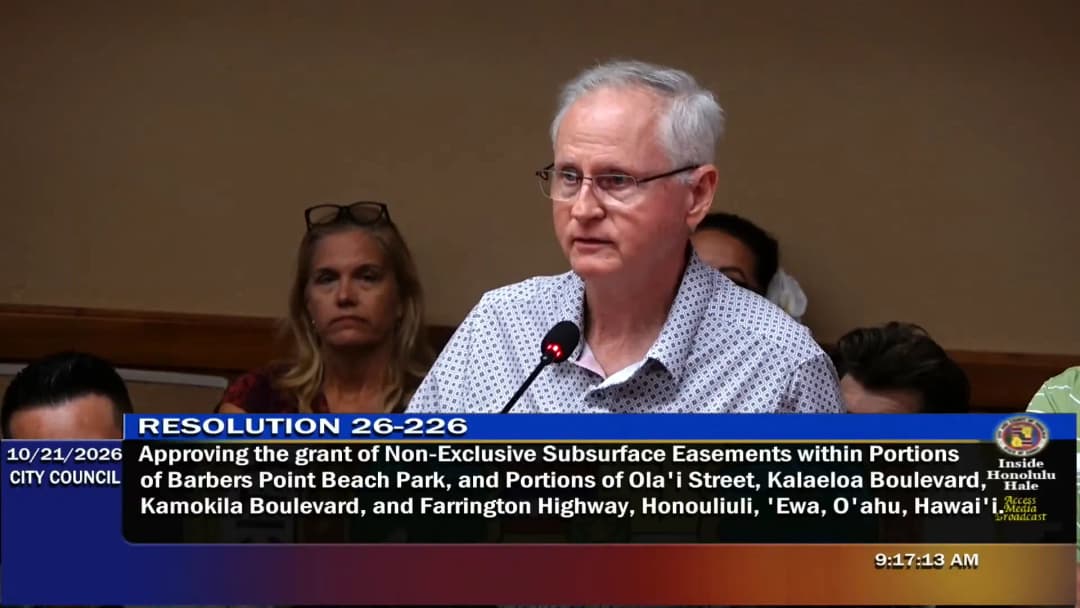
The Committee on Infrastructure, Transportation, and Technology, chaired by Chair Cordero, convened on Wednesday, October 21, 2026, at 9:02 AM. Members present included Vice Chair Okimoto, Councilmembers Susantis TAM, Topola, and Council Chair Waters. Councilmember Wire was excused at the start but later joined. The committee considered four action items and received two informational briefings. Resolution 26-226: Subsurface Easements for Subsea Fiber Optic Cables (Humu Humu Services) Jim Amato of Humu Humu Services and Chris of BHC presented a proposal for non-exclusive subsurface easements to connect long-haul subsea fiber optic cables to a new telecom facility at the University of Hawaii West Oahu campus. The project aims to expand broadband capacity and improve internet redundancy in the Pacific. The community benefits package includes an in-kind beautification of Barbers Point Beach Park (trees, irrigation, fencing) valued at an estimated $700,000. Council Vice Chair Tipola, whose district includes the project area, raised several concerns. She noted that the $700,000 community benefit is an in-kind donation, not a cash contribution, and questioned the long-term maintenance of the park improvements by DPR. She strongly emphasized the severe traffic congestion on Kalailoa Boulevard, particularly at the Kapolei Commons intersection, and requested detailed construction notification flyers for businesses in the Campbell Industrial Park. Jim Amato committed to providing advance notification and working with the city on traffic mitigation, including potential off-peak and night work. Paula Youngling of the Department of Budget and Fiscal Services confirmed the $2,950,310 easement fee will go directly to the city's general fund. Council Chair Waters suggested the possibility of appropriating these funds for specific needs, such as the Kapolei Police Station. Councilmember Okimoto inquired about the project timeline, noting it was "down to the wire" for end-of-year construction. Amato confirmed the permitting process is ongoing, with the building permit for the telecom facility being the main outstanding item. Councilmember Wire expressed strong support for the project, highlighting its benefits for digital resilience and redundancy in the Pacific. Key Outcome: Resolution 26-226 was reported out for adoption by the full council. The vote was unanimous. Resolution 26-235: Appointment of Anthony J. Baldomero Jr. to the HART Board Anthony J. Baldomero Jr., a 33-year veteran of the Hawaii Campaign Spending Commission, introduced himself as the council's appointee to the Honolulu Authority for Rapid Transportation (HART) Board of Directors. He emphasized his experience with government transparency, budgets, and the legislative process. Baldomero stated his initial priority is finishing the funded Kakaako segment of the rail project and adhering to the Locally Preferred Alternative (LPA). He acknowledged that any extensions would require additional funding sources authorized by the legislature. Council Vice Chair Tipola expressed support for Baldomero, appreciating his meticulous background. She advocated for the needs of her West Oahu district, specifically requesting consideration for a parking lot at the UH West Oahu rail station on the correct side of the street and improvements to the Kroc Center station. Key Outcome: Resolution 26-235 was reported out for adoption. Baldomero stated he would meet with all council members prior to the formal appointment vote scheduled for November 5. Resolution 26-20: DTS Agency Safety Plan for Rail Operations Director Roger Morton of the Department of Transportation Services presented the annual Agency Safety Plan required by federal transit law, covering the Skyline rail system. Director Morton detailed safety improvements made since the system began operation, including re-engineering fair gates to prevent trapping children and closing small gaps on station platforms. He reported very few federally reportable incidents over the system's three-year history. Regarding elevator and escalator outages, Morton stated they are running at over 99% availability. Deputy Director Hong Lin provided an update on the Pearl Highlands pedestrian bridge project, a top priority for DTS. Lin stated a $20 million federal grant has been secured, an engineering support contract was signed in September 2026, and construction is anticipated to begin in 2030. Key Outcome: Resolution 26-20 was reported out for adoption. Bill 58 (2026): Shared Micromobility Vehicle Parking (Waikiki Exemption) Major Paul Okamoto of the Honolulu Police Department testified in support of a bill to amend shared micromobility vehicle parking regulations. He cited an unlicensed scooter operator in Waikiki whose vehicles are frequently left haphazardly on sidewalks and roadways, creating trip hazards. Currently, under Section 15-31.8, the city must notify the operator and wait four hours before removing improperly parked vehicles. The bill seeks an exemption for the Waikiki Special District, allowing for immediate removal of shared micromobility vehicles from public property. Major Okamoto noted that a cease-and-desist letter had been sent by DTS, but the operator continues to operate and has retained legal counsel. Council Chair Waters, the bill's introducer, supported it as a preventative measure against trip hazards and lawsuits. Key Outcome: Bill 58 was reported out for second reading and scheduling of a public hearing. Informational Briefing: AI-Driven Mainframe Modernization (Department of Information Technology) Director Ryan McKee provided an update on the city's effort to modernize its DMV mainframe system, which still relies on COBOL programs and green-screen terminals. McKee outlined three modernization paths explored by the department: 1. Commercial Off-the-Shelf (FAST): Estimated cost of $80M+ (California paid $500M), with a long implementation timeline. 2. Code Share with Arizona DOT: A modern system available for $16M but requiring 2-3 years to implement. 3. AI-Driven Transformation: A new proof-of-concept successfully converted 15 COBOL programs into a modern Azure cloud stack. This option is estimated at $2.3 million and could be fully operational in 6-12 months. McKee stated he has chosen to proceed with the AI-driven path, which is funded within his current budget. Upon completion, the city will own the code and save $3 million annually in mainframe rental costs. The new system includes built-in AI assistance for customer service representatives. The mainframe will be kept in an archival state for 1-2 years as a backup during the transition. Council Vice Chair Tipola and Councilmember Okimoto questioned the staffing transition (2 COBOL developers to 20 modern staff) and data backup plans. McKee clarified the 20 staff members are reallocated from the existing applications team and that the database migration to MongoDB is already underway. Key Outcome: This was an informational briefing; no action was taken. The department will proceed with the AI migration starting next month. Informational Briefing: Q4 2026 Public Works Projects (Department of Design and Construction) Deputy Director Mark Yonamine of the Department of Design and Construction (DDC) presented a list of upcoming public works projects scheduled to bid before the end of 2026. Highlights included the Capilani Boulevard paving project, replacement of the fire alarm system at the traffic management center, and the Mahly Community Park irrigation system improvements. Council Vice Chair Tipola discussed the challenges of community engagement and traffic mitigation for projects on busy corridors. She asked about notification procedures for shifting construction schedules. Yonamine stated that DDC works with contractors and DTS on traffic control plans and will coordinate with council members to inform the public of significant changes. Key Outcome: This was an informational briefing. Chair Cordero announced this will be a recurring first-quarter briefing to allow the committee to review upcoming construction projects.
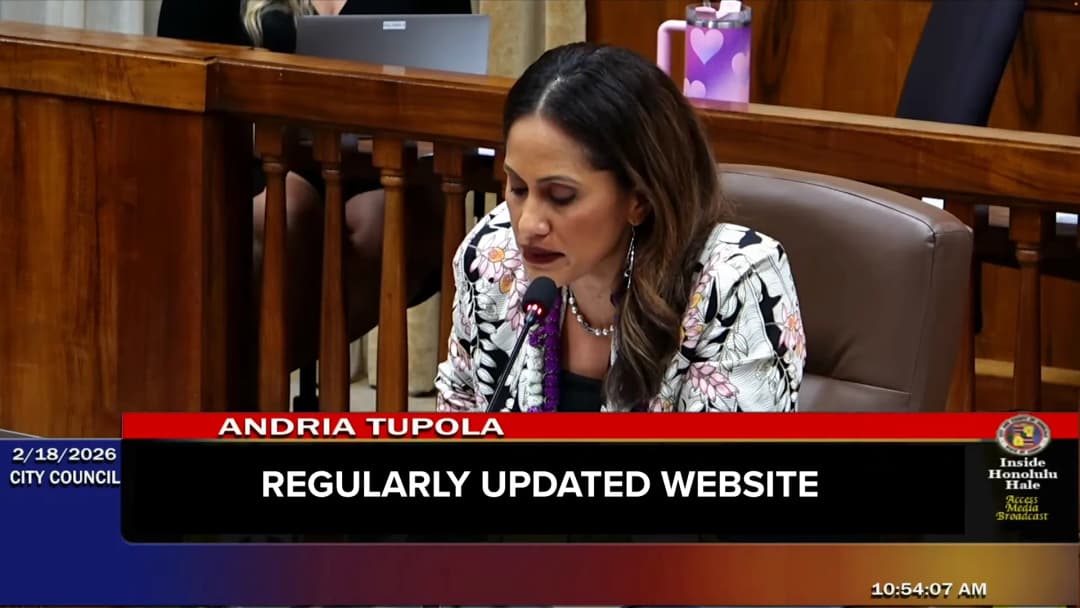
The meeting opened with Chair Tommy Waters welcoming viewers to Council Conversations. Councilmember Tupola led the Pledge of Allegiance. Chair Waters introduced University of Hawaii Rainbow Warriors head football coach Timmy Chang, stating that tough decisions are needed to preserve Hawaii. Lulu the Honu, the city's beloved ambassador, made a special appearance. Discussion Items - Wastewater and Stormwater Transparency Bill: The council discussed a bill requiring a publicly accessible, regularly updated website with an interactive map integrating the city's wastewater and stormwater systems, described as a measure to strengthen transparency and accountability. - Councilmember Position: A councilmember expressed support for the bill, explicitly requesting that the proposed website include information for communities waiting to connect to the city system, including time frames and whether the city will conduct community outreach. The councilmember stated the bill does not remove council oversight over the project and \"heart\", and emphasized that it does not represent a blank check. The speaker expressed hope for future funding to extend the project. Key Outcomes - The bill was discussed as a transparency and accountability mechanism for the city's wastewater and stormwater systems. - A councilmember requested that community-specific connection timelines and outreach efforts be included in the transparency portal. - The councilmember affirmed the bill maintains council oversight and does not constitute a blank check appropriation.