Kirkland City Council Regular Meeting – March 7, 2023
STREAMING COPY IN PREPARATION — RECORDING AVAILABLE FROM THE ORIGINAL SOURCE
Kirkland City Council Regular Meeting – March 7, 2023
The Kirkland City Council held a hybrid study session at 5:30 p.m. and a regular meeting at 7:30 p.m. on March 7, 2023, with all seven councilmembers present. The agenda included a Google Fiber study session, a NE 85th Street Station Area Plan Phase 2 briefing, a Women’s History Month proclamation, public comment, a Capital Improvement Program update, the consent calendar, and business items including Health Through Housing agreements and a state legislative update. The regular meeting adjourned at 10:30 p.m. after entering closed session to discuss collective bargaining.
Study Session: Google Fiber Discussion
- Google Fiber proposed to build and maintain a citywide fiber-optic network in Kirkland rights-of-way at no cost to the city, using micro-trenching, with 1, 2, or 5 gigabit internet products and potential low-income rates.
- Staff described benefits including digital equity, city fiber resiliency, and support for future smart city services, and concerns including impacts on pavement condition, utility conflicts, sidewalk crossings, franchise agreement terms, and staffing.
- Council members expressed cautious interest in continuing to explore the proposal. Questions included private streets, multifamily housing access, long-term location of shallow fiber, fair treatment of other providers, possible exclusive pilot, SEPA/EIS requirements, and public benefits.
- Staff noted Comcast had sent a letter indicating it was watching the discussion and might be interested in micro-trenching.
Study Session: NE 85th Street Station Area Plan Phase 2
- Staff and Planning Commission Chair Angela Rozmyn updated the Council on draft phase two form-based code, rezones, and code amendments implementing the Station Area Plan.
- The Planning Commission recommended transition standards (25-degree sky exposure plane for 30–50 foot height differences; 30-degree for differences over 50 feet), lower parking minimums, zero required parking for affordable units, and a limited grocery-store incentive amenity requiring at least 20,000 square feet and available only if no grocery store is within half a mile.
- Affordable housing analysis from Arch found the upzone value could support inclusionary requirements of up to 15% in parcels up to 65 feet and 20–25% in parcels 65 feet and higher; several program structures are under consideration.
- Public testimony generally supported affordable housing, with some saying 10% was too low and others concerned that 20% or more was too high; other concerns included heights, bus ridership, pedestrian safety, and parcels in the Urban Flex district.
- Council asked about 85-foot heights near lower-density neighborhoods and about how grocery-store incentive space would be filled and maintained. No action was taken.
Honors and Proclamations
- Mayor Sweet and Councilmembers Curtis and Falcone presented a Women’s History Month proclamation for March 2023, accepted by women leaders including Deputy City Manager Beth Goldberg, Police Chief Cherie Harris, Public Works Director Julie Underwood, Human Resources Director Truc Dever, and CIO Smitha Krishnan.
Public Comments and Testimony
- Sam Uzwack, head of school elect at Eastside Preparatory School, thanked the city and county for progress on Health Through Housing agreements but said two concerns remain: no prohibition on firearms or deadly weapons and unresolved screening language. He urged council to direct staff to include EPS’s proposed changes.
- Jennifer Loy appreciated engagement but raised concerns about off-site behavior by residents, including parking vehicles, tents or other structures, and panhandling; she urged a national criminal background check and rejection of the county’s screening proposal.
- Dietmar Schimmel supported the strengthened agreements but questioned voluntary treatment requirements, data use and consequences, and noted misspellings in the draft.
- John Van Oppen, identifying himself as a Ziply Fiber employee, recommended using FCC broadband data rather than state data; said Ziply covers roughly 80% of Kirkland houses with fiber and is interested in micro-trenching to close the last 20%, and noted WAVE also operates in Kirkland while Comcast has captured much of the multifamily market.
Special Presentation: Capital Improvement Program Update
- Capital Projects Manager Rod Steitzer reported 86 active CIP projects, with 11 in construction representing $81.5 million and five more projects worth $32.2 million expected to start soon; the city is managing over 150 contracts.
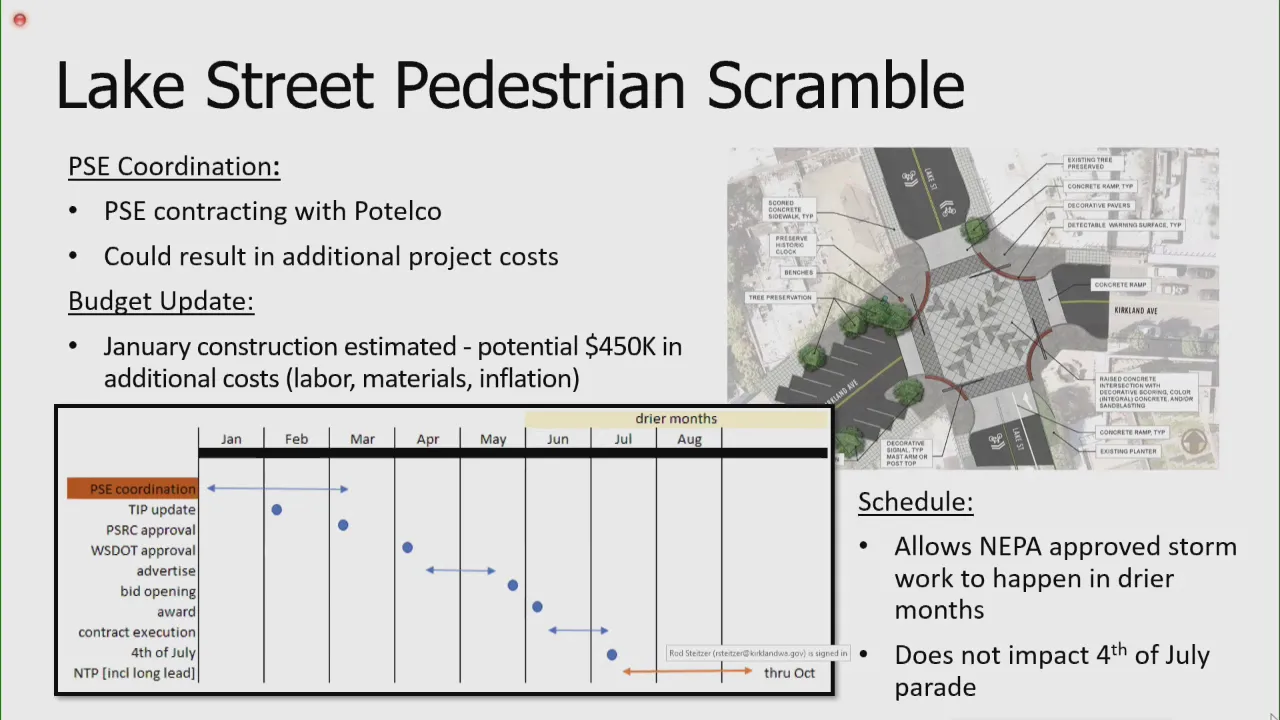
- Highlights included fire station projects, the Totem Lake Connector (ribbon-cutting planned June 17), 100th Avenue (bids extended to March 20), Juanita Drive right-of-way (19 of 21 acquisitions complete; 207 significant trees inventoried, 127 scheduled for removal and 91 for replacement), and the 124th Street project (estimated $2 million cost increase, total $18.6 million, 41% external funding).
- The city has 33 active capital grants, up from 28 the previous year.
- Councilmember Pascal raised deteriorating pavement conditions; staff said a strategic 10-year pavement preservation planning effort is underway.
Consent Calendar
- Council approved the consent calendar 7-0, with item 8.h.(1) (Resolution R-5579) pulled for separate consideration.
- The audit included payroll in the amount of $4,732,289.73 and bills in the amount of $5,947,436.08.
- Approved items included minutes of February 21, 2023; a purchasing contract for approximately 68 replacement police duty rifles and required accessory equipment from Pro Force Law Enforcement of Prescott, Arizona, for $112,153.73; Resolution R-5578 adopting the 2023-2024 City Work Program; and acknowledgment of the 2022 4th Quarter Animal Services Report, Police Crime Dashboard Report, Automated Safety Camera Report, January 2023 Sales Tax Report, and Procurement Report.
Business: Interview Selection Committee Recommendation
- Council approved the Interview Selection Committee’s recommendation 7-0, including approximately 30 interviews, reappointment of incumbents without interviews, and combined interviews for applicants seeking multiple positions.
Business: Health Through Housing Agreements and Screening Options
- Deputy City Manager James Lopez and King County Director of Community and Human Services Leo Flor presented updated draft agreements for the county’s permanent supportive housing facility in Kirkland.
- Staff cited county data including at least 6,000 people sleeping outside in King County as of May 2022, a 2020 point-in-time count of 586 sheltered and 446 unsheltered people on the Eastside, and more than 270 deaths of people without secure housing in King County in 2022.
- The county proposed a two-phase screening process: Phase 1 uses the King County Sheriff’s Office to check sex offender registries; Phase 2 uses county human services and behavioral health databases (HMIS, CORE, ECLS) combined with individualized clinical assessment rather than third-party criminal background checks.
- Council discussion highlighted differing views. Councilmember Black expressed strong support for the county approach, citing racial and disability disparities in the criminal justice system and the importance of reentry; Deputy Mayor Arnold asked why criminal background information could not be used as a supplement; Councilmember Nixon raised concerns about unregistered sex offenders.
- Staff recommended individual council briefings before a decision, currently expected on March 21. No vote was taken on the agreements.
Business: State Legislative Update #4
- Government Affairs Manager Diana Hart reported it was day 58 of the 105-day legislative session; 180 of 325 tracked bills were still alive. Dead policies included tree ordinances, tenant protections, jaywalking, and missing middle housing, though related versions could still move.
- The Blake decision bill (SB 5536), vehicular pursuit bills, and the missing middle housing bill (HB 1110) were discussed. HB 1110 passed the House with changes applying high thresholds to suburbs contiguous with large cities.
- Councilmember Curtis noted state budgets will be released March 24 and 26 and thanked the legislative work group.
Business: Resolution R-5579 – Parks and Community Services Sponsorship Guide Program
- A substitute resolution was approved 7-0 to clarify approval authority for sponsorships exactly at $7,500, correcting a gap in the administrative policy.
Reports and Motions
- Councilmember Nixon moved two legislative request memos, both approved 7-0: one for a comprehensive review of the animal control code and program, and one to review the short-term rental ordinance and its enforcement.
- Councilmember Curtis reported the Parks Funding Exploratory Committee reached a majority consensus to recommend a fall ballot measure for at least one aquatic and recreation center plus five elements: year-round restrooms, green loop trail priorities, new sports courts, youth and teen programming, and increased lifeguarding. No majority was reached on funding mechanism, measure size, or location.
- Councilmember Falcone reported on a WANIC tour and a revised proclamation in support of the local Iranian American community.
- Mayor Sweet reported on regional meetings and an overture from Carl Bradley regarding the Kirkland Cannery Building, and authorized exploration of that opportunity.
- City Manager Kurt Triplett noted an upcoming joint meeting with the Park Board, a possible King County ballot measure briefing, and progress on Regional Crisis Response Agency executive director recruitment.
Closed Session and Adjournment
- The Council entered closed session to discuss collective bargaining at approximately 10:30 p.m., with the City Manager, City Attorney, Assistant City Attorney, Police Chief, Human Resources Director, and Employee Relations Officer attending. The meeting was then adjourned.
Meeting Transcript
Thank you. I'd like to call to order the city council meeting on March the seventh, two thousand twenty-three. Tonight's meeting is a hybrid meeting. Community members are welcome to join us either in person or remotely through Zoom or by telephone. Clerk, will you please call the roll? Council Member Nixon. Here. Council Member Curtis. Council Member Falcone. Here. Council Member Pascal. Here. Here. Thank you. Our study session tonight is on two topics. The first is a Google Fibre discussion. The second is for Northeast Eighty Fifth Street Station Area Plan Phase Two Briefing. We will expect to reconvene our regular meeting at approximately seven thirty PM. City manager. We're approached last fall by representatives of Google Fiber about their desire to want to talk to us about having them build a fiber network on their own cost, but in Kirkland right of way. What we're looking for in the study session is sort of what questions do you have. What more would you like to know? Are you interested in us continuing to go forward with at least exploring the option or not? So presentation is going to be done in partnership between Shaan Nzheng, who's our technology and resiliency officer who's going to focus a lot on the fiber side. And then Julie Underwood, our public works director, who's going to talk about the potential challenges and opportunities in the city right of way. So with that, good evening, council. We have about nine slides, so it should hopefully go pretty quick. So allow you to uh give us input and feedback. Um, Shawnee's gonna kick us off with um why would we even consider this? So what are the benefits for this? Shanine, are you there? Yeah, all right. Okay, thank you. Thank you, Julie, and good evening, Madam Mayor and the members of the council. Uh, before I talk about high level concept of the Google Fiber proposal and its benefit to the community, I'd like to share a couple of maps to provide some context. Um, the first map you're seeing on the screen is uh um is showing the uh Washington State Broadband Office 2020 Internet Speed Survey results, which highlighting the reported speed in our area and the report, the average reported speed for downloading is around 100 megabytes, and the upload speed is around uh 40 megabytes, even though Kirkland area does have some you know high speed available. Um, and the second map, um Julie, can you yeah, the second map is the uh our Kirkland city owned fiber network map, which shows the current connectivity extent. So those highlighted color is Kirkland owned. So as described in the staff memo on Google Fiber approach the city and proposed to deploy uh gig five gigabyte speed fiber to the home network in Kirkland. The proposal package includes citywide deployment over a two-year period. And the company will cover the entire expenses for installation and ongoing maintenance and provides the multiple gigabyte speed products to consumers, including either one gig, two gig, or five gigabytes. And the company also will primarily using the micro trenching for installation, and it's open to discuss um joint trenching to potentially expand the city's existing fiber network. So we're kind of excited, and uh um we know the implementation of the Google Fiber um gigabytes, fiber to the home network in Kirkland could offer many benefits to the community, um, which include advancement of cities, diversity, equity, inclusion, and uh belonging objectives 18.3, and which means the city will explore continued and expanded opportunities to make internet access available to all. And in addition to creating access, reduced fee for low-income residents could be explored in the franchise agreement. So, which provides some opportunity to improve digital equity and enhance the quality of life for all. And through joint trenching, the city will potentially enhance the resiliency of the existing fiber infrastructure, which includes reducing single point of failure and uh uh enhancing connectivity to other public-owned facilities and assets. And also joint could increase the capacity for supporting future city services and smart initiatives, such as intelligent transportation systems and other IoT devices. So, yeah, so there's some also staff projects, they might be business and rest residential consumers who'd like to have this kind of services available to them for fast streaming and virtual reality and simultaneously used by multiple devices. So yeah, also, you know, as Kurt mentioned, there are also some challenges. So I'm going to turn over to Julie to talk about potential challenges, since this is a complex topic.
openpublica.com