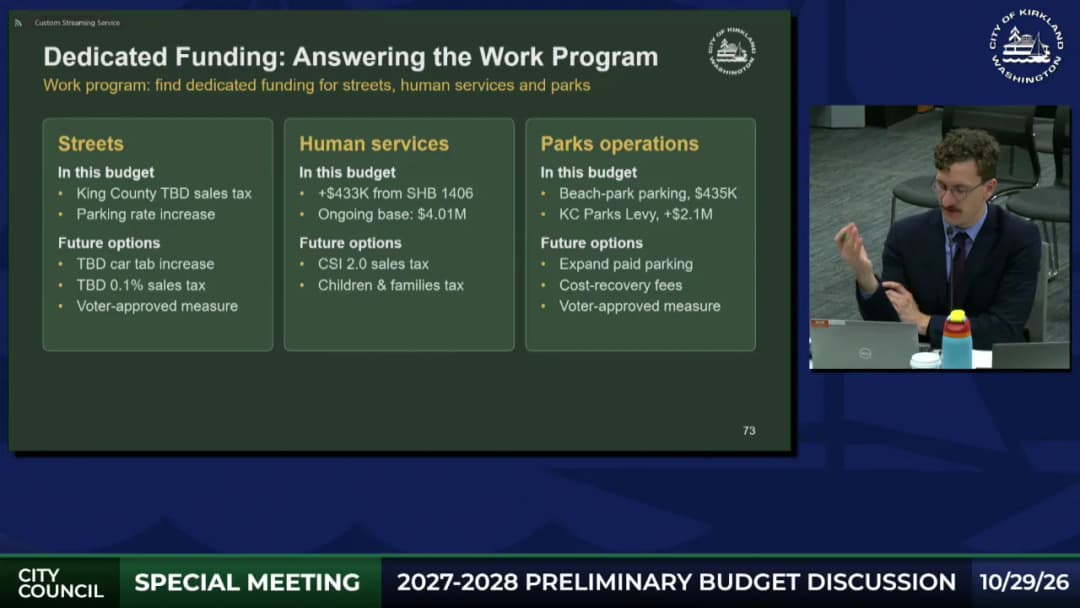
The Kirkland City Council convened a Special Meeting on October 29, 2026, beginning at 3:00 PM, to conduct a comprehensive 6-hour study session on the City Manager's Preliminary 2027-2028 Budget. Led by City Manager Kurt Triplett and Financial Planning Manager Kevin Pelstring, the session presented a $1.15 billion balanced biennial budget (with a $361.9 million General Fund) that relies heavily on one-time fund balance to cover a growing structural deficit. The Council reviewed major budget priorities, discussed new sustainable funding options such as the children and families sales tax and a potential community safety initiative, and provided initial feedback on the draft 2027-2028 City Work Program. Public Comments & Testimony - No public testimony was taken during this study session. The meeting was dedicated entirely to Council and staff deliberation. Public hearings on the budget are scheduled for November 4 and November 17, 2026. Discussion Items Budget Overview and Strategic Anchors - City Manager Triplett framed the budget around three strategic anchors: affordability, sustainability, and responsiveness to the public. He noted the budget is balanced, all general purpose reserves are fully funded, and the city’s triple-A credit rating is maintained. The only significant new investment is the Kraken Iceplex and Kirkland Community Center (KIKCC), which is fully funded. - Kevin Pelstring described the 9-month budget development process. He detailed a $10.6 million structural deficit in the base budget that is closed with one-time fund balance ($14.8 million) derived from conservative budgeting practices in the previous biennium, including salary savings, a two-year sales tax lag, and utility taxes coming in above budget. Budget Priorities - Kraken Iceplex and Kirkland Community Center (KIKCC): Grace Hansen presented the $5.3 million plan for the 12,500 square foot community center opening in January 2028. It is funded by program and rental fees, beach parking fees ($435,000), King County Parks Levy funds, and $1.9 million from the General Fund. Councilmember Prem asked for clarification on the parking lot, clarifying that the city owns and is responsible for the entire north lot. - Human Services: $5.28 million in grant funding was presented, including a $433,000 increase to the ongoing base from HB 1406 funds. Councilmember Falcone explained to viewers that per-capita funding has not increased due to the expiration of one-time federal dollars that previously boosted the budget. - ARCH Contributions: The city is increasing its contribution to the Regional Coalition for Housing (ARCH) to $1.43 million over the biennium, funded by a new fee-in-lieu on homes over 2,000 square feet. Councilmember Arnold stressed the importance of preserving dedicated revenue sources for these ongoing needs rather than using them for one-time costs. - Public Defense: The cost of public defense has approximately doubled (98% increase) due to new Washington State Supreme Court caseload standards, which is a primary driver of the structural deficit. Balancing the Budget and Future Outlook - Structural Deficit Projections: The current structural deficit of $19.7 million in 2027-2028 is projected to grow to $24.3 million in 2029-2030 and $26.9 million in 2031-2032, assuming current service levels and no new revenue sources. This is driven by salary and benefit growth far outpacing the 1% property tax increase limit plus new construction. - On the Radar: Deep dives were presented on several areas: - Health Benefits: Medical claims are up 22% from the 2025-2026 budget. - Street Fund: Hit by a structural deficit due to rising costs (insurance, energy) outpacing growth in the property tax and declining gas tax revenues. Balanced with new King County TBD sales tax revenue and parking fee increases. - Parks Levy Fund: Approaching a structural gap as operating costs rise faster than levy revenues. Councilmember Pascal asked for a historical look at the original levy projections vs. current reality. - Public Records: Costs rising to $1.5 million in response to increased demand, including more complex requests and the emergence of AI. - Kingsgate/Peter Kirk Pool Financing: Staff outlined the closing of the Kingsgate property acquisition and a planned bond issuance to repay interfund loans and fund pool renovations. - Unprogrammed Fund Balance ($616,000): Staff presented initial options for the remaining unprogrammed General Fund balance, including an AI intelligent transportation system pilot ($106,000) and a 4-year citywide speed limit reduction program. Council deferred specific decisions, noting other emergent needs like increased jail medical costs and a lower-than-expected Evergreen Levy contribution. - Children and Families Sales Tax (ESHB 2442): Staff presented a new 0.01% sales tax adopted by King County. By opting in, Kirkland can direct an estimated $665,000 over 2027-2028 to local housing, childcare, and youth services. The Council expressed a strong consensus to opt in. Councilmember Pascal stated the city could spend it more effectively locally. Councilmember Falcone supported using the dollars for the city's own growing needs. Councilmember Black supported it. Councilmember Arnold stated, "I was in support." Councilmember Timchison supported collecting the tax. Councilmember Prem reserved her detailed comments for a later time. - Community Safety Initiative 2.0 (0.1% Sales Tax): Tracy Dotlap introduced this potential sales tax generating $4.2 million per year for a wide range of uses (police, public defense, human services). Council action is required by June 30, 2028, to avoid a public vote. Councilmember Falcone requested information on the impact of this tax on a typical Kirkland family and what purchases it applies to. Deeper discussion was deferred to the November 17 study session. - HB 2015 Grant Award: The city was announced as a recipient of the grant, funding 6 entry-level police officers (with a $75,000 city match), a jail navigator, and an officer wellness program for the grant period. Department Highlights - Police: Mike Liu highlighted the budget for 163 FTEs and the new grant. Councilmember Pascal requested more data on how school zone safety camera locations were determined based on Public Works speed studies and the accounting for the revised state law sharing revenue with the Cooper Jones safety account. - Fire: The budget includes a new fire strategic plan (first since 2012) and continued funding for the Mobile Integrated Health (MIH) team via the Evergreen Levy. Councilmember Arnold requested more information on a decision to move a fourth firefighter from Station 24 to the ladder truck, which was acknowledged as a change from original Prop 1 plans. - Public Works (Transportation and Streets): Veronica Hill presented service packages for parking study implementation (increasing rates at Lake Shore/Lake Street, charging on Sundays, and adding summer beach parking fees). City Manager Triplett acknowledged the budget proposal did not fully align with the Council's recent direction on speed limit reduction implementation and promised a reconciliation at the next meeting with options to fund a faster roll-out. - Parks and Community Services: KIKCC, Kirkland Teen Union Building (KTUB) programming, and new turf fields at Crestwood and 132nd Park were reviewed. Councilmember Falcone requested exploring a partnership with EvergreenHealth for mammogram spots for uninsured residents at the annual health and wellness fair. Councilmember Pascal asked for an evaluation of the newly installed security gates at Juanita and Houghton Parks. - Planning and Building: Adam discussed service packages for affordable housing contributions and an AI permitting tool pilot. He clarified this is a Kirkland-specific initiative distinct from the regional Challenge Seattle or ECD Gov Alliance efforts, focusing on front-end application completeness and planning inquiries. - Other Departments: The supported employment program for individuals with developmental disabilities is being restarted. A new business license enforcement position was noted as net revenue positive for the city. Key Outcomes - Policy Direction: The Council reached a broad consensus to move forward with the adoption of the Children and Families Sales Tax (ESHB 2442) to direct the 0.01% levy revenues locally. Staff will prepare the necessary legislation for consideration during the budget adoption process. - Budget Clarifications Requested: Staff will bring back detailed information at the November 4 and November 17 meetings, including: - Scoped costs and timelines for implementing a faster speed limit reduction program. - The specific impact (e.g., per $100 purchase) of a 0.1% Community Safety Initiative sales tax on a typical household. - More detailed justification for proposed school zone safety camera locations based on speed/safety studies. - Options for an increased frequency of the Kirklander newsletter and potential sponsorships. - City Work Program Feedback: Council provided extensive input for the draft 2027-2028 City Work Program. Additions discussed for potential inclusion were: - Transit-oriented development and Bus Rapid Transit (BRT) readiness at 85th Street. - Setting sustainable, target investment levels for human services and homelessness. - Feasibility study for a community pool at the newly acquired Kingsgate property. - Creating a holistic citywide AI governance and policy framework. - Implementing great ideas identified in the forthcoming transit needs study. - Next Steps: The formal budget adoption process continues with a study session and public hearing scheduled for November 4, followed by another study session and public hearing on November 17. Final adoption of the 2027-2028 budget and the 2027-2032 CIP is scheduled for December 8, 2026.
Public Meetings - Kirkland, Washington
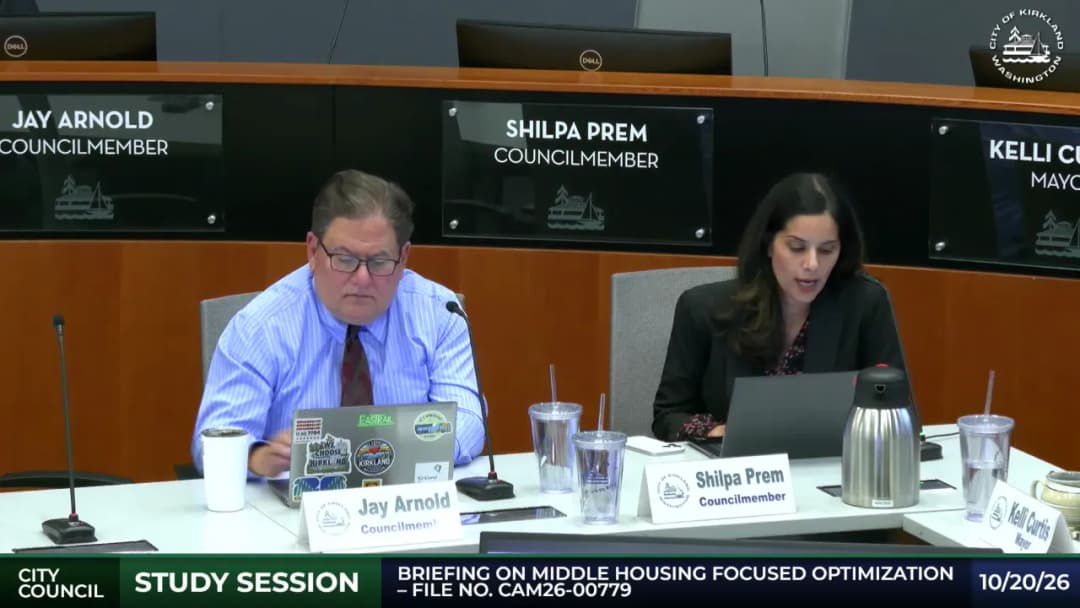
Public Meetings - Kirkland, WashingtonNote: The transcript of the meeting states the meeting was called to order as “October 20th, 2026,” but the session metadata specifies the meeting took place on 2026-10-23. This summary uses the date provided in the metadata per the summarization instructions. The Kirkland City Council convened on October 23, 2026, for three study sessions followed by a regular meeting. Study sessions covered intelligent transportation systems (ITS) and artificial intelligence, the Green Loop implementation plan, and middle housing focused optimization. The regular meeting included public comment, adoption of utility rates for 2027–2028, review of the draft 2027 state legislative agenda, and action on four legislative request memos (LRMs) concerning micromobility, bicycle helmets, and two Homes Point Overlay (HPO) items. Consent Calendar - Motion and second: Deputy Mayor Black moved approval of the consent calendar; seconded by Councilmember Prem. - Vote: Unanimously approved (7–0), including payroll of $8,270,916.57 and bills of $14,526,619.15. - Councilmember Tim Chisholm indicated support before logging off due to a work commitment. Public Comments & Testimony Seven members of the public addressed the council: - Karen Story (wearing a green bandana, representing a group of residents) urged the council to accelerate the phase-out of gas-powered leaf blowers, proposing an ordinance by early 2027. She suggested initially exempting properties larger than one acre, allowing gas blower use during emergencies, enforcement by code enforcement (not police), and holding property owners (not landscapers) responsible. She noted that over 200 U.S. cities have adopted restrictions. - Valentine Kaspar expressed frustration with the Homes Point Overlay (HPO) impervious surface limits, stating his 58,000-square-foot lot was restricted to roughly 14% coverage, preventing remodeling or additions. He argued the progressive sliding scale makes redevelopment infeasible and added that it cost him $50,000 to convince the city of an error in his case. - Scott Morris (Finn Hill Neighborhood Alliance) submitted a letter on two legislative request memos on the agenda and reinforced that any HPO amendments should follow a robust public process with Planning Commission review and public comment. - Steve Yoder (Kenmore resident) thanked the council and police chief for investing in noise enforcement training (Pipe Down training) for officers, stating that citations will be the true measure of success. He expressed broad support for actions against noise pollution. - Susan Carlson (Finn Hill Neighborhood Alliance, Mountains to Sound Greenway Trust) urged the council to adopt a robust ordinance phasing out gas-powered leaf blowers in 2027, citing examples from Washington, D.C., Montgomery County, and Portland. - Ken McKinsey proposed a tool‑lending library partnership with King County Library System (KCLS), modeled on Issaquah’s Curiosity Collection, which was launched in October 2026 with city-donated items and KCLS Foundation funding. - Mark Vossler (retired cardiologist) spoke about air pollution from small engines (particulate matter, oxides of nitrogen) and associated health risks (cardiovascular disease, stroke, asthma). He urged rapid phase-out of gas leaf blowers, noting electric alternatives are cost-effective and emit no pollutants. Discussion Items 1. Intelligent Transportation Systems (ITS), Traffic Signals, and AI (Study Session) - Presentation by Jennifer Palmer (Transportation Engineering Supervisor) and Stephen Padua (Transportation Manager): Palmer outlined Kirkland’s ITS (68 signals, 59 connected to the Transportation Management Center). AI tools include multimodal intersection detection (29 intersections) and a near‑miss analysis pilot (vendor Dirx). Two potential pilots were presented: 1. Adaptive Signal Control Technology: MyOVision ($74,000 for six intersections on NE 85th Street) or Scoot ($140,000 plus unknown infrastructure costs). Vendor-published studies suggested travel‑time reductions of 8–41%. 2. Near‑Miss Analysis: $16,000 per intersection per year (1–5 intersections), requiring staff resources to analyze data and implement countermeasures. - Council Feedback: - Councilmember Prem supported both pilots and asked how near‑miss intersections would be prioritized (Palmer: compatible cameras, higher volume/crash rates, proximity to schools/parks). - Councilmember Pascal supported the adaptive pilot but stressed that staffing resources must be available to operate new systems (citing Issaquah’s experience). He asked for a full view of transportation program priorities. - Councilmember Arnold expressed support but noted budget concerns, requesting that unfunded future‑upgrade items be tracked in the CIP. He asked about MyOVision equipment compatibility (Palmer: MyOVision already deployed on 85th; further expansion would need $25–30K per intersection). - Deputy Mayor Black supported the adaptive pilot and suggested a smaller near‑miss deployment. He asked about connecting the five unconnected signals (Palmer: high cost due to fiber trenching; one will be connected by 2027 via ITS Phase 3, leaving four orphaned signals with no relay options). - Outcome: Council gave general support to both pilot concepts; staff will incorporate budget discussions into next steps. 2. Green Loop Implementation Plan Update (Study Session) - Presentation by Mariah Gill (Planning and Development Manager) and Jody Galvin (Parks Maintenance/Green Loop Partnership Manager): The Green Loop (13.73 miles) connects parks in Finn Hill and Juanita. Of that, 6.28 miles already exist; 7.45 miles of new natural-surface trail need development. The plan would require adding over 10 acres of open space, largely through acquisition from willing sellers. Three logo concepts (tree ring, banana slug, fern) were presented; community feedback favored the fern. $14 million has been dedicated (four Conservation Futures grants, a Department of Commerce grant, and parks levy funds). Near‑term priorities were highlighted. - Council Feedback: - Deputy Mayor Black viewed it as a long‑term project, recommending opportunism and prioritizing North Juanita park needs. - Councilmember Pascal asked for specific timeline expectations for near‑term priorities (staff: will vary by segment—some trails can be built in a few years, others need acquisition). He supported the concept but sought clearer five‑year actions. He deferred on the logo and asked whether connections proposed by the Finn Hill Neighborhood Alliance had been vetted (staff: open to opportunities but want genuine connections). - Councilmember Arnold was more optimistic, asked why certain segments (e.g., near elementary school, Finn Hill Middle School) were mid‑ or long‑term, and whether acquiring all land now might be a priority (staff: focus on acquisition with levy funds, but some grants require construction). He favored the tree ring logo. - Councilmember Prem considered the plan a living document open to opportunism; she disfavored the banana slug and liked the fern or tree ring. - Councilmember Tim Chisholm (remote) echoed Deputy Mayor Black’s comments. - Mayor Curtis noted grant timelines (Conservation Futures may time out soon) and commended the $14 million raised. - Outcome: Staff received feedback to refine priorities and will return in January 2027 with a draft implementation plan. 3. Middle Housing Focused Optimization (Study Session) - Presentation by Adam Weinstein (Planning Director) and Martha Rhubar (Senior Planner): Middle housing (cottages, ADUs, townhomes, multiplexes, stacked flats) was first allowed in 2007; updates in 2020 and 2025 (state law) have increased production (peak of 140‑160 units per year, mostly ADUs and cottages). The 2026–2028 planning work program explicitly allows updates to lot coverage and floor‑area ratio (FAR) but not height, setbacks, or tree retention (to be addressed in 2028). Four options were presented: 1. Targeted adjustments to streamline permits. 2. General optimization (adjust FAR, lot coverage). 3. Incentivize retention of existing homes and age‑friendly housing (e.g., stacked flats). 4. No action until 2028. The Master Builders Association supported options 1, 2, and voluntary incentives from option 3, emphasizing simplicity and flexibility. - Council Feedback: - Councilmember Arnold supported options 1 and 2, advocating for streamlined FAR (e.g., fixed allowances per unit instead of calculations) and tiered FAR bonuses for preserving existing houses. - Deputy Mayor Black offered four guiding principles: Simple, Smaller, Streamlined, Stability. He emphasized FAR as a key lever and urged quick, stable implementation. - Councilmember Prem supported option 2 with a tiered FAR approach that incentivizes more units rather than larger units. - Councilmember Pascal supported options 2 and 3, stressing market demand and the need to make ADU/cottage projects feasible for small property owners (e.g., retired residents who want to downsize). - Councilmember Tim Chisholm supported option 2 with elements of option 3. - Councilmember Falcone supported options 1, 2, and 3, especially age‑friendly housing types like stacked flats. - Mayor Curtis called herself a “strong option 2,” wanting to pull in option 1 for short‑term gains, and expressed interest in option 3 pending time constraints. - Outcome: Council provided direction to pursue options 1 and 2, with some interest in option 3; the matter goes to the Planning Commission next. 4. Adoption of 2027–2028 Utility Rates (Regular Business) - Presentation by Jenny Gauss (Surface Water Strategic Advisor) and Tracy Dunlap (Deputy City Manager of Operations): Rates were presented following earlier preliminary discussions (August and September 2026). The approved increases are: - Water: 6.75% each year (2027, 2028) - Sewer: Local 8.85% each year; King County pass‑through 6.29% (2027), 12.75% (2028) - Surface Water: 5.9% each year - Solid Waste: 5.3% each year Rate smoothing over six years helps stabilize revenue; regional partner increases remain a key driver. - Motion and vote: Councilmember Pascal moved, Deputy Mayor Black seconded, to adopt ordinances O4951, O4952, O4953, and O4954. Councilmember Prem expressed strong concern about the burden on residents and businesses and urged cost reduction efforts. The motion carried 7–0. 5. Draft 2027 State Legislative Agenda (Regular Business) - Presentation by Andriana Campbell (Government Affairs Manager): Eight legislative priorities grouped under three headings. Highlights include preserving local planning authority, counting ARCH contributions toward GMA housing targets, utility rate regional affordability, balanced approach to electric motorcycles, transportation funding (including road‑usage charge revenue sharing and heavier‑vehicle weight limits for TBD fees), noise camera authority, municipal jail liability, public defense funding, ballot‑box buffer zones (expanding from 25 ft to 100 ft), and stable behavioral health funding. - Council Feedback: Councilmember Arnold asked that the Agenda explicitly include counting Affordable Housing contributions (e.g., ARCH) toward GMA obligations; City Manager suggested extending the language to sub‑regional entities. The draft will be refined by the legislative work group and brought back for adoption on November 17, 2026. 6. Legislative Request Memo – Micromobility (Regular Business) - Presentation by Stephen Padua (Transportation Manager): Four options were presented: (1) pilot a shared mobility program, (2) contract with a private company for a longer‑term program, (3) procure and operate a city‑owned fleet, or (4) a hybrid. - Motion by Deputy Mayor Black (seconded by Councilmember Arnold): Commence a due diligence process, including conversations with the Transportation Commission, with a goal of reporting back in or around the end of 2027, taking into account the opening of high‑frequency transit (Stride BRT, RapidRide), and subject to budget discussions and available resources. An amendment adding budget considerations (moved by Deputy Mayor Black, seconded by Councilmember Pascal) was adopted. - Vote: Motion carried 7–0. 7. Legislative Request Memo – Bicycle Helmets (Regular Business) - Options: (1) adopt a local ordinance requiring helmets for all bicyclists/e‑bike/e‑scooter users, (2) further research and engagement, (3) incentive‑based approach, (4) pursue statewide legislation. - Council Discussion: Councilmember Prem (option 1) stressed urgency. Councilmember Falcone supported options 2 and 3 (equity concerns). Councilmember Arnold supported option 3 (incentive‑based). Deputy Mayor Black supported option 1 plus option 3 (helmets for all, with a distribution program). Councilmember Pascal favored option 3. Mayor Curtis leaned toward options 2 and 3, wanting more community engagement and free‑helmet distribution (e.g., via Evergreen Health). - Motion by Councilmember Arnold (seconded by Councilmember Falcone): Pursue options 2 (further engagement before considering an ordinance) and 3 (incentive‑based approach). - Vote: Carried 5–1 (Councilmember Prem opposed). 8. Legislative Request Memo – Homes Point Overlay: Middle Housing Development Standards (Regular Business) - Presentation by Adam Weinstein (Planning Director): The HPO has unique environmental constraints (landslide hazards, streams, wetlands). Options Menu A: (1) leave code, (2) bring lot coverage up to 50% citywide standard, (3) special carve‑out for middle housing with looser standards. Menu B: standard or more public engagement. - Council Feedback: Councilmember Pascal sought a “surgical” change (option 2). Councilmember Arnold suggested exploring values below 50% (40% as a max). Councilmember Falcone agreed but wanted to see impacts of 50% vs. lower numbers. Deputy Mayor Black supported standard public engagement. Councilmember Prem asked for clarity on determining thresholds and proposed returning with a staff report analyzing three options (40%, 50%, hybrid). - Motion by Councilmember Pascal (seconded by Councilmember Falcone): Proceed with option 2 (lot coverage modifications from 40% to 50% or other options) with a standard public engagement process. - Vote: Carried 6–0. 9. Legislative Request Memo – Homes Point Overlay: Tree Removal Allowances (Regular Business) - Presentation by Adam Weinstein: Current HPO tree removal only for hazard/nuisance. Options: (1) leave code, (2) focus code amendments (citywide allowance of 2–4 trees per year depending on lot size, or something less such as two trees every 5 years as proposed by the Finn Hill Neighborhood Alliance), (3) same plus more public engagement. - Council Feedback: Councilmember Falcone wanted options ranging from matching the rest of Kirkland to a compromise (e.g., one tree per year). Deputy Mayor Black preferred uniform citywide allowance (two per year) or one per year, but not the five‑year variant due to administrative burden. Councilmember Pascal supported exploring one per year or similar. Councilmember Prem wanted consistency unless strong environmental reasons justify otherwise. Deputy Mayor Black noted that critical‑area constraints naturally limit removals. - Motion by Councilmember Falcone (seconded by Deputy Mayor Black): Proceed with option 2 with standard public engagement, with two variants: (a) match the rest of Kirkland (two trees per year), (b) half of the rest of Kirkland (one tree per year). - Vote: Carried 6–0. Key Outcomes - ITS/AI Pilots: Council expressed general support for adaptive signal control and near‑miss analysis pilots; staff will incorporate budget considerations. - Green Loop Implementation Plan: Staff to refine priorities and return with a draft plan in January 2027; logo direction favors fern or tree ring, with final designs to be presented for community vote in November 2026. - Middle Housing Focused Optimization: Council directed staff to pursue options 1 and 2 (streamlined adjustments and general FAR/lot coverage optimization); matter proceeds to Planning Commission. - 2027–2028 Utility Rates: Four ordinances adopted 7–0 (water +6.75%/yr, sewer local +8.85%/yr + King County pass‑through, surface water +5.9%/yr, solid waste +5.3%/yr). - 2027 State Legislative Agenda: Draft agenda reviewed; staff directed to include explicit reference to counting sub‑regional affordable housing contributions toward GMA obligations; final adoption scheduled for November 17, 2026. - Micromobility: Motion approved 7–0 to commence due diligence (Transportation Commission input, considering high‑frequency transit openings, reporting by end of 2027, subject to budget). - Bicycle Helmets: Motion approved 5–1 to pursue further engagement (option 2) and an incentive‑based approach (option 3); no ordinance adopted at this time. - HPO – Middle Housing Standards: Motion approved 6–0 to explore lot‑coverage modifications (40–50% range) with standard public engagement. - HPO – Tree Removal: Motion approved 6–0 to pursue a focus code amendment with standard public engagement, considering two options: (a) citywide allowance (two trees per year) or (b) half that (one tree per year). - Executive Session: Council adjourned to executive session to discuss sale/lease of real property and potential litigation; reconvened at 11:10 PM solely for adjournment.
The Kirkland Planning Commission held a study session on October 22, 2026, to continue developing the framework for a potential new neighborhood commercial allowance. The meeting was largely a working session to build a baseline 'Tier 1' model, asking the question: 'What regulation would work for most neighborhood commercial uses in most locations with decent actors?' Topics covering use types, scale, operational limits, and location criteria were systematically addressed to provide clear direction for staff to draft code amendments. A companion list of 'bike rack' outlier issues was established for future consideration. Public Comments & Testimony No members of the public appeared in person or virtually to provide testimony during the designated public comment period at the start of the meeting. Staff reviewed written public comment themes received prior to the meeting. These comments indicated strong support for the existing home occupation system, concern about the potential impact of new neighborhood commercial allowances on neighborhood character, and a preference for targeted location-based allowances over a citywide approach. Enforcement capability and the management of external traffic were recurring themes. Discussion Items Home Occupation Refinements: Staff reviewed proposed changes to home occupation regulations, primarily focused on removing 'hard to observe' standards (such as the 500 square foot limit) to improve enforceability for code enforcement. The commission reached a consensus to remove the specific 500-square-foot limit for home occupations, with Commissioner Bunyall and Chair Jacobson noting it was impractical and easily weaponized against neighbors. The commission supported retaining the requirement that the business owner resides on the property. It was agreed the primary distinction between a home occupation and a new neighborhood commercial use should be the level of customer openness and nuisance potential rather than a rigid square footage cap. Neighborhood Commercial Purpose & Allowed Uses: The commission affirmed the project's core purposes: facilitating convenience, ensuring compatible integration, promoting walkability, and creating community gathering spaces. Commissioner Reiser successfully added the goal of educating the public on the positive role of small businesses. The commission decided to combine the previously separated Tier 1 and Tier 2 allowed use lists into a single unified list encompassing retail, personal services, and crafts. A modification process will be included for uses that meet the overarching intent but are not explicitly listed. Auto-related uses, age-restricted products, and wholesale trade remain prohibited. Residential Connection & Scale: A significant debate centered on whether neighborhood commercial must be tied to a residential use on site. Commissioner Rutherford strongly advocated for requiring a resident with a direct connection to the business (someone with 'skin in the game'), a position supported by Commissioners Bunyall and Reiser. Chair Jacobson and Vice Chair Day favored ensuring a residential component exists on the property (a dwelling unit) without regulating the relationship between the resident and the business owner, arguing operational standards were better suited to addressing concerns. Staff was directed to explore both framing options and research how peer cities approach the issue. On scale, the commission settled on 500 square feet of customer-facing space as the baseline for Tier 1, applicable citywide. Operational Standards & Design: The commission generally supported an 8 a.m. to 8 p.m. hours of operation limit for the baseline and requiring customer queuing to occur on private property. A proposed 50-foot setback for outdoor food and beverage service was criticized by Commissioner Reiser as eliminating most standard Kirkland lots. The commission asked staff to return with a less restrictive alternative, such as a 15-foot setback paired with enhanced screening. Regarding parking, the commission supported staff's recommendation not to allow customer parking on the business's private property, relying instead on available on-street parking within 600 feet. Tier 2 Framework & Alcohol: The commission supported a Tier 2 allowance of up to 1,200 square feet within a quarter-mile radius of parks, schools, and medium-to-high density zones, generally aligning with the staff memo. Commissioner Rutherford suggested an alternative limiting tier 2 allowances to streets immediately fronting these public amenities. After extensive debate on alcohol, the commission supported allowing alcohol sales for on-site consumption (in restaurants/cafes) and for products manufactured on-site. The commission stood firmly against allowing a standalone off-sale liquor store as a neighborhood commercial use, with Commissioner Reiser asking, 'Do we really need to have it in the neighborhoods?' Pilot Program: The commission declined to pursue a formal pilot program for the new code. Commissioner Reiser stated he did not foresee a 'mad dash' of applications, and Chair Jacobson expressed a reluctance to add automatic legislative check-in milestones to the work program. Key Outcomes - Decision on Home Occupations: The 500 sq ft limit will be removed, focusing enforcement on observable impacts like noise and traffic. The owner-residency requirement remains. - Decision on N.C. Use List: Tier 1 and Tier 2 use lists are merged into one comprehensive list subject to a modification process. - Decision on N.C. Tier 1 Scale: 500 sq ft of customer-facing space, allowed citywide. - Decision on N.C. Tier 2 Scale & Location: Up to 1,200 sq ft, restricted to within 0.25 miles (or potentially adjacent to) designated activity zones. - Decision on Alcohol in N.C.: Allowed for on-site consumption and on-site manufacturing. Standalone off-sale liquor stores are prohibited. - Decision on Residential Connection: Deferred for more information. Staff will provide draft options for the December meeting on how to codify a requirement for a residential component vs. a specific resident connection to the business. - Directive to Staff: Begin drafting code amendments reflecting the commission’s direction for review at the December 10, 2026, study session. - Next Steps: Public hearing on the draft code anticipated in early 2027. The commission will formally vote on a residency connection requirement at a future meeting.
The Kirkland City Council met on October 20, 2026, for a combined study session and regular meeting. The study sessions covered three topics: an update on intelligent transportation systems (ITS) and AI, the Green Loop implementation plan, and middle housing focused optimization. The regular meeting included public comments, adoption of the 2027-2028 utility rates, review of the draft 2027 state legislative agenda, and action on four legislative request memos (LRMs) concerning micromobility, bicycle helmets, Homes Point Overlay (HPO) development standards, and tree removal allowances. Two scheduled public hearings on resolutions opposing state initiatives were not conducted. Consent Calendar - Unanimously approved by roll call. Included payroll of $8,270,916.57 and bills of $14,526,619.15. Public Comments & Testimony - Six members of the public addressed the council: - Several speakers urged the council to accelerate a ban on gas-powered leaf blowers, citing noise, health, and environmental benefits. - A resident of the Homes Point Overlay (HPO) described difficulty building an accessory dwelling unit due to strict impervious surface limits. - The Finn Hill Neighborhood Alliance requested that any amendments to the HPO be processed through a robust public process with planning commission review. - A speaker from Kenmore supported local police efforts against excessively noisy vehicles and asked for consistent enforcement. - A resident proposed a tool-lending partnership via the King County Library System, modeled after Issaquah’s program. - A retired cardiologist highlighted the cardiovascular risks of particulate matter from gas-powered leaf blowers and called for a rapid transition to electric equipment. Public Hearings (Not Held) - Public hearings on Resolution R-5748 (opposing Initiative Measure 26638 regarding K-12 athletics participation) and Resolution R-5749 (opposing Initiative Measure 26001 regarding parental rights in public schools) were scheduled but not held during the meeting. No action was taken. Study Session: Intelligent Transportation Systems (ITS) and AI - Jennifer Palmer, Transportation Engineering Supervisor, presented an overview of Kirkland’s 68 traffic signals (59 connected via fiber or cellular to the Transportation Management Center), current AI uses (multimodal detection at 29 intersections, near-miss analysis pilot), and two potential pilot programs: adaptive signal control (at 6 intersections on NE 85th Street) and near-miss analysis (1–5 intersections). Costs discussed were $74,000 for a MyOVision adaptive pilot and $16,000 per intersection per year for near-miss analysis. - Council questions focused on integration with existing work plans, staffing, and prioritization of transportation projects. Council expressed support for both pilots but stressed the need to understand trade-offs and resource allocation. No formal vote was taken. Study Session: Green Loop Implementation Plan - Mariah Gill (Planning and Development Manager) and Jody Galvin (Parks Maintenance and Green Kirkland Partnership Manager) presented the draft implementation plan. The proposed 13.73-mile loop includes 6.28 miles of existing trail and 7.45 miles of new natural surface trail, requiring over 10 acres of open space acquisition. Funding includes $10 million from the King County Parks Levy plus $3.9 million in grants. Near-, mid-, and long-term priorities were identified, primarily driven by available funding and willing sellers. Three logo concepts (tree ring, banana slug, fern) were presented. - Council supported a flexible, opportunity-driven implementation strategy, with an emphasis on addressing park needs in North Juanita and allowing community input on the logo design. No formal action was taken. Study Session: Middle Housing Focused Optimization - Senior Planner Martha Rhubar provided a timeline of middle housing regulations in Kirkland (starting in 2007) and presented data showing a peak of 194 middle housing permits in 2025. Current trends favor ADUs and cottages, but units are often large, and infill of smaller units is limited by Floor Area Ratio (FAR) and lot coverage constraints. Four potential code amendment packages were outlined: Option 1 (targeted cleanup), Option 2 (general optimization of FAR/lot coverage), Option 3 (incentives for retaining existing homes and age-friendly types), and Option 4 (comprehensive rewrite). The planning work program limits adjustments to lot coverage and FAR in this phase, with height and setbacks deferred to 2028. - Council expressed general support for Option 2 (optimization) with elements of Option 3, focusing on FAR adjustments to encourage more units and smaller homes, while streamlining the process for homeowners. Several members emphasized the importance of simplicity and stability. No formal vote was taken. Regular Business: Adoption of 2027–2028 Utility Rates - Tracy Dunlap (Deputy City Manager of Operations) and Jenny Gauss (Surface Water Strategic Advisor) presented final utility rates after adjustments from preliminary August rates. The adopted rates include water (6.75% each year), sewer (local 8.85% each year; King County pass-through 13.29% and 12.75%), surface water (5.9% each year), and solid waste (5.3% each year). The increases are necessary to meet financial policies, but rates were smoothed over a six-year period and mitigated through staff recommendations. - Council adopted the four related ordinances (Ordinances 4951, 4952, 4953, 4954) unanimously, acknowledging that the increases are burdensome but necessary, and committed to continued regional advocacy on affordability. Regular Business: Draft 2027 State Legislative Agenda - Government Affairs Manager Adrianna Campbell presented the draft agenda, which includes priorities on housing (preserving local planning authority, counting ARCH contributions toward GMA requirements), regional affordability (utility rate impacts), electric motorcycle regulation, transportation funding (exploring road usage charges, supporting noise camera authority, and increasing weight limits for TBD fees), public safety (municipal jail liability, public defense funding, and 100-foot ballot box buffer zones), and behavioral health. The legislative work group also proposes adding the Sound Cities Association to the list of monitored organizations. - Council provided input, including requests to make explicit that contributions to ARCH or other subregional entities be counted toward GMA housing targets. The final agenda will be considered for adoption on November 17. Legislative Request Memo (LRM): Micromobility - Transportation Manager Steven Padua outlined four options: pilot program, contract/partner with private firm, procure city-owned fleet, or hybrid. Council directed staff to commence a due diligence process that includes consultation with the Transportation Commission, to be completed by the end of 2027, subject to budget discussions and available resources. The motion carried 7-0. Legislative Request Memo (LRM): Bicycle Helmets - Steven Padua presented options on requiring helmets for e‑bikes, e‑scooters, and bicycles. Options included a local ordinance, further engagement before an ordinance, an incentive-based approach, and state legislation. Council voted 5-1 to pursue a combination of Option 2 (conduct further engagement) and Option 3 (develop an incentive-based program, such as education and free helmet distribution), rather than adopting an immediate ordinance. Legislative Request Memo (LRM): HPO Development Standards for Middle Housing - Adam Weinstein (Planning and Building Director) offered options on lot coverage in the Homes Point Overlay: keep existing code (40% for first 6,500 sq ft, sliding scale), standardize to citywide 50%, or create special middle housing allowances. Council approved a motion (6-0) to pursue a surgical, uniform modification to lot coverage (options ranging from 40% to 50% or other staff‑developed alternatives) with standard public engagement. Staff will bring alternatives back for further consideration. Legislative Request Memo (LRM): Tree Removal Allowances in HPO - Adam Weinstein presented options: no change (only hazard/removal), focused code amendments with standard or enhanced engagement. Council voted 6-0 to pursue Option 2 with two variants: matching the citywide allowance (2 trees per year) and a half allowance (1 tree per year), applying standard public engagement. Key Outcomes - Adopted 2027–2028 utility rate increases for water, sewer, surface water, and solid waste (four ordinances passed unanimously). - Directed staff to conduct due diligence on a micromobility program, reporting back by end of 2027. - Chose to explore further engagement and an incentive‑based approach on bicycle helmets, deferring a possible ordinance. - Advanced code amendments for the Homes Point Overlay: a surgical adjustment to lot coverage (40–50% range) and options for tree removal allowances (one or two trees per year), both with standard public engagement. - No action was taken on the two scheduled public hearings.
The Kirkland Planning Commission met on October 8, 2026, for a study session on the Neighborhood Stores and Services Code Amendment Project, a briefing on state legislative compliance, a public hearing on miscellaneous code amendments, and approval of prior meeting minutes. Public Comments & Testimony - No members of the public offered testimony during the initial public comment period or during the public hearing on the miscellaneous code amendments. Discussion Items Study Session: Neighborhood Stores and Services Code Amendments Staff presented findings from community engagement, including a survey and tabling events. Common themes included support for home occupations as a way to start businesses affordably and concerns about potential negative effects of more intense commercial uses. - Home Occupations: Commissioners broadly agreed to remove or revise regulations that are difficult to enforce, such as limits on deliveries and client visits, and instead apply the same non-observable standards as for residential uses. Observable criteria like outside storage, vehicles, and signage would be retained. Commissioner Bunyall noted enforcement challenges and that the 500-square-foot limit triggers commercial building code occupancy requirements. Commissioner Rutherford suggested allowing food trucks and focusing on externally observable criteria. Commissioner Nolan argued that if a rule cannot be enforced, it should not exist. Vice Chair Medea supported retaining limits on observable items. Chair Jacobson summarized consensus: treat home occupations like residential uses for non-observable impacts. - Neighborhood Serving Commercial: Commissioners addressed several policy questions: - Association with residential use: A majority favored requiring some residential use on the same site, with Commissioner Rutherford suggesting a 50% residential square footage threshold. Commissioner Ricer advised caution because of public hesitancy. - Maximum floor area: The commission generally supported 500 square feet as a baseline, with discussion of allowing up to 1,200 square feet for certain uses or locations. Commissioners Choudhry, Rutherford, and others supported the higher limit for businesses like bookstores if the house is large or if located on an arterial street. - Location allowances: Commissioners opposed restricting to corner lots or requiring sidewalks. Instead, they preferred basing location on street type (e.g., arterials vs. local streets). Chair Jacobson asked staff to return with options on size and location. - Standards to reduce vehicle trips: Commissioners endorsed limiting floor area, hours of operation (suggested 8 a.m. to 8 p.m.), counting outdoor space against square footage limits, and implementing loading/delivery standards. Commissioner Bunyall emphasized prioritizing walking and biking over car access. - Buffering: Some visual and noise buffering was considered necessary, but commissioners noted practical limitations of fences and landscaping. - Approval process: Commissioners strongly preferred a by-right approach with a clear list of permitted uses. Some suggested limited discretionary review for alcohol sales, firearms, and other high-impact uses. Chair Jacobson supported by-right and proposed prohibiting guns, marijuana, and tobacco. The commission did not reach consensus on alcohol sales vs. service. - Location and Access: Commissioners agreed that neighborhood commercial should not be limited to corners or areas with sidewalks, as such restrictions could exclude underserved neighborhoods. Commissioner Bunyall raised concerns about ADA accessibility for customers. Staff noted that 75% of Kirkland streets have sidewalks on at least one side and 86% of arterials/collectors do. - Next Steps: The discussion will continue at the October 22, 2026 meeting, where staff will present specific options on size, location, and use limitations. State Compliance Presentation and Policy Decisions Staff reviewed state legislation requiring or permitting local action. The commission provided guidance on three policy choices: - Family Burial Grounds (HB 2239): Commissioners unanimously supported staff's recommendation to disallow family burial grounds in Kirkland, citing complications for property disclosure, future development, and the urban context. - Child Care Centers (SB 5509): Noted as a state mandate requiring child care centers as an outright permitted use in all zones except industrial and open space by July 2027. The commission agreed that adult daycares should be treated as a separate use category. - Residential Uses in Commercial/Mixed-Use Zones (SB 6026): Commissioners expressed support for allowing residential uses in the one station area zone that currently prohibits housing (within the TIFF area). Chair Jacobson noted potential traffic reduction benefits. Staff will return with code amendments and conduct environmental review. Public Hearing: Miscellaneous Code Amendments Staff presented a package of minor code amendments, including definition clarifications, removal of obsolete zone references, updates to terms (e.g., replacing "alien" with "permanent resident card"), and technical revisions related to sewer connections and permit renewals. No public testimony was offered. Commissioner Nolan moved to recommend the amendments to city council as drafted; the motion was seconded and passed unanimously. Approval of Minutes Minutes from May 28 and June 25, 2026, were approved unanimously without correction. Key Outcomes - Home Occupations: Consensus to simplify enforcement by aligning non-observable regulations with residential standards and retaining enforcement on observable criteria. - Neighborhood Commercial: Direction to staff to bring back options on size (500 sq ft baseline, up to 1,200 sq ft based on use/location), location (by street type), hours (8 a.m.–8 p.m.), by-right approval, and buffering. Continued to October 22, 2026. - Family Burial Grounds: Commission recommends prohibition; to be included in 2027 code amendments. - Child Care Centers: Mandate acknowledged; staff to draft code by 2027. - Residential in Station Area Zone: Support for allowing residential; staff to proceed with analysis. - Miscellaneous Code Amendments: Unanimously recommended to city council. - Minutes from May 28 and June 25, 2026: Approved unanimously.
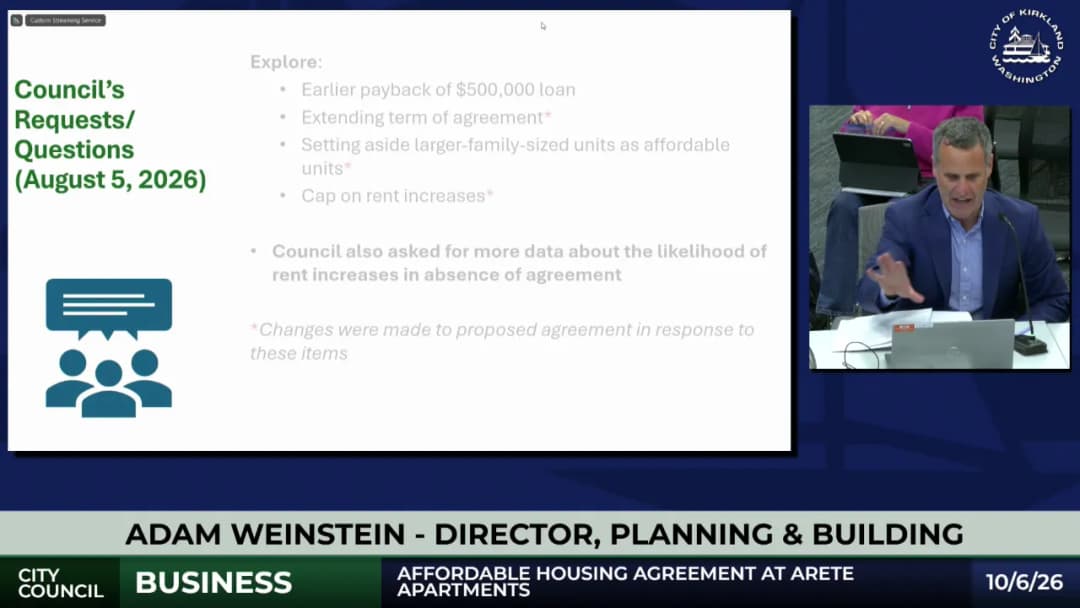
On October 6, 2026, the Kirkland City Council held a study session from 5:30 p.m. covering citywide speed limit changes, a comprehensive emergency management framework, and a short-term rental code briefing, followed by a regular meeting at 7:30 p.m. that included honors, public testimony, a special presentation from EvergreenHealth, and action on multiple business items. The meeting adjourned after 10:30 p.m. Study Session: Speed Limit Changes - Jennifer Palmer, Transportation Engineering Supervisor, presented options for implementing lower speed limits on arterials and local streets. Staff recommended starting with three arterial corridors (Juanita Drive, NE 132nd Street, and Totem Lake Boulevard) based on high crash rates and 85th percentile speeds. - Council members expressed support for accelerating sign replacement and favored option two (directly swapping 25/20 mph signs) over the staff-recommended hybrid gateway signs. They requested cost and timeline options for faster implementation. - The council directed staff to prepare engineering studies for the three arterials and code changes to lower the default local street speed limit to 20 mph, with a robust public education campaign. Study Session: Comprehensive Emergency Management Framework (CEMF) - Emergency Manager Heather Kelly presented the updated CEMF, which replaces the previous plan and aligns with federal and state standards. The document received a 97% compliance review from the state. - Council praised the work and asked about FEMA policy changes, inclusion of behavioral health, cybersecurity updates, and equity considerations for vulnerable populations. - The CEMF was adopted later in the evening via the consent calendar (Resolution R-5746). Study Session: Short-Term Rental Code Briefing - Senior Planner Stacey McGregor outlined administrative challenges: inability to verify ownership, occupancy limits, and enforcement gaps. She presented six proposed code improvements and six policy questions. - Council discussions covered: - Allowing two rentals per host (from current one). - Allowing renters to host (left to property owner discretion). - Primary residence vs. investment properties; Kirkland residency requirement (council leaned toward retaining residency requirement but open to tiered models). - Guest occupancy limits: council skeptical of enforceability and noted potential negative economic impact on tournament lodging. - No final votes; staff will bring back more data, including a comparison table of nearby cities' policies. Public Comments & Testimony - Minimum Wage (first six speakers): Alicia Ramirez (grocery worker) urged adoption of King County's $20.82/hour wage floor. Joseph Werty (small business owner) warned of automation and cost pressures. Jory Hamilton described coworker housing instability. Catherine Straub (Kirkland Chamber) asked for more study and business inclusion. Marla Gonzalez (Head Start teacher) highlighted food insecurity. Debbie Lacey (Eastside for All) supported a phased increase. - Agenda Packet Timing: Susan Davis requested earlier packet posting (one week in advance), inclusion of presentations, side-by-side changes, and delayed votes on late changes. - Carbon Commute Count: Students Ella Hanif and Tenoushri presented a transportation survey for middle and high schools, promoting carpooling and transit bingo. - Heritage Society: Louita Hawkinson suggested naming the NE 85th Street corridor "Kellett Heights" after Peter Kirk's chief engineer. - Holmes Point Tree Code: Emily McCallum requested a uniform tree code allowing removal of hazardous trees. - Other: Joe Kunzler urged stricter exclusion policies for disruptive speakers. Special Presentation: EvergreenHealth 2026 State of Healthcare - CEO Dr. Etori Palazzo reported that EvergreenHealth remains independent, with 5,600 employees, second-highest birth rate in the state, and a $100 million donation from Dean Widener for a new tower. Financial recovery is underway (104 days cash on hand). He noted challenges from federal and state cuts, but affirmed the hospital's commitment to community care. - Council thanked him and requested follow-up on workforce wage data relevant to the minimum wage discussion. Consent Calendar (Approved 7-0) - Approved minutes of September 15, 17, 19 meetings. - Audit of accounts: payroll $9,663,064.63 and bills $11,880,807.30. - Adopted proclamations: Arbor Day (October 15), Disability Awareness Month, Walk and Roll to School Month, Fire Prevention Week. - Adopted Resolution R-5746 (Comprehensive Emergency Management Framework). - Approved 2026 Third Quarter IT Operations Update, vehicle surplus declaration, August 2026 Investment Report, and Procurement Report. Business Items - 9b – Economic Competitiveness and Minimum Wage Study - EcoNorthwest presented findings: Kirkland's taxes are competitive with peer cities; the main differentiator is the per-employee head tax vs. B&O tax. A minimum wage white paper reviewed literature and local wage data. - After extensive debate, council voted 7-0 to direct staff to bring back community engagement and targeted study options for minimum wage to the November 4, 2026 council meeting. - 9d – Adoption of State Election Statute - Ordinance O-4949 adopted (7-0), adopting state protections against voter intimidation and establishing a 25-foot buffer zone around ballot boxes. Council also directed staff to consider adding election safety to the state legislative agenda. - 9e – Affordable Housing Agreement at Arete Apartments - Resolution R-5747 authorized the city manager to negotiate a loan and purchase 224 units for long-term affordability, with revised terms including a 60-year loan term, rent caps, and family-size units. Adopted 7-0. - 9g – Lease of Former LDS Church Property - Council authorized (5-2, Councilmembers Tinchisholm and Pascal opposed) leasing the property at 13220 NE 132nd Street for community purposes while city resources focus on the Kraken Iceplex. Staff will return with a formal lease resolution. Reports - City Council regional committee reports were deferred by email. - City Manager reported on NERTS negotiations (potential high-level meeting with County Executive) and a 0.1% sales tax option for human services (city could adopt instead of county, generating $430,000). - Council directed staff to prepare only opposition resolutions for two state ballot initiatives (I-26638 and I-26001) for the October 20 meeting (motion passed 7-0 after reconsideration). Key Outcomes - Speed limits: Staff to return with arterial studies and code changes, plus cost options for faster sign replacement. - Short-term rentals: Staff to provide additional policy data and a comparison table. - Minimum wage: Staff to present engagement and study options on November 4, 2026. - Election safety: Ordinance adopted; legislative agenda item considered. - Arete Apartments: Agreement authorized; 224 units preserved as affordable. - LDS property: Lease authorized (5-2); formal resolution to follow. - Ballot initiatives: Only opposition resolutions will be prepared for the October 20 meeting.
The agenda and meeting minutes for this meeting were not available. The raw transcription provided did not contain recognizable meeting proceedings; instead, it consisted of unrelated, non-deliberative text (resembling song lyrics or personal reflections). As a result, no city business, motions, votes, or public comments could be identified or summarized from the source material. Source Material Limitations - No agenda was provided for this meeting. - No minutes were provided for this meeting. - The supplied transcription contained no reference to City of Kirkland business, agenda items, board/council actions, or speaker testimony. - Because the transcription lacked any substantive or decipherable meeting content, this summary cannot accurately report on discussions, positions, or outcomes.
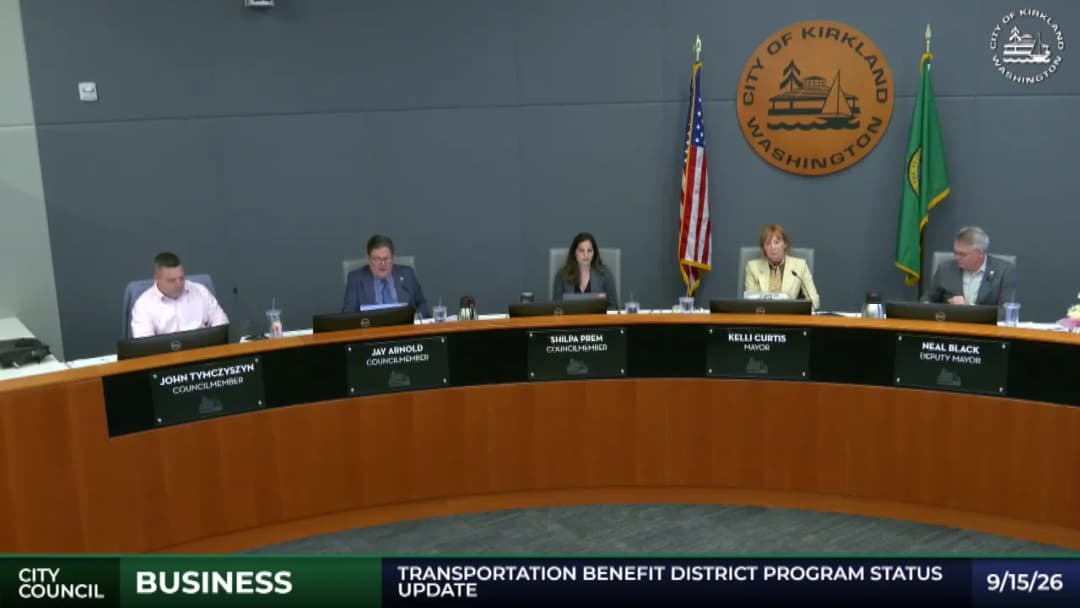
The Kirkland City Council met on September 15, 2026, for a study session starting at 5:30 PM and a regular meeting at 7:30 PM. Councilmembers Pascal and Falcone were excused. The council discussed utility rates for 2027-2028, human services grant funding, adopted the Youth Bill of Rights, approved the Highlands water pressure alternative, and provided direction on station area naming, a development agreement, and the Transportation Benefit District program. Study Session: 2027-2028 Proposed Utility Rates - Staff presented updated proposed rates based on council input. Water: 6.75% increase in 2027 (down from preliminary 8.5%), sewer: 8.85% (down from 19.5%), surface water: 5.9% (down from 7.15%), solid waste: 5.3% (down from 6.75%). The combined single-family bill increase is approximately 8.4% ($22/month) in 2027. - The council discussed reserve balances, regional advocacy, and the need for a King County affordability summit. No action was taken; final adoption is scheduled for October 20, 2026. Study Session: 2027-2028 Human Services Commission Grant Funding Recommendations - The Human Services Commission presented three funding options: Option A (base budget $1.8M/year, 31 programs), Option B (partial one-time $634K/year, 22 programs), and Option C (continued one-time $511K/year, 22 programs). Priorities include basic needs, housing stabilization, youth mental health, and culturally specific services. - The council discussed performance metrics, new vs. existing programs, and the prioritization of Option C. Staff was directed to continue refining recommendations based on council feedback. No formal action was taken. Consent Calendar - Approved unanimously (5-0). Items included approval of minutes (September 1, 2026), audit of accounts (payroll $8,250,298.14 and bills $4,490,912.87), general correspondence, claims, and several other routine items including Ordinance O-4948 (zoning amendments for vehicle/bicycle parking) and Resolution R-5745 (CDBG fund allocation). Public Comments & Testimony - Jennifer Cucumitis (resident): Described ongoing noise pollution from Pursuit Church, citing violations of municipal code and submitted a petition with 27 signatures. Requested enforcement and adoption of bass limits. - Christina Mendieta (Kindering): Thanked the commission for partial funding of the Families in Transition program but asked the council to restore funding for the child care/preschool consultation program, noting 96% of children served were retained in childcare. - Susan Davis (North Rose Hill resident): Raised noise concerns from amplified music, criticized current enforcement, and urged the council to adopt a low-frequency decibel standard and incorporate performance standards into neighborhood store amendments. - Karina O'Malley (resident): Opposed the new RV parking ban, arguing it would deter people from seeking services and suggested allowing 24-hour parking or designated areas for outreach. - Kim Fauss (Main Street Property Group): Clarified commercial space calculations for the Slate Peak project, stating they are providing 65% non-residential floor plate including retail, lobby, and parking, contrary to staff report. - Alex Zimmerman (Stand Up America Party): Made critical remarks about city and county governance, accused council of censorship, and made Holocaust-related statements that were later refuted by another speaker. He was excused during the public hearing for violating rules. - Liz Hunt (resident): Questioned the vision for the North Norkirk area regarding the Slate Peak project and asked whether the proposed public benefit ($200,000 contribution) is adequate for a 20-foot height increase. - Joe Kunzler (online): Refuted Alex Zimmerman's Holocaust claims and asked the council to place grassroots lobbying on the legislative agenda to address dark money in local government. Public Hearing: Revenue Sources for 2027-2028 Budget - Kevin Pelstring presented revenue projections: property tax (1% increase + 1.5% new construction), sales tax (flat at $36M/year), utility tax (increase due to PSE rate requests), and business license fees. The general fund faces a $6.4M budget gap. No new taxes are assumed. - Public comment: Liz Hunt questioned the large increase in utility tax revenue (from $18.2M in 2026 to $22.4M in 2028) and its impact on affordability. Alex Zimmerman spoke but was excused for violating public comment rules. The hearing was closed. Discussion Items - Kirkland Youth Bill of Rights (Resolution R-5738): Adopted unanimously (5-0). The resolution endorses a nine-pillar framework to guide policy and budget decisions affecting youth. The Youth Council presented the document, which focuses on basic needs, health, safety, community spaces, transportation, civic engagement, and recreation. - Highlands Water Pressure Alternatives: Staff recommended Alternative One (cost $8.1M) to restore pressure to the upper elevation area while preserving benefits of the 2024 conversion and reusing temporary infrastructure. Approved unanimously (5-0). The alternative includes replacing aging water mains and decommissioning the temporary booster station. - NE 85th Street Station Area Naming: Three name options were presented: The Rise District, The Forge District, and The Union District. Council feedback favored The Rise and The Forge, with concerns about The Union District causing confusion with Seattle locations. No vote taken; further discussion scheduled for October 6, 2026. - Slate Peak Development Agreement: Main Street Property Group proposes a 65-foot mixed-use building (20 feet above zone height) with 170 units (10% affordable at 50% AMI, 30% two/three-bedroom) and 7,800 sq ft of non-residential space. Two public benefit options: Option A (1,500 sq ft below-market community arts space) or Option B ($200,000 to Cross Kirkland Corridor). Council directed staff to continue negotiations focusing on Option A, with emphasis on increasing the amount and duration of subsidized space, deeper affordability for family-sized units, and potential step-backs for the building. - Transportation Commission Charter: Postponed to October 6, 2026, due to legal questions about delegation of authority and additional input from the commission. - Transportation Benefit District (TBD) Program Update: Staff recommended removal of four scopes (Lake Washington Blvd/NE 52nd St, 120th Ave NE, State Street Bike Markings, 7th Ave Greenway) and use of contingency ($2.23M) to cover shortfalls on four projects (North Juanita Crosswalks, NE 124th St, 98th Ave Bike/Ped, 90th Ave NE Sidewalk). Approved unanimously (5-0). - Urban Forest Management Plan Update: Staff presented draft objectives tied to five goals: protect forest health, grow engagement, maintain 40% canopy cover, maximize tree benefits, and enhance city programs. Council provided feedback on land-use-based metrics and language flexibility. No formal action. Key Outcomes - Consent Calendar: Approved 5-0. - Resolution R-5738 (Youth Bill of Rights): Adopted 5-0. - Highlands Water Pressure Alternative One: Approved 5-0. - TBD Program Modifications: Approved 5-0 (scope removals and contingency use). - Station Area Naming: Council narrowed options to The Rise District and The Forge District; further discussion on October 6. - Slate Peak Development Agreement: Council directed staff to negotiate toward Option A with enhancements. - Transportation Commission Charter: Postponed to October 6. - Human Services Grant Funding: Staff to refine options based on council feedback; no vote. - Utility Rates: Final adoption scheduled for October 20. - Executive Session: Held to discuss potential litigation; meeting adjourned at approximately 11:25 PM.
The meeting on September 10, 2026, at 2:00 PM UTC, is documented only by a single line of transcript. No agenda or minutes were provided. Discussion Items - The transcript contains the statement: "And then we're going to go to the camp." No additional context or discussion is available. Key Outcomes - No decisions, votes, or directives are recorded.
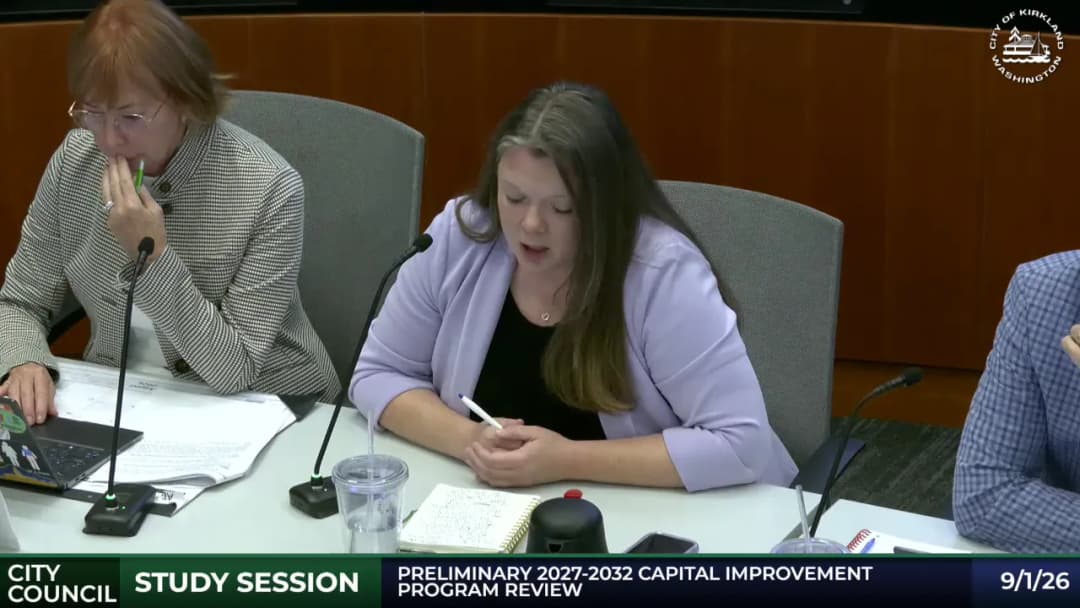
The Kirkland City Council met on September 1, 2026, for a study session beginning at 5:30 p.m. and a regular meeting at 7:30 p.m., adjourning at 10:07 p.m. All seven council members were present. The study session covered domestic violence and sexual assault advocacy programs and a preliminary review of the 2027–2032 Capital Improvement Program (CIP). The regular meeting included proclamations, public comments, a public hearing, consent calendar approval, and action on four business items: civil detention center code amendments, an International Community School (ICS) development plan amendment, affordable housing zoning amendments, and revised parking enforcement code amendments. Consent Calendar - Approved as a block (7-0) including: - Minutes of August 5, 2026. - Audit of accounts: Payroll of $8,635,240.77 (Aug 7) and $9,553,344.95 (Aug 24); bills of $13,511,645.01. - Claims for damages from Volha Shyshyna and Makayla Titus. - Award of bid for 105th Ave NE Sewer Line Repair to Shoreline Construction Co. ($178,450.56) with a $60,141 transfer from Sanitary Sewer Utility Reserves. - Resolution R-5743 authorizing the City Manager to execute WSDOT turnback agreements for the I-405/NE 132nd Street Interchange and Totem Lake Freeway Station projects. - Proclamations for Suicide Prevention Awareness Month, National Recovery Month, and Childhood Cancer Awareness Month (September 2026). - Ratification of International Association of Firefighters Local collective bargaining agreement. - Reports: Fire Department Dashboard, Parks and Community Services, Financial Management, Sales Tax (July 2026), Investment (July 2026), and Procurement — all second quarter 2026. Public Comments & Testimony - Karina O'Malley (on-site) opposed the revised parking enforcement ordinance, arguing it effectively bans RVs and people living in vehicles, and cited an instance where a van used as shelter was impounded without notice. - Britt Hykal (virtual) and Sierra Diaz (on-site) spoke in support of the Lake Washington Toddler Group, a cooperative preschool facing closure due to the State Board of Community and Technical Colleges ending funding. They urged the Council to use its influence to protect the program. - Erin Belmore (on-site) complained about unresolved permitting issues at Park 54 Condo Association (404 Fourth Avenue) and lack of responses from city staff, requesting answers before a resolution. - Alex Tsimerman (on-site) raised personal housing complaints against King County Housing Authority, threatened litigation, and made unrelated remarks; he was warned and later asked to leave during the public hearing. - Erin Hamilton (on-site) discussed mental health system failures, criticizing Crisis Connections and hospital treatment, and urged better support for those with brain injuries and transgender individuals. - Aliesha Ruiz (Habitat for Humanity, on-site) urged rejection of Ordinance O-4937, arguing that permitting delays — not the affordable housing fee — are the main barrier to building, and that cutting the fee reduces funding for affordable homes. - Public Hearing on Civil Detention Center Code Amendments: Guillermo Rivera (Eastside for All) thanked the city for community engagement and translation efforts. Lisa Berenson argued the amendments are insufficient against federal detention facilities. Discussion Items - Study Session: Domestic Violence and Sexual Assault Advocacy Programs — Kate Garvey (KCSARC CEO) and Hua Goldstein reported on the Kirkland pilot: 43 survivors served July–Dec 2025, 62 Jan–June 2026, with 85% of referrals from Kirkland Police Department. KPD Chief St. Jean, Lieutenant Slominski, Deputy Chief Goguen, and DV advocate Shanice Dawson presented on domestic violence advocacy, noting 1,159 case reports in 18 months (509 with criminal offenses). Council discussed coordination, weapons identification, and school engagement. - Study Session: Preliminary 2027–2032 Capital Improvement Program Review — Financial Planning Supervisor Veronica Hill and Senior Financial Analyst Jessica Clem presented the $224 million proposed CIP across eight programs (transportation $83M, parks $32M, utilities $74M, etc.). Projects included Peter Kirk Pool renovation, South Reservoir replacement (cost increase to $44.7M), transportation improvements (e.g., 85th St and Kirkland Way protected intersections, safer routes to school). Council requested more transparency on project selection criteria. - Business Item: Civil Detention Center Code Amendments (Ordinance O-4947) — Senior Planner David Barnes explained the amendment to prohibit civil detention centers as authorized land use, except those required by state law. Council adopted unanimously (7-0) after public hearing. - Business Item: International Community School Development Plan Amendment (Resolution R-5744) — A quasi-judicial matter. Senior Planner Tony Leavitt presented the Hearing Examiner’s recommendation to increase ICS enrollment from 445 to 545 students with on-site traffic improvements. Councilmember Falcone disclosed her child attends co-located CES but remained impartial. Council suspended rules and approved (7-0). - Business Item: Affordable Housing Zoning Amendments (Ordinance O-4937) — Planning Director Adam Weinstein presented data. Councilmember Prem and Falcone proposed an amendment to raise the per-square-foot fee from $15 to $20 and keep the exemption at 2,500 square feet (instead of lowering it to 2,000). After debate, this amendment passed 4-3. A second amendment to delete a required 2028 progress report passed 7-0. The amended ordinance then failed 3-4, leaving the original June 2025 policy (2,000 sq ft exemption, $15/sq ft fee) in effect. - Business Item: Revised Parking Enforcement Code Amendments (Ordinance O-4946) — Assistant City Attorney Ryan Gompertz and Lieutenant Troy Knafla presented revisions: codified 72-hour owner notification before impound, added compassion for unhoused individuals, and redefined RVs as vehicles 7 ft wide used for recreation. Councilmember Falcone opposed due to insufficient community input on the RV ban. Others supported, citing KPD’s outreach-first approach. Adopted 6-1. Reports - Council Regional and Committee Reports: Pride Across the Bridge event (Sept. 5), federal budget advocacy, State Building Code Council updates including embodied carbon appendix and wildfire rebuilding committee, and Kirkland’s role in the latter. - City Manager Reports: NE 132nd St Roundabouts Safety Improvement Project — speed cushions to reduce collisions, funded by WSDOT, completion expected late October 2026. Calendar update: Councilmember Falcone will attend the Sept. 15 meeting virtually; Councilmember Pascal will be absent. Key Outcomes - Consent Calendar approved 7-0. - Ordinance O-4947 (civil detention center prohibition) adopted 7-0. - Resolution R-5744 (ICS enrollment increase) adopted 7-0. - Ordinance O-4937 (affordable housing fee) as amended failed 3-4; the original June 2025 policy remains. - Ordinance O-4946 (parking enforcement) adopted 6-1 (Councilmember Falcone opposed). - Study sessions concluded with direction to staff to bring back more detailed project selection information for the CIP and to continue collaboration on advocacy programs.