Kirkland City Council Regular Meeting – May 5, 2026
STREAMING COPY IN PREPARATION — RECORDING AVAILABLE FROM THE ORIGINAL SOURCE
Kirkland City Council Regular Meeting – May 5, 2026
The Kirkland City Council held a study session at 5:30 p.m. and a regular meeting at 7:30 p.m. on May 5, 2026. The meeting included a study session on public defense and code enforcement, honors and proclamations, public comments, a special presentation from the King County Housing Authority, consent calendar items, and discussion and votes on several business items including the NE 85th Street Station Area zoning amendments, the Neighborhood Safety Program, a Housing on Faith-Owned Land pilot program, the Kirkland Tool Library, and an interlocal agreement with Woodinville. The meeting adjourned at 11:31 p.m.
Study Session
- Kirkland Public Defense Services Overview: Deputy City Manager Tracey Dunlap and Interim Senior Management Analyst Juliana Da Cruz presented an overview of public defense services, focusing on state caseload standards and budget impacts. The council discussed rising costs, recruitment fees, and potential regional approaches.
- Proposed Amendments to Code Enforcement Process: Code Enforcement Officer Shannon Sedlacek presented proposed amendments to KMC Chapter 1.12, including streamlined appeal processes, civil fines, stop work order penalties, tree protection fines, and abatement authority. The council asked questions and provided feedback.
Honors and Proclamations
- National Asian American and Pacific Islander Heritage Month Proclamation: Read by Deputy Mayor Black; accepted by Judy Siông-iông Tân, President of the Formosan Association for Public Affairs (FAPA) Washington Chapter.
- Affordable Housing Week Proclamation: Read by Councilmember Prem; accepted by King County Housing Authority President and CEO Robin Walls.
Public Comments & Testimony
- Joe Kunzler (virtual): Censured the council's decision not to incorporate stronger rules against hate speech in council procedures; urged action to stop a speaker's alleged hate campaign.
- Stanley Ho (virtual): Requested unqualified responses to prior questions about prosecution services; noted a discrepancy in legal standards applied.
- Charlene McElligott: Supported high-density housing and mixed-use development near the NE 85th Street Station to create inclusive, walkable neighborhoods.
- Joyce Stone: Supported high-density housing near the station to enable aging in place and vibrant commercial activity.
- Penny Kahn: Supported high-density housing and commercial uses near the station over townhomes.
- Penny Sweet: Expressed strong support for the Kirkland Tool Library as a community-building, sustainable project; urged council to move forward.
- Kurt Dresner: Supported the tool library, highlighting waste reduction and community benefits.
- Judy Nguyen: Supported the tool library based on volunteer experience at Shoreline and Northeast Seattle libraries.
- Barbara Trunkhill: Opposed townhomes in the station area; advocated for apartment living with ground-floor businesses for seniors and walkability.
- Loita Hawkinson: Questioned the logic of part-time school zone speed limits; urged 20 mph at all times near schools.
- Alex Tsimerman: Accused the King County Housing Authority of corruption; demanded answers from Deputy Mayor Black regarding a complaint.
- Kim Faust (virtual, Main Street Property Group): Supported Amendment #3 to allow townhomes on smaller parcels in the station area.
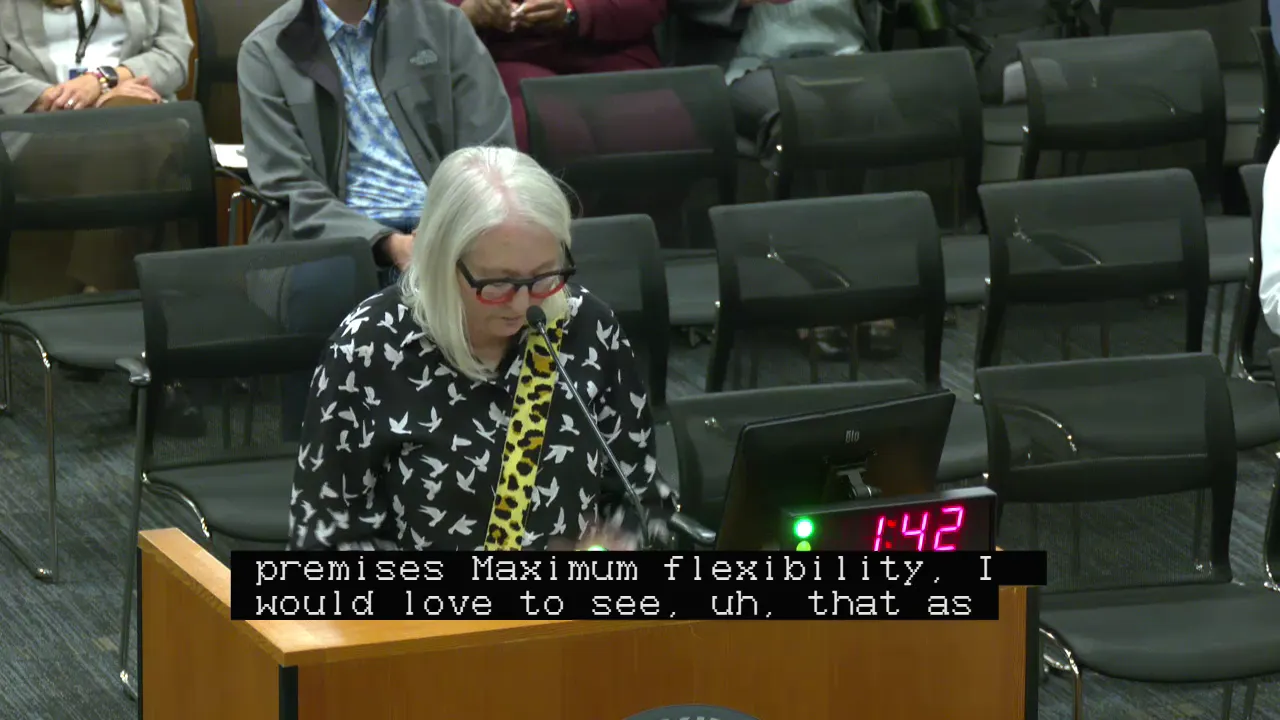
- Joan McBride: Supported the Housing on Faith-Owned Land pilot; urged flexibility, professional support for faith groups, and inclusion of social services.
- Susan Davis (virtual): Supported the Neighborhood Safety Program projects; expressed concerns about the tool library's ongoing costs; supported townhomes as transition zones in the station area.
- Liz Hunt: Critiqued the proposed rotation process for boards and commissions appointments; supported townhomes in transition areas of the station area.
Special Presentations
- King County Housing Authority Update: President and CEO Robin Walls provided an overview of KCHA operations, including 2,265 households in Kirkland, 596 tenant-based vouchers, and signature properties like Kirkland Heights. The presentation highlighted the grand opening of Kirkland Heights and ongoing partnerships.
Consent Calendar
- Approved unanimously (7-0): Approval of minutes (April 21, 2026), audit of accounts, claims, Jewish American Heritage Month Proclamation, Bike Everywhere Month Proclamation, honoring Larry Springer, acknowledgement of youth member resignation from Park Board, Resolution R-5733 (amending council policies and procedures), 2025 Surface Water Utility Annual Progress Report, declaration of surplus vehicles/equipment, March 2026 Sales Tax Report, March 2026 Investment Report, and Procurement Report.
Discussion Items
- Adoption of NE 85th Street Station Area Zoning Code Amendments (Ordinance O-4936): The council resumed consideration from the April 21 meeting.
- Amendment #1 (strike Sections 2-4) was considered; motion failed 0-7.
- Amendment #3 (allow townhomes on parcels with max height ≤65 ft) failed 3-4.
- Amendment #4 (allow townhomes east of 124th Ave NE with max height ≤65 ft) passed 5-2.
- Amendment #5 (sunset provision for townhome prohibition in 2029) failed 0-7.
- The main ordinance as amended (with Amendment #4) was adopted 7-0.
- Neighborhood Safety Program (NSP) Recommended Projects: Senior Community Engagement Coordinator Daniel Lazo presented three options. The council approved Option 2 (fund nine projects at $395,261 and direct staff to identify additional funding) by a 7-0 vote.
- Housing on Faith-Owned Land Pilot Program Briefing: Senior Planner Scott Guter presented options for a pilot program. The council directed staff to proceed with Option 1 (by-right administrative pilot with tiered incentives) by a 7-0 vote.
- Kirkland Tool Library Draft Scope of Work: Government Affairs Manager Andreana Campbell and Special Projects Coordinator Kate Ryan reviewed the draft scope. The council provided feedback emphasizing clarity on city liability, financial self-sustainability, and openness to proposals that do not assume city-owned space. The council agreed to move forward with issuing the RFP incorporating that feedback.
- Woodinville School Camera Zone Pilot Program – Interlocal Agreement: Deputy City Manager Tracey Dunlap presented Resolution R-5734 approving the second amendment to the interlocal agreement for court services. The council approved the resolution 7-0.
City Manager Reports
- Economic Competitiveness Study (LRM040726): City Manager Kurt Triplett presented options for a study. The council discussed Option 1B (targeted study focusing on economic factors, retail vacancy rates, taxes, fees, utilities, and evaluation of a local minimum wage, with a scope brought back for 2027-2028 budget). An amendment to include commercial lease rates passed 7-0. The main motion for Option 1B as amended passed 7-0.
- Calendar Update: City Manager Triplett noted a ribbon cutting at Taylor Fields and reminded of the Annual Community Appreciation Night on May 7.
Key Outcomes
- Consent Calendar approved 7-0.
- Ordinance O-4936 (NE 85th Station Area zoning) adopted 7-0 after Amendment #4 was incorporated.
- Neighborhood Safety Program Option 2 approved 7-0, funding nine projects at $395,261.
- Housing on Faith-Owned Land pilot direction set: proceed with Option 1 (by-right administrative model).
- Kirkland Tool Library RFP to proceed, incorporating council feedback.
- Resolution R-5734 (Woodinville interlocal agreement) approved 7-0.
- Economic Competitiveness Study Option 1B as amended approved 7-0; staff to bring back a narrowed scope.
Meeting Transcript
You guys ready? Uh hello everyone. I'd like to call to order the city council meeting on May 5th, 2025, 26. City Clerk, will you please call the roll? Councilmember Tim Chisholm. Here. Councilmember Arnold. Here. Councilmember Prem. Here. Councilmember Falcone. Here. Councilmember Pascal. Here. Deputy Mayor Black. Here. Mayor Curtis. Here. Our study session tonight is on two items. First, we'll hear an overview of the public defense services in Kirkland. Secondly, we will discuss proposed amendments to the city's code enforcement process. We expect to reconvene our regular meeting at 7 30. City manager. All right. Thank you, Madam Mayor. Deputy Mayor, members of the council. So our first topic is a discussion of public defense. This is a staff focused conversation because as you saw in the memo, we really want to talk a lot more about the potential implications to the budget of the caseload issue that's coming up, but we will talk a little bit about what public defenders do in the court. So then the second session will be on code enforcement. That will be later. So I'm going to keep an eye on the clock for about 45 minutes each. The presentation time is committed by our deputy city manager Tracy Dunlap and our interarm senior management analyst Juliana DeCruz. So take it away, Tracy. Thank you, City Manager. I'm just going to make a brief introduction that repeats a little bit of what the city manager said is this will be a little bit different than some of the other criminal justice initiative presentations, in that we'll focus less on what public defenders do and more on the state of public defense in the state of Washington and the impacts on the city's budget. And so you saw a lot in the prosecution presentation about the process, and Juliana will touch on that briefly, and then we'll get into what's happening in the state of Washington, and then I'll I'll close with the budget discussion. We have about 15 slides, and Andriana is here, our now our government affairs manager, to also answer questions as she's been involved in this discussion as well during the legislative session and and before that. So I'll turn it over to Juliana. Thank you again. So we're gonna start with a brief overview of what is public defense. And as you know, the criminal defendant's right to counsel is guaranteed by the U.S. constitution, the state constitution, state statutes and court rules. And if a defendant cannot afford legal counsel, then an attorney is appointed to them. And this is a public defender, and they represent the defendant through the same process that was outlined in the previous uh council meeting, and which is will be briefly outlined on the screen. So typically a case is filed by the prosecutor or direct filed by police, and um when the individual comes to court for their arraignment, they usually screen for indigency, which is their qualification for a public defender before the arraignment or shortly after. And then the public defender represents them throughout the resolution of the case. And you'll hear us use the term indigent defense and public defense interchangeably throughout this presentation. A person can be assigned a public defender if they are deemed indigent. An indigency is defined by RCW 10101010, and they are considered indigent if their income is 125% or less of the federal poverty level, if they receive public assistance, if they're involuntarily committed to a public mental health facility, or if they're unable to pay the anticipated cost of counsel. The RCW also outlines how an individual should be determined to be indigent, but there is some latitude in how the screening occurs.
openpublica.com