OPENPUBLICA · PUBLIC MEETING RECORD
Record of Proceedings
Manhattan City Commission Work Session: Floodplain, Stormwater, Habitat Housing (October 27, 2026)
City Commission — Tuesday, October 27, 2026
BodyManhattan, Kansas
SessionCity Commission
DateTuesday, October 27, 2026
StatusNEW · FILED
Video Record
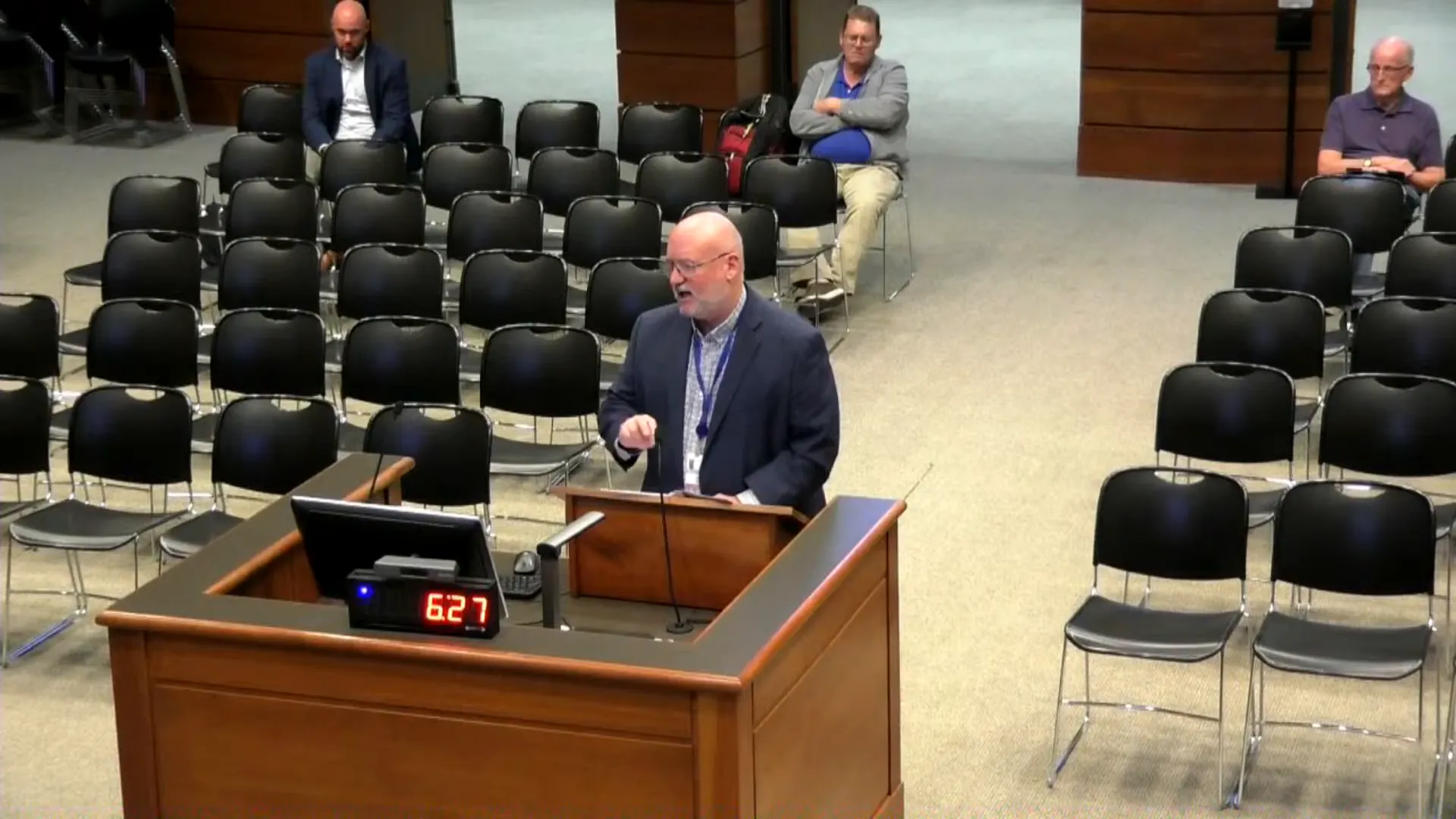
STREAMING COPY IN PREPARATION — RECORDING AVAILABLE FROM THE ORIGINAL SOURCE
Transcript — Verbatim
Speaker numbers apply only to this recording. Names come from transcript evidence. “Possibly” marks uncertain attribution.
Discussion Breakdown — Share of Meeting
Water And Wastewater Management42%
Affordable Housing35%
Engineering And Infrastructure7%
Procedural6%
Public Engagement3%
Intergovernmental Relations2%
Environmental Protection2%
Fiscal Sustainability1%
Parks and Recreation1%
Summary of Proceedings
Manhattan City Commission Work Session — October 27, 2026
The Manhattan City Commission met in a work session on October 27, 2026, with Mayor Adam Jack and Commissioners McCullough, Fox, Morrison, and Von Leno present; the clerk confirmed a quorum. No agenda or minutes were provided with the source transcript. Staff presented an annual floodplain management plan review, a stormwater program update, and a workforce housing sales tax request from Habitat for Humanity for housing at 3115 Dickens Avenue.
Public Comments & Testimony
- On the Habitat for Humanity item, Gary Mott of 1526 West Wind Drive, an adjacent property owner, said he was not necessarily against the project but was concerned about stormwater runoff and gravel from the former daycare site washing onto his property, possible construction disruption to his yard, and whether smaller homes in the neighborhood could affect neighboring property values. He also noted an existing diversion terrace and easements.
- Donna Shank Hamlin of 1922 Leavenworth Street spoke in support of a community land trust, describing it as one of three recommendations from the 2018-2019 Community Solutions to Affordable Housing study funded by the Kansas Health Foundation. She said the CLT was the working group that moved forward and that shared equity tools let people build modest wealth instead of remaining trapped in rentals. She offered to provide the study report to the Commission.
- Gary Oles of 3308 Frontier Circle cautioned the Commission about the tax-exempt status of land trusts, noting that Prairie Glenn and Prairie Glen East have not paid property taxes since the late 1960s and that services for tax-exempt properties are subsidized by other taxpayers. He said he was unsure how the county appraiser would treat land owned by a nonprofit and improvements owned by an individual.
- No public comment was offered on the floodplain or stormwater presentations.
Floodplain Management Plan Annual Review
- Bill Heatherman, Principal Stormwater Engineer, presented the 2026 annual floodplain management plan review, a CRS requirement. Manhattan participates in the National Flood Insurance Program and the Community Rating System at Class 6. He described the program as a partnership among local, state, and federal governments and said the city has adopted higher regulatory standards, public education, enforcement, planning, and mitigation activities. He noted nearly 35% of the city’s floodplain is in open space.
- The regional multi-hazard mitigation plan is updated every five years; the Commission concurred with the current plan by resolution in April. Floodplain maps show floodway, flood fringe, future-conditions floodplain, 500-year floodplain, and levee-protected areas; the future-conditions floodplain is a higher city standard tied to Wildcat Creek modeling.
- 2026 highlights included the Sunflower Flats project progressing so Garden Groves residents can relocate before floodplain buyouts close; a FEMA extension for that timeline; completion of levee phase one in 2024; ongoing phase two railroad stop-log gap negotiations; permitting moved into the Opal system; and 12 property buyouts completed since 2016, with the most recent single-family home buyout in 2024.
- In discussion, staff said the Wildcat Creek floodplain management plan update presented at a joint city-county meeting in March 2021 did not result in a final report and is not currently planned to be restarted. Commissioner Fox raised debris and fallen trees in Little Kitten Creek and other channels; staff said city policy does not remove large trees or debris from natural stream channels because of liability, cost, and private ownership, but staff offered to visit the sites. Public Works staff said most stream channels are on private property and no Kansas city performs that private maintenance.
- On Fort Riley, staff said a previous proposal for large reservoirs on the fort was rejected by the Pentagon about five or six years ago. A later study found about 18 smaller upstream detention areas could provide similar benefits, but implementation stalled on cost, authority, and cooperation. Public Works staff said they recently reconnected with new Fort Riley leadership and discussed a possible larger MOU covering maintenance, traffic signals, and line painting.
- Asked about program cost, Public Works staff said the stormwater fund’s personnel budget is in the range of $800,000 to $1 million out of roughly $4 million in revenue, and more than 90% of stormwater fund dollars go to projects.
Stormwater Program Update
- Bill Heatherman gave a broader stormwater program update. Maintenance crews perform inlet repairs, box culvert rebuilds, ditch cleanouts, and levee mowing, with staffing shortages noted. The Corps of Engineers annual levee site visit occurred the same day.
- Water quality work is governed by the MS4/NPDES permit through KDHE; the current five-year permit is in year two. Activities include public education, trash and recycling events such as a Halloween-themed event with KACEE, facility audits under the Good Housekeeping program, outfall inspections, follow-up on pollution reports, construction erosion control, and inspections of private stormwater treatment facilities. Staff said they inspect about 20% of facilities per year, above the 10% minimum.
- The city has more than 140 detention basins, mostly privately maintained. The city updated detention design methodology in 2023 and adopted a fee-in-lieu of detention program; six developments have paid into it. Staff said a city-driven inspection of basins found the median condition adequate. The fee was set at $1,155, rounded up from a calculation developed with Kansas State University, to fund downtown east and west drainage projects.
- Special projects include the Campus Creek study with Kansas State University and the Kearney Street Storm Collector study, both with consultant Benish under contracts approved at recent Commission meetings. CIP2, the culvert under the levee, is complete; CIP3 is about 90% complete and is scheduled to finish this fall and winter. CIP4, a large culvert under the state highway, is the hub for projects 8, 9, and 10 and will be designed to about 15% before being handed to KDOT for a partnership delivery.
- Staff described an alternative off-site stormwater treatment compliance program, one of the first three in Kansas, under which developer fees are used to pay farmers for cover crops through K-State K-Care. The first round of farmer contracts is being finalized.
Workforce Housing Sales Tax Request — Habitat for Humanity at 3115 Dickens Avenue
- Stephanie Peterson, Director of Planning and Development, said Habitat originally requested $50,000 in workforce housing sales tax for two units, but the request increased to $150,000 after the need for a sanitary sewer connection was identified. The existing home at 3115 Dickens is not connected to public sewer.
- Public Works staff member Randy described the proposed sewer line. The public sewer currently terminates at a manhole south of 1521 Wreath Avenue. Habitat plans to use an existing 16-foot public utility easement on the west side of the property and establish an additional easement through the replat. The neighboring property owner is not opposed; temporary easements could be available if needed. A previous shared lateral was cut off when the neighbor’s lateral was rehabilitated with an in-situ liner.
- Josh Brewer, Executive Director of Habitat for Humanity of Northern Flint Hills, presented the proposal. Habitat is using a community land trust model, described as the first shared-equity CLT construction in Manhattan in about 30 years. Under the CLT, the homeowner owns the home and leases the land under a 99-year ground lease; the land trust owns the land and preserves affordability. The resale formula currently gives the homeowner 25% of market appreciation and preserves 75% for the next buyer.
- For the first home, the target first sale price is $299,000 against an appraised market value of $360,000, a $61,000 discount. Under the formula, after five years the resale price would be about $307,557, and the homeowner could leave with up to $49,833 in earned equity from mortgage payments plus about $8,000 in appreciation. For the second home, the target price is $225,000 against a $325,000 market value, a $100,000 discount, with a formula resale price of about $231,000 after appreciation.
- Habitat requested $100,000 to reimburse property acquisition and $50,000 for sewer construction. Total development cost before developer fee is $931,860. The city share would be 16%, or about $75,000 per home. The property was purchased from Oak Grove School and was formerly tax-exempt; Habitat estimates the project would return about $524,000 to the tax rolls and produce annual property tax revenue of more than $9,200.
- In Commission discussion, some commissioners questioned whether the 25% homeowner appreciation share is fair, especially for long-term owners who may need to invest in repairs; Mr. Brewer said the initial below-market purchase price is the offsetting benefit and that the 25/75 split matches current Kansas CLT practice, though it could be revisited. The mayor noted no workforce housing funds had been expended this year and the money was set aside for this purpose. A commissioner expressed reluctance about using public funds for the sewer infrastructure and asked about alternative approaches; staff said sewer special assessments were possible but could make the homes less affordable. A commissioner asked to see the ground lease and equity-lending documents before approval. Mr. Brewer said the lease is based on the national Grounded Solutions Network model, is acceptable to Fannie Mae, Freddie Mac, HUD, and USDA, and includes a $25 monthly CLT administration fee and $25 monthly shared maintenance fund.
Key Outcomes
- The Commission gave consensus direction for staff to work with Habitat for Humanity to prepare an agreement for the $150,000 workforce housing sales tax request, including both the $100,000 acquisition reimbursement and the $50,000 sewer component.
- Commissioner direction included reviewing a prototype of the ground lease and equity/funding agreement before final approval, and clarifying how realtor fees would be handled on CLT resales.
- A commissioner requested a copy of the Community Solutions to Affordable Housing study for review.
- The meeting was a work session; no formal substantive vote was taken. The Commission adjourned by unanimous voice vote on a motion.
Meeting Transcript
Good afternoon and welcome to the uh October 27th, 2026 work session of the Manhattan City Commission. Jason slash Jared, would you please, or Chelsea, would you please take the role? Mayor Adam Jack. Here. Commissioner McCullough. Yes. Commissioner Fox. Here. Commissioner Morrison. Here. Commissioner Von Leno. Here. Mayor Quorum of Three has been met. Thank you. Will you please rise and join me in saying the Pledge of Allegiance? I pledge allegiance to the flag of the United States of America. And to the Republic for which it stands. Thank you. As this is a work session, we will move right into our agenda for this evening. Our first item is an update on our 2026 floodplain management plan annual review, and we'll hear from Bill Heatherman. Commissioner Macken. Okay. Good evening, Mayor and Commissioners. My name is Bill Heatherman, Principal Stormwater Engineer for the City of Manhattan in the public works department. And we have uh two uh stormwater related items tonight. The first is our floodplain management plan review, and then the second item will be a broader overview of stormwater program. Uh as far as the floodplain management program goes, that that is one of the major programs of our division. And uh we do this management plan update annually. It's uh both a good opportunity to cover what we do, but it's also one of the requirements under our community rating system, which is an effort that we go to to um meet some higher higher goals and guidelines, and we get some credit for that as well. So we'll do some introduction, uh cover some floodplain basics and talk about our floodplain management program here in Manhattan, and then the regional mitigation plan. Uh that that is the highlight of tonight's meeting. Mitigation is all things that we do to try to be more resilient and more prepared for when flooding happens and and to minimize damages in the aftermath. And then we will talk about some of our near-term priorities and highlights, and then we do need to take any public comment tonight that the public would wish to give. Uh and each year that we've done this, we have uh gotten some public comment and had opportunities to have follow-on meetings with individuals, which has been very valuable. So floodplain is a partnership, and that's key for understanding why we do things the way we do. It's a partnership between local communities, the federal government, and the states. Uh what the federal government brings to the table is the national flood insurance program. Uh they also bring all of the support to the mapping, which is necessary in order to administer the program, and they operate the hazard mitigation grant program, which provides uh funding to remove uh flood hazards and take other activities to improve our resiliency, which the city of Manhattan has made uh heavy use of the hazard mitigation program. But uh the local community has key obligations. Uh we are required to adopt specific regulations that help move us in a flood-resilient direction, uh, to do public out education and outreach, to take enforcement actions against things that violate regulation in the floodplain and that would put property and people at risk. Uh exercise leadership and planning towards uh future flood risks, and if we want to pursue mitigation, which we have always uh been pretty proactive with as a city, is that you know we have to prepare the applications and undertake the project management for anything that we're awarded.
SUMMARIZED BY OPENPUBLICA AI
TRANSCRIPT VIA PUBLIC VIDEO
openpublica.com
openpublica.com