OPENPUBLICA · PUBLIC MEETING RECORD
Record of Proceedings
City of Miami Tree Ordinance Advisory Committee Meeting – November 2, 2026
Meeting Portal — Monday, November 2, 2026
BodyMiami, Florida
SessionMeeting Portal
DateMonday, November 2, 2026
StatusNEW · FILED
Video Record
STREAMING COPY IN PREPARATION — RECORDING AVAILABLE FROM THE ORIGINAL SOURCE
Transcript — Verbatim
Speaker numbers apply only to this recording.
Summary of Proceedings
City of Miami Tree Ordinance Advisory Committee Meeting – November 2, 2026
On November 2, 2026, the City of Miami Tree Ordinance Advisory Committee met with Melissa Fernandez Steers, assistant director in the building department, presiding. Seven of ten appointed members were present at roll call: Chris Barrelado, Diana Bell Duelen, Aaron DeMaio, Avra, Maria Lopez Dalbiar, Andy Parrish, and Ian Wogan. Lindsay Corrales, Riza Fernandez, and Thomas Lawrence were absent. The committee continued its category-one regulations review by rating four draft recommendation concepts and discussing implementation, then moved into process issues: tree banking, appeal stays and standing, development-review timing, private providers, tree-trust-fund uses, and scheduling. Ratings were explicitly not votes. No final recommendations were adopted; staff was to revise worksheets and return with additional items. The meeting later lost quorum.
Discussion Items
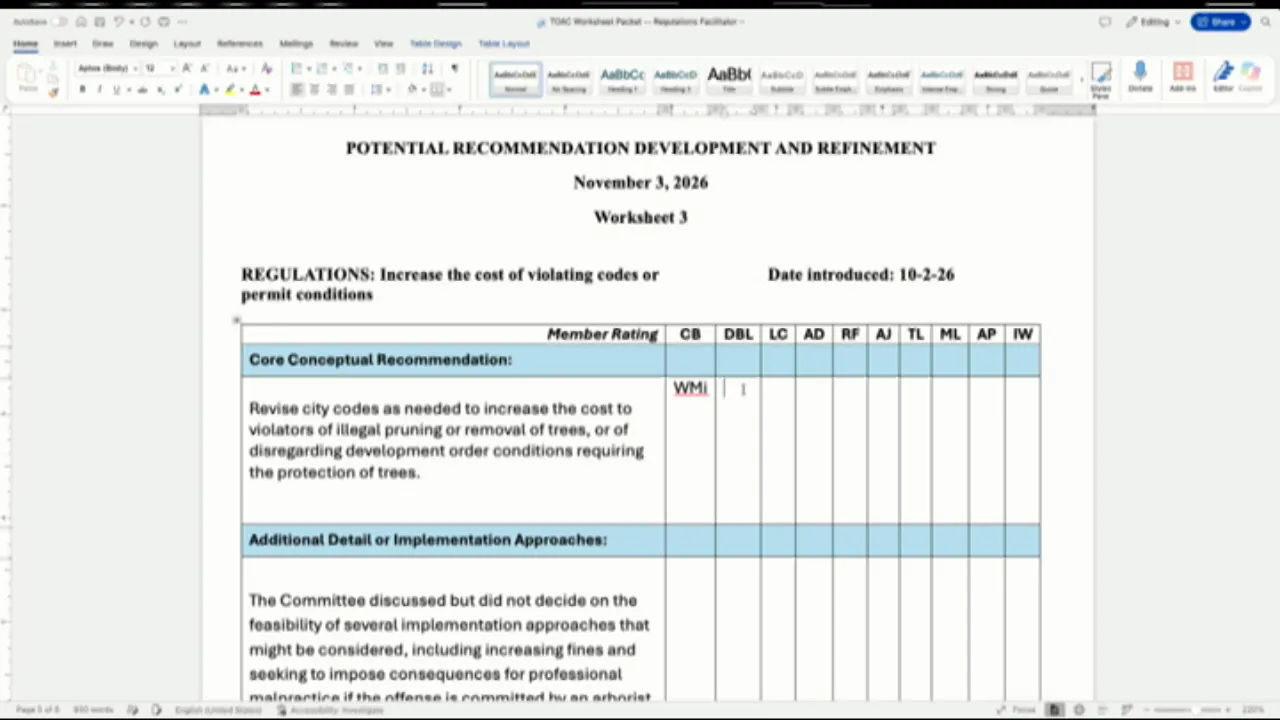
- Worksheet packet and rating framework: Staff explained four worksheets based on prior committee ideas. Members were asked to rate only the core conceptual recommendations using a scale of wholehearted support, minor reservations, or major reservations. Staff stressed that ratings were a discussion tool, not votes, and that members were rating as individuals rather than on behalf of constituencies.
- Single-family zoning incentives and Flora: The first concept was to revise the zoning code to provide incentives and flexibility to preserve trees in redevelopment of single-family houses, with the Flora proposal as one implementation approach. All members present rated it wholehearted support. Chris called Flora one of the most intelligent solutions he had seen and said other incentives and neighborhood assessment should be explored without making permitting onerous. Andy said residential properties are about 70% of the city's area and should be treated separately from commercial; he urged substantial incentives or carrots rather than sticks and suggested tree-fund money as a possible source. Dina emphasized flexibility because lot sizes, setbacks, height limits, historic designations, and neighbor input will vary. Maria asked for specific examples of incentives and flexibilities and asked whether historic-designated homes would be treated differently. Ian suggested building a project as a proof of concept to show the return on investment and cost of building around a specimen tree. Aaron proposed charting and ranking the nuances for the public report, and Avra asked whether planning and zoning staff had vetted the concept. The city attorney noted that neighborhood conservation districts are governed in Miami 21 and that any chapter 17 interaction would need further research.
- Chapter 17 canopy-based mitigation: The second concept was to revise chapter 17 so mitigation considers tree height and canopy, not just trunk size, and replicates a specified percentage of lost canopy within a specified period. All members present rated it wholehearted support. Chris explained a proposed metric integrating girth, height, and crown area, with crown area weighted 50% and girth and height weighted 25% each, using existing arborist-report data. He said diameter tables can allow removal of 95% of benefits, which are volume-based. Andy noted the county's 30% canopy goal by 2030 may be impossible and suggested a 2035 target, while emphasizing the political need for commission support. Maria said developers must be educated and brought on board. Aaron said some proposals may cost more than current practices and that timing and incentives matter. Chris said clear mitigation tables and a streamlined process can build costs into development while producing savings, and that species selection matters because replacing a large live oak or strangler fig with a small stopper tree does not provide equivalent canopy over time.
- Increasing costs to violators: The third concept was to revise city codes and procedures to increase costs for illegal pruning or removal and for disregarding tree-protection conditions. Support was strong but with minor reservations and clarifications. Members said pruning must be distinguished from removal; violators must be defined, including property owners versus professionals; first versus repeat violations; homesteaded versus business-owned property; and intent. Chris said the valuation table could provide a base and that the city should not make it easier to remove trees than to preserve them. Ian said contractors or professionals who advise owners incorrectly should face liability. Others suggested requiring documentation before trimming and using city staff or environmental forensics to establish species, size, and violation facts after the fact.
- Homestead paperwork reductions: The fourth concept was to reduce arborist reports and paperwork for homesteaded properties and provide exemptions or flexibility where warranted. Members supported the concept but with reservations and calls for clarification. Dina and Avra said pruning should be separated from removal; Dina did not think pruning without a permit should be treated as severely as removal without a permit. Aaron said the category has nuance and needs more specificity. Maria and Andy supported with minor reservations, with Andy asking what incentives would encourage voluntary compliance. Ian supported with additional clarifications and questioned why homestead status should change the ecological value of a specimen tree. Chris suggested possible tree-trust-fund subsidies for homesteaded properties with demonstrated need, and members noted that removal authority is affected by state statute 163.05.
- Tree banking and relocation registry: Avra introduced tree banking: catalog trees that will be removed, identify public park or school-board land for holding or receiving trees, make the information public, and match sending and receiving sites. Ian supported the idea, noting that moving large trees is expensive and requires permits, wide loads, escorts, equipment, and best-management practices; he said the city already has a tree-relocation vetting form. Avra described Coral Gables practice of reviewing tree-removal disposition at the first development-review step and connecting developers who need to remove trees with developers who want specimen trees. Chris supported the concept but said mitigation credit must be carefully designed because ecological benefits are localized; a developer might get partial, not full, credit if a tree is relocated outside the neighborhood. Members also noted FPL utility conflicts and costs for moving large trees. Staff said a worksheet would be prepared for the next meeting.
- Chapter 163 memo and preemption: Andy distributed a memo on chapter 163 constraints and argued that the city must consider the politics of preemption. He said he had heard only about 8 to 10 bad actors had taken advantage so far, though he was unsure of the period, and warned that chapter 163 is dangerous if more people learn about it and that penalties could push more owners to use it. Staff asked members to read the memo and decide next Monday whether to include related recommendations.
- Appeals, stays, and standing: Andy described a large oak on Irvington Street that was removed after city approval even though neighbors appealed, because no injunction or stay stopped the removal. Maria described a similar case in northeast Miami where a developer removed a tree on a Saturday before an appeal motion could be filed. Members discussed an immediate stay until the appeal period or appeal is resolved, broader notice through multiple emails or phone numbers, and clearer standing rules. Dina said appellants should confirm they have read the record and should state specific grounds; she favored making tree-process information easily accessible through iBuild. Chris asked for clarification on how far this committee can change standing rules, noted HEP board meetings are onerous, and suggested an affidavit and a pre-appeal resolution meeting. Chris and Maria supported considering a separate board dedicated to tree issues rather than combining trees with historic preservation; Maria added that such a board could oversee tree funds. Ian said arborist reports, surveys, and condition reports should be more accessible to appellants.
- Development review and pre-application: Dina said the most important step is to make tree review robust at the very beginning of development review, using preliminary sketches or volume studies before developers spend heavily on engineering. Andy said property rights and square footage are the central political obstacle; he suggested flexibility on rear or side setbacks and possibly height to preserve trees without reducing buildable square footage. Aaron noted that pre-application is typically voluntary and that any mandatory milestone would need careful definition, such as for specimen trees or certain site conditions. Avra said she would pay for a tree pre-application and would take advantage of it because trees are the first thing she checks; she said commercial owners are more likely to pay than residential owners. Members discussed whether staff resources could support expanded pre-application and whether private providers could review chapter 17 tree compliance. Staff said private-provider questions were included in the staff question-and-answer document.
- Funding and review tools: Andy asked where tree-trust-fund money has gone and how future funds could support incentives. Staff said the code provisions for the tree trust fund are separated from the provisions governing use of the money and that this would be taken up at the next meeting. Chris said revised mitigation tables could increase tree-trust-fund revenue and that funds could support homestead subsidies, more staff, and process efficiency. Ian said a plug-and-play app can reduce staff review time. Chris said the app is available through a university website, uses arborist reports to value trees, and can show mitigation owed under revised tables.
- Scheduling and input analysis: Staff said scheduling remains difficult because daytime meetings do not work for some newer members; evening or Saturday meetings had previously drawn little enthusiasm. The committee has a seven-member quorum requirement. Dates discussed included November 9, 2026, from 2 to 5 p.m., and December 8, 2026, with discussion of moving December 8 to an evening slot. Chris said he could not make an evening meeting on November 9 because of childcare. Avra said she has a Little Haiti Revitalization Trust meeting on December 8 from 6 to 8 p.m. and would seek to be excused. Staff also explained that the Orthon group can provide a thematic analysis of public input but is reluctant to provide frequency analysis because the respondents were self-selected and not representative. Staff cited 100 pages of workshop input and 259 pages of website input, and noted that online input emphasized property rights more than the workshops did. A category-three ideas list was to be sent before the next meeting.
Key Outcomes
- No binding votes or final recommendations were taken. The ratings were a snapshot to guide discussion and could change later.
- The single-family zoning incentive concept and the chapter 17 canopy-mitigation concept received wholehearted support from all members present.
- The violator-cost concept received strong support but with minor reservations and requests to clarify pruning versus removal, define violators, address owner versus professional liability, and distinguish first or repeat violations and intent.
- The homestead paperwork concept received support with reservations and calls to separate pruning from removal, add specificity, and consider tree-trust-fund subsidies where need is demonstrated.
- Staff was to revise the four worksheets with member comments, prepare a worksheet for tree banking and relocation, and return with potential recommendations on appeal stays, standing, notification, and related process changes. Staff was also to send a category-three ideas list.
- Staff responses to committee questions were distributed but not discussed after quorum was lost; they were to be reviewed for the next meeting. The committee also lost quorum near the end, prompting a member to remind colleagues not to leave early and to protect the seven-member quorum.
- Scheduling remained unresolved in part: November 9, 2026, was still planned for 2 to 5 p.m. at short notice, while December 8, 2026, was discussed for a possible evening meeting, subject to member availability and confirmation.
Meeting Transcript
So we need roll call taken. Good afternoon, everyone. This is the November 2nd, 2026 meeting of the City of Miami Tree Ordinance Advisory Committee. My name is Melissa Fernandez Steers, and I'm an assistant director with the building department, and I would like to call the meeting to order, and I'll now start with roll call. Chris Barrelado. Present. Diana Bell Duelen, present. Lindsay Corrales, previously advised she would be absent. Aaron DeMaio? Present. Riza Fernandez, previously advised she would be absent. Averaging? Present. Thomas Lawrence, previously advised he would be absent. Maria Lopez Dalbiar. Present. Andy Parrish. Andy Parish? Present. Ian Wogan. Present. Madam City Attorney, do we have quorum? Any person who is a lobbyist pursuant to chapter two, Article 6 of the City Code must register with the city clerk and comply with the related city requirements for lobbyists before appearing before the tree ordinance advisory committee. A person may not lobby a city official board member or staff member until registering a copy of the city code section about lobbyists available in the city clerk's office or online on communicode.com. Any person may be heard by the committee for not more than two minutes on any proposition before the committee. The video of the meeting may be requested at the Office of Communications or viewed online at WWMGov.com. Please sign us all cell phones and any other noise might noise-making event. Any person with a disability requiring a sister auxiliary aids and services for the meeting may notify the city liaison. Please note that the committee members may have been generally uh advised on the items before the agenda today. And in order to ensure that the public has plenty of ability to view the meeting, the city's communication department will broadcast the meeting. The meeting can be viewed live on Miami TV, MiamiGov.com back slash TV, Comcast 277 within the city of Miami, and the broadcast will also have closed captioning. Um if I can ask, do we have uh I think we know the answer, but is there any member of the public who would like to offer comment later in the meeting? Okay. Welcome everybody. Thanks for coming. Um just going over the agenda before we start the discussions. There are two big pieces to today's meeting. At your last meeting, you started putting ideas on the table under the first category of issues that we've talked about. Regulations, code, chapter 17, Miami 21, variety of other uh city provisions that govern what can and can't be done with trees. We're going to continue. The first part of the discussion continues that. We've taken the potential recommendation ideas you put on the table at the last meeting, put them into worksheets. We'll look at those worksheets first, see how you feel about those ideas, flesh them out, add detail, add other potential implementation approaches. If those are ideas you want to continue considering, and then we'll ask you are there other ideas in that category that you'd like to put on the table at this meeting for continuation at the next. Categories don't go away after they're introduced. They you continue to discuss them, detail them, and you can add ideas to them at any time.
SUMMARIZED BY OPENPUBLICA AI
TRANSCRIPT VIA PUBLIC VIDEO
openpublica.com
openpublica.com