The Miami Historic and Environmental Preservation Board (HEP) convened on November 3, 2026, at 7:45 PM. The meeting covered multiple agenda items including consent calendar approvals, several public hearings on tree appeals and certificates of appropriateness, and a lengthy public hearing on a proposed amendment to the historic designation of the First Presbyterian Church. The board approved most items with conditions, and one appeal was continued. Consent Calendar - Approved minutes from September 1, October 6, and a special meeting on October 13, 2026, with an amendment granting an after-the-fact absence waiver for a board member. - Accepted withdrawal of Item 1 (appeal) as requested by the appellant. Public Comments & Testimony - On Item 4 (Palm Grove alterations): One resident spoke in favor of the project, noting the windows should be allowed. - On Item 5 (Bayside addition): A representative from the Bayside Residence Association supported the project with modifications to parking. - On Item 3 (First Presbyterian Church): Extensive public comment from both supporters and opponents. Supporters included church members who emphasized the congregation's growth and need for funding. Opponents, including residents of the Icon Brickell condominium and preservation advocates, argued that the annex and parking lot are integral to the historic property and that the board should not reduce the designation. Discussion Items - Item 2 – Non-Conforming Use Exception (175 NE 45th St): Staff recommended approval for continued multifamily use in a T3-O zone. Board member Perez expressed concern about non-permeable asphalt parking. The board approved the exception 7-0 and separately recommended that the owner improve the parking to permeable surface. - Item 4 – Special Certificate of Appropriateness (7650 NE 5th Ave): Applicant sought to enclose a garage, add windows and a deck in Palm Grove Historic District. Staff recommended approval with conditions. The board voted 7-0 to approve with additional conditions: remove chain-link fence, add brick pattern under new garage window, allow clearstory windows, and limit fence height to 6 feet. - Item 5 – Special Certificate of Appropriateness (747 NE 72nd St): Applicant proposed a new addition and site improvements in Bayside Historic District. Staff recommended approval with conditions including removing barrel tile coping and limiting driveway width. The board voted 7-0 to approve with amendments: allow 16-foot driveway per neighborhood guidelines, allow barrel tile coping, add windows to west elevation, and preserve decorative front steps tile. - Item 6 – Appeal of Intended Decision (Tree Removal, 221 NE 36th St): The appellant requested continuance because their attorney was unavailable. The board granted continuance to the next regular meeting on December 1, 2026, over the appellee's objection. - Item 7 – Appeal of Intended Decision (Tree Removal, 3201 Day Ave): Initially postponed, later the appellant withdrew the appeal after the property owner agreed to retain a key tree (Gumbo Limbo 5) and provide additional replacement trees. The board accepted the withdrawal. - Item 3 – Amendment to Historic Designation (First Presbyterian Church, 609 Brickell Ave): The applicant (church) sought to reclassify the school annex and parking lot as non-contributing and amend the boundary to include only the sanctuary. After hours of testimony from experts and public, the board voted 6-1 to approve the amendment with conditions, including a covenant requiring that any future development on the non-designated portion be reviewed by the board for consistency with Chapter 23 standards. The approval was based on the specific plans presented, and any material changes to the exterior (scale, proportion, materiality, articulation) would require board approval. Key Outcomes - Item 2: Approved 7-0 with a recommendation for permeable parking. - Item 4: Approved 7-0 with conditions. - Item 5: Approved 7-0 with amended conditions. - Item 6: Continued to December 1, 2026. - Item 7: Withdrawal accepted. - Item 3: Approved 6-1 to amend the historic designation report for First Presbyterian Church, removing the school annex and parking lot from the designation, subject to a covenant requiring board review of future development on the site consistent with the plans presented. The board also decided not to hold a special meeting in December. The meeting adjourned after 9:00 PM.
Public Meetings - Miami, Florida
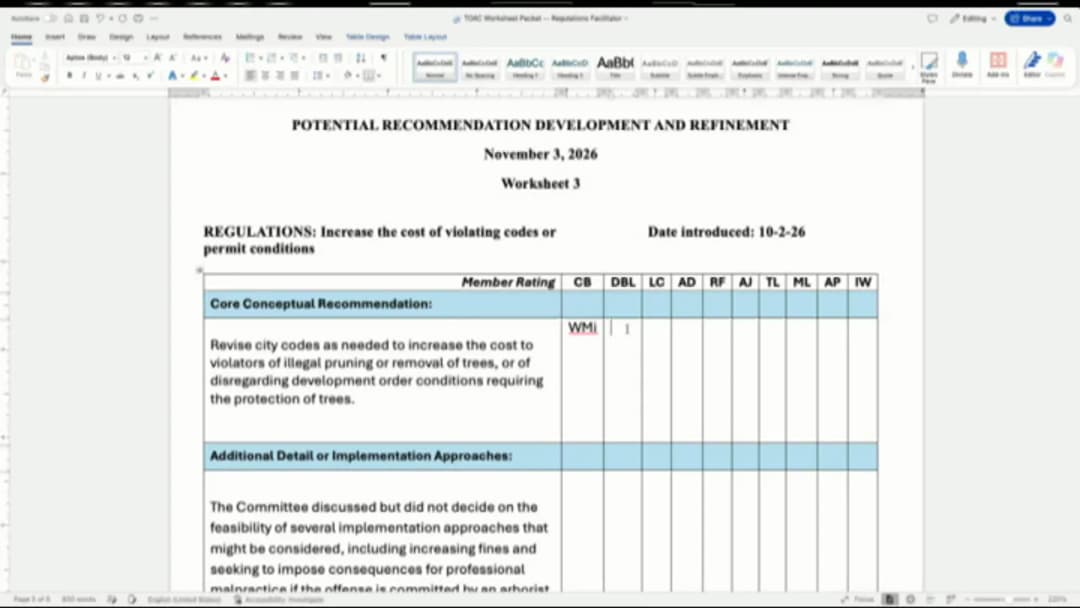
Public Meetings - Miami, FloridaOn November 2, 2026, the City of Miami Tree Ordinance Advisory Committee met with Melissa Fernandez Steers, assistant director in the building department, presiding. Seven of ten appointed members were present at roll call: Chris Barrelado, Diana Bell Duelen, Aaron DeMaio, Avra, Maria Lopez Dalbiar, Andy Parrish, and Ian Wogan. Lindsay Corrales, Riza Fernandez, and Thomas Lawrence were absent. The committee continued its category-one regulations review by rating four draft recommendation concepts and discussing implementation, then moved into process issues: tree banking, appeal stays and standing, development-review timing, private providers, tree-trust-fund uses, and scheduling. Ratings were explicitly not votes. No final recommendations were adopted; staff was to revise worksheets and return with additional items. The meeting later lost quorum. Discussion Items - Worksheet packet and rating framework: Staff explained four worksheets based on prior committee ideas. Members were asked to rate only the core conceptual recommendations using a scale of wholehearted support, minor reservations, or major reservations. Staff stressed that ratings were a discussion tool, not votes, and that members were rating as individuals rather than on behalf of constituencies. - Single-family zoning incentives and Flora: The first concept was to revise the zoning code to provide incentives and flexibility to preserve trees in redevelopment of single-family houses, with the Flora proposal as one implementation approach. All members present rated it wholehearted support. Chris called Flora one of the most intelligent solutions he had seen and said other incentives and neighborhood assessment should be explored without making permitting onerous. Andy said residential properties are about 70% of the city's area and should be treated separately from commercial; he urged substantial incentives or carrots rather than sticks and suggested tree-fund money as a possible source. Dina emphasized flexibility because lot sizes, setbacks, height limits, historic designations, and neighbor input will vary. Maria asked for specific examples of incentives and flexibilities and asked whether historic-designated homes would be treated differently. Ian suggested building a project as a proof of concept to show the return on investment and cost of building around a specimen tree. Aaron proposed charting and ranking the nuances for the public report, and Avra asked whether planning and zoning staff had vetted the concept. The city attorney noted that neighborhood conservation districts are governed in Miami 21 and that any chapter 17 interaction would need further research. - Chapter 17 canopy-based mitigation: The second concept was to revise chapter 17 so mitigation considers tree height and canopy, not just trunk size, and replicates a specified percentage of lost canopy within a specified period. All members present rated it wholehearted support. Chris explained a proposed metric integrating girth, height, and crown area, with crown area weighted 50% and girth and height weighted 25% each, using existing arborist-report data. He said diameter tables can allow removal of 95% of benefits, which are volume-based. Andy noted the county's 30% canopy goal by 2030 may be impossible and suggested a 2035 target, while emphasizing the political need for commission support. Maria said developers must be educated and brought on board. Aaron said some proposals may cost more than current practices and that timing and incentives matter. Chris said clear mitigation tables and a streamlined process can build costs into development while producing savings, and that species selection matters because replacing a large live oak or strangler fig with a small stopper tree does not provide equivalent canopy over time. - Increasing costs to violators: The third concept was to revise city codes and procedures to increase costs for illegal pruning or removal and for disregarding tree-protection conditions. Support was strong but with minor reservations and clarifications. Members said pruning must be distinguished from removal; violators must be defined, including property owners versus professionals; first versus repeat violations; homesteaded versus business-owned property; and intent. Chris said the valuation table could provide a base and that the city should not make it easier to remove trees than to preserve them. Ian said contractors or professionals who advise owners incorrectly should face liability. Others suggested requiring documentation before trimming and using city staff or environmental forensics to establish species, size, and violation facts after the fact. - Homestead paperwork reductions: The fourth concept was to reduce arborist reports and paperwork for homesteaded properties and provide exemptions or flexibility where warranted. Members supported the concept but with reservations and calls for clarification. Dina and Avra said pruning should be separated from removal; Dina did not think pruning without a permit should be treated as severely as removal without a permit. Aaron said the category has nuance and needs more specificity. Maria and Andy supported with minor reservations, with Andy asking what incentives would encourage voluntary compliance. Ian supported with additional clarifications and questioned why homestead status should change the ecological value of a specimen tree. Chris suggested possible tree-trust-fund subsidies for homesteaded properties with demonstrated need, and members noted that removal authority is affected by state statute 163.05. - Tree banking and relocation registry: Avra introduced tree banking: catalog trees that will be removed, identify public park or school-board land for holding or receiving trees, make the information public, and match sending and receiving sites. Ian supported the idea, noting that moving large trees is expensive and requires permits, wide loads, escorts, equipment, and best-management practices; he said the city already has a tree-relocation vetting form. Avra described Coral Gables practice of reviewing tree-removal disposition at the first development-review step and connecting developers who need to remove trees with developers who want specimen trees. Chris supported the concept but said mitigation credit must be carefully designed because ecological benefits are localized; a developer might get partial, not full, credit if a tree is relocated outside the neighborhood. Members also noted FPL utility conflicts and costs for moving large trees. Staff said a worksheet would be prepared for the next meeting. - Chapter 163 memo and preemption: Andy distributed a memo on chapter 163 constraints and argued that the city must consider the politics of preemption. He said he had heard only about 8 to 10 bad actors had taken advantage so far, though he was unsure of the period, and warned that chapter 163 is dangerous if more people learn about it and that penalties could push more owners to use it. Staff asked members to read the memo and decide next Monday whether to include related recommendations. - Appeals, stays, and standing: Andy described a large oak on Irvington Street that was removed after city approval even though neighbors appealed, because no injunction or stay stopped the removal. Maria described a similar case in northeast Miami where a developer removed a tree on a Saturday before an appeal motion could be filed. Members discussed an immediate stay until the appeal period or appeal is resolved, broader notice through multiple emails or phone numbers, and clearer standing rules. Dina said appellants should confirm they have read the record and should state specific grounds; she favored making tree-process information easily accessible through iBuild. Chris asked for clarification on how far this committee can change standing rules, noted HEP board meetings are onerous, and suggested an affidavit and a pre-appeal resolution meeting. Chris and Maria supported considering a separate board dedicated to tree issues rather than combining trees with historic preservation; Maria added that such a board could oversee tree funds. Ian said arborist reports, surveys, and condition reports should be more accessible to appellants. - Development review and pre-application: Dina said the most important step is to make tree review robust at the very beginning of development review, using preliminary sketches or volume studies before developers spend heavily on engineering. Andy said property rights and square footage are the central political obstacle; he suggested flexibility on rear or side setbacks and possibly height to preserve trees without reducing buildable square footage. Aaron noted that pre-application is typically voluntary and that any mandatory milestone would need careful definition, such as for specimen trees or certain site conditions. Avra said she would pay for a tree pre-application and would take advantage of it because trees are the first thing she checks; she said commercial owners are more likely to pay than residential owners. Members discussed whether staff resources could support expanded pre-application and whether private providers could review chapter 17 tree compliance. Staff said private-provider questions were included in the staff question-and-answer document. - Funding and review tools: Andy asked where tree-trust-fund money has gone and how future funds could support incentives. Staff said the code provisions for the tree trust fund are separated from the provisions governing use of the money and that this would be taken up at the next meeting. Chris said revised mitigation tables could increase tree-trust-fund revenue and that funds could support homestead subsidies, more staff, and process efficiency. Ian said a plug-and-play app can reduce staff review time. Chris said the app is available through a university website, uses arborist reports to value trees, and can show mitigation owed under revised tables. - Scheduling and input analysis: Staff said scheduling remains difficult because daytime meetings do not work for some newer members; evening or Saturday meetings had previously drawn little enthusiasm. The committee has a seven-member quorum requirement. Dates discussed included November 9, 2026, from 2 to 5 p.m., and December 8, 2026, with discussion of moving December 8 to an evening slot. Chris said he could not make an evening meeting on November 9 because of childcare. Avra said she has a Little Haiti Revitalization Trust meeting on December 8 from 6 to 8 p.m. and would seek to be excused. Staff also explained that the Orthon group can provide a thematic analysis of public input but is reluctant to provide frequency analysis because the respondents were self-selected and not representative. Staff cited 100 pages of workshop input and 259 pages of website input, and noted that online input emphasized property rights more than the workshops did. A category-three ideas list was to be sent before the next meeting. Key Outcomes - No binding votes or final recommendations were taken. The ratings were a snapshot to guide discussion and could change later. - The single-family zoning incentive concept and the chapter 17 canopy-mitigation concept received wholehearted support from all members present. - The violator-cost concept received strong support but with minor reservations and requests to clarify pruning versus removal, define violators, address owner versus professional liability, and distinguish first or repeat violations and intent. - The homestead paperwork concept received support with reservations and calls to separate pruning from removal, add specificity, and consider tree-trust-fund subsidies where need is demonstrated. - Staff was to revise the four worksheets with member comments, prepare a worksheet for tree banking and relocation, and return with potential recommendations on appeal stays, standing, notification, and related process changes. Staff was also to send a category-three ideas list. - Staff responses to committee questions were distributed but not discussed after quorum was lost; they were to be reviewed for the next meeting. The committee also lost quorum near the end, prompting a member to remind colleagues not to leave early and to protect the seven-member quorum. - Scheduling remained unresolved in part: November 9, 2026, was still planned for 2 to 5 p.m. at short notice, while December 8, 2026, was discussed for a possible evening meeting, subject to member availability and confirmation.
On November 2, 2026, Special Magistrate Darcy Siegel presided over the City of Miami Code Enforcement Meeting. The meeting addressed multiple cases including extensions of time for code compliance and hearings on alleged violations. The magistrate granted extensions, issued compliance orders with fines, and heard cases in absentia. Preliminary Remarks The special magistrate outlined procedures, including fines up to $250 per day for residential first violations and $1,000 per day for commercial first violations. Witnesses and interpreters were sworn in. Extension of Time Cases Granted - 2742 SW 8th St: Representative Ben Fernandez requested 120 days to complete building permits. Granted with no objection. - 101 & 111 NW 26th St: Representative Mickey Morero requested 120 days for each address for parking lot improvements. Granted. - 459 NE 25th St: Representative Mickey Morero requested 45 days to close out demolition permit. Granted. - 7101 North Miami Ave: Representative Justin Tarrani requested 120 days to obtain certificates of use and business tax receipts for units. Granted. - 5296 NW 4th St: Owner requested 120 days to complete fence installation. Granted. - 1774 NW 42nd St: Owner Federico Crespo requested 120 days for driveway approach modifications. Granted. - 3671 SW 13th St: Owner Nuan Chandimal requested 120 days for tree removal permit processing. Granted. - 152 NW 34th St: Owner Marisol Garcia requested 120 days to finalize permit inspections. Granted. - 2495 SW 21st Terrace: Owner Cedar Wilvert requested 120 days for windows and painting permits. Granted. - 3199 SW 26th St: Owner Manor Francois requested more time for carport/as-built permits. City recommended 90 days; magistrate granted 90 days with caution about progress. To-Be-Heard Cases (Guilty Pleas) - 1021 NW 48th St (Flip King Real Estate LLC): Owner Carlos Moreno pleaded guilty to work without finalized permit for interior renovations. City recommended 120 days, $150 per day fine. Magistrate set 120 days, $250 per day fine, noting commercial nature of flip property. - 5740 NW 3rd Ave: Owner Reynolds Gonzalez (represented by daughter Yasenia Gonzalez with power of attorney) pleaded guilty to work without permit. Magistrate set 120 days, $150 per day fine to comply. Cases Heard in Absentia - 624 NW 65th St: Violation of failure to register vacant lot and failure to maintain lot. Inspector Troutman presented evidence. Magistrate found guilty, gave 7 days to comply, fine of $500 per day. - 1304 NW 43rd St: Violation of work without permit (doors, windows, fence). Inspector Hedgeburg de Jou presented evidence. Magistrate found guilty, gave 7 days to comply, fine of $250 per day. - 1741 NW 40th St: Violation of work without permit for remodeling. Inspector Troutman reported owner (92 years old) facing financial hardship. Magistrate found guilty, gave 120 days to comply, fine of $50 per day, noting ongoing efforts to secure funding. Omnibus Order The magistrate denied all extension-of-time requests for those who failed to appear, except page 104 (property at 1792 SW 11th Terrace) which was reset due to an invalid power of attorney. Key Outcomes - Ten extension of time requests were granted with compliance periods ranging from 45 to 120 days. - Two respondents pleaded guilty to violations and were given 120 days to comply with per diem fines ($250 and $150). - Three properties were found guilty in absentia, with compliance periods of 7 or 120 days and fines from $50 to $500 per day. - All unexcused extension requests were denied, and one case was reset. - Respondents were reminded to request extensions online before deadlines to avoid automatic liens.
The City of Miami Climate Resilience Committee (CRC) convened a workshop on November 2, 2026, due to a lack of quorum (five of six members present). The committee received presentations on the Miami Loop trail network and flood-adaptive building design, received updates on the tree ordinance and resilience projects, and discussed the significant October king tide event and proposed bylaws updates. Consent Calendar - No items were approved due to the workshop status. Public Comments & Testimony - No members of the public offered comment. Discussion Items - Miami Loop Presentation: Christian Molino from Commissioner Rosato's office presented the Miami Loop project. He distinguished the outer county-to-county trail from the inner loop connecting all five commission districts. He detailed a timeline from 2014, noting the creation of a city task force in 2025, the securing of $3 million from the Public Benefits Trust Fund for the Ludlum Trail, and an additional $5 million for the trail segment at Robert King High Park. Results from the October 10 Miami Loop Summit were shared, where 91% of respondents indicated they would use public transit if it were safer, and residents expressed a desire to prioritize connection over beautification. The link between the trail network and climate resilience was highlighted through sponge park designs for flood mitigation and water quality improvements. - Designing with Water Presentation: Vincent Lee, Principal at ARUP, presented a national overview of designing flood-adaptive buildings and resilient urbanism, citing thorough case studies from New York, Boston, Miami Beach (Buoyant City Project), Honolulu, and Cleveland. He discussed balancing historic preservation with resilience and detailed strategies like dry floodproofing and adaptive recovery. Committee members discussed the urgent need for best practices and floodproofing guides, the status of the Army Corps' Back Bay and 216 studies, and the importance of integrating local flood protection projects. Mr. Lee committed to sharing ARUP's summary of floodproofing options and details on the Miami Beach private property adaptation program. - Tree Ordinance Advisory Committee: Member Avra reported significant progress. The committee is exploring recalibrating mitigation fees based on canopy benefit rather than diameter, establishing a tree bank program, improving process transparency with pre-application meetings, and developing penalty structures for bad actors. The goal is to finalize recommendations by January. - Biscayne Bay Watershed Management Advisory Board: The CRC's resolution supporting the board's creation has been submitted for the December 10th City Commission agenda. - Resilience & Sustainability Updates: Chief Resilience Officer Sonia Brubaker noted a final community meeting for the Margaret Pace Park Master Plan on November 9th. The office is compiling a citywide resilience accomplishments document for the budget book. - Bylaws Update: Draft language for an absence waiver process was circulated. The committee discussed the need for clear, firm criteria for waivers to prevent them from becoming a crutch affecting quorum. The possibility of starting public portions of meetings without quorum was raised. Final changes will be voted on in December. - 2026 King Tide Update: Sonia Brubaker reported that the October 27 king tide was extraordinary, reaching 1.8 feet higher than predicted. Data from Brian McNoldy indicated that 32 new daily high tide records have been set in Miami this year, with six of the top ten highest water levels occurring during non-hurricane events, driven by onshore winds compounding sea level rise. Current city measures include over 100 installed backflow preventers with 80 more planned in the next two years, and the Brickle Bay Drive seawall project (8 ft high, 1800 ft long) starting construction in 2027. The committee expressed urgency in reevaluating current seawall standards and policies given this new data. Key Outcomes - Workshop Status: No formal votes were taken; action items were discussed for future meetings. - Directives and Next Steps: The annual report and finalized bylaws updates are scheduled for a December vote. Staff will investigate the timeline for additional backflow preventers. The chair will push for a comprehensive presentation from the Army Corps and County on the Back Bay/216 studies. A future presentation on freeboard heights by Gensler is scheduled for December.
The City of Miami HCLC committee met on October 28, 2026, at 14:15 UTC (10:15 a.m. EDT). No agenda or minutes were available, so this summary is based on the raw transcript. The meeting had one substantive item: releasing a $200,000 CDBG loan lien and changing the borrowing entity for the Edison Towers 2 affordable housing project. Two other items were deferred and are expected to return in January. Consent Calendar - The committee unanimously approved the minutes of the September 30 meeting. Public Comments & Testimony - Carol Gardner, identified as president/CEO of TEDC (Tacosa Economic Development Corporation), said the requested lien release clears title on the second parcel for Edison Towers 2 and allows the project to move forward with pre-development, property tax exemption, and low-income housing tax credit financing. She said the project is fully funded and drawings are being submitted to the City of Miami. - In response to a committee member's question about a vacant former bank property near 58th Street and 7th Avenue, Gardner said TEDC has tried to acquire the site: the owner bought it for about $3 million; TEDC offered $5 million and was countered at $7 million, then offered $7 million and was countered at $10 million. She said TEDC would put affordable housing there if it can acquire the property. Discussion Items - Staff recommended approval to release the $200,000 CDBG lien (executed in 2010) against the Edison Towers 2 property so TEDC can obtain clear title, and to change the borrower from Edison Towers 2, LLC to Edison Towers 2 Apartments, LP to qualify for property tax exemption and LIHTC financing. The project is an eight-story, 96-unit tower in Liberty City. The committee approved a $3.5 million HOME CHDO set-aside for the project in July. TEDC is a Florida nonprofit community housing development organization that has operated in South Florida for over 40 years. - Committee member Pierre Rutledge asked whether releasing the lien on the second parcel would preserve the city's security for the $200,000 loan. Gardner responded that the old Tower 1 debt was supposed to remain on Tower 1; staff/city attorney discussion indicated the new loan documents would include covenants and rent restrictions, with the property transferring to Edison Towers 2 Apartments, LP at closing. - There was confusion about the current legal owner of the parcel. Gardner initially said TEDC Affordable Communities is the owner; after a check of the Miami-Dade property appraiser website, she said the owner is the Colsay Economic Development Corporation (also rendered elsewhere in the transcript as Teculsey/Tacosa Economic Development Corporation). The staff memo was to be amended to clarify the owner. Key Outcomes - The committee unanimously approved the staff recommendation to release the $200,000 CDBG lien and change the borrowing entity to Edison Towers 2 Apartments, LP, with a minor amendment/correction to the staff memo to clarify ownership. No one voted against. - The amended memo will be distributed to committee members. - The next HCLC meeting is scheduled for November 18, 2026. No December meeting is scheduled; the following HCLC meeting is expected in January 2027, when the two deferred items are expected to return.
The Code Enforcement Board of Miami, Florida, convened on October 28, 2026, at 10:15 AM to address administrative matters and hear cases related to code violations. The board approved the 2027 meeting calendar, excused an absent member, and heard 17 cases including extensions of time and requests for mitigation of fines. New board member Jason Manowitz was welcomed. Discussion Items Extensions of Time (EOT) - Seven cases were granted 120-day extensions to allow property owners to complete compliance work. Cases included 2631 NW 23rd Ct, 2628 NW 23rd Ct, 3031 NW 11th St, 4926 SW 7th St, 729 NW 55th Ter, 2479 NW 34th St (initially requested 60 days but board granted 120), and 761 NW 29th St. In each case, the city recommended 120 days, and the board voted unanimously to approve. Mitigations - 2320 NW 24th Ave (single-family, non-homestead): Lien of $309,750. After a failed motion to reduce to $5,000 (2-2 vote), the board reduced the fine to $3,000 on a second motion. - 80 NW 45th St (single-family, non-homestead, short-term rental): Lien of $791,000. The board reduced to $15,000, treating the violation as commercial due to rental activity. The owner's representative described the owner as having been misled by the prior seller and having stopped renting immediately upon discovering the violation. - 350 NW 45th St (single-family, non-homestead, now vacant lot): Lien of $725,100. The board reduced to $7,500, noting the owner had demolished the structure and obtained permits for new construction. - 30 NW 17th Ave (two cases, same property): Two liens totaling $591,500 and $638,500. Each reduced to $15,000. The property was vacant and undergoing 40-year recertification. - 1436 SW 5th St (commercial): Lien of $158,250. Reduced to $15,000. The owner's attorney explained a property manager mistakenly believed a certificate of use was not needed. - 45 SW 63rd Ave (homestead): Lien of $519,900. Reduced to $0 by unanimous vote. The owner bought the property with existing violations and took time to obtain financing; all violations were now corrected. - 7622 N Miami Ave (single-family, non-homestead, corporation): Lien of $1.7 million. Reduced to $10,000. The owner purchased in 2009 with violations and had difficulty due to inspector miscommunication. - 508 NE 67th St (vacant lot, originally single-family): Lien of $194,000. Reduced to $2,500 after a failed motion to reduce to $5,000. The property had a fire and was demolished; the owner was selling the lot. - 1642 SW 8th St (commercial): Lien of $515,000. Reduced to $15,000. Compliance was achieved after code changes and COVID delays. - 1700 NW 18th Ave (duplex, homestead): Lien not specified. Reduced to $0 by unanimous vote. Violations were for work without a permit and a tree permit issue. - 1222 NW 59th St (two cases, single-family, now vacant): Initially proposed $7,500 each, but upon discovery that the property had a structure at the time of violation, the board reversed the previous motion and reduced each to $1,000. The owner had paid other fines and liens. - 382 NW 24th St (commercial): Lien of $28,000. Reduced to $5,600 (20%), the statutory minimum for commercial. Compliance occurred during COVID. - 2337 NW 5th Ave (commercial): Lien of $514,500. Reduced to $15,000. The owner discovered the violation during a title search and immediately complied. - 420 NW 45th St (single-family, non-homestead): Lien of $43,750. Reduced to $0 because the city acknowledged a notice issue; the board concurred. - 3161 NW 2nd St (single-family, lost homestead exemption due to divorce): Lien of $116,500. Reduced to $0 by unanimous vote. The board advised the owner to reapply for homestead exemption. - 528 SW 6th St (commercial): Lien of $624,000. Reduced to $15,000. The owner discovered the lien during refinancing; the board noted cities had provided proper notice to the registered agent. - 154 NE 58th Ter (duplex, non-homestead, corporation): Lien of $528,000. Reduced to $2,500. The owner demolished the structure and was stuck with a mortgage; the board considered her financial hardship. Key Outcomes - The board approved the 2027 meeting calendar and excused board member Keon Williams. - All EOT requests were granted exactly as recommended by the city (120 days) unless the owner requested less. - Mitigation results ranged from full reduction to $0 (in three cases) to statutory minimums ($10,000 for non-homestead residential, $15,000 for commercial, $10,000 for single-family, etc.) with some cases going below minimum by unanimous vote. - The board demonstrated flexibility in cases involving notice errors, pandemic delays, and properties purchased with pre-existing violations.
The Miami Nuisance Abatement Board met on October 28, 2026, at 10:00 AM to approve the nuisance abatement calendar dates and consider a single case. All actions were taken by unanimous voice vote. Consent Calendar - The board approved the calendar dates for nuisance abatement and code enforcement matters. (Motion by a board member, seconded, all in favor.) Discussion Items - Case 25-1-6 (1969 Northwest Second Court, Apartment 13): The city reported that the property is fully in compliance with nuisance abatement requirements. The board voted to close the case. (Motion, second, all in favor.) Key Outcomes - Approved nuisance abatement calendar dates (unanimous). - Closed Case 25-1-6 based on full compliance (unanimous). - Adjourned the nuisance abatement hearing (unanimous).
The Virginia Key Advisory Board met on October 27, 2026, to discuss the Rickenbacker Marina referendum, the city's application for 195 mooring balls, and the proposed Miami Seaquarium redevelopment. The meeting opened with the Pledge of Allegiance, a welcome to new members, and the standard lobbyist-registration and appeal-record notice. The next regular meeting was set for December 22, 2026. Public Comments & Testimony - Laura Reynolds (Friends of Biscayne Bay) said the Rickenbacker Marina proposal's own report includes phase-two maintenance dredging to 8-9 feet in a basin that averages about 4 feet deep, with 5 feet the deepest point. She said the largest vessel currently in the marina is 90 feet with a 5.6-foot draft, and the proposal's drawings show new piers extending about 600 feet beyond the current marina to accommodate mega-yachts. She said Virginia Key LLC had claimed there would be no dredging, but the RFP already allows dredging to 8-9 feet; she recommended voters reject the referendum. On the mooring-ball item, Reynolds argued that 198 anchors was too many and proposed 42 day-use moorings in the center of the basin as a compromise to protect seagrass. On the Seaquarium, she said the Aquatic Preserve Act applies regardless of ownership, criticized the lack of public charrettes, and reported that the Florida Fish and Wildlife Conservation Commission (FWC) issued an October 22 request for additional information recommending no more than 250 total slips. - Roger Bernstein (Miami resident) said Commissioner Pardo held an open meeting on the mooring field and that the city is now considering reducing the number of anchoring points below 195. He said changes in state law gave Miami-Dade County more authority over its waters, and the county may have passed a no-anchoring area on second reading. He reported that enforcement by city Marine Patrol and FWC had cleared the basin of abandoned vessels. He also said funding would come from the Florida Inland Navigation District (FIND), covering about half the cost, roughly $1.2 million, and that the existing Dinner Key mooring field is only half developed, raising questions about demand. - Leah Kennard, a regular user of the basin, said the July 2010 Virginia Key Master Plan contains no mooring-field reference and that the basin has a historic designation separate from the Miami Marine Stadium. - Greg Frankel (Coconut Grove resident) said he and Aaron Stauber filed a citizen enforcement action under Article 7 of the Miami-Dade County Charter to require a countywide vote on the proposed Seaquarium lease and marina. He said he takes no position on the project and seeks no money. He said the county plans add 295 wet slips and 552 dry-stack spaces. Laura Reynolds later said the applicant had proposed 325 wet slips and 552 dry-stack spaces, for 877 total. Frankel argued Article 7's Seaquarium exemption does not cover submerged bay bottom, a new 99-year term, or non-aquarium uses, and cited a 2006 Zoo Miami precedent. He asked the board to recommend that the city commission urge the county to submit the lease to voters and defer November hearings until it has. - Cecile Sanchez (Key Biscayne) said government is not allowing residents a voice and urged the board to help protect the environment. Louisa Conway (Key Biscayne) asked the board to take a symbolic stand, expressed concern about dredging, marinas, and traffic, and said the proposed Key Biscayne Shoreline Project/Viaduct is not a consensus village position. Discussion Items - Rickenbacker Marina RFP and referendum: At the time of the meeting, the Rickenbacker Marina RFP was the subject of a voter referendum on the ballot through the following week. The city attorney advised against discussing the marina site because of pending litigation involving an affiliate of the current tenant. After public testimony, a board member proposed a resolution opposing the marina and asking voters to vote no. The board held the item for legal research; later, the city attorney advised that VCAB, as a city advisory board, could not pass a resolution urging voters to vote one way or another, and that the city itself cannot use city resources to sway the vote. - The board also discussed a possible uniform policy on dredging and vessel size, and later adopted a general resolution on that subject. - Mooring-ball application: No city executive provided an update. Board members discussed whether the original need for the mooring field still exists, enforcement costs, displaced vessels outside the basin, and seagrass protection. A copy of the 2010 master plan was referenced, and Leah Kennard noted it contains no mooring-field reference. - Miami Seaquarium redevelopment: The chair noted the site is county-owned and not part of Virginia Key Park, but is important to access and island-wide planning. The board heard detailed public testimony about the proposed lease, marina, submerged lands, permitting process, and pending Article 7 litigation. The board voted to add two Seaquarium-related resolutions to the agenda and adopted them. - Marine Stadium RFP, events, and administrative items: City staff said the operating agreement for Marine Stadium is being worked on after the referendum and that further updates will be provided. A Village of Key Biscayne representative said traffic on the causeway has been manageable, with only school-related delays. The city commission in June passed a resolution authorizing the city manager to place the VCAB quorum change on a future agenda, and the board is awaiting that action. The chair said a new chair election will be held at the next meeting. - At the outset, a board member moved to hear all public comment before agenda discussion and to set equal speaking times; no second was offered. Later, a board member stated the bylaws allow the chair to determine when public comment occurs and normally limit speakers to two minutes unless extended. Key Outcomes - The board did not adopt the proposed resolution opposing the Rickenbacker Marina referendum; the city attorney advised that advisory boards cannot urge voters to vote a particular way. - The board passed a resolution recommending that the city commission establish a uniform policy not to authorize dredging beyond existing depths within Virginia Key, with maintenance dredging limited to current depths and no boats over 120 feet or with a draft over 6 feet, subject to applicable laws. It passed with one dissenting vote. - The board passed a Seaquarium public-process resolution urging the city commission to ask Miami-Dade County to delay further Seaquarium consideration until comprehensive public engagement, including public charrettes and full transparency, is completed, and to use the full long-form CDMP amendment review process rather than the expedited process. The vote was six in favor and one abstention, after the abstaining member declared a conflict of interest. - The board passed a Seaquarium voter-referendum resolution recommending that the city commission urge Miami-Dade County to submit the proposed Seaquarium lease and marina to the voters and defer the November hearings until it has. The motion was amended to remove a legal determination about Article 7 and to require distribution before the next city commission meeting on November 19, 2026. - The board scheduled its next meeting for December 22, 2026, including the election of a new chair. Marine Stadium operating-agreement updates are expected to be on that agenda.
The Tree Ordinance Advisory Committee (TOAC) held its first working meeting. The session focused on outlining the committee's iterative process, discussing takeaways from initial public outreach and a prior staff question-and-answer session, and putting a first set of ideas on the table regarding regulatory changes. The committee did not take any formal votes but laid substantial groundwork for future meetings. Consent Calendar - No consent calendar items were presented. Public Comments & Testimony - No members of the public were present to provide oral comment during this meeting. Discussion Items Committee Process Overview - Facilitator Raphael described the four-part structure for the committee's work: 1) Regulations (Code, Plans), 2) Process (Permit Review, Enforcement), 3) City Actions (Planting, Pruning, Parks), and 4) Overarching Issues (Trust, Transparency). The group will generate ideas, receive information from staff, rate concepts, and ultimately present recommendations to the City Commission. A second round of public comment on the committee's draft ideas is planned for early 2027. Takeaways from Staff Q&A and Community Input - Legal Pathways (Abra): Abra asked for a formal explanation of the city's ability to make changes that impact county or state regulations, specifically questioning whether county rules are an absolute floor that prevents any changes at that level. - Data Needs (Dina): Dina requested specific data on the number of plan reviewers in Environmental Resources, their current workload volume, and the status of a comprehensive tree survey of the public right-of-way. - District Disparities (Dina, Andy, Lindsay): Members noted that public feedback varied significantly by district. Dina suggested grouping overlapping ideas versus outliers. Andy emphasized that a single standard cannot fit all transect zones (T3 vs. T6). Lindsay observed that many public concerns are already addressed in the existing code, indicating a potential implementation gap rather than a policy gap. - Thomas's Four Themes: Thomas Lawrence distilled public feedback into four primary concerns: inadequate replacement trees, low removal fees, a lack of preservation incentives relative to mitigation, and insufficient city inspection and enforcement of Chapter 17. Proposed Regulatory Changes - Revised Tree Valuation and Mitigation (Chris, Thomas): Chris Barolado proposed overhauling the mitigation table to be based on a composite measure of a tree's ecological value (diameter, height, canopy volume) rather than a simple linear trunk diameter, ensuring replacement fees reflect true value. Thomas noted public interest in using canopy area as the primary metric. - Tiered Fee and Fine System (Lindsay, Mariela, Andy): Members proposed a tiered fee schedule distinguishing residents (homesteaded properties) from commercial developments. Lindsay suggested raising the minimum replacement tree size from a 2-inch caliper to a 4-inch caliper. Andy called for significantly increased punitive fines for intentional, after-hours removal of protected trees, arguing the current fine is merely a cost of doing business. - Preservation of High-Canopy Non-Native Trees (Dina): Dina proposed allowing exemptions for valuable non-native trees (such as the historic Ficus trees on Coral Way) from blanket prohibitions on exotic species, provided they offer significant canopy and community value. Proposed Process and Implementation Changes - Self-Certification (Abra, Dina): Abra proposed allowing residents to use licensed landscape architects for self-certification of routine tree pruning or dead tree removal to reduce city staff burden. Dina clarified that certified arborists, unlike landscape architects, are not state-regulated licensed professionals. - Appeals Process (Abra): Abra suggested requiring appellants in tree hearings to demonstrate they have reviewed and are citing specific code violations, increasing transparency and reducing appeals based on general dissatisfaction. - Trust Fund Transparency (Abra, Lindsay): A call for codified transparency regarding how payments into the city's tree trust fund are spent. Zoning and Incentive Proposals - Zoning Flexibility for Preservation (Aaron): Aaron DeMaio presented a detailed proposal previously developed for the Climate Resilience Committee and indefinitely deferred by the City Commission. It suggests amending Miami 21 to allow floor area transfers (e.g., moving unbuilt ground floor square footage to a second or third story) within T3 single-family lots in exchange for preserving existing specimen trees and their critical root zones. - Developer Incentives (Andy, Mariela): Andy urged the committee to understand what specific incentives work for developers, such as expedited permitting or height and setback relief. He requested a future session with local for-profit developers to discuss the economics of tree preservation. - Tree Banking (Chris, Abra): The committee discussed creating a city-supported tree bank to temporarily hold and allow for the relocation of displaced trees off-site, with mitigation credits granted for successful relocation. Technology and Education Needs - Technology Seminar (Andy, Dina): Andy requested a dedicated presentation on modern tree preservation technologies, including air-spading, bridging over root zones, and canopy projection modeling. Dina noted that the City of Coral Gables recently completed a full LiDAR canopy analysis and digital twin that could serve as a useful model. Legal Constraints and Staff Responses - Members discussed the impact of state statute HB 1555/SB 180, which allows single-family homeowners to remove hazardous trees with a certified arborist report without a city permit. Staff agreed to provide a comprehensive overview of all state and county statutory constraints in the next meeting to clarify the committee's true scope of authority. Key Outcomes - No Formal Votes: As this was a working session, no formal votes were taken on any of the discussed ideas. - Information Requests Granted: Staff committed to providing a legal overview of jurisdictional pathways and constraints, specific data on city staffing levels and tree inventories, and answers to operational questions at the next meeting. - Member Presentations Scheduled: Chris Barolado will distribute his research on a volumetric tree valuation methodology to the full committee. Aaron DeMaio will share the link to his full zoning flexibility proposal for committee review. - Scheduling: The committee aims for three to four more meetings. Staff will circulate a scheduling poll for available dates on Monday, Wednesday, or Friday afternoons, with a goal of having a set of conceptual recommendations ready by early 2027. - Public Engagement Roadmap: The initial public input portal will close shortly to formalize the first round of idea collection. A second round of public comment on the committee's drafted recommendations is scheduled for January or February 2027.
The Tree Ordinance Advisory Committee met on October 23, 2026, for a question-and-answer workshop with City administration about the existing regulatory framework for tree preservation, protection, and canopy. Facilitators from the FSU Consensus Center, Rafael Montalvo and Hal Birdal, led the session. No agenda or minutes were provided in the source materials; this summary is based on the raw transcript. No public attendees were present, and the transcript indicates the meeting was approaching 4 p.m. near its close. Discussion Items - Quorum and attendance: Seven members were present at roll call, meeting the six-member quorum. Chris Baralotto was initially absent but joined later; Thomas Lawrence was absent. Committee member Andy Parrish urged that vacancies be filled so future meetings are not canceled for lack of a quorum. - Workshop purpose and future meeting format: The session was deliberately unstructured to let members ask detailed questions. Facilitators announced that an interim compilation of public input from the August/September workshops would be distributed after the meeting. It contains more than 100 pages of input plus more than 1,100 online comments from about 400 respondents. The comments are grouped into four categories: regulations; process; direct city actions; and overarching issues such as trust, transparency, strategy, and public education. One category will be introduced at each of the next four working meetings; the next meeting will focus on regulations. - Permitting process overview: At the start, a show of hands indicated five of the seven members had direct experience with city permitting or development review. Eureka Kulangis, Building Services Manager, described the five-step permitting process: application in the iBuild portal, plan review, permit payment, construction inspections, and final certificate. Review is concurrent across disciplines; zoning is always required, and environmental review is flagged when tree impacts are identified. A standalone tree permit can be submitted separately from a master permit. Applicants may seek same-day permitting help, walk-in assistance, and the city offers a homeowners assistance clinic. - Tree plan submittal requirements: Sean Smith, Acting Chief of Environmental Resources, said projects with tree activity require a tree disposition plan, tree protection plan, superimposed site plan, and tree replacement plan when removal is proposed. Boundary surveys must depict trees when required. Arborist reports are requested on nearly every project although not explicitly required by code. For commercial projects, submittals must be prepared by a Florida licensed landscape architect; for residential projects, a homeowner or representative may prepare them. Sean Smith also noted that demolition permits generally do not allow tree removals unless trees block access or become unsafe due to structure removal, and new-construction tree activity is reviewed as a subpermit so conflicts can be assessed. - Environmental review staffing and workload: Asked about capacity, Sean Smith said his division has seven reviewers plus himself. Tree plan reviews number in the thousands each year. Committee members raised concerns about whether site visits can keep pace with that volume. - Site verification: Environmental Resources does not visit every site. Staff use aerial imagery, Google Street View, historical imagery, and tools such as Zillow to check conditions, and conduct site visits for many canopy and specimen trees. Drones are not currently used. Lindsay Corrales questioned relying on possibly outdated imagery; staff said they use whatever tools are available. - Tree relocation and mitigation decisions: Sean Smith explained that the first question is whether a conflict exists. Preservation in place is the first priority for specimen trees; redesign may be required. Relocation is considered based on size, species, age, condition, the availability of a feasible landing spot, and the tree's likely long-term viability. Supplemental arborist reports and tree-mover vetting may be required. - Review time and transparency concerns: Ian Wogan said the tree review is often the longest part of the permitting process and that back-and-forth is not visible to the public. He suggested separating or duplicating the tree submittal process to improve transparency. Staff explained current public access options: iBuild accounts, public records requests, on-screen review at the building department, and the environmental resources page on the city website. The committee indicated that increased transparency should be considered in future recommendations. Eureka Kulangis said she did not have an exact count of applications that should have been flagged for environmental review but were not, and that it was minimal; committee members asked that the number be tracked and made public. - Interdepartmental coordination: Plan review is concurrent, and a joint plan review process exists when needed. Departments also consult directly because many review staff are on the same floor. Asked how much authority Environmental Resources has to force plan changes, Sean Smith said he does not personally have power, but Chapter 17 governs the process and departments generally work together to preserve trees, including on specimen-tree and right-of-way conflicts. - Pre-application and planning-stage review: Dina Bellown described Coral Gables' practice of requiring tree surveys, tree disposition plans, tree protection plans, and parking plans before a project can move to preliminary design. She asked why the city does not require equivalent information at the pre-application stage. Planning and zoning staff responded that pre-applications are optional except for rezones and variances, so landscape plans cannot be demanded in an optional meeting; landscape and environmental review occur by cycles once plans are submitted. Committee members suggested evaluating whether earlier tree review should be required. - Legal, state, and county constraints: Senior Assistant City Attorney Patricia Aria discussed legal limits on a stricter tree ordinance. Florida Statutes Chapter 163 and 163.045 were cited as state preemption provisions, and the city cannot go below Miami-Dade County requirements. She also discussed Senate Bill 180, tied to hurricanes Debbie, Helene, and Milton, which may limit certain stricter regulations, potentially through October 1, 2027, depending on hurricane tracking details. She did not give a definitive answer, noting it depends on what the committee recommends. Private providers may perform plan review only for Florida Building Code disciplines; environmental resources review is not among those disciplines. - Urban canopy data and right-of-way planting: Thomas Lawrence could not attend; his emailed questions were read and answered. The city quantifies urban tree canopy using GIS-based UTC assessments derived from aerial and satellite imagery, tracking progress toward the 30 percent canopy goal. The city will ground its tree keeper inventory software within the next 60 days to supplement countywide assessments. Right-of-way tree plantings are requested through multiple avenues, including 311, commission district offices, the Department of Resiliency and Public Works web page, phone, and email, not only by residents. - Potential future agenda topics: Andy Parrish asked for specific code sections to be printed and discussed, requested legal analysis of the court decision Cube 3585 v. City of Miami, and proposed exploring incentives such as additional height or expedited permitting for developers who preserve trees. Chris Baralotto requested relevant code citations be attached to each regulatory category and asked for access to canopy data and metadata to verify city statements. Marieta Lopez de Alviar cited an illegal weekend tree removal with what she described as a minimal fine and urged stronger enforcement and higher fines. Key Outcomes - No formal motions, votes, or recommendations were adopted; the meeting was framed as a question-and-answer workshop. - The interim compilation of workshop and online input will be sent to committee members after the meeting; the next working meeting will focus on the regulations category. - The audio recording of the workshop will be available so member comments can be carried into future discussions. - Staff committed to providing some written information, including an explanation of planning and zoning application types and environmental review triggers. - The committee's next meeting will require members to bring calendars; a focus on the first category of public input was set, and follow-up topics including transparency, earlier tree review, incentives, code citations, and Cube 3585 were placed on the table for future sessions.