OPENPUBLICA · PUBLIC MEETING RECORD
Record of Proceedings
Climate Resilience Committee Workshop – November 2, 2026
Meeting Portal — Monday, November 2, 2026
BodyMiami, Florida
SessionMeeting Portal
DateMonday, November 2, 2026
StatusNEW · FILED
Video Record
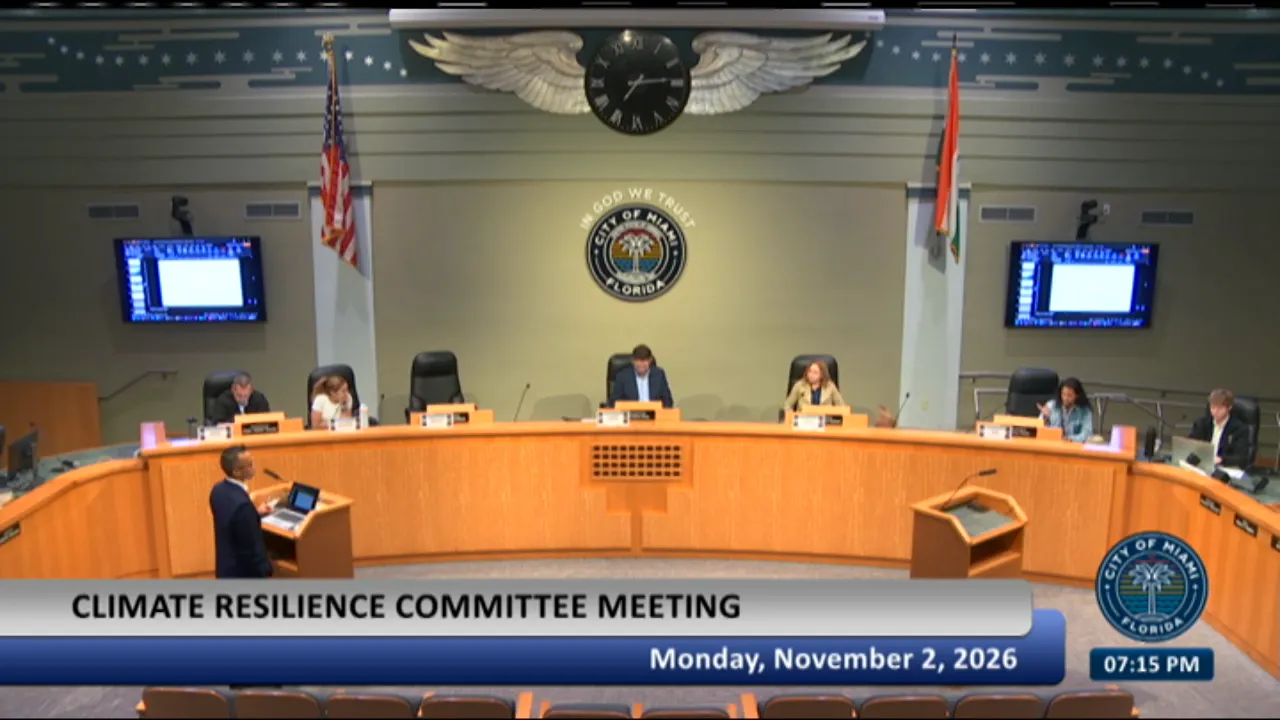
STREAMING COPY IN PREPARATION — RECORDING AVAILABLE FROM THE ORIGINAL SOURCE
Transcript — Verbatim
Speaker numbers apply only to this recording.
Discussion Breakdown — Share of Meeting
Environmental Protection23%
Disaster Preparedness and Resilience16%
Procedural14%
Water And Wastewater Management13%
Public Transportation11%
Engineering And Infrastructure5%
Public Engagement4%
Public Works3%
Historic Preservation3%
Summary of Proceedings
Climate Resilience Committee Workshop – November 2, 2026
The City of Miami Climate Resilience Committee (CRC) convened a workshop on November 2, 2026, due to a lack of quorum (five of six members present). The committee received presentations on the Miami Loop trail network and flood-adaptive building design, received updates on the tree ordinance and resilience projects, and discussed the significant October king tide event and proposed bylaws updates.
Consent Calendar
- No items were approved due to the workshop status.
Public Comments & Testimony
- No members of the public offered comment.
Discussion Items
- Miami Loop Presentation: Christian Molino from Commissioner Rosato's office presented the Miami Loop project. He distinguished the outer county-to-county trail from the inner loop connecting all five commission districts. He detailed a timeline from 2014, noting the creation of a city task force in 2025, the securing of $3 million from the Public Benefits Trust Fund for the Ludlum Trail, and an additional $5 million for the trail segment at Robert King High Park. Results from the October 10 Miami Loop Summit were shared, where 91% of respondents indicated they would use public transit if it were safer, and residents expressed a desire to prioritize connection over beautification. The link between the trail network and climate resilience was highlighted through sponge park designs for flood mitigation and water quality improvements.
- Designing with Water Presentation: Vincent Lee, Principal at ARUP, presented a national overview of designing flood-adaptive buildings and resilient urbanism, citing thorough case studies from New York, Boston, Miami Beach (Buoyant City Project), Honolulu, and Cleveland. He discussed balancing historic preservation with resilience and detailed strategies like dry floodproofing and adaptive recovery. Committee members discussed the urgent need for best practices and floodproofing guides, the status of the Army Corps' Back Bay and 216 studies, and the importance of integrating local flood protection projects. Mr. Lee committed to sharing ARUP's summary of floodproofing options and details on the Miami Beach private property adaptation program.
- Tree Ordinance Advisory Committee: Member Avra reported significant progress. The committee is exploring recalibrating mitigation fees based on canopy benefit rather than diameter, establishing a tree bank program, improving process transparency with pre-application meetings, and developing penalty structures for bad actors. The goal is to finalize recommendations by January.
- Biscayne Bay Watershed Management Advisory Board: The CRC's resolution supporting the board's creation has been submitted for the December 10th City Commission agenda.
- Resilience & Sustainability Updates: Chief Resilience Officer Sonia Brubaker noted a final community meeting for the Margaret Pace Park Master Plan on November 9th. The office is compiling a citywide resilience accomplishments document for the budget book.
- Bylaws Update: Draft language for an absence waiver process was circulated. The committee discussed the need for clear, firm criteria for waivers to prevent them from becoming a crutch affecting quorum. The possibility of starting public portions of meetings without quorum was raised. Final changes will be voted on in December.
- 2026 King Tide Update: Sonia Brubaker reported that the October 27 king tide was extraordinary, reaching 1.8 feet higher than predicted. Data from Brian McNoldy indicated that 32 new daily high tide records have been set in Miami this year, with six of the top ten highest water levels occurring during non-hurricane events, driven by onshore winds compounding sea level rise. Current city measures include over 100 installed backflow preventers with 80 more planned in the next two years, and the Brickle Bay Drive seawall project (8 ft high, 1800 ft long) starting construction in 2027. The committee expressed urgency in reevaluating current seawall standards and policies given this new data.
Key Outcomes
- Workshop Status: No formal votes were taken; action items were discussed for future meetings.
- Directives and Next Steps: The annual report and finalized bylaws updates are scheduled for a December vote. Staff will investigate the timeline for additional backflow preventers. The chair will push for a comprehensive presentation from the Army Corps and County on the Back Bay/216 studies. A future presentation on freeboard heights by Gensler is scheduled for December.
Meeting Transcript
Stay connected to your community and know your elected officials. It's all just a call away. Dial 311, your connection to Miami's leadership. Alright, we will start with our our first item, which is roll call from our right, please. Good evening, Grant Leser. Alison Weinstock. Aaron DeMeo. Average. Nick Atkison, Office of the City Attorney. And because we have, sorry. Sonia Brubaker, Chief Resilience Officer for the City of Miami. Thank you. We have five members, so we need six for quorum. So this will be a workshop this evening. Alright, great. So we'll move to item two, which is public comment. If anyone from the public would like to make a comment, now is the time you have two minutes. Or are there any online? No, at this time. Alright, great. So we can't do approval of the minutes, so we'll skip that for the next meeting. And we'll move right into item four, which is presentations. So our first presentation of the evening is the Miami Loop. Thanks so much for being here. Thank you very much for having me. Hello. Good afternoon. Christian Molino with the office of Commissioner Rosato. I'm also here joined by Yosvani Romero, who's also with our office and has been very helpful on the Miami Loop and our initiative. So I'm here on behalf of Commissioner Rosato. He is unfortunately not able to join us. He is on a trip, though he is, you know, very, very supportive of the work you all do and really wants to make sure that you guys are up to speed on the Miami loop. So I had prepared a presentation, I believe, if we can get that rolling. I can do either, yeah. Sure, yeah, sir. And just as we set up this presentation, you know, as far as relevance for why why this is in front of us today, we've seen the Commodore Trail at multiple meetings in the past, the Rick and Bacher Causeway, um, and land use. We also had the conversations about the the greenway and the connectivity report at you know in the last couple months. So this kind of ties everything together, and it's very important to have non-automated, non-automotive means of getting around, which allows us to mitigate our impacts. Absolutely. So I I do want to say I also believe that this is a really good opportunity to show this to you all because I do think it is a really good intersection, cross-intersection between public transportation and climate resiliency. Right. Like I think the Miami loop is where all of those things meet. Um, and and you know, happy to get into it right now. Before do I do so, I do also want to say, you know, thank you to to Sonia here, who has been a part of the Miami Loop as well, and she's part of our our working group and is always there, so thank you to her.
SUMMARIZED BY OPENPUBLICA AI
TRANSCRIPT VIA PUBLIC VIDEO
openpublica.com
openpublica.com