Common Council Special Workshop on Baker Tilly Compensation Study - May 26, 2026
STREAMING COPY IN PREPARATION — RECORDING AVAILABLE FROM THE ORIGINAL SOURCE
Common Council Special Workshop on Baker Tilly Compensation Study - May 26, 2026
The Middletown Common Council held a special workshop on May 26, 2026, at 5:30 p.m. to review the final report of the Baker Tilly Classification and Compensation Study (dated December 2025) and discuss next steps for potential adoption and implementation. The workshop featured presentations by Deputy General Counsel Corey Wisneski, Payroll/Pension Supervisor Nicole Carr, and Human Resources Director Justin Richardson, followed by a question-and-answer session with council members. No public comments were taken and no formal vote was held.
Discussion Items
-
Presentation and Study Background: Corey Wisneski explained that the current classification system (Maximus) is about 25 years old and outdated. The study aimed to update job classifications and create a new pay scale for non-bargaining employees and those covered by unions UPSU and Local 466. Phase 1 and 2 (data collection, market assessment, job description updates) were completed; Phase 3 would require a council vote and implementation over an estimated minimum of six months.
-
Implementation Process and Impact Bargaining: Wisneski outlined that 178 positions would need to be vetted with unions, including 102 positions for Local 466 (estimated 30 minutes per job, total 45–50 hours), 46 positions for UPSU (estimated 10 additional hours), and 5 non-bargaining positions (estimated 5 hours). Impact bargaining would address practical consequences of the new system, such as hours, wages, benefits, and parity. Meetings would be held by department with department heads, division leaders, union leadership, and HR present.
-
System Updates and Costs: Nicole Carr detailed the complexity of updating the payroll system (AUC) to accommodate a new seven-step pay plan (current system has six steps) while maintaining existing salary schedules for fire, police, library, temporary employees, and elected officials. AUC vendor support at $250/hour was estimated to cost at least $250,000 for necessary updates. Justin Richardson outlined parallel updates to the HR system (NeoGov), estimated at $975. Both systems do not communicate and would need independent updates. Carr emphasized that current payroll staffing is insufficient; additional personnel would be needed to manage the dual-platform system and to address succession planning for her pending departure in July 2027.
-
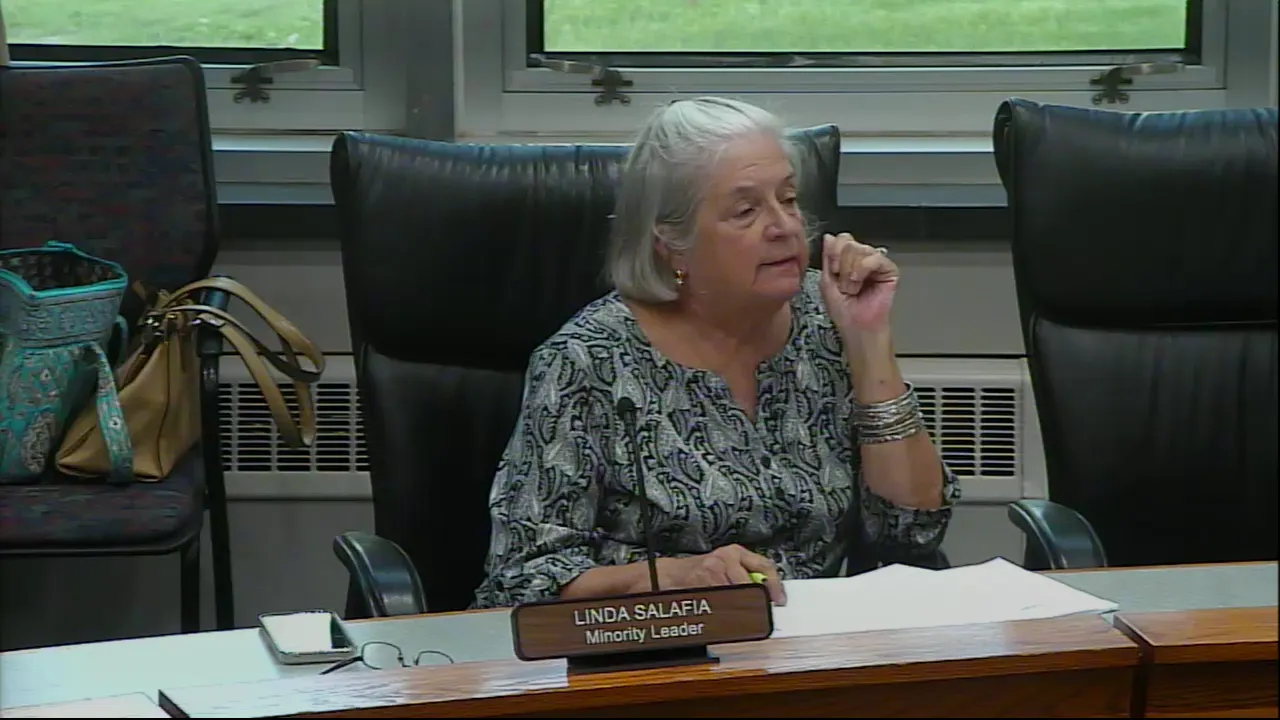
Statistical Comparisons: Richardson reported that of approximately 184 submitted job titles, Baker Tilly benchmarked 154 against ten peer municipalities. Only 35 positions had sufficient market data (three or more comparable positions). Among those benchmarked, 15 were above market, 2 were below, and the rest fell within an acceptable range. Councilwoman Linda Salafia questioned the need for a full overhaul given that most positions appear adequately compensated. Richardson and Wisneski argued that salary compression (e.g., manager and director earning nearly the same) and outdated job descriptions necessitate the update, and that the new schedule would create a 5% differential between grades to encourage advancement.
-
Union Engagement: Wisneski and Richardson noted that UPSU cooperated closely with job description review, while Local 466 had not yet been fully engaged. If the council approved the study, impact bargaining would begin. Councilwoman Jeanette Blackwell asked about the fate of the study if not adopted; Wisneski responded that the city would retain the antiquated Maximus system, and collective bargaining agreements would govern future labor-management processes. She also noted that the current Local 466 contract includes a clause requiring council action on a new classification plan by January 5, 2027, else the city reverts to the existing process (reviewing 20 jobs instead of 10 per year). Fire and police were excluded from the study because they are certified under state standards and have no labor-management process.
-
Red Circling and Implementation Scenarios: Richardson explained red circling using the Carpenter position as an example—an individual currently paid above market who would retain their salary but no future step increases, and the position would revert to proper grade upon departure. Councilwoman Salafia requested totals of proposed salary increases; Richardson directed her to pages 15–18 of the report showing three implementation scenarios. Scenario 1 would cost approximately $428,000 to move employees into new grades. Councilwoman Sweeney asked about software alternatives; Finance Director Carl (last name not stated) noted that a full Munis implementation would cost over $4 million and require more accounting expertise, making AUC a preferable partner.
Key Outcomes
- No formal vote was taken; the workshop was informational only.
- Council members expressed varying opinions: some questioned the cost-benefit (Salafia), others emphasized the need to address salary compression and outdated classifications (Blackwell, Gennaro).
- Next steps include potential council vote on adoption in a future meeting. If approved, impact bargaining would begin immediately, with implementation expected to take at least six months.
- The meeting adjourned at approximately 7:15 p.m. (based on transcript flow).
Meeting Transcript
Thank you, Mayor. Allegiance to the flag of the United States of America. And to the Republic for which it stands. One nation under God. Thank you, everyone, for being here for our workshop on the classification and compensation study, Baker Tilly. And just before we uh move to the call of the meeting, who do we have online? Um online, we have Councilman Darnell Ford and Councilman Jonathan Polino. Okay. Thank you. And now if uh can read the call to meeting, please. The chief of police of the city of Middletown, greetings. By authority of the state of Connecticut, you are hereby commanded to summon and notify Vincent J. Lafredo, Jeanette Blackwell, Darnell Ford, Grady Faulkner Jr., Kelly Sweeney, Anthony Mangiopico, Linda Salafia, Anthony S. Gennaro Sr., Jonathan Polino, Leslie Spatola, Chine Fulton, Ava M. Hart, members of the Common Council of the City of Middletown to attend a special meeting of said common council for the purpose of conducting a workshop on the final report of the Baker Tilly classification and compensation study, dated December 2025, including a presentation followed by a question and answer session. Said meetings shall be a hybrid meeting to be held in the council chamber of the municipal building, 245 DeCoven Drive in said city, and remotely via WebEx at Join a Meeting Event 23315431262 on Tuesday, May 26, 2026 at 5 30 p.m. Hereof fail not, but make due service and return to the clerk of said city three hours prior to the time of fixed meeting. City of Middletown, May 18th, 2026, attested by Honorable Eugene Pinocchera Mayor. City of Middletown, May 20th, 2026. I hereby certify that I have delivered an attested copy of the foregoing order and detached agenda of the common council meeting to each and every council member named above via electronic mail, attested by uh Deputy Chief of Police Richard Davis. All right. Thank you. And now we'll get right into the workshop. Um and I think uh uh Corey Wisnowski is gonna make a presentation, followed by questions. Good evening, everyone. My name is Corey Wisneski, Deputy General Counsel for the City. I'm just gonna open it up tonight and then um transfer it over to our subject matter experts. Um, but thank you for the the time here. We are talking tonight. Um if you could put the PowerPoint presentation up on the screen. Um I would appreciate it. We're talking tonight about Baker Tilly, our compensation classification study, and this is um what we have coined um phase three, which is the vote and implementation. And if you just give me a minute, I'm gonna make sure that it's the full screen. Just one. Do you know how to do that? What is that? Yeah, black and white copy. Okay, great. All right, so I thought it was a good idea um to just kind of bring us back to why we're here, right? Um so the current classification system for um up sue 466 and non-bargaining employees. Um, our current classification system is maximus, and it was implemented about 25 years ago. Um, and that system is pretty antiquated and ineffective for today's workforce. Um, as we have all discussed numerous times, either from me, HR, unions, um, there's a lot of frustration with our current classification system. Um, it is if you look at some of the um the pieces that you have to put together, it says, you know, does somebody use a typewriter? I mean, we are in a totally different world than we were 25 years ago. Um, and so I think we need to to kind of bring it into this um 21st century and to make sure that we are up to speed um on the latest and greatest for classification systems. So the council worked um with the administration to hire a firm to do a classification um or a salary comparison of our current jobs, uh, rewrite job descriptions and implement a new pay scale. So as you all might remember, there was an interview, an RFP, an interview process. Some of you served on that panel, and ultimately it was decided that we would go with Baker Tilley, who was chosen as the company to do our classification and compensation study. So just to reiterate kind of what has transpired to to date, and that's phases one and two.
openpublica.com