Middletown Public Safety Commission Meeting – August 3, 2026: Flock Drone Agreement, Court Street Changes, Crime Report
STREAMING COPY IN PREPARATION — RECORDING AVAILABLE FROM THE ORIGINAL SOURCE
Middletown Public Safety Commission Meeting – August 3, 2026
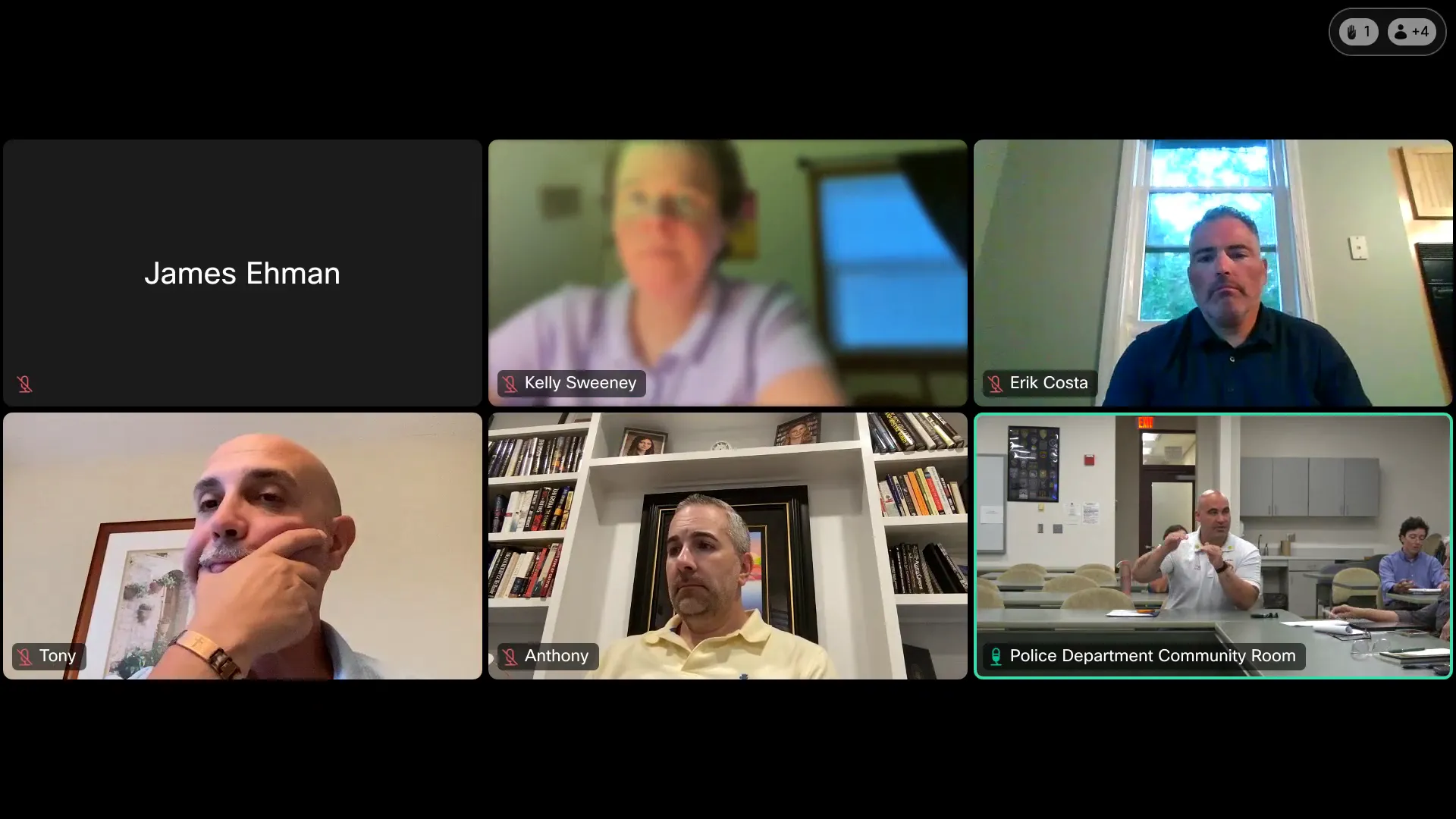
The Middletown Public Safety Commission met on August 3, 2026, at 6:46 PM and adjourned at 8:22 PM. The meeting covered approval of previous minutes, public testimony on the proposed Flock drone system, a presentation and discussion of a revised Flock drone agreement, a one-way traffic proposal for Court Street, a crime statistics report, and other routine matters. The commission voted 4-1 (one abstention) to recommend the revised Flock drone master agreement to the Common Council.
Consent Calendar
- Approval of Minutes from June 15, 2026: Moved by Tony, seconded by Kelly. Approved unanimously.
Public Comments & Testimony
- James Calabrese (32 Grand Street): Opposed the Flock drone system, citing a nationwide error rate of 1% (200 million errors out of 20 billion monthly license plate reads). Gave examples of false police encounters in Minnesota and Nebraska due to Flock misreadings. Urged the commission not to proceed.
- Anson Muelick (530 High Street): An automation engineer, opposed the Flock drone due to lack of transparency in the code and inability to guarantee it would follow local programming. Raised concerns about plausible deniability for police.
- Meredith Pollock (182 Carriage Crossing): Opposed the cameras as sophisticated tracking devices with minimal oversight. Cited instances of stalking, harassment, and hacking vulnerabilities. Stated that she and neighbors did not consent to data storage.
- Unnamed resident (first heard of meeting 30 minutes prior): Questioned public notice, asked about neighboring town rejections and funding source.
- Alex Jones (online chat): Expressed support for the Flock drone program as a town resident.
- Mads Reed (21 In Town Terrace) and Alisa Reed: Expressed strong concerns about surveillance, data being sold to tech firms, and lack of opt-out. Requested the trial not be extended and existing devices be removed. Noted that other Connecticut towns have reversed ALPR contracts.
- Frank (Wesleyan student, 35 Foss Hill Drive): Voiced concern about mass surveillance and lack of accountability, especially in a national context.
- Brendan Berry (Wesleyan student, 36 McConaughey Avenue): Raised concerns about data sharing with DHS and other agencies, citing violations in other cities (Wisconsin, LAPD, Cambridge). Questioned protections for immigrants given the local intelligence fusion center.
- Mads Reed (second appearance): Stated he was not comforted by the city attorney's response, calling it a sales pitch. Emphasized the irreversible nature of data collection.
- Meredith Pollock (second appearance): Submitted two questions: (1) clarification on time savings compared to existing drones, (2) how the drone system would prevent bridge suicides.
- James Calabrese (second appearance): Questioned the $50,000 cost, suggesting in-house training and equipment might be more cost-effective.
- Anson Muelick (second appearance): Argued that the agreement is unenforceable because Flock can change terms via hyperlinks and has refused third-party code audits to verify compliance.
Discussion Items
- Correspondence and Reports (Chief Costa):
- Animal Control: ACOs working with Paper Olsen to neuter/spay cats in the south end (donations received).
- Promotion: Detective James Ramati promoted to acting sergeant to fill a long-term workers’ compensation vacancy.
- Homelessness/Panhandling: Complaints about Main Street; overtime position added Thursday–Saturday evenings for outreach and support, including partnership with St. Vincent DePaul.
- Overtime Budget: FY25-26 within budget; $46,000 returned to general fund.
- Community Programs: PAL summer program active; new VIF system (online registration for individuals with mental health/dementia/autism) launched—Middletown is second city in CT to adopt it.
- Calls for Service: 5,495 in June, steady with prior periods.
- Accountability Training: Contract with Dagle Law Group for monthly training on pursuits, use of force, and employment issues.
- One-Way Traffic on Court Street (Chief Costa and Christine Marks):
- Proposed change: Court Street from DeKoven Drive west to Main Street to become one-way (eastbound) to align with Upper Court Street.
- Benefits: 21 new metered parking spaces (total 19 full-time spots), improved sightlines at DeKoven Drive intersection (poor due to courthouse transport vans), safer turning onto Cross Street, added ADA ramps and crosswalks at Millilliy Drive, and a loading/unloading zone at Main Street.
- Fire Marshal and Public Works reviewed; plan vetted with judicial facilities (no concerns). Changeover planned for August 16, 2026. Commission received notice; no vote required.
- Crime Statistics (Chief Costa):
- Citywide crime rate decreased 14.02% in fiscal year 2025-26 (third consecutive annual decrease). Attributed to officer work, technology, community partnerships, and social worker integration.
- Notable: Two homicides in past two years solved within hours.
- Flock Drone Agreement (Attorney Briggs Smith, Chief Costa, Chief Albert):
- Background: Common Council passed a resolution in January 2026 authorizing a $50,000/year contract for a drone-as-first-responder (DFR) program. After public concerns raised by Councilman Ford, the city negotiated a more robust Master Services Agreement (MSA) with Flock Safety.
- Key changes: The MSA explicitly states customer data belongs to the city, not Flock; Flock cannot sell the data; and the system will not be used as a license plate reader (LPR). Terms and conditions cannot be unilaterally updated without city consent.
- Operational purpose: DFR for emergencies (bridge suicides, large fights, structure fires) to provide immediate aerial intelligence. Deployed from dispatch; front desk staff trained on every shift.
- Funding: Year one via asset forfeiture (seized funds); subsequent years from non-taxpayer sources (grants, stakeholders).
- Duration: 90-day trial, after which city can evaluate.
- Concerns raised by commission members: Councilwoman Salafia questioned the notification process and lack of council input; Councilman Sweeney asked about training and conditions for termination. Chiefs responded that the trial would reveal if the technology is effective, and policies will be developed if the program continues.
Key Outcomes
- Court Street One-Way: No vote needed; change to take effect August 16, 2026. Signs and social media notification to be increased.
- Flock Drone Agreement: Motion made (Councilman Gennaro) and seconded to recommend the revised MSA to the Common Council. Vote: 4 in favor, 1 abstention (Councilwoman Salafia). The agreement will be presented at the next council meeting.
- Adjournment: Motion to adjourn passed at 8:22 PM.
Meeting Transcript
Yes. Yes. And Judy. Judy. All right. We are recording the meeting. I'm going to call a meeting to order at 646. First item on the agenda is approval of the minutes from June 15th. Is our motion? Thank you, Tony. Is there a second? Kelly, thank you. All in favor? Hi. Okay, the minutes are approved. Thank you. Our next up is a public hearing. If anyone from the public would like to speak on any matter on the police agenda, please raise your hand and you can move forward to sit next to the chief at the table there so we can see you on WebEx. State your name, address, and you have five minutes to speak to any agenda item. So is there anyone who'd like to speak? Yeah, well, Consumman, I have a letter that was sent via Linda Reed. Is this the time that it would it's it's about public comment in regards to the flock cameras? Should I read that into the record that that's what the request of the Sunder is? We don't always do this at the ends of public comment chief. So if you go into the end. Okay, thank you. I think your guidance on it. Thank you. All right. So who would like to speak first? No, of course. Um my legal name is James uh Calabrese. Um and I live at 32 Grand Street, Middletown. Um six four five seven. And um, yeah, I'd like to speak about um Flock. So um Flock as a nationwide service um uh reads 20 billion uh license plates in America every month. 20 billion is a really big number. It's a lot bigger than the number of Americans there are. But when it comes to uh their success rate, uh their success rate is you know, they claim on the on their sites it's about 99%. So 99% sounds really good. It's like the number you'd kind of want if you have a surgery and you want to know if that surgery is gonna go well. But when it comes down to whether or not uh you know our data is being used correctly, uh that 1% actually really does add up and really does matter. Um so 1% of 20 billion is 200 million missed uh uh inputs, uh errors, uh clerical errors, uh, and the like. And so there's been numerous instances in the last uh eight months, 10 months of uh individuals getting their license plates uh tagged and pinged by the FBI when their license plate isn't uh isn't a stolen car, it isn't a vehicle that should be uh looked into. So the specific uh instance I'll just quickly try to summarize is uh a man in uh Minnesota uh had his car pinged. Uh there was a car in California, the FBI realized was um was a stolen car, and so they put out sort of a uh you know, like a search for it. The automatic license plate reader in Minnesota uh determined that this man's car uh was the exact match of this stolen car in California. Unfortunately for him, uh, you know, he was out doing errands and four you know, cops showed up with guns drawn. Umfortunately for him, you his car was just not the right car. It was just missing two uh two numbers, which would have made it identical to the car that had been stolen.
openpublica.com