OPENPUBLICA · PUBLIC MEETING RECORD
Record of Proceedings
Minneapolis Budget Committee Meeting on 2026-11-02: 2027 Budget FTE Reductions
City Council — Monday, November 2, 2026
BodyMinneapolis, Minnesota
SessionCity Council
DateMonday, November 2, 2026
StatusNEW · FILED
Video Record
STREAMING COPY IN PREPARATION — RECORDING AVAILABLE FROM THE ORIGINAL SOURCE
Transcript — Verbatim
Speaker numbers apply only to this recording. Names come from transcript evidence. “Possibly” marks uncertain attribution.
Discussion Breakdown — Share of Meeting
Budget Management71%
Personnel Matters24%
Procedural5%
Summary of Proceedings
Minneapolis Budget Committee Meeting on 2026-11-02: 2027 Budget FTE Reductions
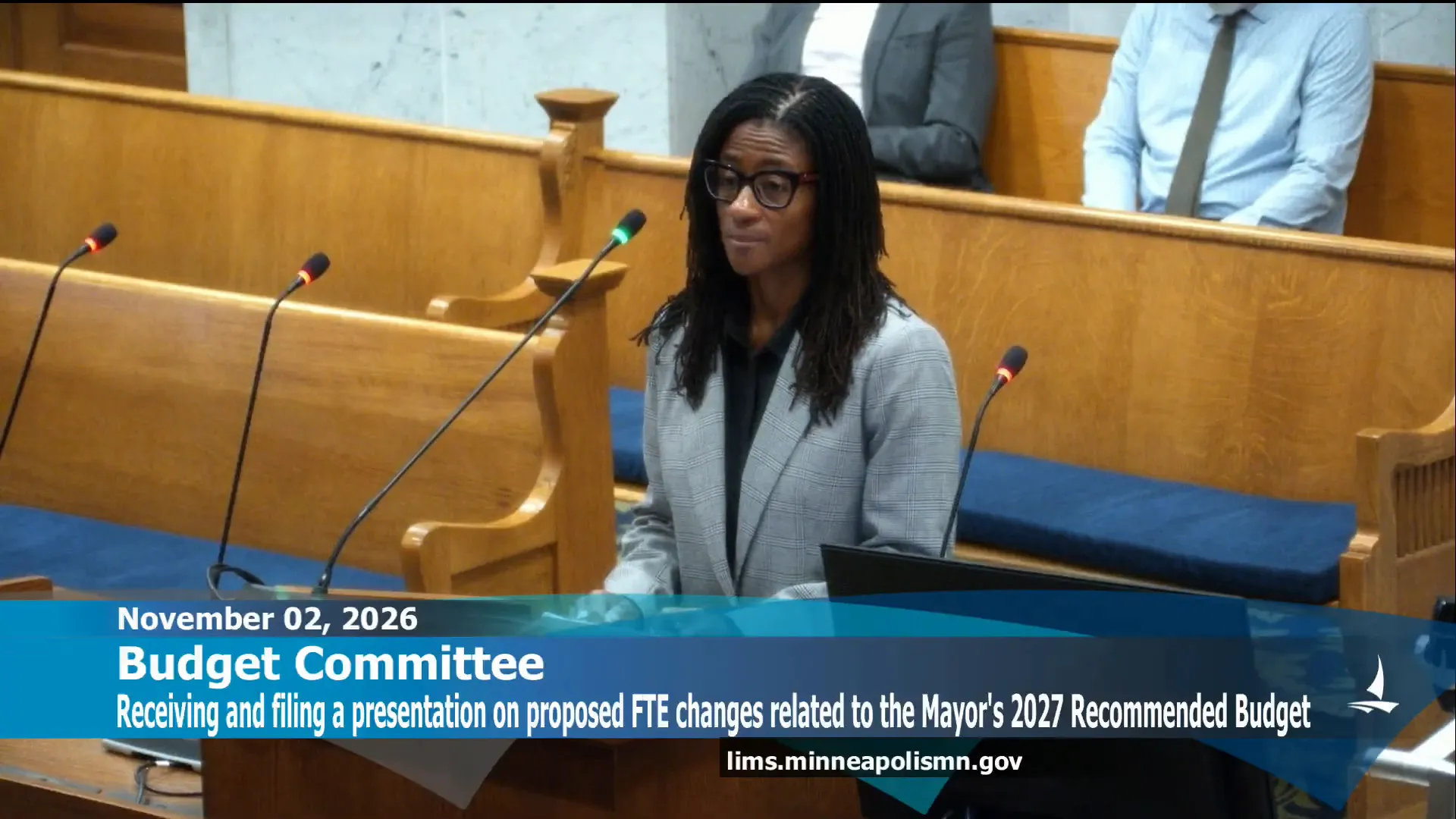
The Minneapolis Budget Committee convened an adjourned meeting on November 2, 2026, with Chair Aisha Chuktai presiding. The clerk recorded eight members present and a quorum; several members were absent. The sole presentation concerned the mayor's recommended 2027 budget and proposed full-time-equivalent position reductions. Nikki Odom, Chief Human Resources Officer, described the elimination list and employee-placement process; Budget Director Sean Green and City Operations Officer Margaret Anderson Kelleher also responded to questions. No public comment was recorded. The committee filed the presentation and adjourned without objection.
Discussion Items
- Nikki Odom presented the mayor's recommended 2027 budget's proposed FTE reductions at an aggregate level to protect non-public employee information. The recommendation identifies 94 positions for elimination: 47 vacant and 47 filled. Odom said 68 positions, approximately 72%, are union positions and 26 are non-union. She emphasized that the 47 filled positions do not mean 47 employees will leave the city, because employees may move into vacancies or exercise displacement or bumping rights.
- Odom explained displacement as moving into a position held by a less senior employee in the same classification based on classification seniority; bumping as returning to a lower classification previously held and completed probation in, subject to contract and civil service rules; and the job bank as priority consideration for available positions at or below classification grade. The job bank is open for 45 days; employees are encouraged to decide within 30 days and can earn additional vacation time. Declining or not deciding within 45 days forfeits job bank rights. A hiring freeze holds covered vacancies for review and possible placement but does not affect sworn or appointed employees. Eligible laid-off employees retain recall rights for up to three years.
- Odom said departments under OPS account for 63 of the 94 proposed eliminations: 28 vacant and 35 filled. She said reductions vary by department size, including approximately 18% of communications staffing, 11% of HR staffing, and 60% for REIB's three positions. Another group of departments accounts for 20 proposed eliminations, including all 17 MPD positions, which Odom confirmed are vacant civilian positions; the remaining three positions across neighborhood safety and OCS are filled. Police reductions represent approximately 2% of total department staffing, or approximately 7% when the 731 sworn positions are excluded from the staffing base. The remaining 11 proposed eliminations include two vacant positions in the city attorney's office and mayor's office and nine filled positions in the auditor's office and city clerk's office, representing approximately 14% of auditor staffing and 10% of clerk staffing.
- Odom outlined the timeline: the mayor released the proposed budget on August 12; departments began preliminary employee conversations in October; council members were briefed on October 21; formal employee notices went out on October 30; and the job bank process began November 1. She said the recommendations remain subject to the council's final budget action.
- Council President Payne asked whether departments received explicit selection guidance or had discretion. Odom said it was a mixture: eliminated programs took their positions, while departments had leeway based on business needs and documented business justifications.
- Councilmember Wonsley asked whether the 17 MPD positions were all civilian; Odom confirmed they are not sworn positions. Wonsley expressed alarm that 72% of proposed eliminated positions are union-identified and asked about union engagement. Odom said HR has been in touch with unions and noted that about 80% of total city staff is unionized, so the 72% figure is below that overall share. Wonsley also requested a follow-up on middle-management percentages in OPS and OCS relative to non-middle-management and upper-level management, citing concerns that city enterprise reorganization has become top-heavy.
- Councilmember Palmasano asked about job bank duration and about discrepancies with the mayor's budget book: PMI was supposed to be reduced by two FTEs but the slide said one, and City Council was slated to lose two positions but the slide indicated zero. Budget Director Sean Green said the initial recommended budget used placeholders aligned to each department's total dollar reduction; the final list reflects business justifications and department-level adjustments. He said if no amendments are adopted, FTEs would be updated in the adopted budget while dollars would remain aligned with the initial proposal. Palmasano said they were perplexed that council staff reduction was amended to none while nearly 50 city employees are losing jobs across the board.
- Councilmember Wonsley asked whether furloughs were considered. Odom said furloughs were discussed briefly but do not save long-term dollars, cited prior experience, and said ongoing reductions favor full FTE reductions over furloughs.
- Councilmember Vita asked about early retirement incentives. Odom and City Operations Officer Margaret Anderson Kelleher said early retirement usually does not save money in the short term, limits the city's ability to discuss effects with employees, and can cause loss of institutional knowledge and disparate department impacts.
- Vita also asked about union engagement. Odom said labor relations has been in touch with union leadership and conversations will continue through the job bank process. Rashida Deloney, Director of Labor Relations, said she individually called each affected union; conversations are ongoing, concerns center on compliance with contractual obligations, which she confirmed, and transparency and communication have continued. Anderson Kelleher said the mayor called at least two meetings with business agents and sought union suggestions early; some were included in the original budget and others were not, and another meeting with union leadership was held.
- Councilmember Chavez said slide 10 showed only one cut in the mayor's office, a vacancy, while the clerk's side had seven cuts that were not vacant; Chavez said the legislative department is facing a much larger burden than the mayor's office.
- Vice Chair Schaefer asked how recently passed rental license increases might affect regulatory FTEs, including high-risk license and tiering changes. Green said he would provide a written follow-up on the FTE plan and coordinate with Regulatory Services; he said the current presentation reflects the mayor's recommended budget and does not include any additional FTEs needed to administer the recent license changes in 2027. Schaefer also raised concern about the long-term forecast, saying revenues are not matching costs and that revenue is growing at 3.5% while costs are rising; they said the committee had not had a presentation on the three-to-five-year forecast. Green pointed to the five-year plan and said the 2027 current-service-level estimate swung from an initial 5.4% estimate to roughly 11%, driven by inflation, health care costs, and labor negotiations; he offered a deeper dive or written follow-up.
- Schaefer asked for a follow-up comparing how the reductions affect the administration versus the legislative branch, including council, clerk, and auditor. The clerk said they would work with the budget team to provide contextualized data.
Key Outcomes
- The committee filed the presentation on the mayor's recommended 2027 budget FTE reductions without objection.
- No public comments were recorded.
- Follow-ups were requested on middle-management percentages in OPS and OCS; regulatory FTEs tied to recent rental license changes; a deeper look at the long-term forecast and revenue-cost gap; and an analysis of reductions between the administration and legislative branch.
- The recommendations remain subject to the council's final budget action. The meeting adjourned with no further business.
Meeting Transcript
Good morning. My name is Aisha Chuktai, and I'm the chair of the budget committee. I'm going to call to order our adjourned meeting for Monday, November 2nd, 2026. Before we begin the meeting, I want to offer a friendly reminder to all members, staff, and the public that these meetings are broadcast live to enable greater public participation. These broadcasts include real-time captioning as a further method to increase the accessibility of our proceedings to the community. Therefore, all speakers need to be mindful of the rate of their speech so that our captioners can fully capture and transcribe all comments for the broadcast. We ask all speakers to moderate the speed and clarity of their comments. At this time, I'll ask the clerk to call the roll so we can verify the presence of a quorum. Councilmember Payne. Present. Present. Vita. Present. Warren is absent. Osman is absent. Stevenson is absent. Chavez. Present. Whiting is absent. Chowdry is absent. Palmasano. Present. Vice Chair Schaefer. Present. And Chair Chugtai? Present. That is eight members present. Let the record reflect that we have a quorum. I'll also remind my colleagues that we're using speaker management today, so please make sure to sign in. This morning we have one presentation related to the mayor's recommended 2027 budget regarding proposed FTE reductions. I'll invite Nikki Odom, Chief Human Resources Officer to begin this presentation. Welcome. Good morning, Madam Chair, Madam Vice Chair, Council President, Council members. I'm Nikki Odom, the City Chief Human Resources Officer. As requested, we are here to provide an overview of the positions identified for elimination in the mayor's recommended budget and explain the process for determining employee impacts. Council members were briefed on the positions identified in the mayor's proposed budget on October 21st and receive that presentation by email afterward. Today's presentation provides summary information by department. We will avoid discussing individual job titles or employee circumstances to protect non-public employee information. HR's responsibility is to support implementation of the adopted budget through a consistent process that honors employee rights and helps retain employees wherever possible. An employee may have rights to another position, and exercising those rights can affect employees beyond the department where the original elimination occurs. For each affected employee, we examine their employment status, classification seniority, prior city positions, and rights under collective bargaining agreements and civil service rules. There are three terms that are particularly helpful to understand. Displacement generally means that an employee has the right based on classification seniority to move into a position held by a less senior employee in the same classification. Depending on the rules governing that position, this can occur within a department or across departments. Bumping generally means an employee exercises rights to return to a lower classification they previously held and completed probation in. Subject to contract and civil service requirements. That can affect another employee who may also have placement rights. The job bank provides eligible employees with priority consideration for available positions at or below their classification grade for which they qualify. Participants receive assistance from an HR coordinator and career transition support. While the job bank is open, a hiring freeze holds covered vacancies for review and possible placement.
SUMMARIZED BY OPENPUBLICA AI
TRANSCRIPT VIA PUBLIC VIDEO
openpublica.com
openpublica.com