Browse by city
Date range
Search help

Search titles, summaries, topics and stored transcripts together. Keywords may match separately; put the whole query in double quotes for a phrase. Matching follows word analysis, so punctuation is not exact. Both dates are included. Documents are not searched.

SHOWING 1–10 ENTRIES
01
NEWOCT 22, 2026 · MINNEAPOLIS, MINNESOTA · CITY COUNCIL
Minneapolis Budget Committee Meeting – October 22, 2026

The Budget Committee met on October 22, 2026, at 9:00 AM to review the Mayor's recommended 2027 budgets for the Finance and Property Services, Communications, and Assessing departments. Presentations and discussions focused on budget changes, staffing impacts, and proposed service reductions. No votes were taken; reports were filed with administrative follow-ups requested. Finance and Property Services Department Presentation - CFO Dushani Dye and Deputy CFO Jane DeSenza presented a proposed 2027 budget of $75.8 million, a $10.3 million increase from 2026. Key changes include $4 million for settlement agreement funds, 4 new FTEs in property services (two custodians, one plumber, one engineer), and a net increase of 1 FTE overall. The department has 10 divisions and 293 FTEs in 2026. - Councilmember Chowdry questioned payroll consolidation with the Park Board (described as a “non-starter”) and asked about vacancies and contractual services. Deputy CFO DeSenza noted 7 vacancies in property services (3 in security) and that professional services contracts total about $1.3 million of $27.3 million in contractual services. - Vice Chair Schaefer clarified that the Utility Billing Division is general fund supported but fully reimbursed by enterprise funds. - The report was filed with a follow-up on the 4% general fund support for property services. Communications Department Presentation - Deputy COO Katie Topinka and Interim Director Chris Kelly presented a proposed 2027 budget of $3.8 million, a decrease from $4 million in 2026. The budget includes a $14,000 investment for Sprout Social (social media management tool) and a reduction of 3 FTEs (from 22 to 19). - The presentation highlighted centralization of communications, which was intended to be budget neutral. Early results include 40% more multimedia projects, 229 creative requests from 19 departments, and 23 campaign-scale projects. - Councilmembers Chavez, Chowdry, Osman, and Stevenson strongly opposed the elimination of cultural media funding (a $100,000 cut). This cut would end radio shows serving Latino, Hmong, Somali, Oromo, African American, and Native American communities. Councilmember Stevenson noted the cut conflicts with the after-action review following the murder of George Floyd, which recommended improved communication with non-English speakers. - Councilmember Palmasano expressed support for the consolidation model. Vice Chair Schaefer requested details on the increased PEG fees (going to Speak Minneapolis) and asked whether the Sprout Social tool could assist council social media. - The report was filed with follow-ups requested on cultural media listenership data and 2026 performance metrics from the consolidation. Assessing Department Presentation - City Assessor Rebecca Anderson presented a proposed 2027 budget of $6.9 million, a decrease of $497,000 (6.7%) from 2026. The reduction requires cutting 5 FTEs (from 38 to 33), despite the budget book stating 4. - The department’s budget is 82% salary and benefits. Staffing cuts will increase workload per residential appraiser by 24% and total workload by 20%. Service impacts include longer response times, fewer inspections, reduced capacity for complex valuation research, and less individualized taxpayer assistance. - The department manages 25,000 quintile valuations per year and litigates 223 tax court cases involving $4.4 billion in market value. - Councilmember Palmasano acknowledged the anticipated impacts. Vice Chair Schaefer asked about appeal trends (which have increased the last two years) and the appeals process for commercial properties, noting challenges for downtown properties with significant value loss. - The report was filed with no additional follow-ups noted. Key Outcomes - All three department presentations were filed as informational. - Follow-ups were requested for: Finance and Property Services – details on 4% general fund investment; Communications – cultural media listenership data and 2026 performance metrics; Assessing – no formal follow-ups requested. - No votes or decisions were taken; the committee will reconvene on October 23, 2026, for budget presentations from the Youth Coordinating Board, Parks and Recreation Board, and Convention Center and Downtown Assets.

BUDGET MANAGEMENT 54% · COMMUNITY ENGAGEMENT 17% · TAXATION 11% · PROCEDURAL 6%
02
NEWOCT 21, 2026 · MINNEAPOLIS, MINNESOTA · CITY COUNCIL
Minneapolis Public Health, Safety & Equity Committee Meeting - October 21, 2026

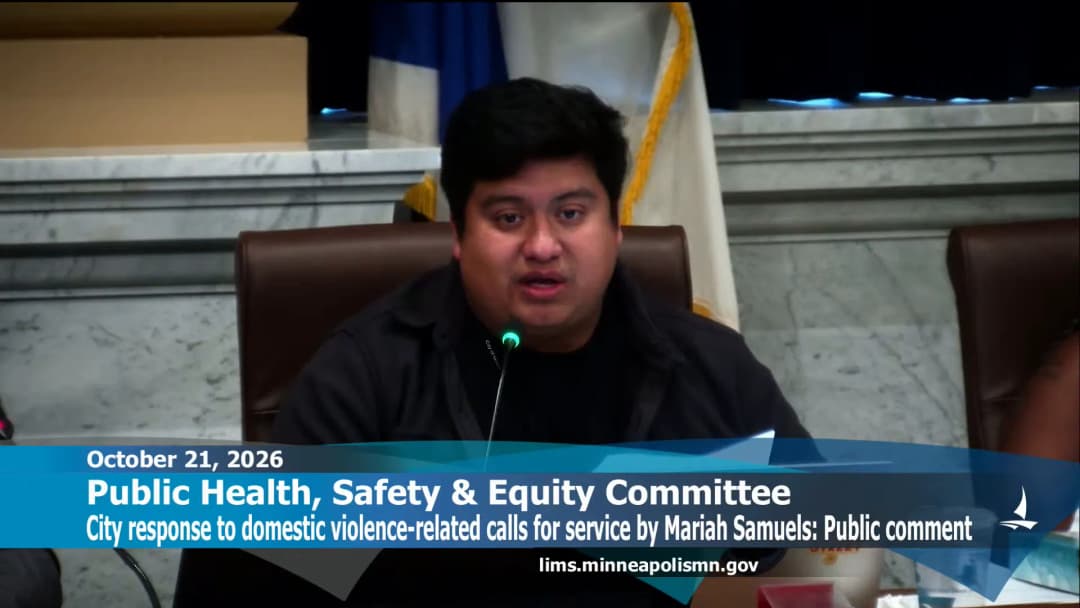
The Public Health, Safety, and Equity Committee of the Minneapolis City Council met on October 21, 2026, at the recorded start time of 2026-10-21 18:32:56+00:00. Chair Jason Chavez presided; members present were Councilmember Payne, Councilmember Wandsley, Councilmember Vita, Vice Chair Stevenson, and Chair Chavez. Councilmembers Greenville and Whiting were absent, and the committee confirmed a quorum. The committee recognized Health Literacy Awareness Month, approved an ethics education alignment ordinance, heard public testimony demanding accountability in the killing of Mariah Samuels, approved several contracts and grants, and received reports on public safety organizational structure and police chief hiring recommendations. Health Literacy Awareness Month Resolution Health department staff presented a resolution declaring October 2026 as Health Literacy Awareness Month in Minneapolis, emphasizing plain-language health information, accessibility for non-English speakers, and science-based information. Chair Chavez shared that his wife is a 10-year breast cancer survivor and spoke about the difficulty of navigating complex medical terminology as a caregiver. Health department staff said health literacy is tied to a resident's right to understand and make informed health decisions. The resolution was approved by voice vote with no announced opposition. Public Hearing: CCPO Ethics Education Ordinance The public hearing concerned a proposed ordinance amending Title 9, Chapter 172 of the Minneapolis Code of Ordinances to align ethics education training requirements for Community Commission on Police Oversight (CCPO) members with the citywide ethics ordinance adopted in May 2026 for non-employee local officials. No members of the public signed up to testify. Councilmember Payne said police reform is a continuous journey. The ordinance was approved by voice vote with no announced opposition; Councilmember Wandsley later asked to be recorded as an aye, and the request was accepted without objection. Public Comments & Testimony: Domestic Violence Response and Mariah Samuels During the public comment period on the city's response to domestic violence-related calls for service, community members and family members described the Sept. 14, 2025 killing of Mariah Samuels and called for an independent after-action review, discipline for responding MPD Officer Ryan Weber, accountability from Mayor Jacob Frey and then-Chief Brian O'Hara, and community control of public safety. Jay Yates of the Twin Cities Coalition for Justice said Samuels had obtained an order of protection, called 911 at 5:14 a.m., and was fatally shot at 7:50 a.m.; he said body-worn camera footage contradicted Officer Weber's report that Samuels said she felt safe. Loretta cited Violence-Free Minnesota statistics of 31 domestic-violence homicide victims in Minnesota in 2025, 24 in 2024, and a historic high of 40 in 2023, and said Black women are murdered at 2.7 times the rate of white women and Native American women at 7 times the rate. Umberto cited a Global Rights for Women study finding that only 20% of more than 43,000 domestic violence calls to MPD resulted in an official police report or arrest. Melissa Washington, also with the Twin Cities Coalition for Justice, criticized unaccountable policing and a $23 million MPD overtime request. Simone Ray, Mariah's sister, said Mayor Frey did not meet with her family and that officers should be reprimanded. Jana Williams, aunt of Allison Lucer and Ariana Buchanaga, demanded justice and said two murderers had been charged in Ariana's case only after community pressure, while a county attorney deal and destroyed evidence threatened the case. Anusha Ramaswamy, a Ward 4 resident, supported the after-action review and opposed a $13 million MPD overtime increase. Another commenter, Phil, cited an audit finding that only three to five investigators handled felony domestic violence investigations at that time. Momo Rose, a domestic violence survivor, said victims must be believed by government when they report. Committee members thanked the speakers; Councilmember Wandsley shared that her aunt was also murdered by a partner and had never received justice; Chair Chavez acknowledged Mariah Samuels was failed and committed to pursuing an after-action review through another route if the independent audit department did not act. Public Hearings Set for Health Commissioner and Police Chief Nominations The committee set a public hearing for Nov. 4, 2026, to consider Mayor Frey's nomination of Heidi Ritchie as health commissioner for a term ending January 30, and a Nov. 4, 2026 hearing to consider his nomination of Bill Peterson as police chief for a term ending January 2030. Chair Chavez clarified these actions set hearings and were not confirmation votes. The motion carried. Contract and Grant Approvals The following items were approved by voice vote with no announced opposition: - Fire and emergency response contract with the Minnesota DNR for Fort Snelling Upper Post Housing Development: $15,000 annual retainer plus per-response fees. Fire Finance Director Luke Scardili said incidents have been rare but included a fire a few years ago. - Three-year contract with Keepers Wellness for firefighter mental health services, approximately $440,000, providing 24/7 first-responder trauma response and critical-incident debriefing. - Contract with Roche Diagnostics for point-of-care testing equipment for chlamydia and gonorrhea on the mobile medical unit, adding to existing syphilis, HIV, and hepatitis C testing. The health department representative said high rates exist among 15-to-24-year-olds, the opioid settlement would cover capital costs, and maternal/child health funding could support supplies. - Acceptance of the Title V Maternal and Child Health Block Grant passed through the Minnesota Department of Health, funding maternal-child health and school-based clinics under a 2024-2029 contract; funding is received year to year and not guaranteed. - Acceptance of $250,000 from the Minneapolis Foundation EPA Environmental Justice Thriving Communities Grant Making Program for the community air monitoring project, including a full-time temporary staff position, community stipends, air monitoring training, and analysis of data collected since 2022. - Joint powers agreement with Hennepin County for $704,000 for Community Trauma Response Services. Neighborhood Safety Director Amanda Harrington said COPE would provide a response team for shootings in the Third Precinct, funded to add two county staff to a current countywide team of two, while remaining available citywide. - Gift acceptance from the National Association for Civilian Oversight of Law Enforcement (NACOLE) to cover costs for one civilian police department implementation-unit member to attend the annual conference in November, supporting oversight and body-worn camera review work. Legislative Directives and Referrals - Automated license plate reader (ALPR) legislative directive, introduced by Councilmember Wandsley, asks for a citywide overview of ALPRs, their functions, data management practices, permitting and regulation, and implementation status of recommendations from an independent MPD ALPR audit. Councilmember Payne noted an officer in Savannah, Georgia was fired for giving an ICE agent husband access to Flock data. Approved. - Behavioral Crisis Response (BCR) transition legislative directive, also introduced by Councilmember Wandsley, requests an overview of steps to bring BCR in-house, including staffing, one-time and ongoing costs, a timeline, a plan to avoid service disruption, and recommended legislative changes. Approved. - The committee set a Nov. 4, 2026, public hearing on an ordinance related to the commercial hood and exhaust cleaning program. Councilmember Payne said restaurant fires involving solid-fuel cooking equipment led him to propose aligning Minneapolis fire code with updated international code inspection standards. - The committee referred to staff a smokeless tobacco use ordinance update related to stadiums, after Councilmember Vita said she and Councilmember Rainville had been working with advocates. Receive and File: Public Safety Organizational Structure Nick Barkley, managing advisor in Legislative Research and Oversight, presented a comparative brief based on publicly available data as of Oct. 19, 2026. It profiled Minneapolis, St. Paul, Oakland, Baltimore, Seattle, and New Orleans. Key findings: form of government shapes command chains; deputy/assistant mayor roles are operationally similar and usually do not require council confirmation, while Minneapolis and Oakland require council confirmation for public safety oversight appointments; consent-decree cities have had higher police chief turnover, with 5 in New Orleans to 11 in Oakland over 15 years, compared with 3-4 in non-consent-decree cities; and structure is not clearly linked to outcomes, with an Oakland study suggesting funding and leadership continuity matter more than organizational design. The report was received and filed. Councilmember Wandsley asked for follow-up materials on Baltimore's codification language. Receive and File: Police Chief Hiring Recommendations The committee received and filed recommendations from the CCPO, adopted in August, on community involvement in the next police chief hiring process, and a letter from the Minneapolis Commission on Civil Rights. The Civil Rights Commission requested meeting the finalists or, if that was not possible, building civil-rights qualifications into candidate evaluation, including experience with MDHR settlement reforms, reducing use of force, working with civilian oversight, building trust with immigrant communities, and stating a clear position on MPD's relationship with federal immigration enforcement. Chair Chavez asked the administration to report which CCPO recommendations were used, and the committee directed that both documents be added to the Nov. 4 public hearing file for the police chief nomination. Key Outcomes - Declared October 2026 as Health Literacy Awareness Month in Minneapolis. - Approved the CCPO ethics education alignment ordinance. - Set Nov. 4, 2026, public hearings for the health commissioner and police chief nominations and for the commercial hood and exhaust cleaning ordinance. - Approved the DNR fire services revenue contract, Keepers Wellness mental health contract, Roche point-of-care testing contract, maternal and child health block grant, EPA air-monitoring grant, Hennepin County community trauma response joint powers agreement, and NACOLE conference gift acceptance. - Approved legislative directives on automated license plate readers and the behavioral crisis response transition plan. - Referred the smokeless tobacco ordinance update to staff. - Received and filed the public safety organizational structure report and the CCPO and Civil Rights Commission police chief hiring recommendations, and directed that the hiring recommendations be included in the Nov. 4 public hearing file. - All approvals in this meeting were by voice vote with no announced opposition.

PUBLIC SAFETY 51% · PUBLIC HEALTH 20% · PROCEDURAL 7% · GOVERNMENT STRUCTURE 7%
03
NEWOCT 20, 2026 · MINNEAPOLIS, MINNESOTA · CITY COUNCIL
Minneapolis Business, Housing, and Zoning Committee Meeting Summary - October 20, 2026

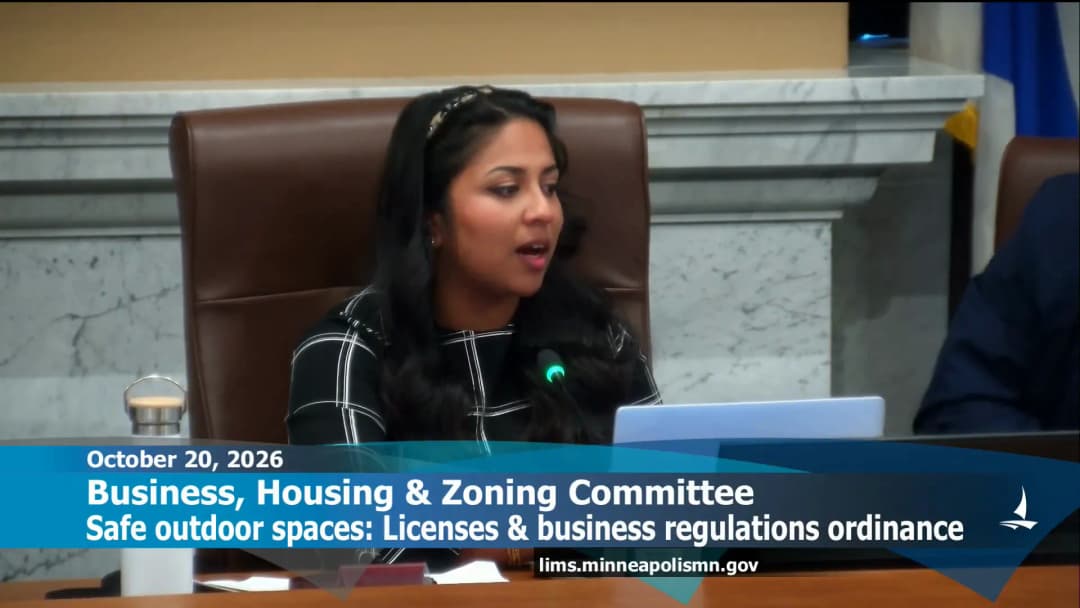
The Minneapolis Business, Housing, and Zoning Committee convened on October 20, 2026, chaired by Councilmember Jamal Osman. The committee addressed a consent calendar, four public hearings, and several discussion items, including a major policy vote on the Safe Outdoor Parking ordinance, a site plan review appeal, and updates on Heritage Park and the 38th & Chicago Thrive Plan. Consent Calendar - Items 5 through 12 were approved en bloc, including liquor and gambling license approvals, a financial agreement with Twin Cities Habitat for Humanity, a legacy grant, TIF district certification, and setting a public hearing for November 5, 2026. Public Hearings & Testimony 1. Mixed Culture Brewery License - Staff: Max Cervantes presented the application. Community feedback: 6 of 7 comments in support. Applicant requested on-sale tap room and off-sale growler licenses. - Applicants: Co-owners Chusha and Kevin Welch stated their goal was to create a welcoming, community-anchored gathering space. Kevin Welch stated the business would be "responsible to the neighborhood." - Council: Councilmember Chowdhury praised the investment and moved approval. The motion carried unanimously. 2. Wheelhouse Studio Extended Hours License - Staff: Inspector Beth Dominguez presented the application for a 24-hour pottery studio access license. Zero community comments were received. - Applicant: Owner Michelle Garens expressed excitement about the project. - Outcome: Approved unanimously. 3. Safe Outdoor Parking Ordinance - Sponsors: Councilmembers Chavez, Chowdhury, and Chuk Tai presented the ordinance package, combining zoning and business licensing to allow managed overnight parking for people experiencing homelessness. - Public Testimony: - Support: Tyler Simmerman called it a "proven bridge back into housing stability." Grace Gerhardt, a previously unhoused resident, stressed the importance of safety and dignity. Mike Hoffman, a shelter operator, urged the committee to "move away from fear." - Concerns/Opposition: MyTech T. Tooth Hill expressed skepticism about regulation. Robin Russell argued the timing was wrong and a 300-foot notification radius was insufficient. Councilmember Schaefer explicitly opposed the ordinance, calling it "premature" without a clear financial model for nonprofits and given current city budget cuts. - Critical: Nat Paul Pula and Reese Kendall characterized the ordinance as a "band-aid" that neglects people without vehicles and fails to address root causes. - Council Debate: - Councilmember Warren shared a deeply personal story of her cousin's death and her own experience, expressing significant conflict over safety concerns (drugs, trafficking, liability) but voting to move the policy forward for further discussion. - Councilmember Chavez introduced an amendment for an annual public outcomes report. The amendment was adopted. - Vice Chair Chowdhury cited successful data from Duluth's Safe Bay program: 164 individuals served, 17 transitioned to permanent housing, and only 8 police calls over six months. - Councilmember Osman voiced strong support, stating the city is in an emergency situation and asking opponents for their alternative solutions. - Vote: The motion to approve the ordinance package and forward it to the full City Council carried. 4. Site Plan Review Appeal (44th St W & Chowen Ave S) - Appellant: Property owner Chris Murphy argued the approved plan did not ensure public health and safety regarding a shared driveway easement and a proposed pad transformer location. - Applicant & Staff: Architect Jessica Harner stated the project complies with the zoning code and drainage or transformer issues will be resolved during the PDR process. Planning staff recommended upholding the Planning Commission's decision. - Outcome: The committee voted to deny the appeal and uphold the Planning Commission's approval. Discussion Items Heritage Park Relocation & Rehabilitation (Items 13 & 14) - Presentation: CPED staff presented a contract amendment with North Point Health and Wellness ($175,000 for relocation services) and an update on the legislative directive. 31 of 81 eligible households opted into relocation by the October 15 deadline. - Controversy: Councilmember Warren sharply criticized a $500,000 plan to replace furnaces in unoccupied units, calling it "wasting money" and "hustling backwards" since the buildings require complete gutting. Councilmember Chuk Tai expressed frustration that Regulatory Services staff were not present to answer questions about inspection processes. - Outcome: The committee sent the items to the full Council without recommendation. Trio Development (Item 21) - The committee approved a revised recommendation to modify affordability limits on six of ten units from 60% to 80% AMI and to waive the subsidy land requirement. 2027 License Fee Schedule (Item 17) - An amendment was approved to set a 90% cost recovery rate for rental license fees. Colfax Avenue Rental License Reinstatement (Item 18) - The committee approved reinstatement for 3016/3018 Colfax Ave S after the owner paid over $4,000 in back fees and met all compliance requirements. Sabathany Community Center Loan Subordination (Item 19) - Approved a request to subordinate a city loan, allowing the center to secure $4.9 million for a geothermal system installation. Upper Harbor Performing Arts Center (Item 20) - Approved a $2 million loan at 7% interest to Port of Minneapolis for construction cost overruns, and approved revised lease terms for a rideshare lot and billboards. 38th & Chicago Thrive Plan (Item 22) - The legislative directive response was received and filed. Councilmember Chavez raised concerns about the allocation of $1.2 million in funds, specifically regarding the use of a "carve-out" model from existing programs. Key Outcomes - Consent Calendar approved. - Mixed Culture Brewery and Wheelhouse Studio licenses approved. - Safe Outdoor Parking Ordinance approved in committee and sent to full City Council for final consideration. - Site Plan Appeal denied; development project upheld. - Heritage Park items forwarded without recommendation. - Trio Development, License Fee Schedule, Colfax Reinstatement, Sabathany Subordination, and Upper Harbor PAC all received committee approval. - 38th & Chicago Thrive Plan report filed.

HOMELESSNESS 39% · PUBLIC HEALTH 10% · LAND USE AND ZONING 10% · PUBLIC SAFETY 9%
04
NEWOCT 20, 2026 · MINNEAPOLIS, MINNESOTA · CITY COUNCIL
Minneapolis Budget Committee Reviews 2027 Budgets and Proposed Engagement Reorganization, 2026-10-20

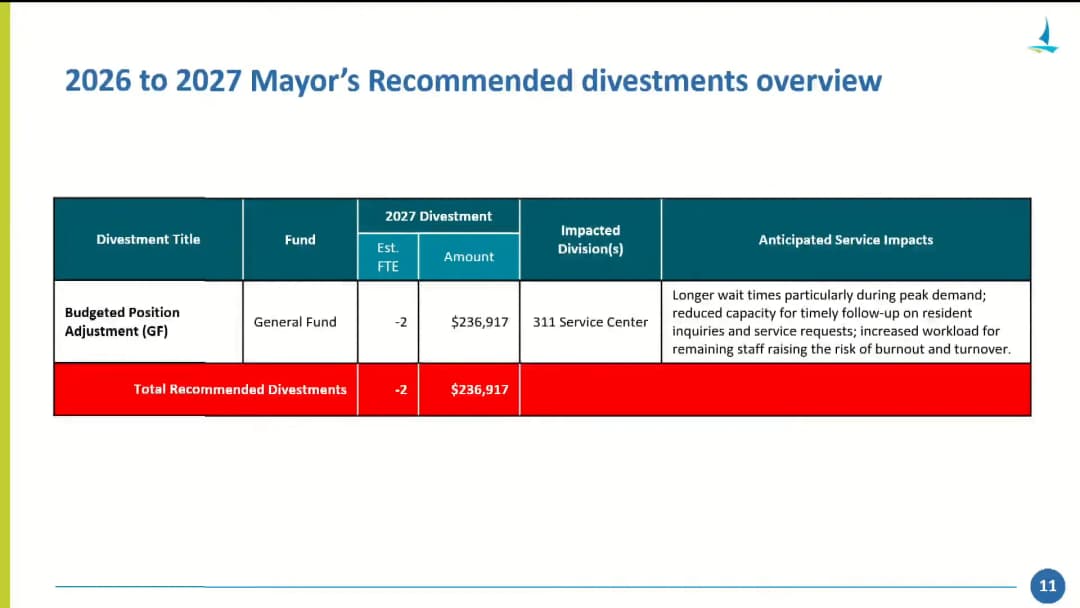
The Minneapolis Budget Committee met Tuesday, Oct. 20, 2026, with Chair Aisha Chugtai presiding, to review the mayor's recommended 2027 budget for four departments: Intergovernmental Relations, Neighborhood and Community Relations, the 311 Service Center, and Racial Equity Inclusion and Belonging. Eight members were present, establishing a quorum. No formal votes were taken; presentations were filed and several administrative follow-ups were requested. City operations staff also used the meeting to introduce a revised plan to consolidate communications, engagement, 311, and racial equity work into a new engagement department. Proposed Reorganization and Community Engagement Consolidation - City Operations Officer Margaret Anderson Kelleher presented a revised organizational proposal following the mayor's August budget recommendation. The revised plan would create a new engagement department combining Communications, Neighborhood and Community Relations (NCR), the 311 Service Center, and functions of Racial Equity Inclusion and Belonging (REIB), while moving Performance Management and Innovation under the Office of Public Service. REIB would no longer move to Human Resources, as originally proposed. - Kelleher said the goal is to elevate engagement, reduce duplicative overhead, bring work in-house, and build a center of excellence; savings would come partly from not having four department heads. She said the combined department would have roughly 85 employees and cited peer cities including Philadelphia, Edmonton, Durham, Charlotte, Calgary, Raleigh, and Seattle. - Councilmember Vita objected to the timing and clarity of the plan, saying the chart felt messier, that departments were being moved down to the wire, and that she wanted a briefing on prior analysis and specific cost savings. - Councilmember Palmasano expressed support for the concept of a larger community engagement department and a centralized communication strategy, and asked about REIB's future structure. - Councilmember Chavez said she did not support the proposal, warning it could dilute NCR's mission after Operation Metro Surge and hurt the communities that rely on the department's services. She asked for the report and analysis behind the plan and suggested the problem could be addressed without a merger. - Councilmember Chowdhury criticized eleventh-hour decision-making, raised employee morale concerns, noting employees had learned of possible job losses through a Star Tribune headline, and asked for combined contracting dollars and total employee counts. She said she did not want to set a precedent of consolidations three weeks before budget markup. - Vice Chair Schaefer summarized the main revisions as moving REIB from HR into the new engagement area and combining 311 with Communications and NCR. She said condensing management roles and standardizing engagement could be positive. - Councilmember Stevenson said she was concerned 311 would become a promotion tool rather than a service-resolution line. Kelleher replied that 311 would not become promotional and that information sharing already happens through scripts and engagement. - Council President Payne said he supported removing old silos, but regretted the mayor did not collaborate with the council before the budget announcement. Kelleher acknowledged the budget process was hard and said she was willing to lead change. Intergovernmental Relations (IGR) - Interim Director Steve Huser presented the mayor's recommended 2027 budget for IGR, a six-FTE department with a proposed budget of approximately $1.5 million. The proposal reduces IGR from six to five FTEs, with a net budget decrease of $44,000, personnel savings of $114,000, and a $12,000 increase for membership dues. - Huser said about 75% of the recommended budget is personnel, with contract services at approximately 20% and operating costs at approximately 12%. Professional services for lobbying firms are proposed at $2,300, and citywide membership dues are proposed at $16,600 for organizations including the League of Minnesota Cities, National League of Cities, and Metro Cities. - In response to questions, Huser said losing one FTE would be manageable through remaining staff and contract lobbyists. He said the mayor's proposal cuts an FTE, not contract services. He described the federal contract lobbyist as important because the city has no Washington, D.C.-based IGR staff, and said two state lobbying contracts add capacity and bipartisan relationships. - Councilmember Chowdhury noted the FTE added about two years ago came from the Department of Health and was a sustainability coordinator focused on climate and Public Utilities Commission work. She argued IGR demands are growing, especially around LGA and revenue, and said she was wary of cutting a lean department that should grow. Neighborhood and Community Relations (NCR) - Deputy COO Katie Topinka presented NCR; Director Karen Moe answered questions. NCR has 23.5 FTEs, a 2026 adopted budget of $12.7 million, and a recommended 2027 budget of $8.2 million. - Topinka noted a technical correction: some special revenues and expenses were unintentionally omitted from the mayor's recommended budget, with no general fund or property tax levy impact; the correction will be submitted as a technical amendment in December. - NCR supports neighborhood organizations, language access, the Office of Immigrant Refugee Affairs (OIRA), and the Office of Two Spirit LGBTQIA+. The organizational chart correction says OIRA has three FTEs, not two. - The mayor's recommended budget includes a new web accessibility (WCAG) position, but Topinka proposed using existing positions and $190,000 in contracted services instead. The mayor recommends divesting $500,000 from the Partnership Engagement Fund; base neighborhood organization funding remains $3.8 million. Six FTE reductions totaling $815,000 are proposed, but Topinka said the actual NCR reductions may be lower because vacancies and the merger are being reviewed holistically. - Councilmember Chavez asked about the history of the Partnership Engagement Fund; Director Moe explained it grew out of the Neighborhoods 2020 process and supports hyperlocal projects chosen through an annual RFP. Chavez listed funded examples including Spanish-language driver's license education, environmental justice education, Lake Street business support, Hmong language outreach, youth programs, and immigrant rights education, and said eliminating the fund would have a devastating impact; she urged restoring it. - Vice Chair Schaefer asked for historical data; Moe distinguished the Partnership Engagement Fund from formula-based neighborhood funds. Moe also said the 2026 allocation of $500,000 was used to honor 2025 contracts and no new RFP was run; unspent funds returned to the general fund. Historical data will be provided. - Councilmember Warren raised questions about unused NRP funds; Moe clarified that NRP funds are pre-allocated, subject to oversight and approval processes, and can be reallocated through proper steps. Follow-up was promised. - Councilmember Warren also said he was wary of promised merger efficiencies, citing last year's communications consolidation, and requested detailed financials for the proposed reorganization. - Councilmember Chowdhury asked why the Partnership Engagement Fund was selected for elimination; Topinka said it was the mayor's budget decision. Chowdhury requested administrative follow-up asking the mayor's office for the rationale and voiced concern about repeated cuts to programs supporting underrepresented communities. 311 Service Center - 311 Director Mwendon Zembi presented the department's recommended 2027 budget. The 311 Service Center has 43 FTEs, and the recommended budget is $7.8 million, up from $7.1 million in 2026, an increase of about $667,000 or 9%. - In 2025, the in-person service center, with five FTEs, served approximately 19,000 residents in about 25,000 transactions. The call center, with 27 FTEs, handled roughly 412,000 interactions: 247,000 agent-assisted calls, 101,000 completed through the interactive voice response system without an agent, about 32,000 emails, and about 32,000 online submissions. - IVR was introduced in late 2023 after turnover had reached about 50%; about 29% of calls are now handled without an agent, and attrition is currently about 7%. - The 2027 budget adds two positions for the South Minneapolis Community Safety Center and eliminates two positions, a net divestment of about $40,000. Salaries and fringe rise 6%; contractual services rise 16%, driven by internal service charges and the new Safety Center footprint. The call center will go from 27 to 25 agents, with possible longer waits or disconnects. - The new 311 system, Mars, had Phase A go live on Oct. 13, 2026. Phase B is scheduled to begin in January 2027 with rollout in the fourth quarter of 2027. The director said technology improvements do not automatically reduce staffing needs. - As of Sept. 30, there were five vacancies; two of those vacant positions are proposed for elimination. About 17% of the remaining call center staff are on PFML leave. Overtime was about $9,000 in 2026 and $5,000 through Aug. 31, 2026; supervisors are covering calls, which the director described as not sustainable. - Discretionary contracts include IVR service budgeted at $80,000, compared with average annual expenditure of $60,000 to $65,000, and translation services budgeted at $100,000. - Councilmember Palmasano congratulated the director on the Phase A launch. Councilmember Chowdhury thanked 311 staff for being a critical access point, including during the ICE occupation. Chair Chugtai said 311 is like 911 for non-emergency services and should not be merged into community engagement. Racial Equity Inclusion and Belonging (REIB) - Deputy COO Topinka presented REIB; Director Corbett was absent, and Equity and Inclusion Manager Isadora Collins was present. REIB has 5 FTEs, a 2026 adopted budget of $1.1 million, and a recommended 2027 budget of $677,000. The mayor recommends reducing REIB from 5 to 2 FTEs; salary and wages fall 47%, fringe 62%, and contractual services 20%, with a small increase in operating costs. - REIB's work includes racial equity consultation and technical assistance, training, support for departmental equity teams, and facilitated processes to address racial harm. Topinka said the racial equity ordinance also includes external-facing responsibilities such as community engagement guidelines, data analysis, and community advisory boards, which supports moving REIB into an engagement department. - Topinka said the Government Alliance on Race and Equity (GARE) membership will continue and that REIB's 2026-2030 strategic plan will need to be revisited because of the budget and possible reorganization. - Councilmember Chowdhury asked which two positions would remain; Topinka said analysis was still being finalized and staff would be informed before the council. Chowdhury said it was sad to see racial equity work atrophied and expected further discussion in committee of the whole. - Councilmember Vita requested a staff memo on the cost and timeline of REIB's strategic planning, noting the city invested in a plan and then proposed cutting more than half the department. - Vice Chair Schaefer asked about contractual services; Topinka noted a 20% cut in contractual services from the 2026 adopted budget to the 2027 recommendation. - Topinka said FTE reduction details would be provided at briefings the next day, after staff had been notified. Key Outcomes - All four presentations were filed with the clerk; no motion or vote was taken. - Administrative follow-ups were requested on: combined contract and spending data for NCR, 311, and REIB; historical Partnership Engagement Fund data; the mayor's office rationale for selecting the Partnership Engagement Fund for elimination; the REIB strategic plan document, cost, and timeline; and final NCR and REIB FTE reduction numbers. - The committee is scheduled to reconvene Thursday, Oct. 22, 2026, for budget presentations from Finance and Property Services and Communications.

PUBLIC ENGAGEMENT 22% · BUDGET MANAGEMENT 21% · COMMUNITY ENGAGEMENT 14% · GOVERNMENT STRUCTURE 11%
05
NEWOCT 19, 2026 · MINNEAPOLIS, MINNESOTA · CITY COUNCIL
Minneapolis Budget Committee Public Hearing on 2027 Budget - October 19, 2026

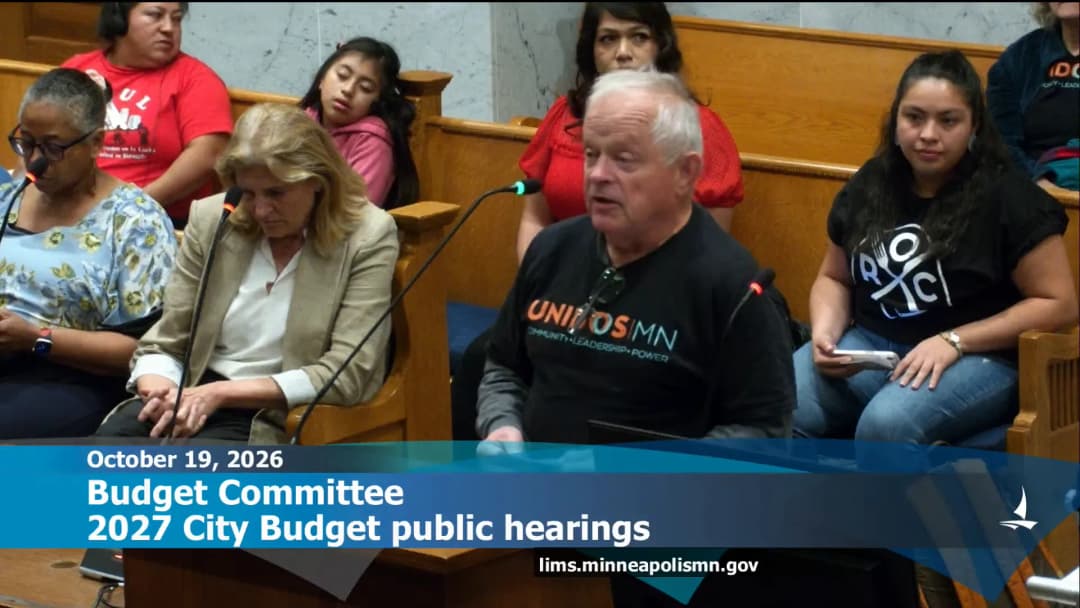
The Budget Committee of the Minneapolis City Council, chaired by Aisha Chuktai, convened an adjourned public hearing on October 19, 2026, to receive public testimony on the Mayor's recommended 2027 budget. The proposed $2.29 billion budget includes an 11.3% increase to the city property tax levy, though the Board of Estimate and Taxation (BET) authorized a maximum increase of 11.9% in September. Budget Manager Justin Carlson presented an overview, noting $23.7 million in divestments and $33.5 million in investments, with major spending pressures from public safety, settlements, and enterprise operations. Budget Overview Presentation - Budget Manager Justin Carlson presented the Mayor's 2027 recommended budget, highlighting a $738 million general fund, a $606 million property tax levy, and major drivers of change including public safety overtime and settlement costs. The presentation noted $23.7 million in proposed divestments, including department consolidations and contract reductions, and $33.5 million in investments, concentrated in police and fire "right-sizing". - The BET increased the maximum tax levy to 11.9% from the Mayor's 11.3% recommendation by adding increases for the Minneapolis Park and Recreation Board and the BET itself, but did not alter the city's proposed levy. Public Comments & Testimony Climate Legacy Initiative (CLI): Over a dozen speakers, many organized by Unidos, urged the council to restore the $4 million in franchise fee funding cut by the Mayor from the Climate Legacy Initiative, which funds the Green Cost Share weatherization programs. Speakers argued the cut breaks a trust commitment, hurts low-income families by raising energy costs, and undermines the city's climate emergency goals. (Lisa Franchette, Marie Franchette, Bill Adamski, Emmer Griffin, Satish Desai, Kent Fitzmead, Lance Rothbouz, Eric Berger, Alice Madden, and others). Worker Co-Enforcement (Labor Standards): A large contingent of workers and advocates from CETUL, ROC Minnesota, and the New Justice Project spoke in strong support of restoring co-enforcement funding. They detailed personal experiences with wage theft, sexual harassment, and retaliation, and credited the program with recovering millions of dollars in stolen wages and providing essential worker protections, particularly for immigrants and people of color. (Lucia D'Avila, Sherelle Montagner, Erica Castro, Artemis Kodzora, Kate Anthony, Chelsea Globetz, PJ Gronquist, Megatron, and others). Homegrown Minneapolis & Food Justice: Many residents and organizational leaders spoke in favor of preserving the Homegrown Minneapolis food initiative within the Health Department. Speakers highlighted its critical community gardening programs, its role in rescuing over one million pounds of food waste, its ability to leverage millions in external grants, and its importance in addressing food insecurity during crises like Operation Metro Surge. (Ann Hill, Princess Titus, Kelso Anderson, Tara Wilder, Michaela Jackson, Alyssa, Dr. Jennifer Nickley, Lane Brown, and others). Community Safety Ambassadors & Violence Interrupters: Business owners from Lake Street and Longfellow requested an eastward extension of the Community Safety Ambassador program. Violence interrupter organizations (Somali Youth Link, Restoration Inc.) asked for continued funding, citing direct impacts on reducing gun violence and engaging at-risk youth. (Janice Downing, Anna Santier, Farheo Khalif, Mohammed Yousuf, Connie Rhodes). Property Tax Levy & Spending Reform: Several residents expressed support for Vice Chair Schaefer's proposals to limit the levy to 6%, implement 4% departmental cuts, review grant-funded positions, and institute a hiring freeze, arguing the city must operate more sustainably. (Eileen Johnson, Lori Matag, Steve Godfus). Others expressed concern that high property taxes are driving residents out of their homes and worsening the affordability crisis. (Pat Paulson, Janelle Austin). Police Budget & Accountability: Multiple speakers criticized the Mayor's budget for increasing police funding despite a $20 million overtime overspend. They argued the city should instead reinvest those funds into community-based programs like co-enforcement and violence prevention rather than "rubber-stamping" MPD budget overruns. (Rai Galbreath, Sam M. Holty, Stacy Gurion Sherman, Malcolm Wells). Other Community Programs: Speakers also urged the preservation of funding for the Partnership Engagement Fund (PEF), the department of Neighborhood and Community Relations (NCR), housing inspections, the Lead Minneapolis program, and the Civil Rights Department. Key Outcomes - The public hearing was adjourned at approximately 9:30 PM. - The third and final public hearing (Truth in Taxation) is scheduled for December 15, 2026, at 6:05 PM. - The Budget Committee will convene the following day, October 20, 2026, at 10 AM for budget presentations from Intergovernmental Relations, Neighborhood and Community Relations, the 311 Service Center, and the Racial Equity, Inclusion, and Belonging Department.

CLIMATE POLICY 15% · BUDGET MANAGEMENT 14% · LABOR STANDARDS 14% · PUBLIC HEALTH 11%
06
NEWOCT 19, 2026 · MINNEAPOLIS, MINNESOTA · CITY COUNCIL
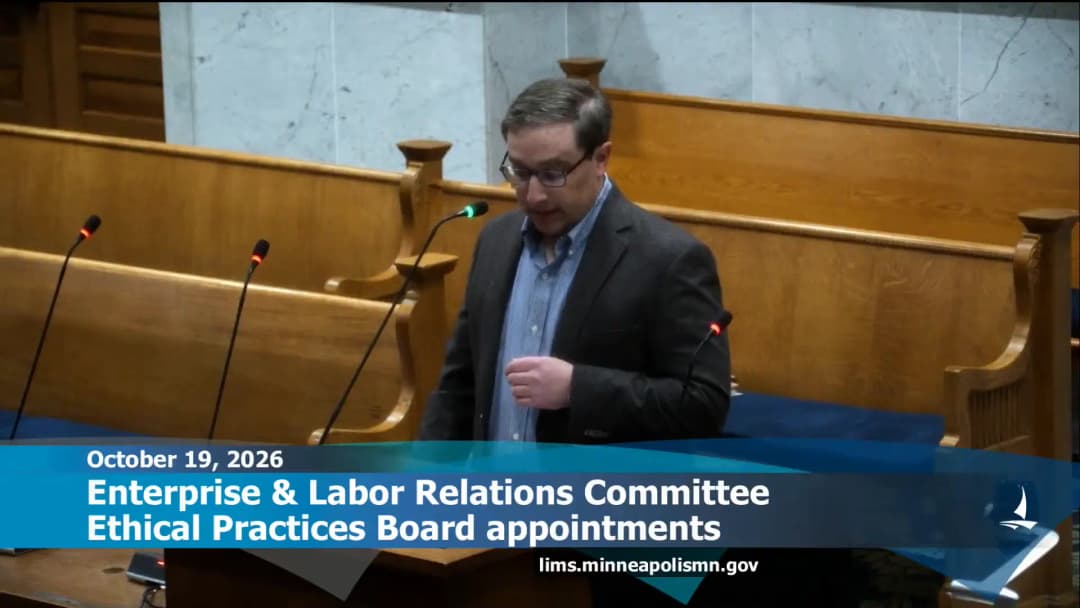
Enterprise and Labor Relations Committee Meeting - October 19, 2026

The Enterprise and Labor Relations Committee met on October 19, 2026, with Chair Linne Palmasano presiding. The committee approved consent agenda items and held a public hearing for appointments to the Ethical Practices Board. No public comments were received, and no discussion occurred on the appointments. Consent Calendar - Approved contracts with Health Equity for flexible spending account and transportation benefit administration services (Item 2). - Approved contract with Code 4 for CAD and mobility safety system configurations support and maintenance (Item 3). - Received and filed the third quarter report for staff purchasing letters and joint purchases (Item 4). - Received and filed the third quarter report for professional services between $5,000 and $175,000 (Item 5). All consent items were approved unanimously. Public Comments & Testimony - No members of the public signed up or spoke during the public hearing for appointments to the Ethical Practices Board. Discussion Items - Public Hearing: Appointments to the Ethical Practices Board – Deputy City Attorney Dan Abelson provided background on the board, which is an independent body handling ethics complaints and advisory opinions. Two vacancies exist starting January 2, 2027, with the appointing authority (Chief Judge of Hennepin County and deans of St. Thomas and University of Minnesota Law Schools) recommending Drew Duffy and Peter Maringolo for three-year terms beginning January 3, 2027. The committee noted that one appointee is not a lawyer, increasing board diversity. No discussion followed the hearing. Key Outcomes - Consent agenda approved unanimously. - Public hearing for Ethical Practices Board appointments was opened and closed with no public testimony; the committee received and filed the hearing (no action required).

PROCEDURAL 66% · CONTRACT MANAGEMENT 34%
07
NEWOCT 19, 2026 · MINNEAPOLIS, MINNESOTA · CITY COUNCIL
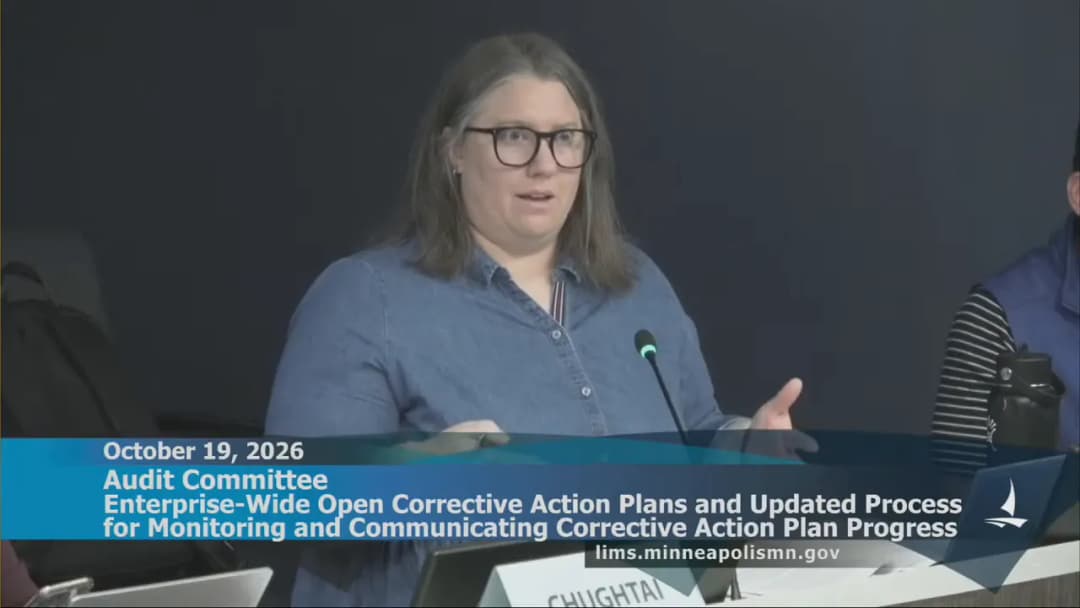
Minneapolis Audit Committee Meeting, October 19, 2026: Corrective Action Plans, After-Action Review Advisory, and BCR Audit

The Minneapolis Audit Committee met on October 19, 2026, at 14:31:16 UTC under Chair Elliot Payne. A quorum was established with six members initially present; Member Engelhardt joined later. The committee adopted the agenda, accepted the August 24, 2026 minutes, and then heard status updates on open corrective action plans, an advisory report on after-action reviews, the Behavioral Crisis Response audit, and an update from the Office of the City Auditor. All formal motions were approved by voice vote with no reported opposition. Discussion Items Corrective Action Plan Progress Updates - City Auditor Timmerman opened by explaining that corrective action plans are developed by auditees, while the Office of the City Auditor monitors and validates status updates. He noted that dashboard entries may not yet show items as closed even if departments describe them as complete, because the office is still validating submitted evidence. - Director Matt Kwaters stated that he had evaluated more than 1,800 pieces of information and 108 individual evidence submissions from public safety departments between August and the night before the meeting. Minneapolis Police Department - Commander Chris Brown reported that the 2023 property and evidence audit, which initially had 12 findings, has been fully satisfied and closed, as has the sexual assault examination kit special project follow-up audit with 4 findings. - On the 2024 fleet management audit, MPD has closed 3 findings and has 4 remaining open: prioritizing MPD investigations in employee-involved vehicle accidents, updating fleet policies and definitions with stakeholders, aligning information sharing with risk management on crashes, and developing a fleet management system with City IT. A meeting with the auditor's office on the fleet system finding is scheduled for October 28. - On the 2019 off-duty audit, one finding has been closed and two remain open. MPD described new internal controls that did not exist in 2019 and said a new timekeeping and scheduling system is planned for 2027, though its full off-duty management capabilities have not yet been assessed. - On the 2026 after-action review following the shooting of Davis Maturry and the death of Alison Lucher, MPD reported 37 findings in total, with 3 fully satisfied and 3 near completion. Work includes policy development, department-wide training, domestic violence protocol changes, additional domestic assault investigators, warm handoffs to navigators, and updated resource cards. - City Auditor Timmerman clarified that a finding can be closed when the auditee completes the corrective action commitment, such as submitting engineering reports, budget requests, and mitigation plans, even if future capital construction remains unfunded. - Committee members asked about evidence storage risks. MPD noted continuity-of-operations and disaster plans, alarms, humidity controls, and a backup generator plan. A $500,000 to $600,000 backup power and climate control project and roughly $250,000 in warehouse environmental controls, plus a $3 million roof replacement request, were identified in the 2026-2031 capital planning process. - On fleet audit deadlines, Commander Reisdorfer said the revised May 2027 target is achievable only if staffing, training, and FTE resources are available; policy development is expected to be substantially complete by December, and the new fleet software system is built and undergoing data migration. - Vice Chair Singleton asked about off-duty call signs and the domestic violence pilot. MPD explained the four-digit off-duty and three-digit 911 call sign distinction. Deputy Chief Adams said the domestic violence pilot had been restarted with a new one-page risk assessment; an internal working group with the City Attorney and Hennepin County Attorney is meeting, and all community navigators have been trained on domestic violence. - Chair Payne noted the City Council passed an ordinance to allow charging fees for off-duty work and asked why IT infrastructure described as a barrier still delays implementation. MPD said the new UKG timekeeping system may help but its off-duty capabilities are not yet fully confirmed. Neighborhood Safety Department - Director Amanda Harrington reported on the neighborhood safety contract management audit. NSD said none of its items are past due, with one sub-item needing its dashboard due date corrected to the latest applicable date. - NSD has held monthly meetings since June 4, 2026 with finance, procurement, controller, and City Attorney staff. A shared agenda and notes document is used, covering contract policy, deviations, invoice issues, and next steps. - Policies completed so far include contractor training and contractor food and beverage reimbursement, both reviewed by finance and the City Attorney. The invoicing policy and contract management policy are being updated. Contract staff training on invoice reviews was completed in July, ahead of the September due date. - NSD developed a standardized site visit form, a centralized contractor training tracker, and updated contract file and communication standards. The City Auditor has informed NSD that the contractor training tracking and contract documentation items are closed. - On the undue influence and pressure finding, Harrington said clearer contract manager designation letters and communication standards should help, but acknowledged that small community-based contractors may still contact elected officials if they are frustrated or stressed by the city's 35-day invoice payment timeline. Finance and Property Services Department - CFO Dushani Dye presented two findings. The first, from the 2023 revenue and collections audit, involved mailed payments left unsecured on a desk. The original due date was October 1, 2024, revised to October 1, 2026. Locked mailbox cabinets have been installed, and the item will close once keys and key holders are finalized. - The second finding involved the Health Department's contract with Helix Health and Housing Services. Finance has moved to a consistent, higher standard for invoice backup aligned with federal grant requirements. Procurement training occurred in October 2026. Dye also stated that emergency procurement procedures are no longer used unless there is an emergency declaration. Minneapolis Park and Recreation Board - An MPRB representative reported all seven cash-handling audit findings remain open, with a target deadline of December 31, 2026. Information security and PCI compliance policies have been updated, an information security and compliance analyst has been hired, and an annual information security awareness training is on the MPRB training portal. - Cash-handling training is being adapted from the city's version and is expected to be available by November. Collection-point-specific procedures and finance oversight procedures are nearing completion. MPRB is limiting cash held at facilities, recreation centers have no cash drawers, and larger cash deposits are directed to headquarters. - MPRB has a $250,000 annual security camera replacement program and is developing concession agreement inspection procedures. - In response to member questions, MPRB described contingency instructions for when internet or credit card systems are down, including phone payments at other locations, and said it would research automated cash-accepting machines. After-Action Review Advisory Report - The Director of Internal Audit presented an advisory engagement requested by the council through the audit committee. It assessed whether the city has an independent function to evaluate high-impact public safety cases. - The conclusion was that the city does not currently have a department or division dedicated to managing after-action reviews of high-impact violent events, and creating one would require new funding and could overlap or conflict with Minnesota Statutes chapter 611A, including sections 611A.72 through 611A.74 and the Crime Victim Justice Unit. - The report recommended creating a work group with the City Attorney's Office to develop training and procedures for routing complaints to the Office of Police Conduct Review and the Crime Victim Justice Unit, maintaining a resource list, and reporting progress to the City Auditor within six months. - Member Wathaq asked how systemic after-action reviews would occur if another high-impact incident happens. The presenter said the state already has the statutory mechanism and expertise, and the city should focus on education and referral rather than creating a new city office. - Member Peterson asked about the source of the 37 recommendations referenced in the report; the presenter confirmed they came from the city's recent after-action reviews involving the deaths of Alison Lucher and Davis Maturry. Behavioral Crisis Response Audit - Matt Kwaters presented the 2026 Behavioral Crisis Response Program audit, covering contract COM0003838 with Canopy Roots for 24/7 citywide behavioral crisis response. Oversight of the contract was transferred to the Minneapolis Fire Department in amendment two, and the reviewed period ran through August 15, 2026. - Finding 1 stated the contract measures service availability but does not define performance targets. The recommendation is to align operational metrics with MFD standards, implement a standard operating procedure, and establish response data sharing. - Finding 2 stated contractor billing and MFD invoice review processes do not match. Auditors observed repeated invoice period labels and summary-level support documentation, but did not find actual noncompliance. A tracking mechanism was recommended. - Finding 3 stated MFD reviews vendor invoices without written criteria, relying on the expertise of the individual contract manager. The report recommended memorializing the oversight process. - The report also included an informational advisory with future program suggestions and possible grant funding streams. MFD provided a management response with corrective actions coordinated with the Office of Community Safety. - Member Wathaq cited approximately $2.73 million in repeated billing amounts despite varying reported staffing and hours, and asked whether a retrospective financial reconciliation would be conducted. Kwaters said determining recoverable amounts was outside the audit scope, but the management response commits to strengthening invoice controls, and a further review could be discussed. - Member Chughtai criticized the MFD management response for suggesting it had not received information from departments within the same office, and criticized the informational advisory for making future-scope suggestions, including homelessness-related funding uses, that were not part of the requested audit. Kwaters apologized, clarified that the advisory was informational rather than a formal recommendation, and accepted accountability for it. - Chair Payne and Member Hosbein added context that the program had moved from Neighborhood Safety to MFD because of earlier contract management deficiencies, and that questions about vendor versus in-house delivery and expanded scope are ultimately policy decisions for the council and administration. Office of the City Auditor Update - City Auditor Timmerman reported completed work, including the reports presented earlier that day, and noted that the surveillance technology review management response had been entered into the dashboard. - Upcoming work includes the permitting process audit in December, a data governance audit, an Ethical Practices Board advisory engagement, a city fleet management audit with a kickoff meeting that day, and the 2027 enterprise-wide risk assessment with meetings expected in November. - The office has two active fraud, waste, and abuse referrals, hired a Macalester College intern, and posted an auditor 3 position and its backfill. - Timmerman said the mayor's proposed budget would reduce the Office of the City Auditor by two FTE and $100,000 in contractual services, which would effectively eliminate outside contracting capacity and create a threat to auditor independence. He suggested exploring a city charter change to set the office's budget with authority to increase, but not decrease, tied to inflation. - Chair Payne suggested using the annual audit work plan and risk assessment to document resource needs ahead of the mayor's budget proposal. Audit committee training was rescheduled to January or February, and fraud awareness week activities were announced. Key Outcomes - Agenda adopted and August 24, 2026 minutes accepted by voice vote. - The committee received and filed the corrective action plan progress updates from MPD, NSD, Finance and Property Services, and MPRB, and directed staff to publish the reports. - The committee received and filed the advisory report on managing after-action reviews and directed staff to publish it. - The committee received and filed the Behavioral Crisis Response audit report and directed staff to publish it. - The Office of the City Auditor update was presented for discussion; no formal action was taken on the budget proposal or future audit plan.

AUDIT AND OVERSIGHT 40% · PUBLIC SAFETY 25% · CONTRACT MANAGEMENT 12% · BEHAVIORAL CRISIS RESPONSE 6%
08
OCT 15, 2026 · MINNEAPOLIS, MINNESOTA · CITY COUNCIL
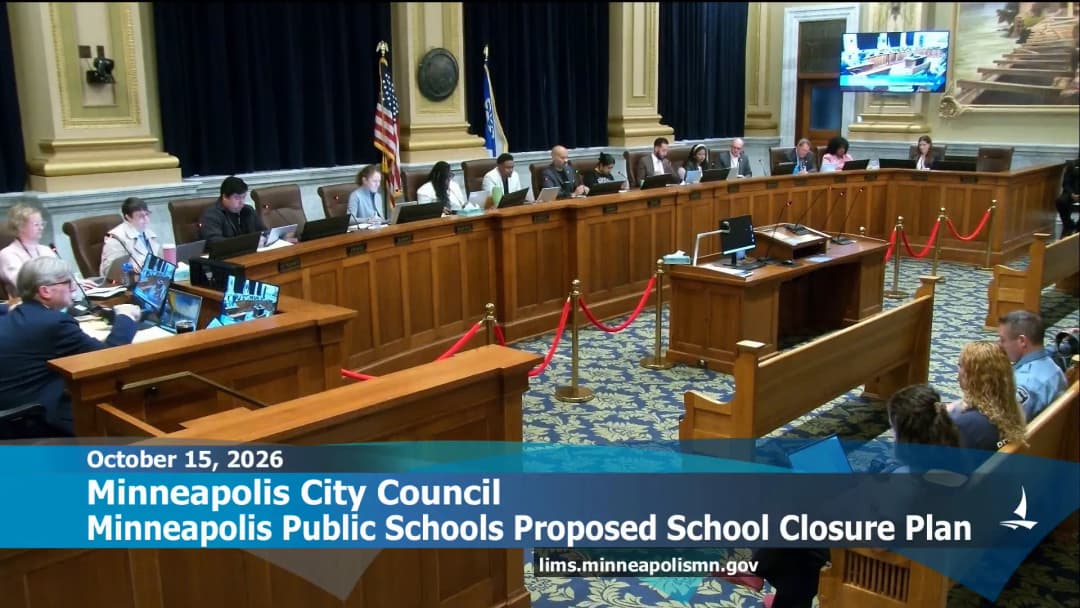
Minneapolis City Council Regular Meeting - October 15, 2026

The Minneapolis City Council met on October 15, 2026, at 2:36 PM for a regular meeting. The session included a breast cancer awareness month resolution, reconsideration of the mayor's veto of autonomous vehicle regulations, reports from standing committees with multiple approvals and debates, and a detailed discussion on the behavioral crisis response contract. The meeting was adjourned for a brief recess to address procedural matters. Consent Calendar - Agenda Adoption: Approved unanimously (12 ayes). - Minutes Acceptance: Approved unanimously (12 ayes) for the October 1, 2026 regular meeting. - Referral of Petitions, Communications, and Reports: Approved unanimously (12 ayes). - Business Housing and Zoning Committee Report: Approved items 1-9 and 11-12 unanimously, except item 10 (Los Andes Latino Bistro) which was pulled for separate vote (see below). - Climate and Infrastructure Committee Report: Approved items 1-11 unanimously; item 12 (Hennepin County waste disposal contract) approved unanimously after discussion. - Committee of the Whole Report: Item 3 (gift acceptance for police chief conferences) approved unanimously. Items 1 and 2 pulled for separate votes (see below). - Enterprise and Labor Relations Committee Report: All nine items approved unanimously. - Public Health, Safety, and Equity (PHSE) Committee Report: Items 1, 11-20, and 26 approved unanimously as a consent block (12 ayes). Items 2-10 and 21-25 were pulled for separate votes (see Discussion Items). Discussion Items - Autonomous Vehicle Regulations Veto Override: The council considered overriding the mayor's veto of Ordinance 2026-034 (regulating autonomous vehicles for commercial purposes). The override required 9 votes but received only 7 ayes (Chowdhury, Stevenson, Chavez, Wandsley, Shugtai, Osman, Payne) vs 5 nays (Rainville, Vita, Palmisano, Schaefer, Whiting). The veto was sustained, and the ordinance was not adopted. Councilmember Wandsley announced plans to continue working on regulations. - Los Andes Latino Bistro Settlement (Item BHZ-10): Councilmember Shugtai moved to deny the settlement agreement due to sexual assault convictions at the business. The motion passed unanimously (12 ayes), sending the matter to an administrative law judge for a contested case hearing. - Committee of the Whole Item 1 – MPS School Closure Resolution: Councilmember Vita moved to withdraw the resolution after the Minneapolis School Board committed to no school closures for 2027-2028. Withdrawn unanimously (12 ayes). - Committee of the Whole Item 2 – Subpoena Authority Legal Analysis: Councilmember Payne moved to request a legal opinion from the city attorney on subpoena authority. Passed 9-3 (Rainville, Vita, Schaefer voted no). - PHSE Items 2-10 – Health Department Master Contracts: Councilmember Schaefer moved to refer these 80 contracts (totaling over $15 million) to the Committee of the Whole for further review. After debate and an amendment to postpone to the next council cycle (failed 4-8), the motion to refer to Cow failed unanimously (12 nays). The items were then approved unanimously (12 ayes). - PHSE Item 21 – Mariah Samuels After-Action Review: Resolution requesting the city auditor to conduct an independent review of the city's response to domestic violence calls related to Mariah Samuels. Approved unanimously (12 ayes). - PHSE Item 22 – Community Bridges Mobile Crisis Response (MCR) Contract: Extended debate. The motion to deny the contract was carried 7-5 (Chowdhury, Stevenson, Chavez, Wandsley, Shugtai, Osman, Payne ayes; Rainville, Vita, Palmisano, Schaefer, Whiting nays). Subsequently, Councilmember Wandsley moved to waive procurement rules to allow an interim contract extension with the current vendor (Canopy Roots) for up to 18 months to ensure service continuity while exploring future options. Debate was ongoing when the transcript ended; no vote recorded. - PHSE Item 23 – MPD Off-Duty Work Audit Legislative Directive: Approved unanimously (11 ayes; Rainville absent). - PHSE Items 24 & 25 – MPD Fleet Management and Overtime Audits: Both approved unanimously (11 ayes). Key Outcomes - Autonomous Vehicle Veto Sustained: The council failed to override the mayor's veto (7-5), so no new regulations are adopted. Council will explore alternative approaches. - Los Andes Settlement Denied: Matter returned to administrative law judge for a contested case hearing on licensing action. - MPS School Closure Resolution Withdrawn: School board committed to no closures for 2027-2028, so council action was moot. - Subpoena Authority Study Approved: City attorney to analyze whether the council can compel administration testimony and documents. - Health Contracts Approved: Despite fiscal concerns, all master contracts for health department services were approved unanimously. - Mariah Samuels Review Ordered: Independent after-action review of domestic violence response by the city auditor. - MCR Contract Denied: The council rejected the Community Bridges contract (7-5). A motion to waive procurement rules for a potential interim extension was pending as the meeting recessed. - MPD Oversight Measures Advanced: Legislative directives on off-duty work and fleet management, and a request for an audit of overtime spending, were all approved.

PUBLIC SAFETY 23% · CONTRACT MANAGEMENT 19% · PROCEDURAL 17% · PUBLIC HEALTH 10%
09
OCT 13, 2026 · MINNEAPOLIS, MINNESOTA · CITY COUNCIL
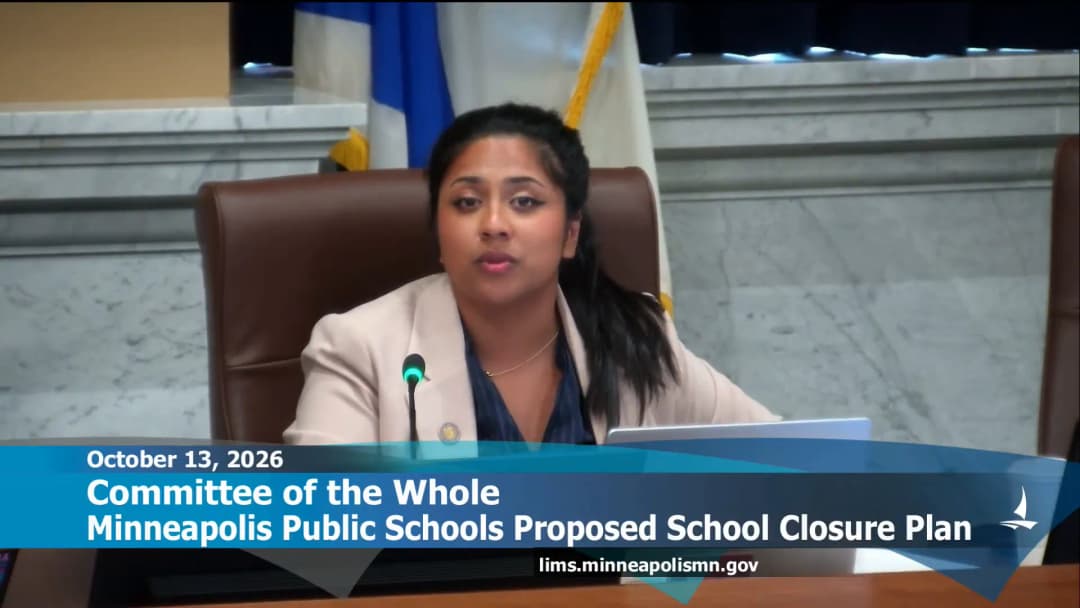
Minneapolis Committee of the Whole Meeting Summary - October 13, 2026

The Committee of the Whole meeting was called to order by Chair Orreen Chowdry on October 13, 2026, at 6:30 PM. A quorum was present with 10 members. The agenda was adopted with an amendment adding a walk-on item for the Minneapolis Police Department gift acceptance. Key discussions included a detailed presentation on the business regulatory environment, a resolution regarding Minneapolis Public Schools closures, a staff direction on subpoena authority, and committee reports forwarding numerous items to the full council. Consent Calendar - A public hearing was set for October 27, 2026, to consider an ordinance regarding the city government structure. Councilmember Wandsley provided context, noting the ordinance originates from a "try before you buy" pilot adopted in 2022 and proposes eliminating the Office of Community Safety, the Department of Racial Equity Inclusion and Belonging, and the Performance Management and Innovation division, arguing these bodies either have not shown measurable success or have better-aligned alternatives. Public Comments & Testimony - Councilmember Chavez acknowledged members of the Latino/a community in the chambers who came to testify against a liquor license for Los Andes. He explained they were unable to testify formally due to the lack of required public notice on the agenda item and thanked them for their presence. Discussion Items - Business Regulatory Environment (Receive and File): Ashley Jook from the Legislative Research and Oversight (LRO) office presented findings from a staff directive requested by Councilmember Vita. The report characterized Minneapolis' business regulatory environment as complex and hard to navigate, contributing to a perception the city is unfriendly to business. Three action areas from other cities were highlighted. Councilmembers expressed a range of views. Councilmember Schaefer called the findings a "five-alarm fire," urging immediate action. Councilmember Wandsley cautioned against a blanket reduction of regulations, noting other stakeholders cited higher costs and livability as primary barriers, and emphasized balancing streamlining with public safety and quality assurance. Vice President Osman highlighted severe communication breakdowns between city departments and business owners. The report was received and filed. - MPD Gift Acceptance (Walk-On): Commander Chris Brown presented an additional gift acceptance from the Minneapolis Police Foundation to fully cover the cost of officer attendance at the International Association of Chiefs of Police conference. The item was approved by voice vote. - Resolution on Minneapolis Public Schools Closures: Councilmember Vita introduced a resolution regarding the MPS Transformation Plan. It was moved forward without recommendation pending a school board meeting that evening. Councilmember Wandsley advocated for a full abandonment of closures, citing failed examples from Chicago. Councilmember Palmasano urged engagement with the district's financial realities and the need for systemic change to serve all students equitably. Councilmember Schaefer expressed hope that redistricting would not be abandoned entirely. Councilmember Vita committed to working to attract the roughly 2,000 students who have left the district back to MPS. - Staff Direction on Subpoena Authority: Council leadership requested a legal analysis from the City Attorney's Office on the council's subpoena authority. President Payne stated the request stemmed from the Mayor's directive limiting staff time for committee appearances and an unproductive meeting with the Mayor on the issue. Councilmember Wandsley framed it as a tool for systemic accountability beyond the cooperation of any administration. Councilmember Schaefer opposed the effort, arguing the body should resolve disputes professionally. Councilmember Palmasano called the effort "ridiculous" but voted to advance it to "put the issue to rest." Vice President Osman and Councilmember Chavez supported it as an essential oversight tool. The motion passed 10-1. Key Outcomes - Business Regulation Report Filed: The LRO report was received and filed, with the discussion serving as a de facto direction for future administrative and policy improvements. - MPD Gift Accepted: The additional gift acceptance for the MPD conference was approved by voice vote. - MPS Resolution Advanced: The resolution regarding Minneapolis Public Schools was advanced without a recommendation to the full council, passing 11-0. - Subpoena Analysis Requested: The staff direction requesting a legal analysis of the city council's subpoena authority was approved by a vote of 10-1.

PUBLIC ENGAGEMENT 26% · PROCEDURAL 11% · GOVERNMENT OVERSIGHT 11% · BUSINESS REGULATION 10%
10
OCT 13, 2026 · MINNEAPOLIS, MINNESOTA · CITY COUNCIL
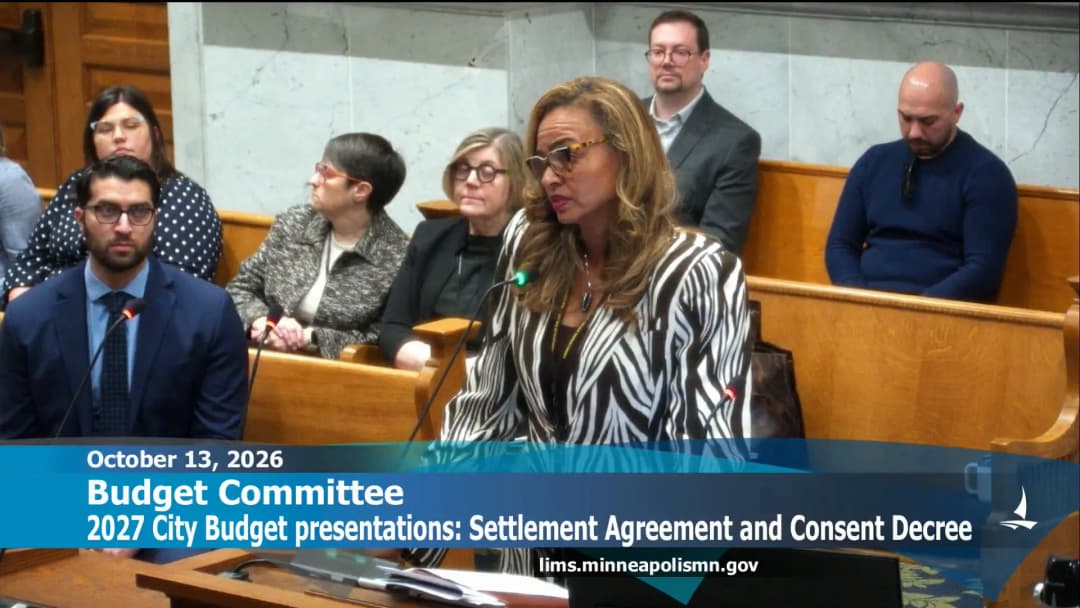
Minneapolis Budget Committee Reviews 2027 HR Budget and Settlement Agreement Work, October 13, 2026

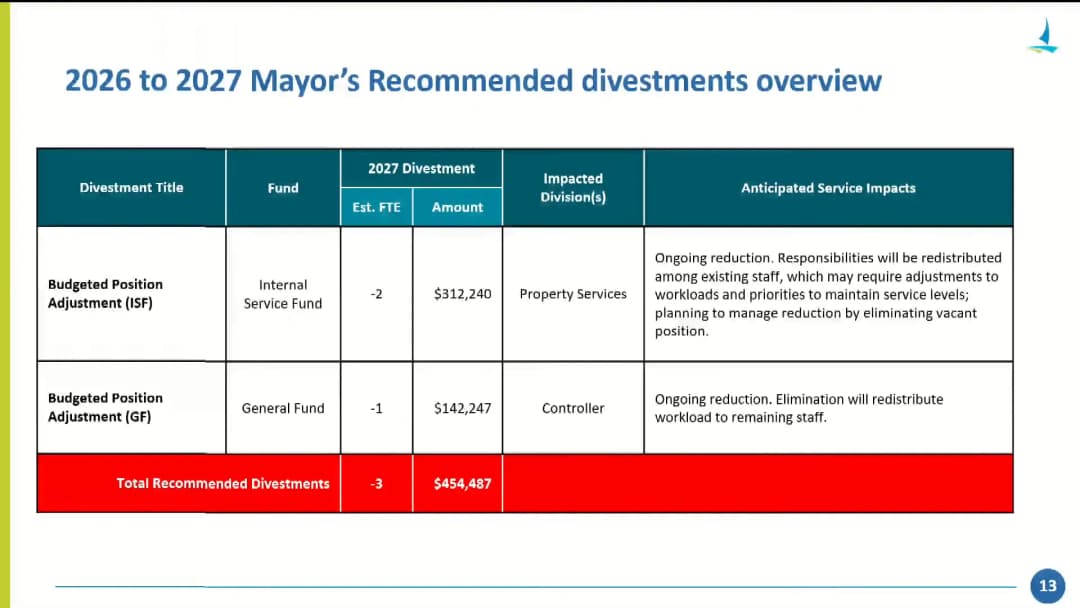
The Minneapolis City Council Budget Committee met on Tuesday, October 13, 2026, with Chair Aisha Chugtai presiding. A quorum was confirmed after roll call. The committee received two staff presentations: the mayor's recommended 2027 Human Resources department budget and a financial review of settlement agreement/consent decree work related to the Minneapolis Police Department. No formal votes were taken; both presentations were filed. A technology improvement plan presentation was rescheduled to the afternoon of October 26. The committee adjourned until Monday, October 19, 2026, at 6:05 p.m. for the second public hearing on the 2027 budget. Human Resources Department 2027 Recommended Budget Chief Human Resources Officer Nikki Odom presented the mayor's recommended 2027 HR budget. The recommended 2027 operating budget is approximately $11.2 million; recommended 2027 expenses total approximately $11.24 million, compared with $11.45 million in the 2026 adopted budget, a decrease of about $203,000. The recommendation removes six positions and approximately $899,000 from HR, representing six of 62 positions, or roughly one-tenth of the department. Revenue is unchanged from 2026 and includes partner-agency contributions supporting Urban Scholars. The budget also includes about $2.3 million in fringe benefits and about $1.7 million in contractual services. Odom reported that HR turnover has fallen from about 40% when she started to about 4%, and the city's overall turnover rate is 8%. The share of separations involving BIPOC employees fell from 56% in 2025 to 44% in 2026, a 12-percentage-point decrease. She noted recognition including the 2026 Finance and Commerce Empowering Women Award, with women holding 45% of executive leadership roles and 50% of director roles, and a state pay equity score that improved by 5% to 97%. Odom said Workday implementation is HR's top 2027 priority; design, architecture, and implementation work will occupy 50%, sometimes 60% or more, of time for many HR staff. Testing is expected to begin around mid-Q2 and continue through at least Q3. With fewer staff, departments should expect longer turnaround times for some requests, and some activities may be deferred. Staffing-reduction placement is not finalized, so division allocations may change. She also said the Racial Equity, Inclusion, and Belonging (REIB) office will move to OPS rather than HR because most REIB work does not align with HR. Council members' questions and positions included: - Councilmember Palmisano asked why REIB was not in the presentation and requested a written list of HR's major contracts. Odom agreed to provide the list. - Councilmember Chavez expressed strong support for Urban Scholars and concern about the program shrinking; Odom said there is a direct correlation between external partnerships and the number of scholars supported. - Councilmember Wita praised the improvements in HR turnover and BIPOC separation rates and asked where the six position cuts would be made; Odom said decisions are close but not finalized. - Vice Chair Schaefer asked about vacancies; Odom said the department has about three vacancies, one when the report was completed, not 14. She clarified that HR business partners are the strategic conduit to departments, with HR representatives in a more operational support role. - Councilmember Chowdhury asked about Workday governance; Odom said the CFO, CHRO, and CIO are project sponsors, supported by a project team of more than 20 people across involved departments and specialties, an external implementation partner, and Workday as the HCM/ERP vendor. The 2028 budget increase to about $11.7 million is driven by salary, rent, and insurance inflation, not new resources. She expected OPS or the CAO's office to notify council about the six FTE decisions next week. - The Chair noted park board data showing city HR costs per FTE of about $11,200 versus the park board's $3,500, within an industry range of $9,000-$14,000; Odom said she could not speculate without knowing what the park board included and offered to investigate. Settlement Agreement and Consent Decree Financial Review Deputy Commissioner of Community Safety Jared Jeffries led a cross-departmental presentation with representatives from the City Attorney's Office, Civil Rights, IT, and MPD. Jennifer Saunders explained that the settlement agreement with the Minnesota Department of Human Rights was issued as a court order on July 13, 2023; it is 144 pages with over 400 paragraphs. Topic areas include non-discriminatory policing, use of force, stops, searches, arrests, citations, body-worn and in-car cameras, training, officer support and wellness, behavioral crisis response, accountability and oversight, and data systems and transparency. The independent evaluator, LIFA (Effective Law Enforcement for All), has issued an updated two-year evaluation plan and semi-annual reports; the court ultimately decides compliance, followed by one- or two-year sustained compliance periods. Ganesha Martin, MPD Bureau Chief of Constitutional Policing, described the reform framework: policy, training, data/technology, audits, and wellness. Over 14 use-of-force policies have been approved, with training effective January 2026 and audits underway. Policies for stops, searches, citations, and arrests have been approved, and training is being developed. The hours-worked policy has been approved but is not yet effective because training has not been delivered; monitoring is being developed because some officers are currently working more than the current limit. Financial highlights: - Most settlement spending comes from the general fund, with a small internal-service-fund portion for IT personnel and services. - Personnel figures reflect FTEs specifically created and funded for the settlement agreement; they do not include staff who split time between settlement and other duties. - Civil Rights expanded its investigator complement from 8 to 11 in 2024. - Contract spending was previously handled through department reimbursement; the 2027 recommendation shifts to a dedicated Finance-held fund. Recommended additions total roughly $4 million: $1.5 million for the LIFA contract, about $2.4 million for ongoing needs such as training, system improvements, and internal affairs supervisory review, and $100,000 in one-time implementation assistance; $3.95 million is recommended as ongoing. - Civil Rights' outside investigator contract, begun in 2024, is expected to close by the end of 2026; total spend by then is about $1 million and outside partners will have completed more than 70 misconduct investigations. The 2027 recommendation includes $386,000 to continue the three in-house investigators added in 2024. - The City Attorney's Office 2027 budget includes $471,000 in personnel and $1.5 million in contractual funding for the LIFA contract. - IT's recommended 2027 budget is just under $511,000 for FTEs focused on data, process, and project management. - Capital work includes the South Minneapolis Community Safety Center, planning for the North Minneapolis Community Safety Center, and facility improvements under the facilities improvement plan. CLIC has recommended $19 million in capital funding through 2030 for a new community safety training and wellness center; 2027 funding supports planning and design. Council members' questions and positions included: - Council President Payne asked how MPD's divestment of 17 non-sworn vacant positions, including seven in constitutional policing and four in professional standards, affects settlement work. Martin said the positions are still being identified. Jeffries said the city contracts out for some training development, misconduct investigations, and certain IT implementations, while aiming to build long-term in-house capacity in internal affairs and the Office of Police Conduct Review (OPCR). - Payne asked about the $100,000 OCS administrative contract; Jeffries confirmed it is an anticipated continuation of the Danny Murphy contract, subject to procurement, for high-level implementation comparison and change management. - Payne said the city has spent about $20 million on implementation over 2023-2025 and that the visible impact so far was four pieces of policy trained on, while acknowledging the staff's hard work. Martin responded that use-of-force policy and training have been significant and that policy, training, and accountability processes are essential baseline work. Payne repeated his ongoing concern about the return on investment. - Vice Chair Schaefer asked whether current technology supports the audit work; Martin said no. The current RMS vendor was assessed as unable to demonstrate compliance, an RFI for a new RMS is underway, and a federal funding request has reached the second tier. More detail is expected at the technology improvement plan presentation on October 26. - Schaefer asked which positions are required by the settlement agreement; Martin said assessments identified a health and wellness director plus an analyst and a program manager. Jeffries said the community safety training/wellness center planning report should be completed by the end of 2026 or early 2027. - Councilmember Palmisano summarized recommended 2027 settlement-related spending as about $5.8 million in capital costs, $5.865 million in personnel, and $4.05 million held by Finance for contracts, totaling about $16 million. Jeffries said this captures most of the settlement-related work, possibly excluding some IT system funds. - Councilmember Chavez said the city is not in alignment with year-one and year-two settlement requirements, called that unacceptable and, in her opinion, out of compliance, and said residents will not receive the police services they deserve. Key Outcomes - No formal votes were taken; both presentations were filed. - HR's 2027 recommended budget with six FTE reductions was presented; final division-level placement is pending, with council notification expected from OPS or the CAO's office next week. - HR will provide a written list of major contracts; Odom will look into the park board per-FTE comparison. - The settlement agreement presentation outlined a recommended shift to a dedicated Finance-held contract fund and continued capital planning for a training/wellness center. - The technology improvement plan presentation is rescheduled to October 26; the committee's next meeting is October 19, 2026, at 6:05 p.m.

BUDGET MANAGEMENT 32% · PUBLIC SAFETY 24% · WORKFORCE DEVELOPMENT 23% · TECHNOLOGY AND INNOVATION 6%
0102
NEXT →
OPENPUBLICA · PUBLIC MEETING INDEXUPDATED DAILY · openpublica.com