HHS Committee Update on Minority Health Initiatives Programs - March 5, 2026
STREAMING COPY IN PREPARATION — RECORDING AVAILABLE FROM THE ORIGINAL SOURCE
HHS Committee Update on Minority Health Initiatives Programs - March 5, 2026
The Health and Human Services Committee met on March 5, 2026, from 1:05 p.m. to 2:52 p.m. to receive an update on the Minority Health Initiatives Programs (MHIPs), including the African American Health Program (AAHP), Latino Health Initiative (LHI), and Asian American Health Initiative (AAHI). Committee members discussed programmatic achievements, challenges, data evaluation, and future budget priorities.
Discussion Items
- Presentation Overview: Dr. Davis, Health Officer, provided opening remarks, highlighting that the three initiatives have been in place for over 20 years and were critical during COVID-19 for reaching diverse communities. She noted that Montgomery County is one of the most diverse counties in the nation, with no single racial or ethnic group making up a majority.
- Latino Health Initiative (LHI): Senior Manager Mariana Serrani presented LHI's mission, six priority areas, and 14 programs. She highlighted the Welcome Back Center training international healthcare providers, the Parents in Action program (now focusing on elementary school parents after starting in high school), and the climate and health initiative. LHI reported 850–900 community events per year and a digital newsletter with 1,800 subscribers. Budget: $6.2 million appropriated for FY26. Remaining budget: 50–60% expended; on track to spend all funds by June 30.
- African American Health Program (AAHP): Program Manager Wine Dixon described AAHP's focus on eliminating health disparities affecting Black residents. Key programs include the SMILE maternal infant health program (home visiting), diabetes prevention (CDC Gold Star designation), remote patient monitoring, and sickle cell awareness. AAHP reported 6% average weight reduction in programs, more than 3,000 community referrals in FY25, and expanded services to French, Haitian Creole, and other diaspora communities. Budget: $4.3 million for FY26. Remaining contract budget: 41%.
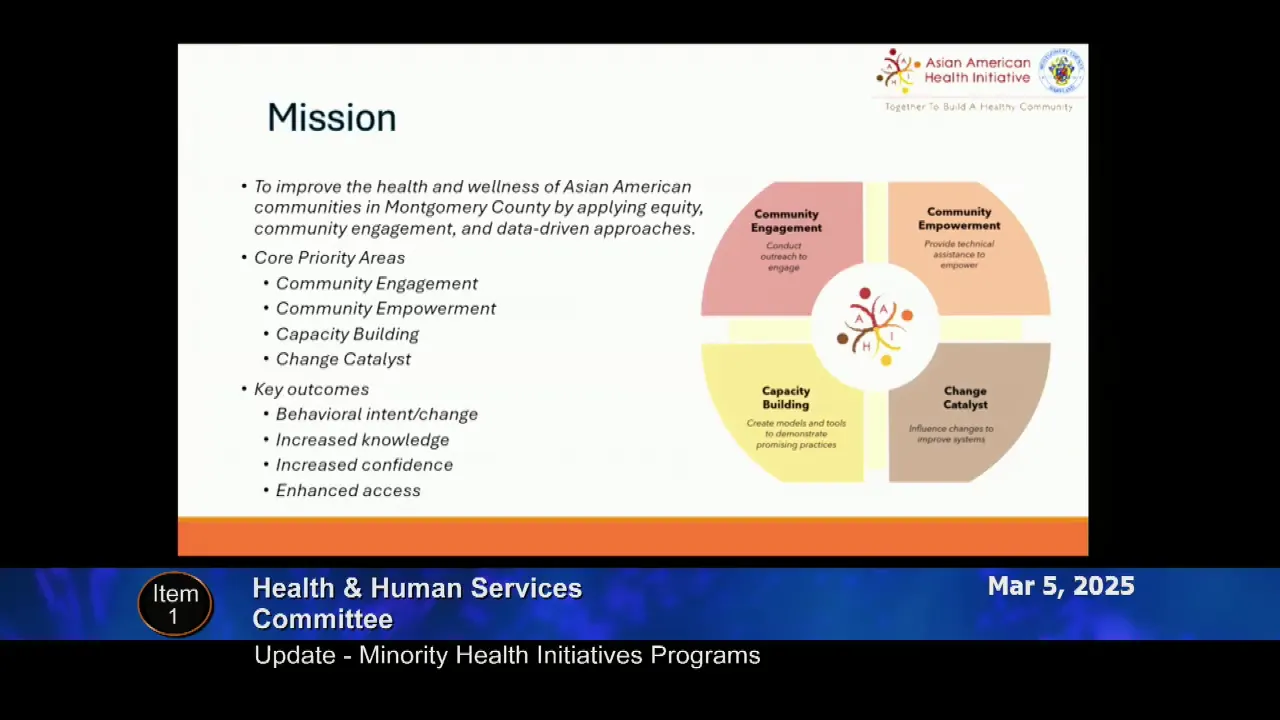
- Asian American Health Initiative (AAHI): Program Manager Mohammed Hasan presented AAHI's two-pronged approach: direct outreach to residents and capacity building for community organizations. He emphasized the model minority myth and the need for disaggregated data. AAHI highlighted the Asian American Center of Excellence (ACE) microgrants ($101,000 pool, up to $15,000 per organization) and the Healthy Communities Fund ($4 million requested by 37 applicants, 16 awarded). Budget: $3.7 million for FY26. Remaining funding: 90% committed through grants; 10% unallocated.
- Committee Feedback: Chair Sayles and Councilmembers Friedson and Luedtke stressed the need for better performance metrics beyond simplistic data collection. Councilmember Friedson urged developing disaggregated, program-specific metrics with clear performance targets, comparing county trends to national trends to evaluate impact. Chair Sayles emphasized the importance of qualitative impacts and kinship relationships among program participants (e.g., multiple household members in different programs). Councilmember Luedtke raised concerns about immigration fears reducing engagement, particularly for home visiting programs like SMILE, and asked about adaptive strategies (e.g., virtual visits, word-of-mouth promotion, avoiding publicizing event locations).
- Challenges Identified: Immigration fears are causing reduced in-person participation and a shift to telephone/SMS communication. Barriers to virtual services (telehealth, digital literacy) remain significant. The committee noted that mental health stigma is decreasing but demand is rising. The upcoming expiration of LHI's 10-year blueprint (end of 2026) requires a new needs assessment.
Key Outcomes
- Committee members recommended that DHHS develop a standardized but program-specific performance evaluation framework with clear metrics, disaggregated data, and comparative analysis (e.g., national trends) to better assess impact and guide budget decisions.
- Dr. Davis committed to working collectively across the three initiatives to align data collection and evaluation, leveraging the new structural connection to the health officer and access to epidemiologists.
- The committee acknowledged the programs' strengths: cultural competency, community trust, and innovative responses to emerging needs (e.g., mental health, climate health, substance use prevention).
- No formal votes were taken; the update was informational. The next discussion on MHIPs will occur during the FY27 budget review after the county executive's budget release on March 13 (or 15), 2026.
- Staff were encouraged to continue collaborating with the Office of Community Partnerships and other county agencies to address immigration-related barriers and maintain community trust.
Meeting Transcript
Good afternoon, and thank you so much for our guests today. Just briefly going over the staff report that this is an update on the Minority Health Initiative programs. We will discuss the minority health initiatives next month during budget when the budget is released on March 13th, 15th, whatever date. So the report just highlights the work of the three initiatives the African American Health Program, the Latino Health Initiative, and the Asian American Health Initiative. I just want to note that that uh initiatives have been in place for a 20 plus years, responding to the needs in the community when we think about uh things that have had occurred like during COVID 19, um, the Affordable Care Act and supporting our immigrant community that the health initiatives have really health initiatives and programs have really been on the forefront of trying to support community members. I know our uh department has a robust presentation, so I will let them get started, and I can address any questions. Thank you. All right, thank you for the opportunity to be here. Good afternoon. Um I'm here to brief you today on what we have collectively called the minority health initiatives and programs, but I will say I do not love that name in that in the grouping. We are really here to talk about the African American Health Program, the Asian American Health Initiative, and Latino Health Initiative. Montgomery County is one of the most diverse counties in the nation. In fact, collectively, our Asian Black and Latino communities make up the majority of the county's population. So the term minority does not fully reflect the reality here in Montgomery County. In MOCO, no single racial or ethnic group makes up a majority. Instead, we have a truly multicultural community, and I'm going to go through some of the statistics of that today. Today I will share how these initiatives work, the communities that they serve, and why their continued partnership with the county is essential to improving health and well-being for all residents. We have the Latino Health Initiative. And our vision is a thriving, empowered, and healthy community in Montgomery County where all residents have equitable access to opportunities, resources, and conditions that support their overall well-being. Just a little brief background. Each of these programs, they sprung up in the late 90s, early 2000s. AAHP was launched in 1999 to address the disproportionate health inequities affecting African Americans. LHI followed just one year later in 2000, focusing on health, language, economic, and workforce barriers impacting Latino residents, and AAHI came to fruition in 2005, the first county program directed to the unique health needs of the Asian American communities. Each of these programs and initiatives sits within the Department of Health and Human Services. Each of them has an executive steering committee, which is an independent group of volunteers. And we'll go a little bit more into what those steering committees are comprised of. So collectively, the executive steering committees for these programs and initiatives serve as critical bridges between the Montgomery County community and the Department of Health and Human Services. They are comprised of community leaders, professionals, and advocates. These volunteers, and they are volunteers, unpaid bodies, provide strategic guidance, technical expertise, and community insight to ensure that each initiative remains responsive to the needs of the populations that it serves. They help shape priorities, inform design, and promote data-informed approaches that advance prevention, wellness, and health equity. In addition, the committee committees play an important advocacy role in elevating community concerns and supporting efforts to secure the resources and partnerships needed to improve health outcomes. Through this collaborative relationship, the steering committees strengthen the connection between DHHS and the communities we serve, helping to ensure that the programs are community informed, culturally responsive, and align with the county's broader commitment to health equity. They are quite literally the eyes and ears and hearts and hands in the community. Each one is unique and structured to meet the needs of their respective communities, and each one plays a vital role in ensuring that the work of DHHS remains grounded in community voice, guided by lived experience, and focused on advancing equitable health and well-being for the populations that they serve. Just to see where they sit within the Department of Health and Human Services, you will see at the top the director. Each of these programs and initiatives sits within the office of the director with oversight from myself as chief health officer and collaboration with the chief administrative officer. You will also see at the bottom public health services. The Black Physicians Health Care Network sits within public health services with a dotted line over to AHP. We will not be spending much time talking about BPHN today as they are a separate service area and structured quite differently from these programs. As you can see, the African American Health Program in FY26 was appropriated 4.3 million dollars, Asian American Health Initiative $3.7 million, and the Latino Health Initiative $6.2 million. BPHN was also appropriated $3.6 million, and again, that is administered through public health services. In the last 36 years, we have seen the black population increase by 58% from 12% to 19%. And you can see the areas of where that demographic shift has occurred within the county. We also see it's important to recognize that none of these communities is a monolith. And as we see diversity in the county overall, we also see diversity increasing within each of these racial and ethnic groups. And so for our Black and African American population, 56% of them are native-born black, but then we also see about 36% from sub-Saharan Africa and about 8% from the Caribbean. For our sorry, I didn't advance that. Our Asian and Pacific Islander population has seen almost doubled, see an 87% increase in that same time frame, and you can also see where those shifts have happened across the county. And you can also see the breakdown within that community. Similarly, for our Hispanic population, we've seen them triple over that same time period, and you can see across the county where that diversity lies.
openpublica.com