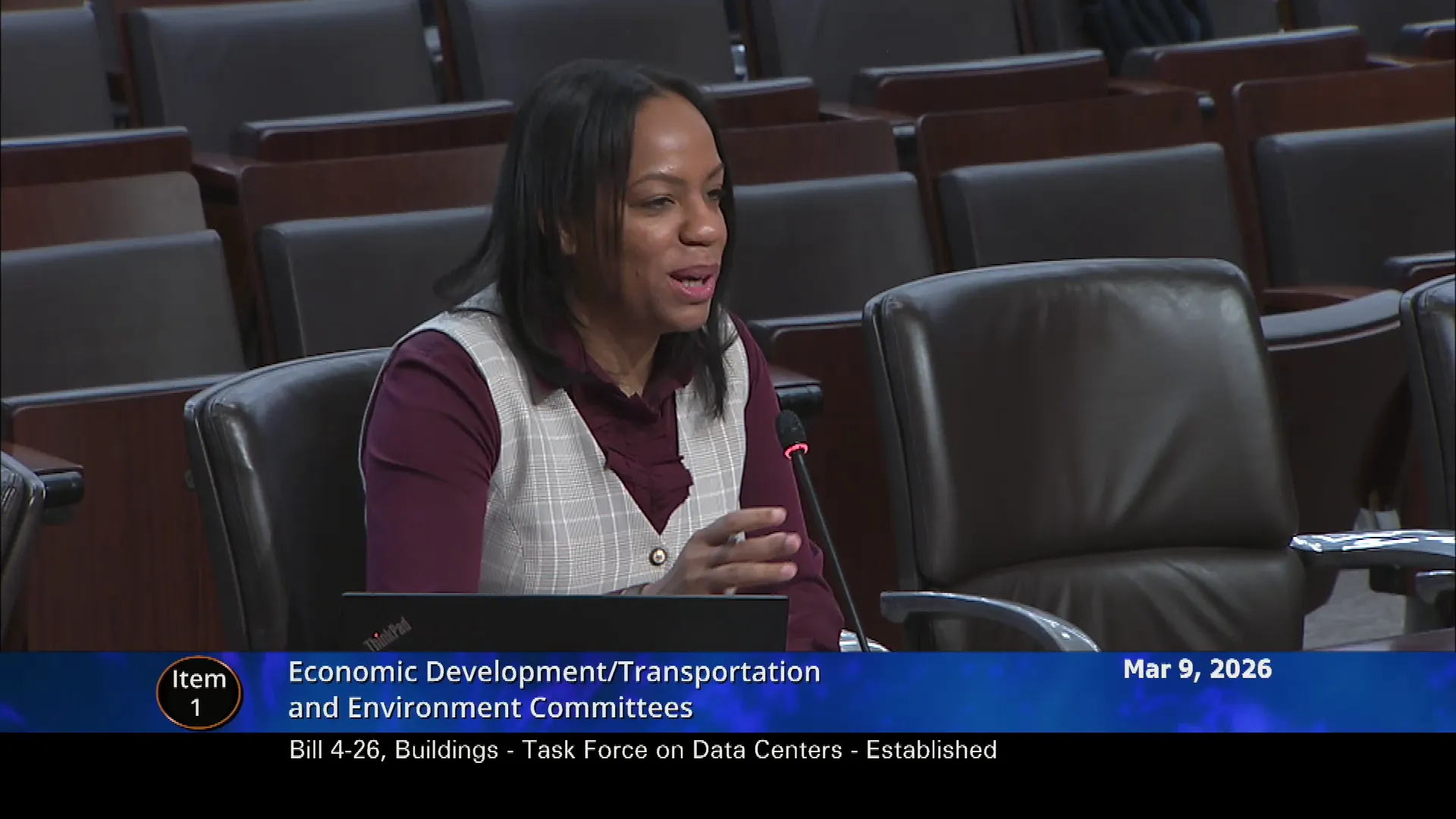
Joint ECON/TE Committee Meeting on Bill 4-26 (Data Center Task Force) – March 9, 2026
STREAMING COPY IN PREPARATION — RECORDING AVAILABLE FROM THE ORIGINAL SOURCE
Joint ECON/TE Committee Meeting on Bill 4-26: Task Force on Data Centers – March 9, 2026
This joint meeting of the Economic Development and Transportation & Environment Committees considered Bill 4-26, which would establish a task force to study data center development in Montgomery County. The meeting ran from 9:30 a.m. to 10:46 a.m. in the 3rd Floor Council Hearing Room. After extensive debate and several amendments, the committee voted 3-2 against recommending enactment of the bill. A separate motion for a temporary moratorium on data center approvals was also defeated.
Discussion Items
- Bill 4-26 – Buildings – Task Force on Data Centers – Established (introduced by Councilmember Glass): The proposed 15-member task force would have studied economic, environmental, and community impacts of data centers, with a report due in one year. Chair Glass later shortened the timeline to six months during discussion.
- Amendments Adopted (all without objection):
- Glass Amendment 1: Expanded the task force from 15 to 16 voting members by adding the Montgomery County Public Health Officer (or designee) and clarified that civic association and environmental group members must be Montgomery County residents.
- Glass Amendment 2 (modified): Required the task force report to consider recommendations from the Maryland Department of Legislative Services’ data center impact analysis – but added the phrase “if feasible” to avoid delaying the task force’s work. Also required the report to include an analysis of and policy recommendations on climate goals (removing the specific quantitative assessment subcomponent after concerns about feasibility).
- Stewart Amendment: Explicitly added noise as a required part of the environmental impact study and directed the task force to review emerging technological advancements that mitigate noise, water, air, and energy impacts.
- Sayles Amendment: Required that one task force member have expertise in racial equity and social justice.
- Technical Amendment: Clarified that the task force must propose a definition of “data center” specific to the county; if the definition differs from the bill’s placeholder, the task force must provide a rationale. (Councilmember Luedtke suggested adding “proposed” before “definition,” which was accepted.)
- Moratorium Motion (Defeated): Chair Glass moved to impose a temporary pause (six-month moratorium) on data center approvals while the task force worked. Councilmember Fani-González declined to second, stating the matter should come as a separate bill with a public hearing. The motion died for lack of a second.
- Positions on Bill 4-26:
- Chair Glass (TE) and Councilmember Stewart (TE) supported the task force, arguing it would ensure transparent, fact-based policy and protect climate goals.
- Council Vice President Balcombe (ECON) opposed, noting that extensive stakeholder engagement and analysis were already underway via ZTA 2601, an OLO report, and state legislation; she called the task force redundant and potentially delaying.
- Council President Fani-González (ECON) and Councilmember Sayles (ECON) opposed, emphasizing that the ZTA was the appropriate vehicle and that a task force would duplicate existing work.
- Councilmember Luedtke (present but not a voting member) offered procedural suggestions but did not vote.
Key Outcomes
- All four amendments were approved unanimously (without objection).
- The motion for a temporary moratorium was defeated (no second).
- Bill 4-26 was defeated on a 3-2 vote (in favor: Glass, Stewart; opposed: Balcombe, Fani-González, Sayles). The committee did not recommend enactment to the full Council.
- The meeting adjourned at 10:46 a.m.
Meeting Transcript
Good morning. It is Monday, March 9th. Hope everybody's clocks woke them up at the appropriate time. This is a joint committee of the Transportation and Environment and Economic Development Committees. We have one item as a joint committee today, and then the TE committee will take up a second item immediately after. But that first item is Bill 426 task force on data centers established. This is a bill that I introduced because Montgomery County deserves to have a transparent and structured process for evaluating data center proposals. There are a lot of conversations in the community across the entire county, and residents have questions. And we need to be able to answer those questions. And I think the best way to do that is by having that transparent process that brings residents, experts, environmental advocates, business leaders, utilities and others to the table to talk about the data center proposals, to talk about how we want to structure this and to talk about what the future Montgomery County, quite frankly, looks like. Data centers raise serious questions about land and water use and about energy consumption, about noise, about environmental impacts, and long-term economic outcomes as well. All of those things are true. And this task force will allow our own community, Montgomery County stakeholders, to evaluate and examine these issues in a very comprehensive way. By bringing together experts and community leaders, I believe that we can put together a policy that is guided by facts, by science, by lived experience, by uh economic expectations because it is essential to think of this holistically, not as a piecemeal approach, not as a uh piecemeal proposal. Um and that means taking the time to ask very hard questions and to do the same thing that other jurisdictions have done. We've seen what is happening across the river in Loudoun County, and there is near universal, if not total universal agreement that we don't want that here. At the same time, we see other neighboring jurisdictions that have undertaken their own task forces, recognizing that Frederick County and Prince George's County are unique communities, all unto themselves, as is Montgomery County. So I think we should have that same process here. Um and let me just be very clear that this task force is about doing our due diligence and establishing a well-understood data-driven approach and framework for the path forward. Um so I look forward to this conversation. It's gonna be a very substantive conversation, and I'll turn it over to uh our co-chair, Council President Fonigonzales. Thank you so much to Chair Evan Glass and to everybody who came to here today. Data centers is a really hot topic and a very important one. I am glad in a feel very honored to have worked with the county executive steen and I see Ms. Sarah Culger's hunter. There you go. Two there you go. Uh joining us today. And at some point I would love for you to come forward. Um we have been working, and when I say we I specifically talk about Council Vice President, Marilyn Balcon and Councilmember Laurie and Sales uh with the county executive team analyzing and examining different jurisdictions uh in the Washington DC, especially in the Washington DC region, how they have handle uh data centers and what lessons to take out of that. Um that's why we have another proposal that is gonna be reviewed in the PHP committees, a ZTA on data centers about restricting the locations of where they're located. Um so we'll take that later on, most likely after the budget. We have time. Um I have maybe for I even come forward and say my views on this particular bill. I think it's better if we can ask staff to go over the bill and at some point ask the county executives um staff to come forward and explain all the work that they have done on this particular issue already to give us data. So that's it. Thank you. Uh thank you, Madam Co-Chair for that. Uh Ms. Kogel Smucker, if you want to come up or prepare yourself, uh clearly your input will be uh welcomed in a few moments. Uh short of any other comments that colleagues might have, Ms. McCartney Green, uh I'll turn it over to you to walk us through the packet. Thank you, and good morning. Um as mentioned, uh the purpose of the bill is to explore um the benefits and potential economic and environmental impacts of data center development in the county. Just to frame this conversation, um, included a little bit of background explaining the current process right now. Uh a developer or applicant who is required to um would like a permit issued for a data center. Uh there's no specific definition right now in our zoning code or in our county code. Um and so right now it's classified as a cable communication system. That's the use. Not going to go too far into zoning, but I just want to point that out there.
openpublica.com