Public Safety Committee Meeting on Police Staffing and Accountability Board Report - March 16, 2026
STREAMING COPY IN PREPARATION — RECORDING AVAILABLE FROM THE ORIGINAL SOURCE
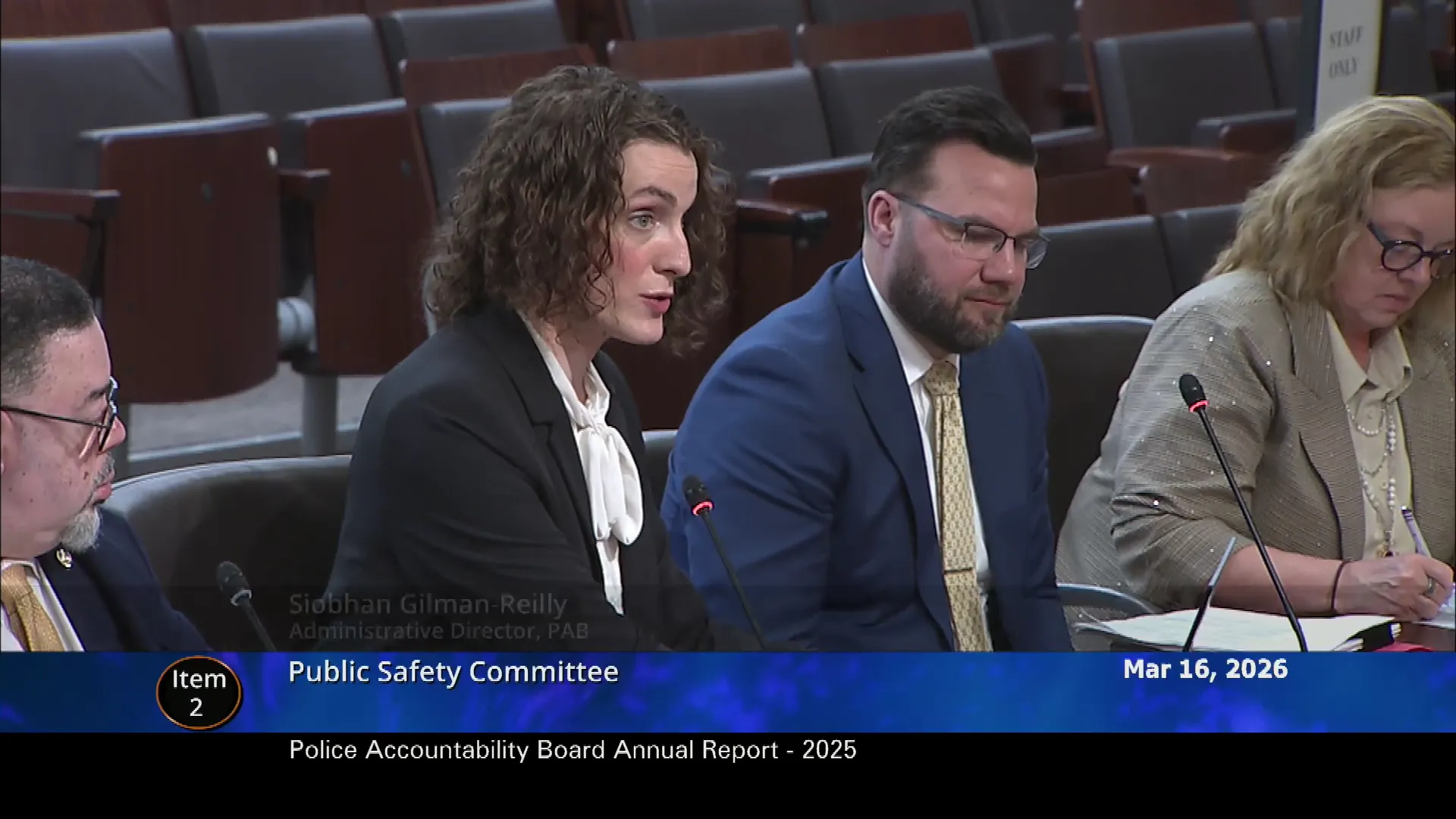
Public Safety Committee Meeting on Police Staffing and Accountability Board Report - March 16, 2026\n\nThe Montgomery County Public Safety Committee met on March 16, 2026, from 9:30 a.m. to 11:49 a.m. to discuss two major agenda items: an update on police staffing, including a patrol workload analysis and an investigative services bureau staffing study, and the Police Accountability Board's 2025 Annual Report. The meeting was recessed from 9:43 a.m. to 10:00 a.m. due to technical difficulties with the audio-video system. Councilmembers Sidney Katz (Chair), Dawn Luedtke, and Kristin Mink were present.\n\n### Discussion Items: Police Staffing Update\n- Patrol Workload Analysis (Corona Solutions): Chief Yamada presented the newly received 350-page patrol analysis based on one year of CAD data, noting it had not yet undergone internal review. Key findings: countywide emergency response time average of 6.7 minutes (75% under 7.92 min, 90% under 11.47 min); non-emergency response times peaked at 36 minutes on Fridays; busiest day is Friday with ~445 calls; 457 hours per week of officer holdovers; theft-related calls (6.8% of patrol time) and suspicious person calls (6.3%) were top workload drivers. High-activity locations included Picard Drive (crisis center), Green Tree Road (juvenile home), Progress Place, Westfield Montgomery Mall, Milestone Shopping Center, and RICA. The next phase will include recommendations on boundary changes, shift adjustments, and civilian response teams. \n- Investigative Services Bureau (ISB) Staffing Study (PFM): PFM consultants Seth Williams, Ron Serpas, Eric Melancon, and Lika Janssen presented the final study. The study recommended adding 41 authorized positions (24 sworn, 17 professional staff) across CID, Major Crimes, Special Victims, and Criminal Enterprise sections. The total gap from April 2025 filled levels was 91 positions (including 47 vacancies). The methodology used 60-day activity logs, surveys, and interviews. Key recommendations: phased staffing approach, investment in professional staff (crime analysts, civilian investigators), and improved data management (RMS/case management systems). A case management system is included in the FY27 budget. Detective sergeants often perform detective work due to staffing shortages, impacting supervision. \n- Discussion by Committee Members: Councilmembers focused on recruitment and retention challenges, noting the difficulty of filling vacancies. Assistant Chief Parker-Loin reported ISB vacancies increased from 47 (April 2025) to 58. The need for a 5-year DROP program was raised. Concerns about hospital guard details and parking enforcement detracting from patrol resources were discussed. \n\n### Discussion Items: Police Accountability Board Annual Report 2025\n- Presentation by PAB and ACC: Bishop Walker (Chair), Dr. Lluberes (Vice Chair), Richard Rosano (Member), Christopher Jennison (ACC Chair), and Siobhan Gilman-Reilly (Administrative Director) presented the report. The report analyzed 434 allegations, with 80% concentrated in five categories: conformance to law/policy, unprofessional conduct, bias/discrimination, use of force, and specific duty violations. Key recommendations: improve information flow from LEAs to ACC to PAB (written ACC decisions and trial board outcomes), standardize complaint forms across LEAs, collect non-identifying aggregate officer data, and increase dedicated staff (requested a research/data specialist at grade N20). \n- Discussion: Councilmembers noted that the PAB is not receiving enough data from ACC to fulfill statutory mandates, particularly the reasoning behind ACC decisions. The PAB confirmed they lack information to conduct trend analysis or track repeat officer complaints. Discussion on whether changes require state law (MPAA) or county law. Councilmember Luedtke emphasized that recommendations should be based on founded allegations, not total complaints. The PAB and ACC noted that while some LEAs are cooperative, standardized data collection is not mandated. \n- Trial Board Update: Captain Brian Merriman (MCPD Internal Affairs) reported that four trial boards have been held since the new system was implemented. Gaithersburg PD had three requests, one completed; Takoma Park PD had one completed trial board with a penalty reduction. Several cases remain pending. \n\n### Key Outcomes\n- Police Staffing: The Committee will schedule a follow-up worksession after the final patrol analysis report is released and internally reviewed (expected in 3-4 months). The committee requested that the next update include a breakdown of 1st District response times excluding crisis center calls, and progress on the retired officer program and hospital guard detail reforms. \n- Police Accountability Board: The Committee agreed to a follow-up worksession in June 2026, with the PAB Annual Report as the sole agenda item. The session will include a detailed presentation on the report's findings and recommendations, as well as an update on data sharing challenges and progress on standardizing complaint forms. The Committee emphasized the need to resolve data access issues before the next meeting. The PAB will report on its discussions with LEAs at the May 21st quarterly meeting.
Meeting Transcript
Well, good morning, everyone, and welcome to the Public Safety Committee work session of Monday, March 16th, 2026. Today we have two topics on the agenda. The first one is an update on police staffing. The second is a the uh police accountability board annual report for 2025. As we begin, I'd like to thank Ms. Farog for preparing the staff reports for the day for the topics today, and for once again and always assembling most informative packets for us. And unless the other committee members have any uh opening comments, I'm gonna ask the panel to please introduce themselves and ask if they have any opening comments, and then ask Ms. Verog to walk us through the discussions. Because of all the weather, it's certainly, I guess, all of our desire, though there's committee meetings this afternoon as well, uh, to be finished this one by around before noon, so that uh people can be off the roads if it's necessary uh if possible. And with that, do any of you, either of you. No. Uh with the panel please introduce themselves. Willie Parker Lone, Assistant Chief of Police, Chief of the Investigative Services Bureau. Assistant Chief Nicholas Ogson, Chief of Management Services Bureau. And Mark Yamada, Chief of Montgomery County Police Department. Did you have any opening? I did. Thank you. Good morning, Chief Committee. Uh the committee received the patrol staffing analysis that was uh provided by Corona Solutions, who uh worked with us as an independent consultant. Um the report was recently provided uh to us after it was finalized, and yes, I understand it's 350 pages, so I apologize in advance. Uh the report reflects a detailed analysis over a one-year period that is based exclusively on our CAD data or computed computer aided dispatch uh data. Ordinarily, the final version would undergo a full um internal review by MCPD commanders, their staff, the executives team, and the FOP before being shared with council and subsequently included in any public-facing uh council packet. However, that internal review has not been completed yet. We just got this uh late last week. Um that said, it remains likely that the reviewers, when we do take a look at this more closely, will identify areas that require clarification, uh refinement, and even further examination. Um it is important, as I said, to recognize this report was the work work product of an independent consultant, uh similar to the PFM analysis on the investigative workload. Um it may not employ MCPD's internal technology uh internal terminology or fully reflect the perspectives of our uh experienced leadership team. It's an analytical tool that we intend to use to support my team and I in evaluating operations, identifying areas for improvement, um, and making that informed data-driven decisions uh that we all um desire. Um this entire process has already highlighted several subjects that matter uh uh that merit additional analysis attention and procedural adjustment as we continue to move forward in this process. Uh the report therefore should not be viewed as the conclusion. I know it's been a long time, uh, but rather this is definitely first steps and a big step for us. Um district commanders um have been asked to review the data uh in order to identify follow-up questions, uh priority focus areas and potential operational adjustments. Um, the level of detail included in this report was needed. Uh we recognize that, but we're all actively working through how to fully digest what's inside. Um as you can see, the report includes a countywide analysis followed by detailed sections for each of our six patrol districts. Um a few things were noted during our initial review. Uh those are that emergency response times remain strong overall, uh, though some districts experience fluctuations during certain days and times, just like we expected. Um geography and time of day also influence our performance in those areas. And non-emergency response times uh reveal predictable increases during certain days and times that we will continue to evaluate. Um there are also several uh call types and specific locations with within each district that consume a disproportionate amount of patrol time and resources. Uh those areas in the first district are Picard Drive, which is the crisis center, um, Green Tree Road, which is the juvenile placement home in 2D, uh Progress Place downtown Silver Spring in 3D, um, uh Westfield Montgomery Mall in 4D, Milestone Shopping Center, specifically Walmart up in uh 5D, and RICA in our 6th district. Um I don't think those areas come as any surprise to anyone. Um each commander will use this information to make better informed decisions and implement implement more effective planning and deployment as we move forward. Uh Corona Solutions will now begin to focus on recommendations to enhance patrol response. We've also asked them to identify potential adjustments to our district boundaries, as we discussed before, uh, to better balance workload as well as an analysis of how additional staffing, both sworn and professional could help reduce our response times and our effectiveness. We also have uh preliminary plan for implementing a civilian response services team. Uh that name is in flux right now. Uh and we'll share those plans as we begin to get closer to finalizing them. Uh we can also uh emphasize uh can't emphasize strongly enough that this is an ongoing flexible process and that this report reflects a single single snapshot within a much broader comprehensive operational overview.
openpublica.com