Joint ECON/HHS Committee Work Session on Bill 1-26 - March 19, 2026
STREAMING COPY IN PREPARATION — RECORDING AVAILABLE FROM THE ORIGINAL SOURCE
Joint ECON/HHS Committee Work Session on Bill 1-26 - March 19, 2026
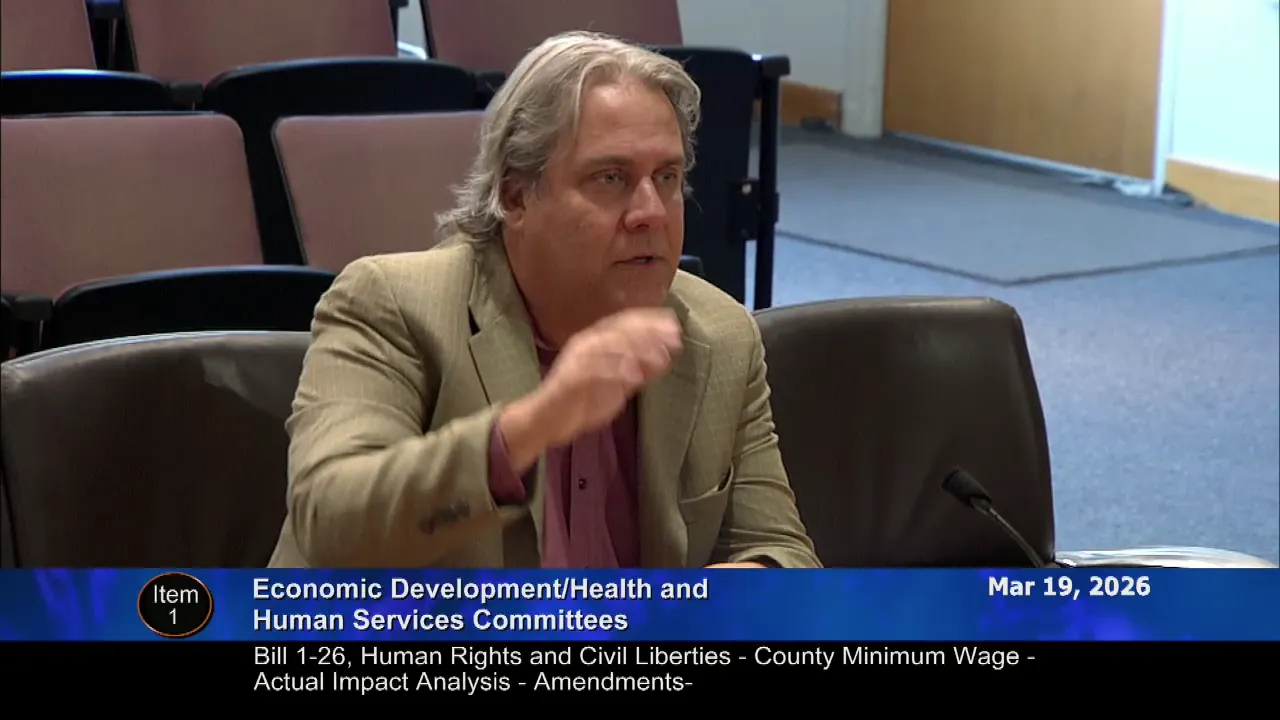
The Economic Development (ECON) and Health and Human Services (HHS) Committees met jointly on March 19, 2026, from 1:30 p.m. to 1:36 p.m. to consider Bill 1-26, which would remove the requirement for the Office of Legislative Oversight (OLO) to produce an annual report on the impact of the county minimum wage. The committees voted unanimously to recommend enactment of the bill as introduced.
Discussion Items
- Bill 1-26, Human Rights and Civil Liberties - County Minimum Wage - Actual Impact Analysis - Amendments
- Councilmember Fani-González (ECON Chair) explained the bill is a technical change to eliminate a reporting requirement that is no longer useful. The original report was intended to track economic impacts of the minimum wage increase, comparing Montgomery County to other jurisdictions.
- OLO Director Cihlar and Senior Legislative Analyst Trombka provided additional context: two main reasons for the change are (1) the state of Maryland has revised its minimum wage law, making county-to-county comparisons less relevant, and (2) the federal government has stopped reporting several data points used in the report, making trend analysis impossible. The report consumes significant staff time for little use, as it has not been discussed with council members or the public in recent years.
- Councilmember Sayles (HHS Chair) expressed support, noting that OLO should focus on more pressing fiscal and economic priorities, especially given federal data gaps. She also mentioned the county's reliance on quarterly reports from the Economic Development Corporation.
- No public testimony was received.
Key Outcomes
- Motion: Councillmember Luedtke moved to approve Bill 1-26 as described; seconded by Councilmember Friedson. The motion passed unanimously (all members present voting in favor).
- Next Step: Council action is tentatively scheduled for April 7, 2026.
- The fiscal impact statement noted no anticipated net effect, with a possible de minimis decrease in OLO workload.
Meeting Transcript
I'm chair of the economic development committee, and this is a joint committee work session with the Health and Human Services Committee. I'm gonna turn it uh in a second to my co-chair. This is our first um joint committee work session with you as a chair. Yeah, I love it. Um so the reason of this um meeting is on bill one-26. Human rights and civil liberties counting minimum wage, actual impact analysis amendments. We are not doing anything to change the minimum wage. It's just about certain requirements that at this point it's they're not useful anymore. And I'm gonna ask uh staff from OLO to come forward and perhaps also explain the need of this uh technical change. I'm gonna call it. Uh, before we do that, I'm gonna turn it to my co-chair, uh Lorian Sales. Oh, Andrew arrived. I didn't even see you. Okay, go ahead. All right. So there's no no uh I think it's working because there's no light on so in case. Yeah, go ahead. Just in case I will use this. Hopefully, they will hope the work. Thank you, Council President Fonny Gonzalez, and uh thank you for introducing the legislation. I think we have uh better things for our Office of Legislative Oversight to uh contend with in thinking about the fiscal and economic priorities of the county, and so I think this was timely legislation. I was happy to support it and uh look forward to um the discussion and seeing how we are going to move forward uh given uh the federal government's uh decisions to uh stop providing or eliminating information from their website that's making it harder for us to predict and understand um economic decisions, but grateful for the uh economic development corporation that we get their quarterly reports, and so um looking forward to working with you all to see how we can better predict uh fiscal decisions and economic outcomes for our residents as we move forward. Thank you. Thank you so much. And uh before I turn it to staff, we the whole idea of the bill is to remove the requirement that the OLO office provides an annual report regarding the implementation of the county minimum wage in the local economy. Uh, if we can turn it to council staff for anything else that they need to add, and then we can have um to ex to explain why this is important to do. I would just note that the uh the only impact statement because OLO did not take uh position because it affected OLO. The only impact statement was was the fiscal impact statement. There is no anticipated effect, presumably there's a slight decrease, but um it would be de minimis, and there were no relevant um speakers and the public from OLO. Um so this um report that we were required to do annually was passed when they passed the increase in the minimum wage. Um things there's two real reasons to get rid of it. I mean, the first is that the state has now changed their minimum law, and so comparing us in a trend line, which is what the report does, to other jurisdictions around here is kind of not really necessarily relevant. Um second, the federal government has stopped reporting um a number of data points, four of which were included in here, so we can no longer do trend lines on those. Um the original purpose was basically to show as the minimum wage um bill was passed. We wanted to see if there was an economic impact that was negatively affecting county businesses. Um so we developed a set of indicators that we compared to other jurisdictions. And the idea behind it was that if there was a trend line that we were kind of going neutral and everything else was going up or we were going down and everything else was going up or vice versa. Um we would be able to be kind of at a first look, say oh, maybe we need to look a little bit more into why um the uh the data is tracking the way it is. Uh and so that was you know, it was done um under good intentions, and I think it was useful for the first couple years, but at this point, given the changes in the minimum law, minimum wage law in the state, and the way that the federal government reports stuff. We spent a lot of time on the report. Um I can't remember the last time we actually talked about it with um a council member or the member of the public. Um and it's it's just something that we spend a good amount of time for very little use given the changes in um both the local government situation and also the federal change to um publishing data. Is there anything you want to say? Nothing to that. Well, thank you for that explanation. Does anybody have any questions? No. Okay, so I do want to have a motion. Uh can I get a motion to approve Bill 1-26, human rights and civil liberties, county minimum wage, actual impact analysis amendments as described today. Moved.
openpublica.com