Joint EC/GO Committee Meeting on Bill 10-26 and Supplemental Appropriation - March 19, 2026
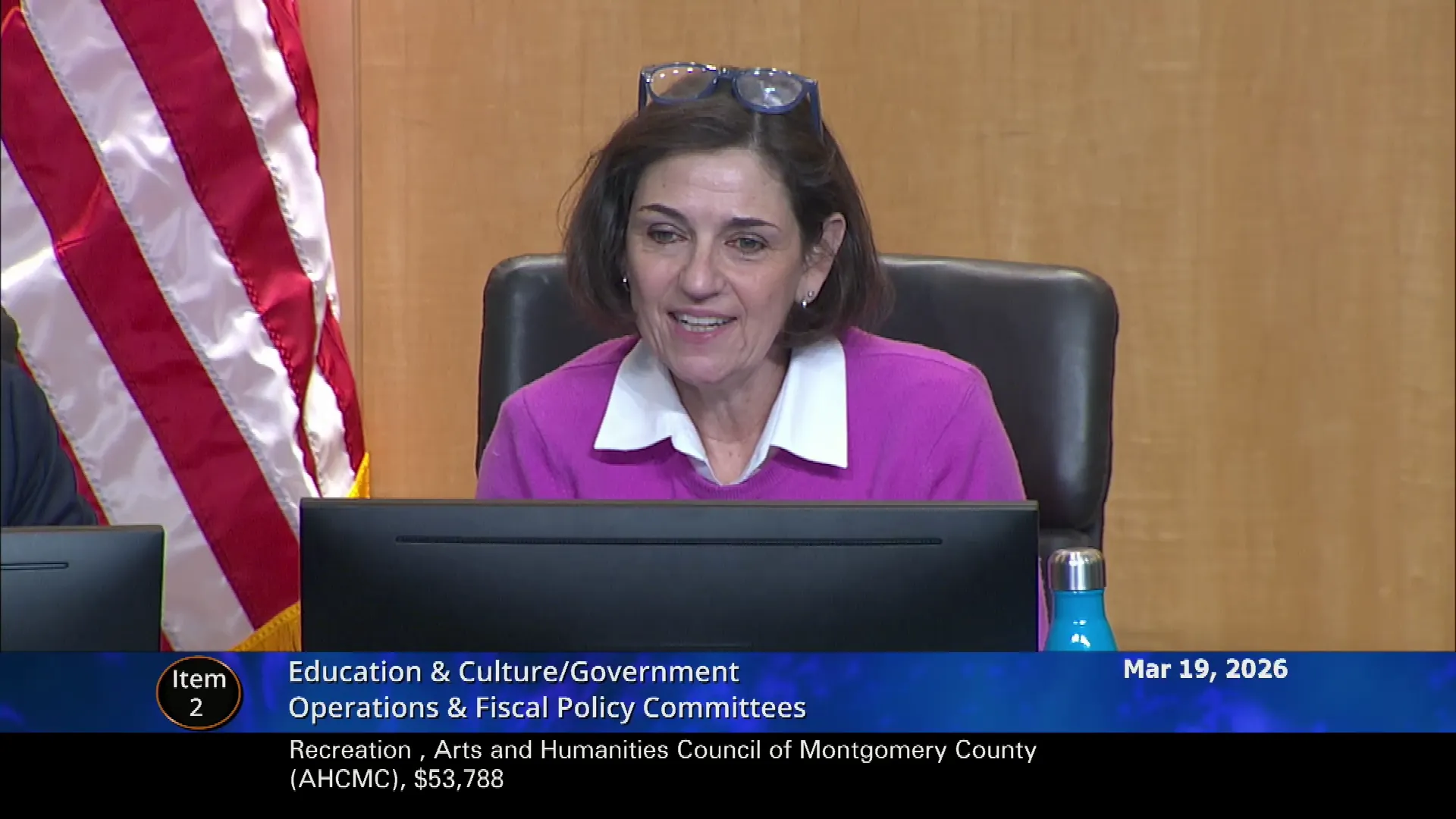
STREAMING COPY IN PREPARATION — RECORDING AVAILABLE FROM THE ORIGINAL SOURCE
Joint EC/GO Committee Meeting on Bill 10-26 and Supplemental Appropriation - March 19, 2026
The Education & Culture Committee and Government Operations & Fiscal Policy Committee met jointly on March 19, 2026, from 9:35 a.m. to 10:28 a.m. in the Council Hearing Room. The meeting was chaired by Councilmember Kate Stewart (GO) and co-chaired by Councilmember Will Jawando (EC). The committees discussed two interrelated items: an expedited bill to modernize the governance of the Arts and Humanities Council of Montgomery County (AHC) and a supplemental appropriation to cover outstanding obligations for the county’s cultural plan.
Bill 10-26 – Arts and Humanities Council Amendments
Discussion
- Purpose: The bill updates the establishment, membership, and duties of the AHC, originally formed in 1976. It requires the council to designate a nonprofit entity as the AHC via resolution every five fiscal years, with power to revoke or suspend designation. The nonprofit must meet requirements including articles of incorporation, bylaws with open meetings act and MPIA adherence, a board of 11–15 members appointed by the county executive and confirmed by the council, and duties such as adopting a racial equity and social justice (RESJ) policy, overseeing grantmaking, conducting a countywide needs assessment every two years, and adopting a strategic plan every five years.
- Staff Recommendations: Chief Legislative Attorney Wellons presented several amendments, which were adopted by consensus:
- Require the RESJ policy to include a process for equitable grantmaking (per OLO recommendation).
- Require the AHC to provide mandated reports to the County Council in addition to the County Executive.
- Require bylaws to include ethics protections consistent with Chapter 19A of the County Code (conflict of interest, training, disclosures, recusals).
- Technical corrections (lettering, chapter references, typo on lines 91-92).
- Debate on Board Voting Rights: The bill as introduced gave two county government representatives (ex officio) full voting rights on the AHC board. Ms. Susan Jenkins, CEO of AHC, argued these representatives should be non-voting due to potential conflicts of interest (e.g., when voting on financial matters involving their employer). She cited concerns about government overreach and noted that board members with conflicts would need to recuse from financial decisions. The County Executive’s office (ACAO Cardona, Director Albornoz) supported voting membership, emphasizing accountability given that the county provides over 90% of AHC’s funding. They argued that voting ensures fiduciary responsibility and real-time collaboration. After discussion, Councilmembers Katz, Stewart, Evans, and Mink expressed support for keeping both representatives as voting members, noting the minority representation and the value of on-record accountability. A proposal to reduce to one voting member was considered but not adopted. The committee unanimously voted to keep the two voting members as introduced.
Supplemental Appropriation #26-59
Discussion
- Amount: $53,788 from General Fund Undesignated Reserves, requested to pay Metris Arts Consulting for work already completed on the county’s cultural strategic plan.
- Context: The appropriation addresses a misuse (not misappropriation) of the Public Arts Trust fund for the cultural plan, as identified by an audit. The county and AHC did not initially recognize the restriction. Since the audit, AHC has wired back $527,000+ of remaining cash balance to the county. The county will continue working with auditors and AHC to determine if additional funds are needed for other cultural plan expenses.
- Support: All parties (County Executive Office, Recreation Department, AHC) supported the appropriation as necessary to honor contractual commitments. The committee discussed the need to review the public arts trust statute to allow broader uses in line with contemporary public art practices.
Key Outcomes
- Bill 10-26: Approved as amended by unanimous voice vote of the joint committee. Final action by the full council will be scheduled later.
- Supplemental Appropriation #26-59: Approved as submitted by the County Executive by unanimous voice vote. Final action by the full council will be scheduled later.
- Future Actions: The committee directed the Executive branch to return with recommendations on updating the public arts trust statute to reflect current public art practices.
Meeting Transcript
Good morning. Welcome to a meeting of the Joint Education and Culture and Government Operations Committee. It's uh the 19th of March, Thursday, and just after 9 30. Uh we have uh two items today to discuss which are interrelated. One is uh Bill 1026, which addresses the Arts and Humanities Council of Montgomery County, its governance structure to really modernize it, and then there's a supplemental appropriation 2659, which my co-chair uh councilmember Stewart will lead, which addresses um an outstanding payment obligation related to the cultural plan of the Arts and Humanities Council. Uh both items taken together uh will help shape and modernize and bring forward and strengthen uh our counties working relationship with the Arts and Humanities Council, uh, which is deep, ongoing and and significant. Um I I did want to take a minute, hey, good morning, to acknowledge uh the work of the Montgomery County Arts and Humanities Council uh and the team who are here, uh, Ms. Jenkins and your team and the board. Uh I it's been a pleasure to work with you over the last eight years and see the growth and the forward movement of the council. Uh and you've been a vital partner in making Montgomery County a creative, vibrant community. And yeah, I know you will continue to be. Um we look forward to a really productive discussion. Uh before I turn to staff, I want to see my co-chair, would you like to say anything? No, no. That's perfect. Let's go. All right. So I'll turn it over to Ms. Cummings and Miss Wellens first. Ms. Wellins on the bill, and then we'll ask everyone to come up as they need to. Ms. Wellins. Great, wonderful. Thank you, uh, Mr. Chair Jawondo. Thank you, Chair Stewart and Council members. Good morning. Um this item number one is expedited bill 1026, Arts and Humanities Council amendments. This is a bill that was put forward uh by the council president at the request of the county executive and council member sales is a co-sponsor. Uh the public hearing occurred on March 10th, as you know. And uh I will give you just a brief rundown about the bill itself. Um the expedited bill kind of makes the amendments regarding the establishment membership and duties of the Arts and Humanities Council, uh, which as you know has been um has been in place since 1976. Um the bill would set up a process for the county council to designate the uh a nonprofit entity as the Arts and Humanities Council. You would do so through resolution, and that would be revisited every five fiscal years, where you could do a new a renewal or new designation. The council also would have the power to revoke or suspend a designation. Uh the nonprofit entity uh would be required to meet certain requirements, including having including having articles of incorporation, uh specifying that the organization is incorporated for the purpose of serving as the county's art arts and humanities council. Uh there would be required bylaws with various provisions, including adherence to the open meetings act and the Maryland Public Information Act. The um the AHC would be required to have a board of directors. Uh it would be between 11 and 15 members. Uh those members would be appointed by the county executive and confirmed by the council. And in addition, uh some of the duties of the uh council would be the Arts and Humanities Council would be further enumerated under the code, um, including that they would be required to adopt a racial equity and social justice policy, um, oversee grant making and programmatic activities funded by the county. Uh and they would be conducting a countywide needs assessment at least once every two years, and also adopting a strategic plan at least every five years. Um in terms of the impact statements, uh the uh OLO, the Office of Legislative Oversight, stated that the bill would have a positive impact on racial equity and social justice. They do have a recommendation to strengthen the bill in that regard, which which we can get to momentarily. No fiscal impact, um, and then uh no economic or climate impacts to note. Uh there was public testimony from the um assistant chief administrative officer Cardona in support of the bill. Uh you also received written testimony from a number of arts and humanities organizations in support of the bill. There are a few um council staff items for your potential consideration. Happy to move on to those, Mr.
openpublica.com