Montgomery County Council Meeting - March 24, 2026: Proclamations, Zoning Amendments, CIP Worksessions, and Public Hearings
STREAMING COPY IN PREPARATION — RECORDING AVAILABLE FROM THE ORIGINAL SOURCE
Montgomery County Council Meeting - March 24, 2026
The Montgomery County Council convened on Tuesday, March 24, 2026, at 9:03 a.m. for a full-day session featuring proclamations, district council actions, legislative session, public hearings, and worksessions on the FY27-32 Capital Improvements Program (CIP). The Council approved multiple zoning text amendments, enacted the County Values Act (Bill 3-26), adopted resolutions supporting the Wheaton Arts District redesignation and the COG Local Food Procurement Challenge, and held public hearings on the ICE Out Act and the Vehicle Recovery Act. All votes were unanimous (11-0) unless noted.
Presentations
- National Agriculture Day Proclamation: Recognized farmers and agricultural producers, noting over $280 million annual economic contribution, 70,000+ acres of agriculturally assessed land, and 500+ farms employing over 10,000 people. Council Vice President Balcombe, Councilmembers Friedson and Luedtke presented.
- Yom HaShoah Proclamation: Holocaust Remembrance Day, presented by Councilmembers Katz, Friedson, and Glass. Noted that Montgomery County is home to 45% of Maryland's Jewish population and passed a resolution in 2022 to combat anti-Semitism.
- Trans Day of Visibility Proclamation: Presented by Councilmember Stewart, recognizing International Transgender Day of Visibility on March 31. Highlighted that approximately 2.3 million adults identify as transgender nationally.
Consent Calendar
Approved unanimously (11y) the following items:
- Received and released OLO Report 2026-7 on police recruitment strategies.
- Introduced supplemental appropriations and CIP amendments (with public hearings scheduled in April):
- $3,064,158 for Emergency Family Shelter Services (DHHS)
- $200,000 for Takoma Park Car Wash revitalization
- $553,497 for MCPS IDEA Part B Grant
- $500,000 for Poolesville Highway Depot
- FY27 Transportation Fees, 9-1-1 Fee Rate, Solid Waste Charges, Water Quality Protection Charge, Property Tax Credit for Income Tax Offset
- Adopted Resolution 20-1072: Abandonment of a portion of a public alley behind Bayard Boulevard.
- Confirmed appointments to the Board of Investment Trustees (Jennifer Shovlin, Adam Downs, Joel Niamien) and the Climate, Energy, and Air Quality Advisory Committee (nine members).
Public Comments & Testimony
Public Hearing on Supplemental Appropriation #26-53 (MCPS Blueprint Career Advising): One speaker (Remai Kimei, a high school student) spoke in strong support, sharing a personal story about a friend's father being detained by ICE and urging investment in career readiness.
Public Hearing on Wheaton Arts District Redesignation: One speaker (Nestor Alvarenga, director of Regional Services) testified in support, highlighting Wheaton's cultural and arts ecosystem, including the future arts center, food scene, and public realm improvements.
Public Hearing on Expedited Bill 13-26 (ICE Out Act): Multiple speakers testified in support, including students, community organizers, and faith leaders. Speakers shared stories of family separation, described poor conditions in detention facilities, and urged the Council to prevent private immigration detention centers. One speaker opposed the bill, criticizing its title and expressing concerns about undocumented immigrants.
Public Hearing on Expedited Bill 14-26 (Vehicle Recovery Act): Four speakers testified in support, including representatives from CASA, Takoma Park Police Department, and mutual aid groups. They described challenges families face when a detained immigrant's vehicle is towed and urged clearer documentation rules. One speaker suggested expanding acceptable IDs to include student IDs from MCPS and Montgomery College.
Discussion Items
District Council Session (9:30 a.m.)
- Remand of Local Map Amendment H-149 (Americana Glenmont): Approved resolution 20-1068 (11y) accepting the Hearing Examiner's recommendation with an additional binding element limiting building height to 45 feet along a portion of Randolph Road.
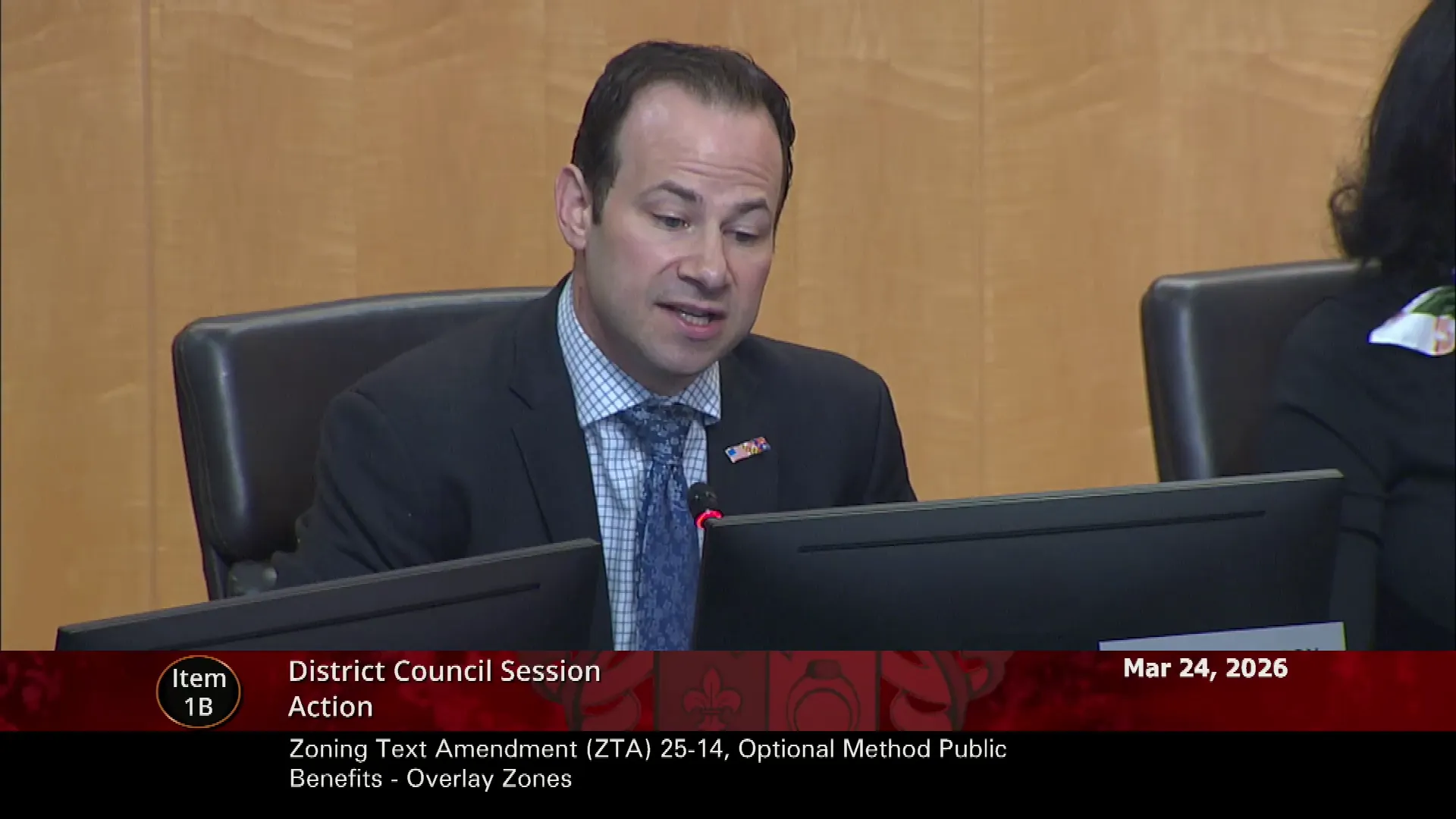
- ZTA 25-14 (Optional Method Public Benefits – Overlay Zones): Enacted ordinance 20-31 (11y) to align overlay zone public benefits with the new system. Grandfathers existing standards for a transition period.
- ZTA 26-02 (Overlay Zones – Regional Shopping Center): Enacted ordinance 20-32 (11y) allowing multifamily residential development to exceed the 30% cap in RSC overlay zones if at least 600,000 square feet of retail remains. Amendments allowed all housing types and replaced gross floor area with gross leasable area.
- Clarksburg Gateway Sector Plan: Adopted resolution 20-1069 (11y) after three committee worksessions. Plan focuses on economic development, job growth, and transportation improvements.
- Rose-Budd House Historic Preservation: Adopted resolution 20-1070 (11y) approving the master plan amendment to designate the property as a historic site. The property owners requested the designation.
Legislative Session (10:15 a.m.)
- Bill 3-26 (The County Values Act): Enacted (11y) after joint PS/GO committee amendments. Requires the County Executive to publish immigration enforcement guidance, establish an online reporting portal for unauthorized ICE use of county property, and mandate signage and training. Effective in 91 days; online portal required earlier.
- Resolution on COG Local Food Procurement Challenge: Adopted unanimously (11y). Montgomery County becomes the first jurisdiction in the region to commit to tracking and increasing local food procurement.
FY27-32 CIP Worksessions (10:35 a.m. and 2:00 p.m.)
- Health and Human Services: Approved as recommended (straw vote 11y). Key projects: Affordable Living Quarters (18 units at 600 East Gude Drive), Diversion Center (Seven Locks Road), and pending closeouts. Noted $3.5 million undesignated placeholder for high school wellness centers.
- Montgomery College: Approved as amended (straw vote 11y). Recommended $461.2 million; accepted college's alternative scenario that includes Rockville Theatre Arts Building renovation (deferred from Germantown Student Affairs Phase 2) and $2 million/year IT reductions. Enrollment up 16% since FY22.
- Montgomery Parks: Approved scenario 1 (retain full funding, $11.2 million above CE recommendation) (straw vote 11y). Includes Wheaton Regional Park, solar initiative, and trails. Johnson's Local Park (Emory Grove) funded as standalone project; $2.5 million request deferred for further discussion.
- General Government – County Offices and Other Improvements: Approved $172.7 million (7.9% decrease). Includes new African American Historical Markers project (up to 40 markers).
- General Government – Technology Services: Approved (straw vote 10y, Glass absent). Includes fiber net, Montgomery Connects broadband, and building wiring upgrades.
- General Government – County Radio Life Cycle Replacement: Approved (straw vote 11y) as recommended by joint PS/GO committee.
- General Government – Public Safety System Modernization: Approved (straw vote 11y). Pending closeout; remaining LE RMS funding transferred to standalone project.
- Public Safety – Fire and Rescue Service: Approved (straw vote 11y). $157.2 million (17.2% increase) including new self-contained breathing apparatus project. Noted apparatus wait times of about two years.
- Transportation – Mass Transit: Approved as amended (straw vote 11y). Removed erroneously added funding for Transit Park and Ride Lot Renovations beyond six years. Requested MCDOT study of alternatives for BRT US 29 through Four Corners (mixed traffic, single median lane, etc.) with analysis of cut-through traffic; committee to revisit April 27.
Key Outcomes
- All 11-0 votes on actions: LMA H-149, ZTA 25-14, ZTA 26-02, Clarksburg Gateway Sector Plan, Rose-Budd House designation, Bill 3-26, Resolution on Local Food Procurement, Wheaton Arts District Resolution, and all consent calendar items.
- Public hearings held for Bill 13-26 (ICE Out) and Bill 14-26 (Vehicle Recovery); records remain open until April 2, 2026. Worksessions scheduled: ECON Committee on April 10 (ICE Out) and PS/GO Committee on April 15 (Vehicle Recovery).
- CIP straw votes: All committee recommendations approved, with final adoption scheduled in May. Montgomery Parks scenario 1 retains full funding despite $11.2 million gap; will be reconciled with overall budget.
- Upcoming public hearings: April 7 (CIP projects, FY27 budgets) and April 14 (various fees and charges).
The meeting adjourned at 3:03 p.m.
Meeting Transcript
Good morning, everyone. Uh, today's March 24th. Welcome to the Mongame County Council. My name is Narali Fanny Gonzalez, and we have two very exciting proclamations today. We're gonna start with a proclamation recognizing National National Agriculture Day by Council Vice President Balcom, Council Members Fritson and Luki. Anybody who came for that proclamation, please move forward. I'm sorry. It's all good. Okay, everyone, come on in. Anyone who's here for ag day? Come on up. So uh welcome everyone. And today we're we're uh uh uh honoring our farmers, our ag producers, and we should do this every day. We eat food every day, we should recognize where it comes from, and we should appreciate our farmers and uh and we're doing that today. Uh we were down, we had a little breakfast this morning in our newly renovated uh cafe, and one of our farmers looked out the window and suggested we needed goats to to instead of the lawnmower on our side. So thank you, Doug, for that. Where's Doug? Thank you for that. Thank you for that suggestion. So um, so we'll be getting little baby goats to for our SAT. Um, so I just wanted to, as I said, um our farmers wake up every morning and and work very hard every day to make sure that we're fed and we appreciate them. And um, and I just want to turn this over to my colleagues to say a few words. Think thank you. Um farming, agriculture is a business, but it is a business that we cannot live without. It is a it is it is not an easy business. Uh it is intensively hard, laborious work. It's also heavily regulated, and I think people forget that sometimes. Um, but there's a lot that goes into the business of agriculture. And time and time again, our agricultural community has showed up. They have been outstanding partners to us in problem solving so that we can make sure agriculture is sustainable in the 21st century and delivers on behalf of our residents and our nearby residents because food insecurity isn't just doesn't just stop at borders. We are a regional um agricultural area. And and I can't say enough about how much they do to assist with resolving our food insecurity issues. And I know Heather Ruskin, our director of the Office of Food Systems Resilience is here today. And um, and and I don't know that people appreciate how much the logistical work of making sure what is grown in our agreserve gets to the people who need it, how much work that takes to make that happen. It cannot happen without deep personal partnerships and without deep personal commitment of all the folks you see up here and all those who they represent who aren't here with us today in making sure that that work is done day in and day out. Um this has been an incredibly challenging time for our community as a whole, and our agricultural producers have stepped up to meet the moment and have been 100% committed to having those conversations and engaging in that dialogue with each of us and with other stakeholders in the community to make sure that we are doing the very best we can under these difficult circumstances. So this year more than ever, I express my sincere gratitude for all that you do in your businesses and all of who you are as people. Thank you for all that you do. Good morning. It's great to be here with the two council members who represent the agricultural reserve. I had the great privilege of being able to represent the agreserve for four years and continue to advocate for the protection and preservation of the ag reserve as chair of the committee that oversees agriculture. And each and every day we eat our food, and I don't think we think intentionally enough about how it got to where we are. And the work, the sacrifice, the efforts that have been undertaken by families in our community who make that food possible. Today we celebrate that. We thank that there is not a tradition that doesn't express appreciation, gratitude, and bless their food before they eat it in some form or fashion. And I think it's important and incumbent upon all of us to think and show our gratitude for the people who actually make that food possible and the hard work that goes into getting it to your farmers market, getting it to your grocery store and getting it to your family to sustain each of us. We are truly sustained by our agricultural producers. It is not an easy time economically in any industry. The agricultural community is an example of that. Not only do they have to deal with economic dynamics and trade dynamics, they have to deal with weather.
openpublica.com