Triple Committee Update on Early Care and Education Workforce – March 26, 2026
STREAMING COPY IN PREPARATION — RECORDING AVAILABLE FROM THE ORIGINAL SOURCE
Triple Committee Update on Early Care and Education Workforce – March 26, 2026
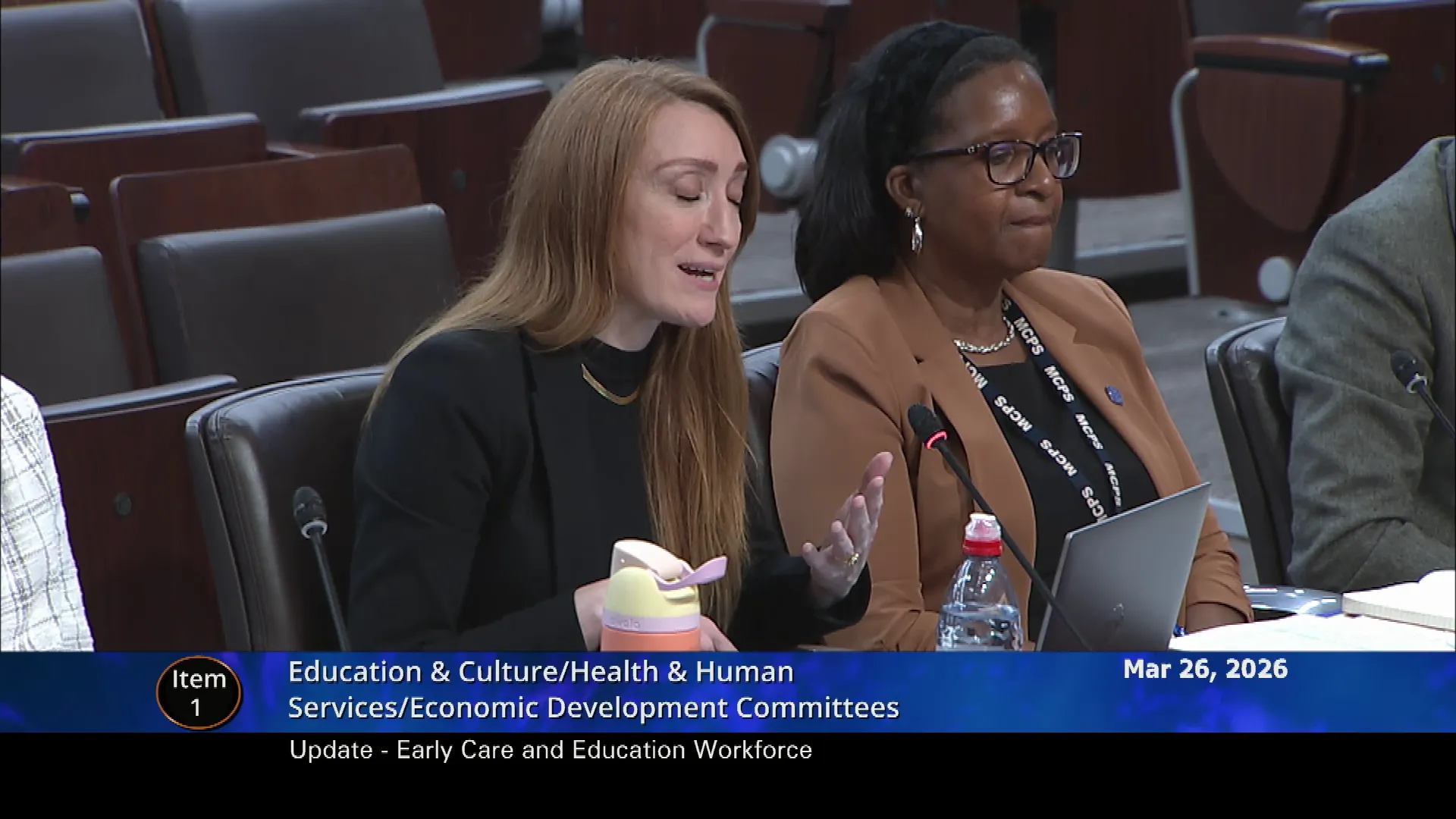
The Education and Culture (EC), Health and Human Services (HHS), and Economic Development (ECON) Committees met jointly on Thursday, March 26, 2026, from 1:33 p.m. to 3:45 p.m. to receive an update on the early care and education (ECE) workforce. The meeting featured presentations from the Department of Health and Human Services (DHHS), the Children's Opportunity Alliance (COA), Montgomery College, Montgomery County Public Schools (MCPS), and Montgomery Moving Forward (MMF). Key topics included workforce compensation, the need for a statewide registry and career lattice, subsidy modernization, and coordinated next steps.
Discussion Items
- Workforce Compensation Study Findings: Jennifer Arnáiz (DHHS) presented results from a survey covering about 23% of the credentialed ECE workforce. Median hourly wage is $21/hour; only 5% reach the self-sufficiency wage of ~$31/hour. 99% earn below the county median household income of $128,000/year. 66% cited higher pay as the single biggest factor to stay. 37% rely on public benefits. Only 28% have employer-provided health insurance. Fewer than half expect to stay with their employer in five years.
- State-Level Advocacy: Sharon Friedman (MMF) and Chris Swanson (C-Impact Now) described a statewide call to action for an ECE workforce registry (Maryland is one of only four states without one) and a birth-to-five career lattice. Estimated startup cost for a registry is $700,000; annual operation $1.8 million. The work will transition to a new Maryland Early Care and Education Coalition on July 1, 2026.
- Local Pathways: Ginger Robinson (Montgomery College) reported that since 2019, $2.3 million in ECEI scholarships have been awarded, with enrollment increasing 75% (from 120 to 209 students) between FY24 and FY26. Nichelle Owens (MCPS) described high school CDA pathways, paraeducator partnerships with Towson University and the University of Maryland, and professional learning for pre-K partners.
- Coordination and Role Clarity: Councilmember Friedson questioned whether roles among partners are sufficiently clear. Kimberly Rusnak (COA) acknowledged the complexity but stated that partners are now aligned on the need to address both seats and workforce. Councilmember Luedtke highlighted the Maryland Longitudinal Data System Center as a resource for tracking educational and workforce outcomes.
- Regulatory and Funding Timelines: Council President Fani-González requested that the Early Care and Education Initiative’s sub-committee recommendations on subsidized childcare and the workforce be transmitted by June 2026, and the County Executive’s official regulatory recommendations by July 2026 to support Council action before November 2026.
Key Outcomes
- Data Requests: Councilmember Mink requested enrollment capacity data for ECE programs from MCPS, Montgomery College, and Universities at Shady Grove, along with data on graduation placement of students who pursue ECE studies. Councilmember Balcombe requested complete seat capacity data for Montgomery College’s ECE credit and non-credit courses.
- Next Steps: Partners committed to launching affordable health insurance benefits through a shared service model in fall 2026, submitting COMAR revisions to modernize subsidy regulations, and supporting a statewide legislative push for a mandatory educator registry and birth-to-five career lattice.
- Community Polling: COA commissioned a poll of registered voters showing that 77% consider retaining and attracting early childhood educators extremely or very important, providing a foundation for future dedicated funding advocacy.
Meeting Transcript
Good afternoon, everyone. My name is Lori Ann Sales, Councilmember and Chair of the Health and Human Services Committee. I want to thank everyone for joining us today for our triple committee of the Health and Human Services, Education and Culture, and Economic Development Committees. I am so glad to have my economic development colleagues. I believe Council Member President Natalie Fani Gonzalez will be joining us remotely today. She is in Annapolis fighting on our behalf. And I will just quickly introduce all of the other members. So from the Economic Development Committee, we are joined by Council Vice President Marilyn Balcombe and Councilmember Evan Glass will be joining us shortly from Education and Culture. We have Chair Will Jawondo, Councilmember Shevra Evans, and Councilmember Kristen Mink, and from Health and Human Services, Councilmember Andrew Friedson and Councilmember Don Luke. With nearly full council participation, we are only without council members Kate Stewart and Sydney Katz, reflecting the importance of today's topic. The early care and education workforce is not a siloed issue. It is foundational to our economy, our education system, and the well-being of families across Montgomery County. So to our residents watching on County Cable Montgomery streaming on the council website and on YouTube. Thank you for joining this conversation. Today we will receive an update on the early care and education workforce. We will review progress, expanding access to high quality early childhood education, and examine ongoing challenges, including workforce shortages, compensation gaps, affordability pressures, and inequities in access. The report makes clear that despite significant county investment, the system remains under strain. Early educators continue to face compensation below self-sufficiency levels, driving turnover, and staffing shortages. These challenges limit provider capacity, meaning that even when physical space exists, workforce instability can prevent programs from operating at full enrollment and meeting family demand. This is not only a local issue. It is a statewide and national challenge. Maryland Comptroller Brooke Learman's State of the Economy series on child care and the economy reinforces what we see locally. Childcare is a core economic driver, and when the system is strained, families, employers, and the broader economy feel the impact. We are also seeing innovation at the state level, including a new community-facing application from the governor's innovation office designed to help families and small businesses access services like child care and healthy food from their phones. At the same time, early childhood education is one of the few sectors where artificial intelligence cannot replace the human role. This work requires presence, relationship building, and care, making investment in educators even more essential. As we look ahead, we must ensure Montgomery County's leadership and education and innovation include strong support for the workforce, preparing our youngest learners for the global economy. Our goal today is to align policy tools across committees to strengthen the educator pipeline, stabilize providers, and expand access for families. I want to thank uh Ms. Nicole Rodriguez Hernandez for preparing today's packet and grounding this discussion and data and recent reports. I want to thank our staff, providers, and partners for your work. Before we begin, I would like to invite Chair Will Jawondo and Council President Fonnie Gonzalez, if she is here to offer any opening remarks. Thank you so much. Uh Chair Sales. And as she said, this is such an important topic. You get almost all of us, so which is nice. Good afternoon to everyone. Uh I I just want to say a couple things. Um last time the triple committee met was November 7th, 2024. Uh so uh about a year and a half ago. Um, and I've literally been looking forward to this day for years. I can say that. Um, I can't tell you how many times I've said, but I want to get these studies. I want to, and particularly this one, the workforce study. So I am really, really excited that we in the public are going to get to talk about this. You know, over the course of these years as we've kicked off the Early Care and Education Initiative. We I've often asked us, and I know you'll do this today to ground us in how many students are being served, how many aren't being served, and what our goals are. Because I think anything, any initiative like this, you've got to have the goals. And I and I was thinking about this over the last couple of days. We also need to know how much our workers getting paid, what are their conditions, and how we're going to make sure that they are compensated well to do this super important work.
openpublica.com