Montgomery County Council Meeting - April 7, 2026: Budget Briefing, Legislation, and Public Hearings
STREAMING COPY IN PREPARATION — RECORDING AVAILABLE FROM THE ORIGINAL SOURCE
Montgomery County Council Meeting - April 7, 2026
The Montgomery County Council convened on April 7, 2026 for a full-day session that included proclamations, legislative action on four bills, worksessions on the Capital Improvements Program (CIP), a detailed briefing on the FY27 Operating Budget, and multiple public hearings on budget and appropriations. The council enacted bills on invasive plants, minimum wage reporting, agricultural building exemptions, and governance of the Arts and Humanities Council. The FY27 budget briefing featured a proposed 6.3-cent property tax increase and a 0.1% income tax increase, along with concerns about a potential $257.3 million structural deficit in FY28. Public testimony on the operating budget ran throughout the afternoon and evening, with speakers divided on tax increases and funding priorities.
Presentations & Proclamations
- Fair Housing Month: Proclamation recognizing April as Fair Housing Month, presented by the Planning, Housing and Parks Committee. Speakers highlighted Montgomery County's historic fair housing leadership and ongoing challenges.
- National Public Health Week: Proclamation for April 6-12, 2026, presented by the Health and Human Services Committee, with remarks from the county health officer and community partners.
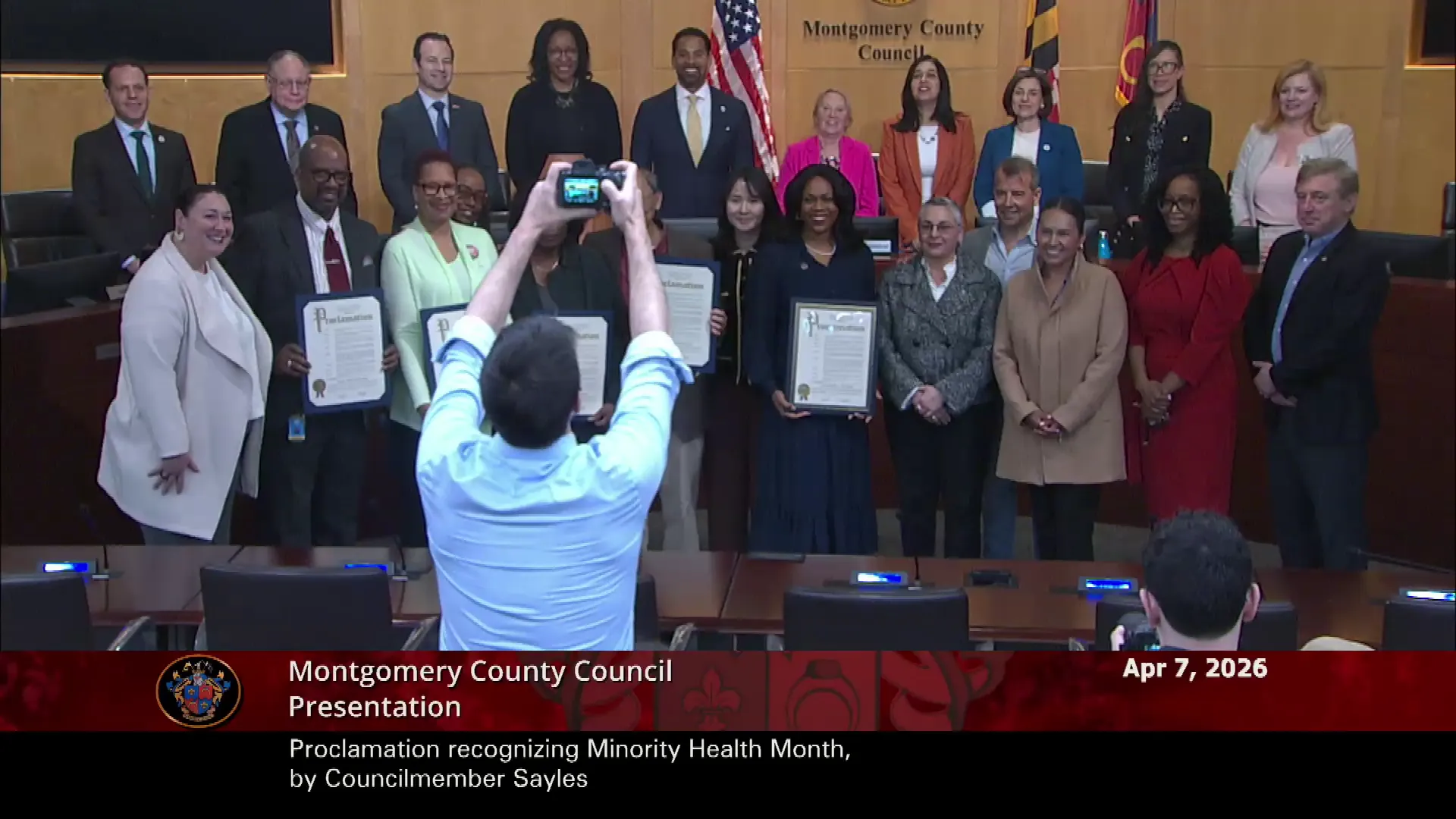
- Minority Health Month: Proclamation recognizing April as Minority Health Month, presented by Councilmember Sayles, with testimony from minority health initiatives.
- Arab American Heritage Month: Proclamation recognizing April as Arab American Heritage Month, presented by Council President Fani-González and County Executive Elrich, with community representatives speaking.
General Business
- Announcements: The council is seeking applicants for the Board of Investment Trustees/Consolidated Retiree Health Benefits Trust and the Planning Board. Applications due April 27, 2026.
- Minutes: Approved minutes from March 9, 10, and 17, 2026 sessions (11-0).
Legislative Session - Day #9 (Four Bills Enacted)
- Bill 26-25 (Vegetation – Invasive Plants): Enacted as amended (11-0). Amends definition of "weed" to align with Maryland Department of Agriculture noxious weed list; prohibits sale and future planting of invasive running bamboo; exempts native species. Councilmember Glass moved adoption of an amendment clarifying the definition.
- Bill 1-26 (Minimum Wage – Actual Impact Analysis): Enacted (11-0). Repeals requirement that the Office of Legislative Oversight submit an annual report on minimum wage impact.
- Bill 7-26 (Buildings – Agricultural Exemptions): Enacted (11-0). Clarifies agricultural purpose exemption from building permits, including processing for market, and aligns with state law.
- Expedited Bill 10-26 (Arts and Humanities Council – Amendments): Enacted (11-0). Overhauls governance: establishes a board of 11-15 voting members appointed by County Executive and confirmed by Council; creates a 5-year designation cycle with OLO evaluation; requires racial equity and social justice policy; mandates ethics disclosures and public meeting requirements.
Worksessions – FY27-32 Capital Improvements Program (CIP)
- Agricultural Land Preservation: Approved without objection (11-0). Total program expenditure of $26,123,000 for conservation easements; funded by agricultural transfer tax, developer payments, state aid.
- Wheaton Arts and Cultural Center: Approved without objection (11-0). Six-year total $45.2 million (a $6.9 million increase from amended CIP due to refined cost estimates).
Briefing – FY27 Operating Budget Overview
Council staff and the Office of Management and Budget (OMB) presented the County Executive's recommended $7.0 billion tax-supported operating budget (5.7% increase). Key proposals:
- Property tax: 6.3-cent increase (supplemental MCPS rate) – third increase in four years.
- Income tax: Increase from 3.2% to 3.3% (flat rate), with a working family income supplement.
- Reserves: Use of $181.5 million in one-time reserves for ongoing expenditures, leaving undesignated reserves at ~$46 million (below typical 10% policy level for revenue stabilization fund).
- Structural deficit: Projected $601 million gap in FY28 new revenue; with known expenditures, a potential $257.3 million hole – equivalent to a 9.85-cent tax increase.
- Compensation: $47.4 million for county government pay adjustments (ranging 2.5%-10.6% depending on bargaining unit); $161.6 million for MCPS.
- Fee increases: Water quality protection charge, solid waste fees, 911 fees, community use of public facilities fees.
- Council President Fani-González deferred two special transportation taxing districts to the Infrastructure Funding Workgroup and delayed solid waste disposal discussion to fall.
- Councilmember concerns: Many members criticized the use of one-time funds for ongoing expenses, the size of the tax increases, and the growing structural deficit. Councilmember Friedson requested a detailed list of efficiencies (0.2% of budget). Councilmember Jawando noted that cuts must account for inflationary cost increases. Councilmember Luedtke called the budget "insane" for relying on reserves. Councilmember Katz called it "the worst budget I've seen." Councilmember Mink asked for clearer distinction between maintenance-of-service and new investments.
- Councilmember Balcombe: Emphasized that short-term tax increases worsen long-term structural deficit. Councilmember Evans committed to thoughtful review. Councilmember Glass noted the regressive nature of property tax increases due to inequitable assessments.
Consent Calendar
Approved (11-0):
- Introduced resolution to extend Council’s Contract for Audit Services (action tentatively 4/14/26).
- Introduced Supplemental Appropriation #26-64 (DHHS Continuum of Care Planning, $502,167 federal grant; hearing 4/21/26).
- Introduced Supplemental Appropriation #26-56 (Office of Food Systems Resilience Food Aggregation Grant, $300,000 private grant; hearing 4/21/26).
- Introduced/Adopted Resolution 20-1077 setting public hearing for FY27 Real Property Tax Rate increase (hearing 4/21/26 9:30 a.m.).
- Introduced resolution to Increase County Income Tax Rate (hearing 4/21/26 9:30 a.m.).
- Introduced/Adopted Resolution 20-1078 amending FY26 budget for non-competitive contract awards: EveryMind, Inc. and League of Women Voters.
- Adopted Resolution 20-1079 approving Supplemental Appropriation #26-59 (AHCMC, $53,788 from undesignated reserves).
- Adopted Resolution 20-1080 confirming appointment of Lori Garibay-Aquino to Local Management Board.
Public Hearings (Afternoon – 1:30 p.m. & 6:30 p.m.)
- Supplemental Appropriation #26-14 (Emergency Family Shelter Services): $3,064,158 from general fund undesignated reserves. Public hearing held; record open until April 16; HHS Committee worksession April 23.
- Supplemental Appropriation #26-63 (MCPS IDEA Part B Grant): $553,497 federal grant. Public hearing held and closed; adopted Resolution 20-1081 (11-0). Councilmember Mink noted OLO concerns about culturally responsive training and equitable identification of students of color.
- FY27 Capital Budget and CIP Projects (NextGen Technology Refresh, BRT MD 355 North, BRT New Hampshire Avenue): Public hearing held; committee worksessions in April.
- FY27 Operating Budgets and FY27-32 Public Services Program: Public hearings held at 1:30 p.m. and 6:30 p.m. (continued on April 8). Committee worksessions in April.
Public Comments & Testimony (Selected Highlights)
- Robin Ficker (taxpayer advocate): Opposed property and income tax increases, calling the budget a "campaign press release." Argued that tax increases make life unaffordable.
- Bruce St. John (resident): Stated his property taxes rose 86% from 2020 to 2025; urged council to control spending and reduce taxes.
- Margie Graff (Greater Rockville Chamber of Commerce): Strongly opposed tax increases, stating they undermine competitiveness and burden residents and businesses.
- Pete Cambus (Greater Bethesda Chamber of Commerce): Urged rejection of property tax increase, restoration of MCEDC funding, and modernization of permitting.
- Bridget Howitt (Nonprofit Montgomery): Requested an 8% inflation adjustment for nonprofit contracts instead of the proposed 2.5%, citing rising demand, operating costs, and workforce strain.
- Courtney Hall (Interfaith Works): Supported 8% COLA and $449,000 for emergency rental/utility assistance (Connections program) to prevent homelessness.
- Ella May Gray (mental health clinician): Advocated for expanding low-cost mental health services, especially for underserved populations.
- Vicky Thomas (Animal Services Advisory Committee): Requested funding for five additional animal care attendants and a foster/rescue coordinator to avoid euthanasia; recommended maintaining $30,000 pet food pantry and $125,000 spay/neuter.
- Bruce Cohen (volunteer): Described overcrowded shelter conditions; urged spay/neuter requirements and additional staffing to prevent euthanasia of healthy animals.
- Mandy Bening (mother of pedestrian fatality victim): Urged funding for Vision Zero measures such as HAWK beacons at mid-block bus stops on high-injury roads.
- Donna deGrasse (Silver Spring Justice Coalition): Called for increased mobile crisis outreach teams and public awareness campaign; opposed drone first responder program expansion without independent evaluation.
- Kevin Walden (Climate Coalition): Supported full funding for Montgomery County Green Bank; urged bus service expansion upcounty; opposed artificial turf in schools, favoring grass fields; supported solid waste management plan to phase out incineration.
- Ben Ross (transit advocate): Criticized budget for spending on "showy" BRT projects while cutting ride-on service; called for more frequent buses and bike-share expansion.
- Jasmine Flores (resident): Testified on the life-changing impact of recreation and parks programs for seniors and youth; urged full funding of these services.
- Lillian Mass (small business owner): Requested creation of a program for startups to compete for small entry-level county contracts, noting current barriers for new businesses.
- Kate Liu (CCACC Health Center): Asked for continued funding of hepatitis B screening program, the only program addressing the biggest health disparity for Asian Americans.
- Carrie Guthrie (Cornerstone Montgomery) and Britt Mobley (Rock Creek Foundation): Opposed 50% reduction to Residential Rehabilitation Program (RRP) supplement, which would force staff cuts and endanger services for people with serious mental illness.
- Davita Rowley (Community Action Board): Supported expansion of emergency rental/energy assistance, free clinics, and working parents assistance; highlighted ongoing fear in immigrant community.
Key Outcomes
- Enacted four bills: Bill 26-25, Bill 1-26, Bill 7-26, Expedited Bill 10-26 (all 11-0).
- Approved CIP worksessions: Agricultural Land Preservation and Wheaton Arts and Cultural Center (both 11-0).
- Approved Consent Calendar (11-0), including introduction of tax rate increase resolutions and supplemental appropriations.
- Adopted Resolution 20-1081 approving IDEA Part B grant for MCPS ($553,497).
- Public hearings held on emergency shelter appropriation, capital budget projects, and FY27 operating budget. Records remain open on shelter appropriation until April 16.
- Budget process: Committee worksessions scheduled throughout April; council will act on full CIP and operating budget in May. Council President Fani-González deferred special taxing districts and solid waste disposal to separate processes.
Meeting Transcript
Good morning, everyone. Um welcome to the county council session for April 7th. I can't believe it's April already. I hope everybody had uh a great spring break. Um we are gonna start with a couple of proclamations. The first one is a proclamation recognizing Fair Housing Month by the County Council's Planning, Housing and Parks Committee. Let's go, guys. If you're here for that proclamation, please move forward. Good morning. We are here as the Planning Housing and Parks Committee to celebrate Fair Housing Month here in Montgomery County. Uh it is a good morning uh to celebrate Montgomery County's historic and ongoing leadership on fair housing, starting in 1967 when Montgomery County planted our flag to make sure that everybody had access to fair housing in our community and we continue to live our values out loud of being an inclusive and a welcoming community, even when it is challenging, especially when it is challenging, and unfortunately, some of the challenges that we have historically faced uh continue to be a challenge today. We have a number of guests with us. We're gonna uh ask them to introduce themselves and also ask the guests who are here for Fair Housing Month to come down. If your name rhymes with me. Last name in particular. Uh come on down. We'll have you introduce yourself last, Jeff. Sure. Good morning, everyone. My name is James Bridgers, and I am the director of the Department of Health and Human Services. Rob Goldman, uh President of MHP, celebrating 25 years in a day or two. So good morning, Melissa McKenna, the executive director of the Affordable Housing Conference of Montgomery County, celebrating 35 years. Rolf Bennett, co-chair of the Affordable Housing Conference. John Mendez, Executive Director at Bethesda Cares. Jim Stowe, Director of the Office of Human Rights. Good morning, everyone. Kerene Brown, Senior Executive Vice President of the Housing Opportunities Commission for 28 years. Good morning. Uh Max Glickman, Director of Real Estate Development Enterprise Community Development. Good morning. Scott Bruton, Director of the Department of Housing and Community Affairs. Christine Hong, Chief of Services to End and Prevent Homelessness with the Department of Health and Human Services. Russell Brazil, the president of the Greater Capital Area Association of Realtors. Good morning. I'm Mary Kohler with the Montgomery Housing Alliance. Just on time. Okay. Great. Well, thank you everybody for being here. I just wanted everybody to introduce themselves to ensure we reiterate how fair housing happens. It doesn't happen by government alone. It doesn't happen by community members alone. It happens because of government, nonprofit, and private sector coordination and partnership. We have an interagency commission that works on these issues. We have county government departments that work on these issues. We have nonprofit partners who dedicate themselves to these issues, and we have private sector partners who are committed to fulfilling inclusive communities. And that is ultimately how Section 27 of the code, which began in 1967 when we really became a champion of these issues in Montgomery County and put those standards into law. That's how we live them every day. And that's how we ensure access to every member of our community. And when we talk about the basic necessities, food, shelter, and clothing.
openpublica.com