Montgomery County Council FY27 Operating Budget Public Hearing – April 8, 2026
STREAMING COPY IN PREPARATION — RECORDING AVAILABLE FROM THE ORIGINAL SOURCE
Montgomery County Council FY27 Operating Budget and Public Services Program Public Hearing - April 8, 2026
The Montgomery County Council convened a public hearing on Wednesday, April 8, 2026, on the FY27 Operating Budgets and FY27–32 Public Services Program and Fiscal Policy for Montgomery County Government, Montgomery College, the Maryland-National Capital Park and Planning Commission, WSSC Water, and Montgomery County Public Schools. Council President Natali Fani-González presided; Vice President Marilyn Balcombe and all other councilmembers were present, with Councilmember Kate Stewart initially attending virtually. The hearing consisted of public testimony on budget priorities; no votes were taken. Committee worksessions on the FY27 budget and Fiscal Policy were announced to be scheduled through April.
Public Comments & Testimony
Parks, Recreation, and the Environment
- Jim Brown (Poolesville Town Commissioners) asked the Council to fund a turf field for Poolesville High School, a new community center on town-donated land appraised at over $1 million, a pool bubble, and requests from WOMCO and Poolesville Seniors; he also supported public transportation and maintenance of Agricultural Reserve rustic roads, noting the Poolesville ZIP code generates more than $100 million in annual taxes.
- Peter Gray (Washington Area Bicyclist Association, over 1,000 members) asked the Council to fully fund the Parks Department FY27 budget request to maintain current services and to invest in Capital Bikeshare, including discounted annual memberships for income-eligible residents and marketing.
- Tom Cove (Montgomery County Sports Advisory Committee) supported the Recreation Department and Montgomery Parks budget requests and the MCPS Stadium Ball Fields Initiative, stressing that turf fields expand equitable access to sports fields.
- Ellen Maidman Tanner (Friends of Sligo Creek) strongly supported full funding for Montgomery Parks, warning that the approved 4.1% increase versus the requested 6.3% would leave an estimated $3 million shortfall and hinder invasive-species removal and flood/stormwater management.
- Jack Pakonsky (Towson University student and Germantown resident) asked the Council to restore the full 6.3% parks increase, arguing parks are free “third spaces” and noting they are only 2.1% of the county budget.
- Jeannie Barnes (Conservation Montgomery) supported continued DEP grant funding for the Home Tree Care 101 program (under $10,000 per year, 93% satisfaction rate) and full parks funding, citing a $3.1 million gap across 416 parks and more than 37,000 acres.
- John Clink (retired Department of the Interior employee) urged full funding of the Parks and Planning Commission request, calling parks critical infrastructure that supports health, community, and economic competitiveness.
- Neil Rumbaugh (lifelong county resident) asked the Council to fully fund parks, citing safety concerns such as ATVs and mopeds on bike paths, speeding vehicles, illegal car meetups, and inadequate park police staffing.
Solid Waste, Incineration, and Stream Restoration
- Vivian Thompson (retired University of Virginia professor) opposed the County Executive’s proposal to close the Resource Recovery Facility and send trash to an out-of-state landfill, arguing resource recovery is more environmentally sound, citing county reports that the RRF does not measurably degrade local air quality and is cheaper, and raising environmental justice concerns about proposed landfill sites.
- Kit Gage (individual) recommended the county gather more data before deciding to close the RRF, including contract buyout, decommissioning, diesel trucking, and lost electricity/metal recycling revenue, and asked why Arlington County and Alexandria continue using older RRFs.
- Kenneth Bauer (Coalition to Stop Stream Destruction) urged the Council to cut DEP and Montgomery Parks personnel costs for engineered stream restorations, calling them unscientific and citing peer-reviewed studies; he proposed redirecting funds to rain gardens, bioretention, and permeable pavement.
- Danila Shabeko (individual) seconded Bauer’s criticisms of stream restoration and asked the Council to examine water-quality funding, saying too much was spent on operating expenses and interest payments rather than measurable water-quality improvements.
- Lauren Greenberg (Zero Waste Montgomery County) supported the solid waste plan to close the incinerator, dismissed previous testimony as industry-funded misinformation, and urged the Council not to delay action.
- Elizabeth Fiedler (resident) strongly supported the FY27 Solid Waste Disposal Plan and incinerator closure, citing dioxin leaks, the 2018 DHHS health report, the 2023 community health needs assessment, and an estimated $365 million repair cost.
- Elad Fairburg (resident, PhD scientist) strongly supported closing the incinerator, citing recent dioxin/furan leaks, 150,000 tons of toxic ash sent annually to a Virginia low-income community, $17 million per year in maintenance, and $365 million in potential renovations; he also criticized the Council President for delaying a DEP briefing.
- Miriam Eday (Friends of the Earth) strongly urged approval of the DEP landfill transition, saying further hearings were unnecessary; she stated incinerators produce 28 times more dioxin, 6 times more mercury, 6 times more lead, 3 times more nitrogen oxide, and 2.5 times more greenhouse gas than coal per unit of energy.
- Carrie Whitcup (Montgomery County Sierra Club) supported DEP’s plan to close the incinerator, noted 150,000 tons of ash had been sent to a low-income Virginia community for 30 years, and advocated for modern landfills with methane capture while pursuing waste reduction.
- Stuart Simon (Faith Alliance for Climate Solutions) supported the county executive’s solid waste budget to close the incinerator, saying it would cut greenhouse gas emissions by half, reduce toxic emissions by 2.5 to 5 times, and stop harming the Virginia community receiving ash.
Education, Child Care, and Youth
- Dawn Potolsky (Montgomery College Alumni Association Board) urged full funding of Montgomery College’s FY27 operating request, including $6.3 million in new dollars, noting MC adds $1.4 billion to the county economy and 87% of alumni stay in the county to live or work.
- Dana Baker (Montgomery College full-time counseling faculty, 33 years) asked the Council to fully fund Montgomery College’s FY27 budget and secure pay raises for faculty.
- William Premosh (retired Montgomery College part-time professor) supported full funding for both Montgomery College and MCPS, emphasizing that many MC students are minorities, low-income, working, or first-generation; he opposed cuts to support staff such as family engagement specialists.
- Nancy Andrade and Miriam Hernandez (Action in Montgomery parent leaders) asked the Council to fully fund the parent-engagement component of Excel Beyond the Bell; Hernandez requested $190,000 for the afterschool program and described training community school liaisons.
- Jennifer Nichols (Family Child Care Association of Montgomery County) thanked the Council for a $500,000 increase to the WPA and opening it to families on the scholarship waitlist, but asked for deeper early-childhood investment; she said $5 million could serve 300 more children, $10 million 600, and $16 million 1,000, and contrasted a proposed $180 million MCPS increase with the small early-education allocation.
- Renee Zapaka (KFEC/Arc of Montgomery County) requested an 8% increase for early childhood education, noting her center is the county’s only fully inclusive child care program, that a 2024 county study found only 59% of residents had access to care, and that scholarship freezes are reducing access.
Nonprofits, Health, and Social Services
- Anna Paula Bettinger (WOMCO Help) supported the $239,000 DHHS line item for WOMCO, stating the program served 598 unique individuals across more than 1,000 encounters in the last six months; she also supported funding to build the planned community center clinic by 2030.
- Anise Cody (Primary Care Coalition) said the County Executive’s proposed budget funded only 12% of the joint request for uninsured health care and asked the Council to maintain $1.5 million in provider reimbursement and $93,000 for dental services and to annualize an increase of 3,000 visits; she highlighted a $200 value per $1 invested in pharmaceutical assistance.
- Christopher Drayton (CSAC) strongly supported the County Executive’s proposed 2.5% increase to the developmental disabilities supplement, noting CSAC has more than 860 employees serving individuals with autism.
- Craig Rice (MANA Food Center) asked for an 8% cost-of-living adjustment to county nonprofit contracts and grants, a $3.5 million increase for the Office of Food System Resilience, $1 million for food-as-medicine grants, $200,000 more for school-based assistance, and $250,000 for the farm-to-food bank program; he noted a 30% increase in families served at MANA in one year.
- Tristan Caldwell (residential rehabilitation services client) strongly opposed the proposed 50% cut to residential rehabilitation (RP) services and urged restoration plus the 2.5% increase, saying services helped him obtain and maintain employment and live more independently.
- Molly Archibald (RRP staff) asked the Council to restore the proposed 50% reduction to the FY27 supplemental budget for residential rehabilitation programs and include the 2.5% increase, warning cuts would increase mental health crises and strain police, fire, and EMS resources.
- Lynn Harris (Interfaith Works Board) supported an 8% COLA for essential nonprofit contractors rather than the recommended 2.5%, and highlighted the Connection Services emergency assistance program, which helped 495 families last year and could support nearly 1,000 with more funding.
- Stacy Womble (parent of a young adult with autism) requested $46,000 to sustain the Community Companions afterschool program through 2026 and $175,000 for FY27, describing the program as a lifeline.
- Kent Sovine (CHIR Long Branch) asked the Council to continue Montgomery County legacy grants for FY27, including LBK, Camp Piney Branch, and Healthy Long Branch.
- Fern Hofner (Presbyterians for Police Transformation) urged shifting police funding to civilian-led crisis response, including at least eight mobile crisis outreach teams, filling vacancies, competitive therapist salaries, funding the Takoma Park Mental Health Outreach Program, 24/7 crisis center telephone staff, and a mental health clinician in the 911 center.
Business and Taxes
- Paula Ross (Gaithersburg-Germantown Chamber of Commerce) strongly urged rejection of the proposed property tax and income tax increases, the 32% increase in 911 fees, and other fee increases; she supported certain economic development investments and called for repealing rent stabilization and focusing on growing the tax base.
- Angela Franco (Montgomery County Chamber of Commerce) strongly opposed the proposed 6.3% property tax increase and 3.3% income tax rate increase, plus special taxing districts and another solid waste disposal charge; she supported MCEDC, MCPS with accountability, Montgomery College, and WorkSource Montgomery, and asked the Council to slow government growth.
- Stephanie Helsing (Greater Silver Spring Chamber of Commerce) opposed the proposed tax and fee increases—including a 6.3-cent property tax rate adjustment, higher income tax authority, WSSC and transportation fees, and the 5.2% MCPS maintenance-of-effort increase—and urged a more competitive business climate.
- Luis Gardenas (Bargain Movers, Gaithersburg) opposed property and income tax increases and new fees, describing $200,000 in county impact fees that made his company’s planned expansion unaffordable and noting he was considering relocating to a neighboring jurisdiction.
- Brian Andelou (Apartment and Office Building Association) opposed the proposed property and income tax increases, noting county spending had increased almost 50% since the County Executive took office, and asked the Council to raise the issue of the revised troubled/at-risk property regulations stuck with the County Attorney.
Housing
- Corrine Hernandez (affordable housing resident) asked the Council to restore county affordable housing funding at least to the level of the previous two years, and ideally more, so more residents can be housed.
- Amna Khan (Maryland Inclusive Housing / Montgomery Housing Alliance) urged the Council to increase affordable housing funding beyond the County Executive’s proposal, noting the budget included about $100 million for preservation and development—about $20 million less than each of the previous two years—while pipeline projects require about $169 million in FY27.
- Melvin DeCruz (NCCF affordable housing resident) asked the Council to increase funding for affordable housing programs, describing how stable housing helped him recover from homelessness and health issues and gain employment.
Other Community Priorities
- Nadine Mason Mort, Stephanie Matthew, and Oju Ajogbe supported full funding for the MoCo Pride Family Center at a minimum of $1 million in the FY27 base budget, emphasizing its services for the county’s LGBTQ+ community; Matthew noted the initial county investment was $5,000 plus $500 in supplemental funding.
- Tom Drischler (retired City of Los Angeles transportation manager) criticized the school bus stoplight camera program as “taxation by citation,” stating it has produced 415,000 citations and $102 million in fines since 2016, with $68 million paid to contractor Bus Patrol, and that 25,000 residents had registrations frozen; he called for a public hearing on the program.
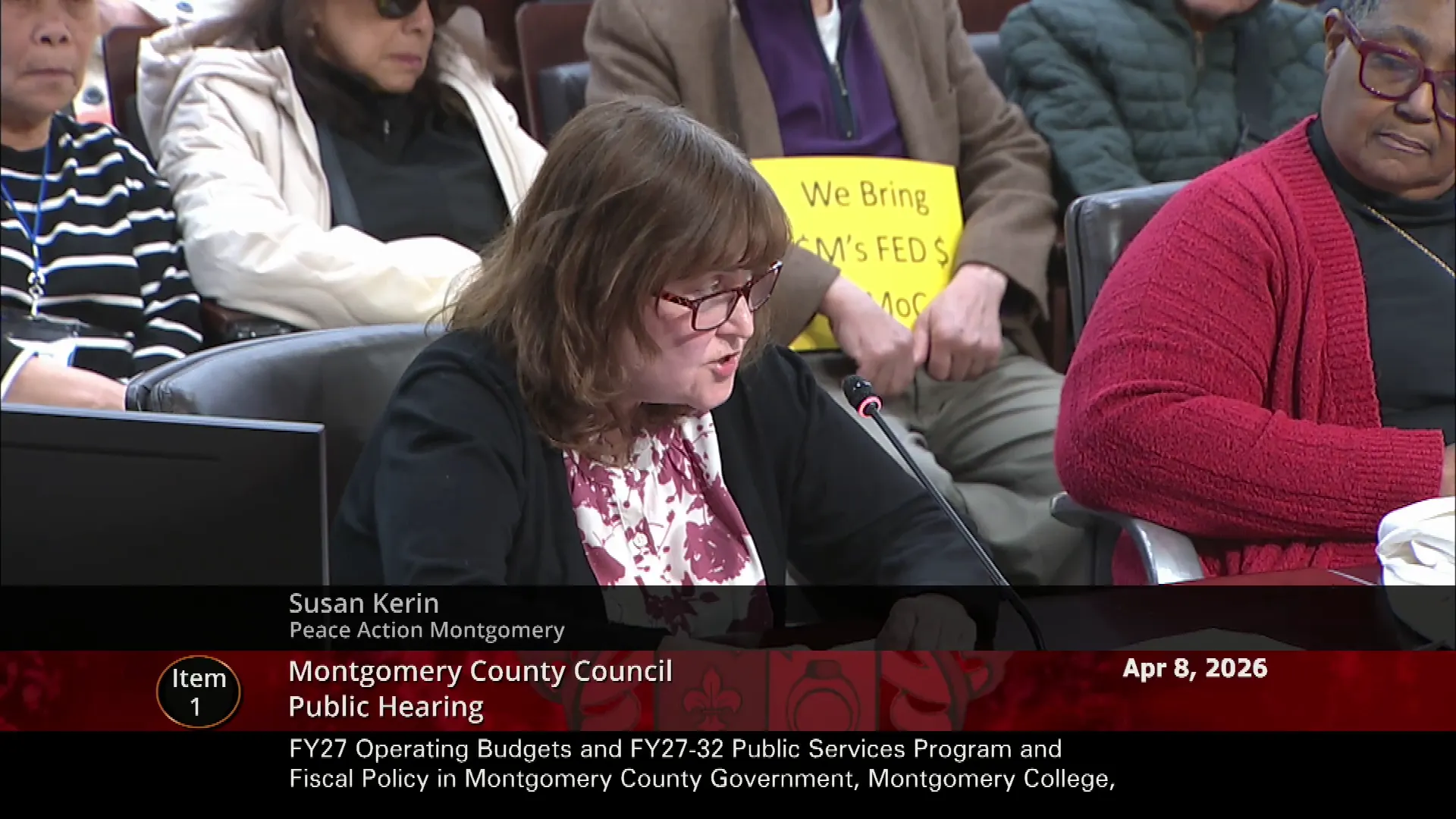
- Susan Kieran (Peace Action Montgomery) acknowledged the County Executive removed Maryland Israel Development Center funding but urged Council members to publicly ground the decision in county values so the funding does not reappear in less visible form.
Key Outcomes
- The public hearing was held and no votes or formal actions were taken.
- Committee worksessions on the FY27 Operating Budget and FY27–32 Public Services Program and Fiscal Policy for the county government, Montgomery College, M-NCPPC, WSSC Water, and MCPS were announced for later in April.
- The Council heard from a large number of residents, nonprofit leaders, business representatives, and advocates on budget priorities, with recurring themes including full parks funding, incinerator closure, affordable housing investment, nonprofit COLA increases, early childhood education, and opposition to proposed tax and fee increases.
Meeting Transcript
Good afternoon, everyone. And your council president, Natalie Fanny Gonzalez, and I'm here with awesome people. We have uh Council Member Stewart. She's in Zoom right now. She's in transit. She'll be here in a few minutes, but she's paying attention. Um. So welcome to the April 8th, 2026 Council session. Agenda item one is a public hearing on the FY27 operating budgets and FY27-32 Public Services Program and Fiscal Policy for Montgomery County Government, Montgomery College, Maryland National Capital Park and Planning Commission, WSSC, Montgomery County Public Schools. Committee work sessions on the FY27 operating budgets and FY27-32 Public Services Program and Fiscal Policy for Montgomery County Government, Montgomery College, Maryland National Capital Park and Planning Commission, WSSC, and Montgomery County Poly Schools will be scheduled through the end of April. As a reminder, for of our public hearings testimony, guidelines, your comments must be limited to issues relevant to the public hearing topic for which you are testifying in at appropriate for public meeting. You will hear a tune when your time is up, and we appreciate everybody following these rules. Please do not clap. Do not interrupt, do not boo anyone testifying. No one. And we're gonna start right now with uh Mr. Jim Brown. Go ahead. All right, everybody. Thank you first of all to all of our friends in the audience, Tao Mung. Good to see you. Come visit Poolsville. Uh I'm the longtime president of the Poolsville Town Commissioners. You guys know that, one of the founders of the Fair Access Committee. Uh whenever I appear before this body, I try to create a theme that separates us from the other good folks that are looking for funding up here. This past February, the theme was appreciation. The theme of my testimony today is the silver platter. Why the silver platter? The town of Poolsville, our Fair Access Committee, and our various partnerships have taken on the responsibility to identify and create the right-sized funding requests needed to benefit the health and welfare of our entire community. Silver Platter number one. We helped county leaders finally recognize the need for a new Poolsville High School. You did it. And for that, I think we can all acknowledge you saved our town. Please refer back to our appreciation theme when thinking about what you've done for us there. Also, please fund our TURF field. We have the fewest practice fields of any high school in the county. That's true. And we're the only modernization project that has not received a TERF field. In addition, you're straining our sole sourced aquifer, also unlike anywhere else in the county, and trying to keep a dead field alive with our water. Our school sports teams also currently have to practice on town-owned fields. Please give us the turf. Silver platter number two. We have again worked with you to show why a community center is vitally important to the health and well-being of our somewhat distant community. Biggest part of the silver platter. We will be donating the use of our town-owned property recently appraised at over $1 million for the community center construction. Please be sure to keep this funded. Silver Platter number three. We've completed the research and base level engineering at our taxpayers' cost to show why a pool bubble on the Sarah E. Hour Western Montgomery County pool makes so much sense. We've also pledged to create the labor pool needed for successful programming and staffing.
openpublica.com