Joint GO/HHS Committee Meeting on Supplemental Appropriation for Community Connect Portal - April 10, 2026
STREAMING COPY IN PREPARATION — RECORDING AVAILABLE FROM THE ORIGINAL SOURCE
Joint GO/HHS Committee Meeting on Supplemental Appropriation for Community Connect Portal - April 10, 2026
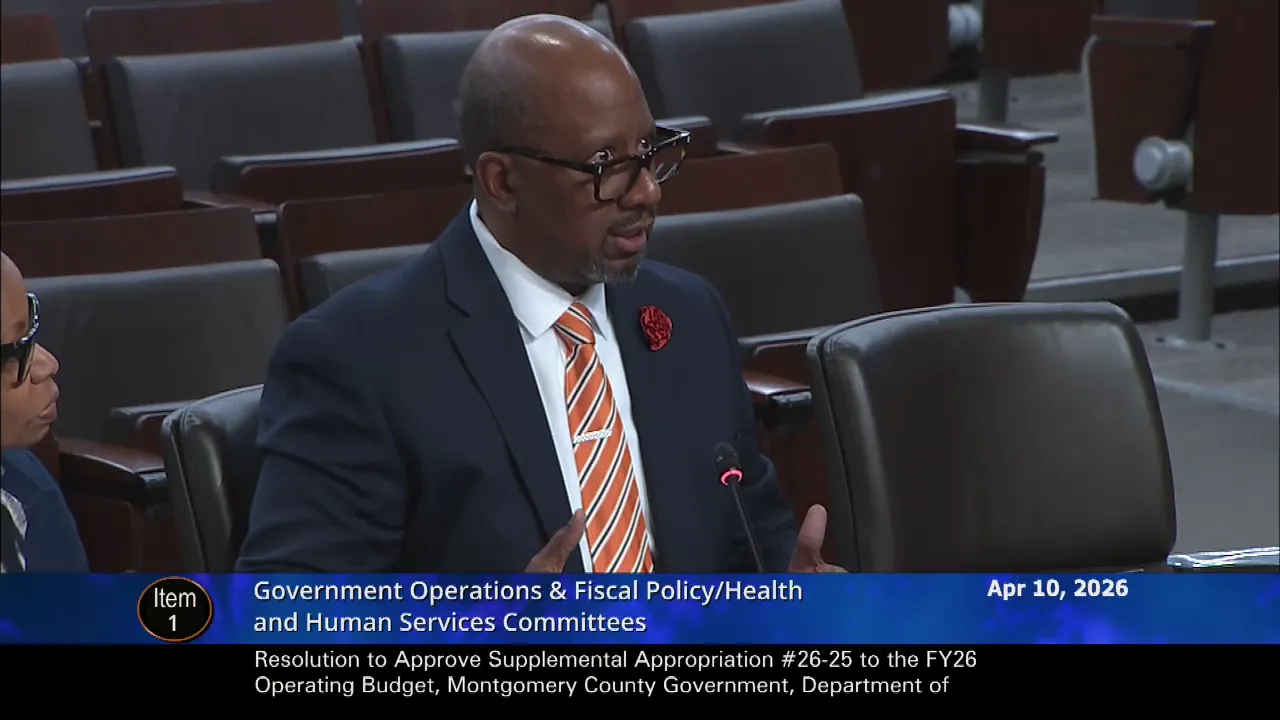
The Government Operations and Fiscal Policy (GO) and Health and Human Services (HHS) committees held a joint session on April 10, 2026, from 1:30 p.m. to 3:33 p.m. to discuss Supplemental Appropriation #26-25, requesting $3 million from General Fund Undesignated Reserves for the Community Connect Portal (CCP). The request included $2.2 million for the Department of Health and Human Services (DHHS) to continue CCP development and maintenance, and $800,000 for the Department of Technology and Enterprise Business Solutions (TEBS) to conduct a feasibility study on countywide expansion. The meeting revealed significant interdepartmental coordination failures and the appropriation was amended.
Discussion Items
- Staff Presentation: Legislative Analyst Nicole Rodríguez-Hernández presented an overview. The CCP was launched in FY22 to digitize applications for DHHS programs, currently supporting six programs with seven languages. Approximately $5.9 million had been spent on development with two vendors. DHHS requested $2.2 million for FY26 (phase four) and $2.5 million for FY27. TEBS requested $800,000 for a six-month feasibility study. The analyst noted that no total cost estimate exists, and maintenance alone would cost $1.5–$2 million annually.
- DHHS Perspective: Dr. Bridgers (DHHS Director) and Dr. Nembhard (Chief Data Officer) emphasized the portal’s benefits: over 2,000 applications processed, 90% of Working Parents Assistance Program applications are electronic, reduced processing time from 30 days to minutes, and improved client experience. Without funding, services would revert to paper, causing delays and increased staff burden.
- TEBS Perspective: Director Roper stated that TEBS was not involved in the initial development (FY22) and was brought in late (October 2025). The feasibility study would assess whether the CCP architecture could be expanded enterprise-wide. She noted that the $800,000 would cover three business analysts and two infrastructure engineers.
- Council Concerns:
- Councilmember Friedson expressed confusion about the emergency nature of the supplemental, noting that the funding gap was due to a budget omission—no one requested funds for FY26. He criticized the lack of interdepartmental leadership, the absence of OMB, and the conflation of the TEBS study with the emergency funding. He stated that the executive branch spent unauthorized funds without council notification.
- Councilmember Katz echoed concerns, calling the situation confusing and highlighting that the request was made after funds were spent. He emphasized the need to keep the portal running but demanded a clear cost breakdown.
- Councilmember Stewart (GO Chair) noted that the TEBS portion should be handled in the FY27 budget, given the fiscal year end. She suggested splitting the requests.
- Councilmember Sayles (HHS Chair) requested the original contract scope, timeline, and vendor details to understand the full project history.
- Councilmember Evans reminded the committee of the portal’s potential to advance racial equity, as stated in the REISJ analysis, and urged caution in disrupting services.
- Executive Branch Response: Luisa Cardona (Assistant Chief Administrative Officer) acknowledged the mistake: the funding fell through bureaucratic cracks multiple times. She apologized for the lack of clear communication. The CFO for DHHS provided a breakdown: $888,576 already spent, $975,000 needed for the remainder of FY26, totaling $2.2 million. Councilmembers requested exact documentation and contracts.
Key Outcomes
- Vote to Remove TEBS Portion: The committee unanimously approved a motion to remove the $800,000 TEBS feasibility study from the supplemental appropriation. The study will be discussed in the FY27 budget context, starting with the GO committee worksession on April 13, 2026.
- Vote to Recommend HHS Portion: The committee unanimously voted to recommend approval of the amended request for $2.2 million for DHHS to continue the Community Connect Portal through FY26. The recommendation is contingent on DHHS providing exact expenditure documentation, contracts, and scope of work before the full council acts.
- Next Steps: The full council is tentatively scheduled to act on the amended supplemental appropriation on May 5, 2026. The GO committee will discuss TEBS’s budget and the feasibility study on April 13. The HHS committee will review the $2.5 million FY27 enhancement for the portal on April 16. Additional joint committee discussions may follow to address the project’s future ownership and enterprise-wide expansion.
Meeting Transcript
Good afternoon, everyone, and welcome to this joint committee session of the Government Operations and Fiscal Policy Committee and the Health and Human Services Committee. Today we are discussing a supplemental that has two pieces. The timing of these things can be a bit funky as we are starting our budget conversations. But just as a reminder to us all, this supplemental is for our FY26 fiscal year, the one we are in now currently. And decisions on the FY27 spending will get decided in committee sessions and full council discussions. So I think we'll dig in, but I'll see if my co-chair wants to say any opening remarks. No, not very many opening remarks. Just looking forward to, you know, both committees seeing how this new technology is going to work and optimize what we have been so used to doing across our government agencies to ensure that our residents can access government services more efficiently and in on demand ways and being able to, you know, uh ensure that our staff has more time to, you know, evaluate and quickly respond to the information that they receive. Um this is the direction that we want to go, and so I look forward to the conversation and any subsequent questions about how we're going to get there and what we've learned since we started this technology upgrade. Thank you. Great. Thank you. All right. So we're going to dig into the community connect portal, and this was launched the creation of it in FY22. We are now again in FY26. There is a request for $2.2 million supplemental for HHS as well as an $800,000 supplemental for TEBS to do a physical feasibility study of the Community Connect portal. Uh Ms. Aradigas Hernandez, you did an excellent packet. I'm gonna turn it over to you first to set the stage and then I'll turn it over to Director Bridges. All right, good afternoon. Would you like to go through the entire staff report first? I think just give us an overview and then we can um have it turn it over to HHS. Okay, great. Great. Good afternoon. Um as the chair noted today, the committee will be reviewing that $3 million supplemental appropriation to the fiscal year 26 operating budget for the Department of Health and Human Services and Technology Enterprise Business Solutions. I'll note in addition to our directors of TEBS and DHHS here, we also have Dr. Nemhard from DHS Online as well. Um as the chair noted, 2.2 million dollars of the supplemental request is allocated for DHGS to continue the Community Connect portal, and $800,000 is allocated to TEBS for a feasibility study on the portal and a potential expansion. Both utilize general funds undesignated reserves, and the executive originally transmitted the supplemental appropriation request on January 5th, with the council introducing it on February 3rd and holding a public hearing on it on February 24th. However, there was no testimony provided on the supplemental appropriation request. As the chair noted, this initiative was launched in fiscal year 22 to help ease the application process for residents staff and private providers through GHHS programs. The chart on the bottom of page two provides you with the standard application lifecycle for an application submitted into the community connect portal. This is where residents can electronically submit their application rather than via email or paper. Um staff are able to review, process, and assess eligibility through this application in the portal, and they're able to communicate with the resident as well as that third-party provider. And the third party provider can also communicate with the resident and request any additional information as needed, receive those referrals, and also streamline their invoicing and payment processes. The Department of Health and Human Services Administration and Support Division initiated this project, and so the Community Connect portal lives under that division within HHS. HHS notes that the primary challenge with the portal has been the administrative burden in managing the complex IT project without the dedicated IT positions for the IT project management, and that the existing programmatic staff have had additional strain placed on them to serve as the subject matter experts on the CCP. And I will note that TBS was not originally consulted in the start of the project back in fiscal year 22. Page three provides you the utilization of the community connect portal to date. Currently, six programs under the Department of Health and Human Services are included in the CCP. That's three of the county health programs, including adult dental, senior dental, and care for kids, two related to early care and education, including the working parents assistance program and the community-based head start program for subsidized child care. That's three of the county health programs, including adult dental, senior dental, and care for kids, two related to early care and education, including the working parents assistance program and the community-based head start program for subsidized child care, and the final is for the rental assistance program for referred individuals who are homeless or have the imminent threat of homelessness. In the Community Connect portal, the applications can be translated into seven languages. That's English, Spanish, Amharic, Chinese, French, Korean, and Vietnamese. And the chart at the bottom of page three provides you 2024 and 2025 data of applications received for the applicable programs and what languages they were input in as. DHES notes that the program performance measures that they track for the CCP include the total volume of applications as well as the utilization amongst the seven supported languages. However, they're evaluating the potential for implementation of a data correction log to track the reduction in data entry errors into their case management system within HHS, which the Community Connect portal was originally established as this bi-directional infrastructure support tool for applicants and applications to be entered into the portal and also connected to their enterprise case management system that they already have. The joint committee may want to understand further the processing timeline for manual versus applications submitted within the CCP and request future data on the impact on error reductions, as well as any demographic demographic breakouts of CCP users and non-CCP users, the utilization of any DGS facilities to apply for the CCP utilizing the computer labs, or any additional information on the percentage of non-CCP applications compared to CCP applications since the launch for each of these programs. To review the funding that the Community Connect portal has received so far, as the chair noted, this project was initiated in fiscal year 22.
openpublica.com