Joint PS/GO Committee Meeting - April 15, 2026: CIP Amendment and Vehicle Recovery Act
STREAMING COPY IN PREPARATION — RECORDING AVAILABLE FROM THE ORIGINAL SOURCE
Joint PS/GO Committee Meeting - April 15, 2026
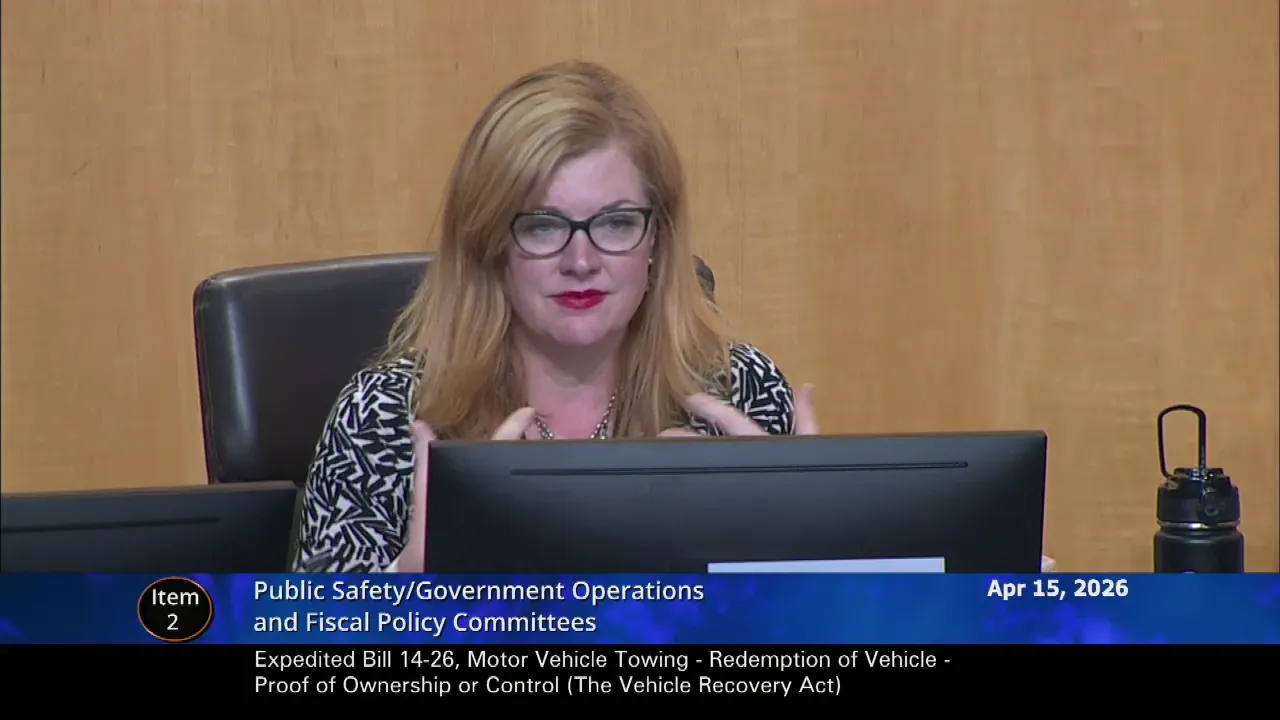
On April 15, 2026, the Government Operations and Fiscal Policy Committee and the Public Safety Committee held a joint session from 1:33 p.m. to 2:07 p.m. to consider two items: an amendment to the FY27-32 Capital Improvements Program (CIP) for County Radio Life Cycle Replacement and Expedited Bill 14-26, the Vehicle Recovery Act, which addresses vehicle release after police-ordered tows.
Public Comments & Testimony
- Councilmember Stewart acknowledged the input of CASA (a community organization) and mutual aid groups, which helped shape the bill. CASA recommended broadening the list of acceptable documents (e.g., school IDs, tax returns) to prove shared residency or familial relationship. Council staff did not recommend these additions, citing concerns about document verification, PII exposure, and operational burden on towing staff.
- Councilmember Mink raised concerns about family members who do not live at the same address (e.g., in-laws, cousins) and whether the bill adequately covers them. The executive branch noted that the bill includes some discretion under subsection D for “other documentation as deemed sufficient.”
Discussion Items
1. FY27-32 CIP Amendment – County Radio Life Cycle Replacement
- The County Executive submitted a March 13 amendment reducing expenditures by $2.6 million and spreading the replacement schedule over the full six-year period. The reduction eliminates duplicate entries for 55 police radio replacements in FY28.
- Council staff recommended approval as submitted. The joint committee agreed without objection.
2. Expedited Bill 14-26 – Motor Vehicle Towing (Vehicle Recovery Act)
- Councilmember Stewart, the lead sponsor, explained the bill’s origin: increased federal immigration enforcement led to vehicles being left behind when occupants were detained, often blocking hydrants or fire stations, leaving no time for families to retrieve them. The bill provides a “Plan C” for family or household members to recover an impounded vehicle without a notarized letter from the owner.
- The bill codifies existing regulations for police-directed tows, allowing a non-owner to redeem a vehicle by presenting a government ID (U.S., foreign, or nonprofit-issued) plus one document showing shared residence (e.g., utility bill, deed, lease, marriage certificate, birth certificate).
- Council staff recommended separating the bill into a new Chapter 30D (Procedures for Police Tow) to avoid confusion with private property towing (Chapter 30C).
- Several clarifying amendments were presented and accepted without objection:
- Relocated the bill to a new chapter for police-directed tows.
- Expanded proof of registration to include out-of-state or temporary registration, not just Maryland MVA documents.
- Replaced the term “authorized agent” with language requiring an individual to demonstrate authorization by the owner via notarized letter, insurance company letter, etc.
- Clarified that “at least one form of documentation” is needed to establish shared residence or familial relationship.
- Specified indemnification language for towing companies when releasing a vehicle to a non-owner.
- Councilmember Luedtke confirmed that the bill does not change the requirement that the person driving the vehicle off the lot must have a valid driver’s license.
- Councilmember Katz asked about jurisdiction if a vehicle is towed from Montgomery County but taken to a lot in Prince George’s County. Office of Consumer Protection staff noted that for police tows, the 15-mile limit may not apply; the vehicle typically ends up in the county’s controlled lot. No amendment was made.
- Councilmember Mink inquired about covering family members who do not share a residence (e.g., in-laws). Council staff expressed concern about verifying distant familial relationships and operational feasibility for lot attendants. The executive branch requested clear, specific guidance to avoid difficult determinations. It was noted that future regulations could be amended by the County Executive without returning to the Council.
Key Outcomes
- CIP Amendment: The joint committee recommended approval of the County Radio Life Cycle Replacement amendment as submitted.
- Expedited Bill 14-26: The committee voted unanimously to recommend approval of the bill as amended, with the clarifying amendments adopted without objection. The next step is full Council action tentatively scheduled for April 28, 2026.
Meeting Transcript
Good afternoon, everyone, and welcome to this joint committee session of the government operations and fiscal policy and the public safety committees. We have two items on our agenda this morning. First is a an amendment we received to the FY27 to 32 capital improvement program, the uh county radio life cycle replacement that we will discuss first, and then we will move on to expedited bill 14-26, motor vehicle towing, redemption of vehicle. Um Ms. Frog, should I turn over to you or Dr. Taregus? Oh, actually, my co-chair, would you like to say a few words before I do that? No, I think you can turn it over to either one of those two. Um staff members, please. All right, great. Let's uh deal with this amendment first. Thank you very much. This is a March 13th county executive amendment to the FY27 through 32 capital improvements program for the county radio replacement project, which has already been reviewed by the joint committee, or the the original um submission was. Uh this amendment is actually reducing expenditures by 2.6 million and it's spreading the expenditures out, so it's delaying some replacements. It's spreading it out across the entire six-year expenditure schedule. The reason for the reduction is there were duplicate entries for 55 police radio replacements in both FY27 and FY28. So the new expenditure schedule is removing the 55 replacements for FY28, and council staff recommends approval as submitted. Perfect. Uh Councilmember Katz, any questions? All right, anyone else have any questions or anything? No, I think the joint committees are good with the recommendation and moving forward with this. Thank you. All right. Thank you very much. Our next item is expedited bill 14 26 motor vehicle towing. Um this is uh also known as the Vehicle Recovery Act. I see Ms. McCartney Green is here, and we have Dr. Stoddard from the County Exec's office. Thank you for joining us. Um as the lead on this bill, I will say that um, and I'm thankful to all my colleagues who have joined on as co-sponsors. Um, this grew out of conversations with um community members, uh, members of our nonprofit organization and mutual aid groups, and I'm thankful that uh we are CASA is here today as we're discussing this bill. Um, and also conversations um I had with uh the police department in the city of Tacoma Park. Um as we saw an increase in federal immigration um activities uh in uh the county, we saw be people being taken off our streets and their vehicles being left behind. And in some instances, reports of uh ICE uh not just leaving vehicles, but blocking hydrants, uh fire stations, and putting them in places that the vehicles needed to be towed immediately, leaving no time for family or friends to recover them after someone was taken. Um then what happens is once the vehicle is impounded, um there are obstacles to recovering that if someone is not on the title, or nor if they did not have a notarized document saying that they were uh able to uh have the vehicle released to them. Um and so after hearing uh many of these stories and looking at how we can assist those who are being impacted uh by uh having loved ones taken um from our streets, uh we looked at drafting this legislation and what alternative um uh forms of identification would be available to have documents released to people who had a familial or household relationship. Um basically we were looking at what could be a plan C. Um so if people were not already on the title for ownership or did not have the notarized document, how could they get a much needed asset for their family, their car, um, out of impoundment as quickly as possible. And so um that is where we are here. Um and I'll see if my co-chair have anything to say. No. All right, Miss McCartney Green, do you want to walk us through the packet and any discussion of any items? Uh thank you, uh Madam Chair Stewart. As a matter of fact, you did a good job walking us through some of the preliminaries. I'll just um circle back on a few uh specific things. Uh so the bill is um really standardized or codifying existing regulations that are under the executive regulations for police to uh specifically when it comes to a release of a vehicle. And so if a vehicle is going to be released, uh one of the things is if there's an owner that's present to pick up the vehicle, they're required to have a government-issued identification along with proof of the motor vehicle um registration. Um so the bill is codifying that part. It's also saying that if the owner is unavailable or not there, that they're able to authorize an agent who they give permission to, either via a notarized letter or my permanent uh preferred terminology is a power returney.
openpublica.com