PHP Committee Work Session on ZTA 26-01 Data Centers – July 22, 2026
STREAMING COPY IN PREPARATION — RECORDING AVAILABLE FROM THE ORIGINAL SOURCE
PHP Committee Work Session on ZTA 26-01 Data Centers – July 22, 2026
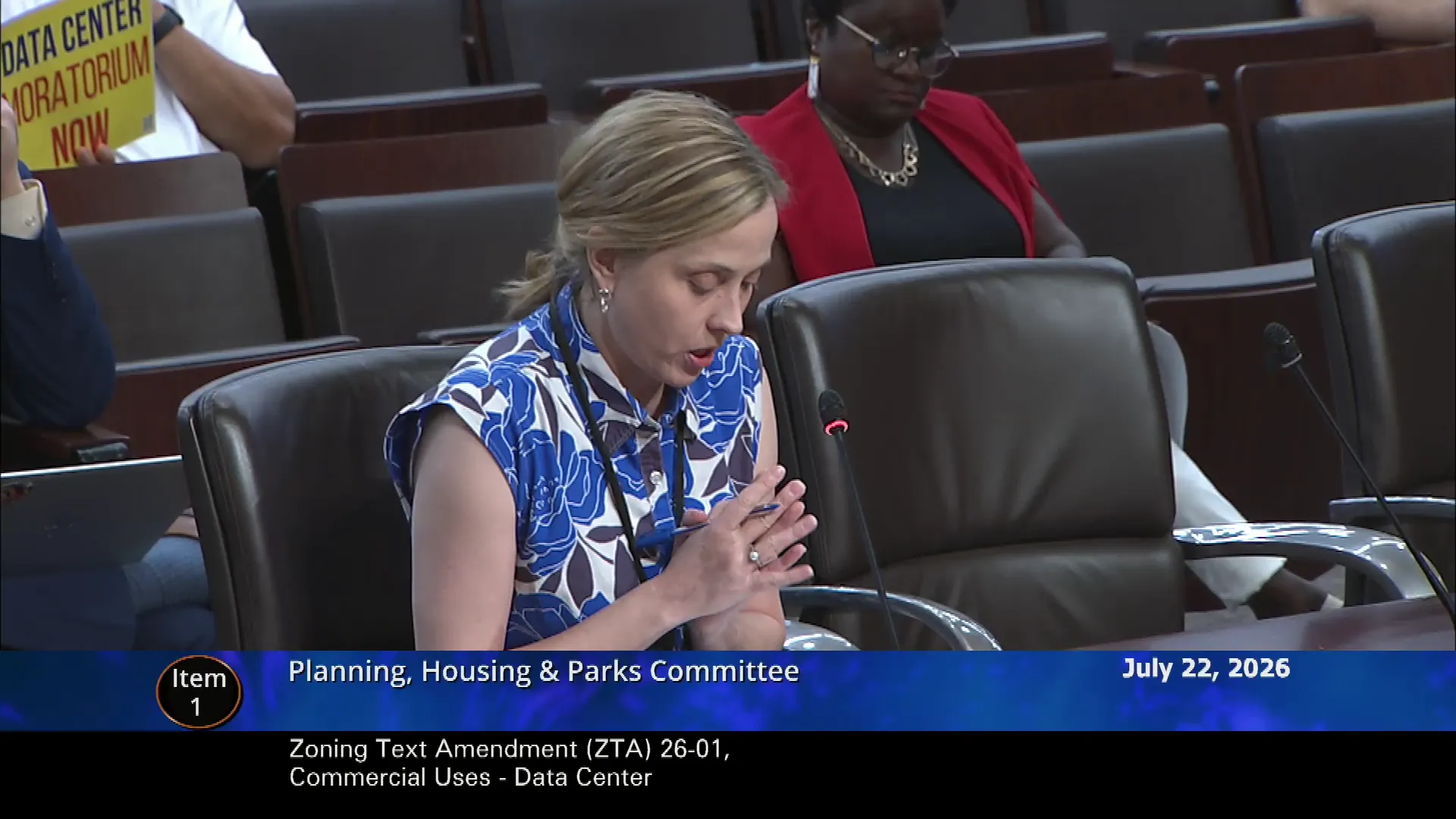
The Planning, Housing & Parks (PHP) Committee, chaired by Andrew Friedson, held a work session on Zoning Text Amendment (ZTA) 26-01 concerning commercial uses for data centers. The meeting occurred on July 22, 2026, from approximately 1:30 p.m. to conclusion, alongside a related Economic Development (ECON) Committee session earlier that morning. The discussion focused on amending the ZTA to define large data centers and temporarily prohibit them countywide while further studies are conducted.
Discussion Items
- ZTA 26-01 Overview and Sponsor Amendments: Council President Natali Fani-González and Council Vice President Marilyn Balcombe, co-sponsors of ZTA 26-01, outlined a revised approach. The amendment, developed with Councilmember Laurie-Anne Sayles, aims to define large data centers (using a threshold of 25 megawatts monthly electricity demand, per the state's Utility Relief Act of 2026) and add them to the use table with blank cells, effectively prohibiting them countywide. Exclusions include higher education institutions and hospitals. The change preserves the status quo while the council awaits an Office of Legislative Oversight (OLO) report on data center impacts, expected fall 2026, and ongoing state studies.
- Context and Moratorium: Earlier that day, the ECON Committee voted unanimously for an 18-month moratorium on large data centers. The PHP Committee’s action on the ZTA definition is intended to align with that moratorium, ensuring a single, consistent definition across county code. Chair Friedson stressed that the moratorium is meant to facilitate ongoing work, not pause it; work on issues like energy, water, noise, setbacks, tax rates, and community impacts should continue.
- Staff Recommendations: Council attorney Ms. Wellens presented the global amendment requested by sponsors. Staff also recommended a transition clause: the prohibition applies to any application that has not received a building permit before the ZTA’s effective date. The use table will show no allowed zones for large data centers.
- Councilmember Questions: Councilmember Will Jawando asked about treatment of facilities under 25 megawatts. Ms. Wellens clarified that existing under-threshold facilities would be unaffected, but expansions that bring a facility to or above 25 megawatts would be prohibited under the ZTA.
Key Outcomes
- Vote on Global Amendment: The committee voted 3-0 (Friedson, Fani-González, Jawando) to adopt the global amendment defining large data centers and precluding their use countywide.
- Vote on Transition Language: The committee voted 3-0 to adopt the transition clause ensuring the prohibition applies to any project without a building permit before the ZTA’s effective date.
- Vote on ZTA as Amended: The committee voted 3-0 to approve ZTA 26-01 as amended.
- Next Steps: The full Council will consider the ZTA on Tuesday, July 28, 2026, followed by the moratorium legislation. The definition agreed upon in this committee is intended to be the county’s definition of a large data center.
Meeting Transcript
Good afternoon. It is just after 1 30 on July 22nd. We're here for the planning housing and parks committee work session on ZTA 2601 commercial uses data center. There was a related conversation in the econ committee earlier today. This is the zoning piece of it. There have been a lot of uh conversations on this issue. Obviously this is a very important issue of significant uh public interest and of significant public concern. The sponsors have sent around a memo of their approach, which we are going to go through uh today, but before we turn it over to Ms. Wellens uh and walk through the packet and the decision points that we have today, which have changed uh in recent days uh and in light of uh recent events and decisions uh including as early as this morning, I'm gonna turn it over uh to uh sponsors and to uh committee colleagues. Uh let me start uh with council president. Thank you so much, Chair Fritson. Um I think most of you were here this morning. So I'm gonna repeat some of the things we say just to make sure that everybody is on the same page. Uh this morning the economic development committee met and voted unanimously on a moratorium for 18 months and is coming to the full council um on Tuesday. That um moratorium also has a definition for uh large data centers, but I what I said this morning is that we need to have one definition only. So today in the zoning text amendment, we're gonna be going through that definition and then on Tuesday, we will first deal with the ZTA in full council and then the moratorium. But the idea is to have the definition that is gonna be agreed on by this committee as the definition for the for what it is a large data center in the county. Um and then um we're doing this because we truly love this county. We're gonna take our time to make sure that the decision for a large data center is done the right way in that we have the right um uh setbacks and protections for the environment, for communities and so forth. We're gonna be also waiting for the OLO report on data centers that is coming up very soon, OLO meaning Office of Legislative Oversight's report, as well as the state. They're doing a study on the impact of on data centers on the community. So we're gonna be getting lots of information in the coming months, which is all great. And then we'll move forward as a county uh on the next steps, taking our time and continue to work with our community on how to do this right. Okay. So with that, the the zoning text amendment, as um the chair has mentioned, um the authors of this ZTA, and you have two of them here is Council Vice President Meryl Balcon and myself alongside uh Councilmember Laurian Sales. Uh we have made some um suggestions that we're gonna be discussing here just to ensure that um that we go side by side with the decision that we made this morning with the moratorium and all the information that we're gonna be getting in the future as I just described a few minutes ago. And with that, if if it's okay, I'm gonna turn it to Council Vice President Balcom so she can um add anything that I missed. Cool. Thank you. Uh it's been quite a journey. Uh so as I've said many times, uh the data centers are currently not defined in our code, and there are no restrictions to data centers as of this moment. And when we um as this was moving forward and it and it looked as if there uh a data center was coming to Montgomery County, uh, we worked together very, very uh diligently to come up with ZTA 2601, which was uh written and introduced back in January. The underlying premise was we had to have not only define data centers, but identify where they would go and how they would operate. So the past seven months has really spent, we we've spent looking at what those guardrails are. We we looked nationally, starting with a policies paper from the county executive and worked on various issues, working with uh all of you as I said this morning. I think I've met with everybody in the room um many times. Uh and um and it would it just became apparent that uh the some of the issues are are still very much in play, uh energy and water being two of the primary ones. Uh and um and it would it just became apparent that uh the some of the issues are are still very much in play, uh energy and water being two of the primary ones, and uh it became apparent to the co-leads that we needed to step back and uh but we have to have a definition in our code. And so what this what this um will now do is just primarily define data centers and and um and kind of go from there. Uh and it's it really is a companion piece to what we did this morning, or vice versa uh with the moratorium. So um thank you. Thank you to the sponsors, uh Councilmember Drono. Thank you. I I appreciate uh the President and Vice President and uh the committee chair. I was a guest at the econ committee this morning. Uh and as I've said from the very beginning, uh we don't want to be first, we want to be right. Uh we want to get this right. Um the 18-month moratorium, uh, while a little shorter than the two years I proposed is is a lot, a lot better than six months, and it gives us a really good, I think, good runway with the work that has already been done and some of the community impact of feedback or on the impact to lay out a process and get and get this right. Uh noise, water, setbacks, uh, the tax rate, which I've talked about a lot. So uh thank again all of the community advocates, uh my colleagues.
openpublica.com