Montgomery County HHS Committee Meeting - July 23, 2026
STREAMING COPY IN PREPARATION — RECORDING AVAILABLE FROM THE ORIGINAL SOURCE
Montgomery County Health and Human Services Committee Meeting - July 23, 2026
The Health and Human Services (HHS) Committee met on July 23, 2026, at 1:00 p.m. in Council Hearing Room 3CHR. Chair Laurie-Anne Sayles presided, joined by Committee Member Andrew Friedson. The committee discussed two bills: Bill 28-26, amending the Intellectual and Developmental Disabilities (IDD) Commission membership, and Bill 12-26, updating payment requirements for developmental disability service providers. Both bills were approved and recommended to the full Council.
Discussion Items
Bill 28-26 – IDD Commission Membership and Naming
- Council staff member Ogorzalek presented the bill, which revises the IDD Commission's voting membership from 19 to 23 members. The 15 member seats reserved for individuals with IDD or their families/guardians would be split into three groups of five: individuals with IDD, family/guardians, and a third group from either category. At least three of these 15 must participate in self-directed services.
- Bill sponsor Councilmember Don Ludke proposed an amendment to rename the bill the “Jake Dedinski Advocacy Act” to honor an original commission member and advocate. The amendment was accepted.
- No fiscal impact was identified. All public hearing speakers supported the bill.
Bill 12-26 – Payments to Service Providers for Persons with Developmental Disabilities
- Council staff Christine Wellons introduced the bill, requested by the County Executive to align code with current practices. It removes a requirement for DHHS to annually recommend payment amounts based on outdated 125% minimum wage metrics, and clarifies that services must be provided to Montgomery County residents in the county.
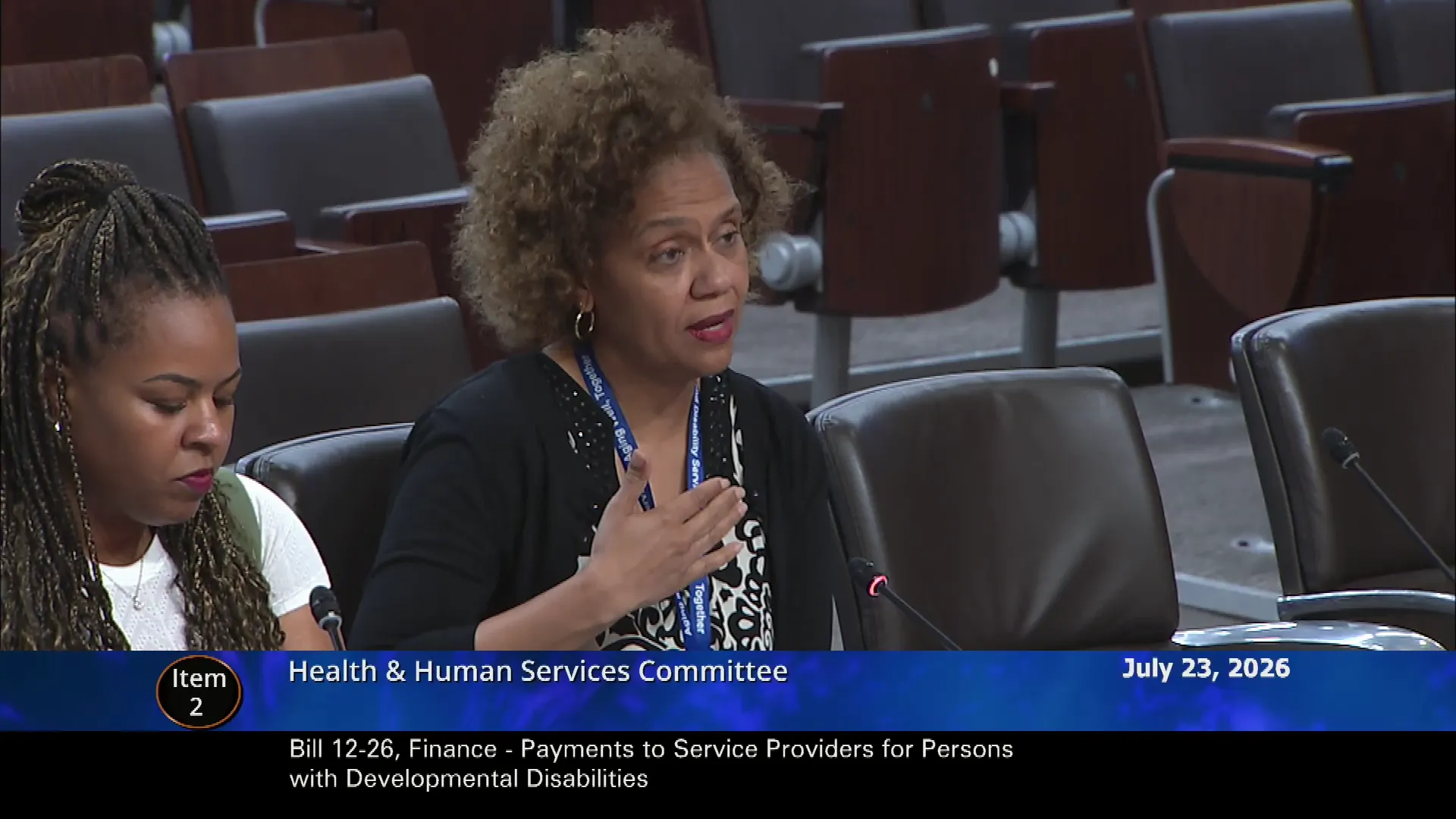
- Dr. Patrice McGee (Director of Aging and Disability Services) and Kim Mayo (Senior Administrator) explained that the 125% rule is no longer used; providers (via the Interact consortium) now submit their own budget requests. The department conducts wage surveys and customer satisfaction surveys to monitor compliance, but no formal report to the Council is required under the bill.
- Councilmember Friedson expressed strong support for providers but voiced concern about the “squeeze” between rising county minimum wage and state funding cuts. He noted a potential $22 million shortfall from a paused 2% state reduction (anticipated October 1) and asked for timely updates. Dr. McGee confirmed the department monitors state changes and previously convened a task force on direct support professional workforce shortages.
- Chair Sayles clarified that the removal of the reporting requirement means the Council would no longer receive an annual calculation from DHHS, but the department committed to providing data upon request.
Key Outcomes
- Bill 28-26 (as amended) was approved unanimously (motion by Chair Sayles, seconded, all in favor) to recommend to the full Council.
- Bill 12-26 was approved unanimously (motion by Chair Sayles, seconded, all in favor) to recommend to the full Council.
- Staff agreed to share the customer satisfaction survey results and wage/turnover data with the committee.
- The committee will be kept informed of October 1 state funding changes and their impacts.
Meeting Transcript
Good afternoon, everyone, and welcome to the Health and Human Services session today where we will be discussing two pieces of legislation introduced by my colleague, Councilmember Don Ludke. We are joined by our other committee member, Mr. Councilmember Andrew Friedson. So we will be talking about two items focused on supporting and strengthening services for individuals with intellectual and developmental disabilities across Montgomery County. Before we begin, I just want to share a quick reminder that today's session is being televised live on County Cable Montgomery and streamed on the council's website. The first item that we will be discussing is Bill 28-26, Health and Sanitation, Intellectual and Developmental Disabilities Commission membership appointment terms and amendments. Our first item regarding the IDD commission will address membership appointments and terms to ensure the commission remains effective, representative and aligned with community needs. I will let Mr. Ogorzelec brief us on the staff report and key provisions of the bill. And then we will hear from the bill sponsor, Councilmember Ludgey. Thank you very much, Chair Sales. This bill would revise the structure of the voting members on the commission. Presently, there are 11 of those 19 members must either be individuals with IDD or family members, guardians, or support staff of the V of individuals with IDD. The revised structure would expand the scope of those 11 members up to 15 members, which would bring the total commission number of voting numbers from 19 to 23. And it would that those 15 members would be divided as five individuals with IDD, five individuals who again fall into that family or guardians of individuals with IDD, and then a third tranche of five members who come from either of those two categories. And I would also note that the bill would require that at least three of those 15 total members be individuals who participate in self-directed services, which is a term defined in state law. The only impact statement so far is the fiscal impact, which indicates uh no impact. Uh, there were multiple speakers at uh public hearing, all of whom testified in support. And there is one amendment. I don't know, Councilmember Ludke. Do you want to discuss that first or would you like me to introduce that? Uh sure. At the time the bill was introduced, um, the our committee here all assembled. We had sent a letter to full council announcing the intent of to name the bill after Jake Dedensky, who was one of the original members of the IDD commission, um, and is an individual with a developmental disability who whose advocacy brought this issue forth and who came to our uh public testimony on the bill again to continue advocating on behalf of those um in the community who are most affected and whose voices need to be elevated rather than having others speak on their behalf. So that is why we um requested to add an amendment to change the name of the bill, um, which would allow us to call it the Jake Dedinski Advocacy Act. Thank you. And nothing further from staff. Uh thank you, Ms. Del Gorzalek. And if there are no further comments or questions, we move to approve to recommend this to the full council. Do we need to take a look at the uh vote? Okay. Can we uh yeah, I move to approve. Make the motion. Thank you. All those in favor, raise your hand. Free nothing as amended. Thank you. Thank you. All right. Moving along, that brings us to our second bill, 1226. Or welcoming Christine Wellens and our director of aging and disability services, Dr. Patrice McGee and Miss Mayo. Thank you so much for joining us. I wanted to um just briefly share the Bill 2820. Bill 1226 focuses on payments to service providers for persons with developmental disabilities. Ensuring our service providers have reliable and sustainable support is critical to maintaining high quality care and resources for vulnerable residents. I will turn this over to Council staff, Ms. Wellins, to present the staff report on Bill 1226, and then we will hear from Dr. McGee and Ms.
openpublica.com