OPENPUBLICA · PUBLIC MEETING RECORD
Record of Proceedings
Montgomery County HHS Committee Reviews Uninsured Care and H.R.1 Impacts on Oct 29, 2026
County Council & Committees — Thursday, October 29, 2026
BodyMontgomery County, Maryland
SessionCounty Council & Committees
DateThursday, October 29, 2026
StatusNEW · FILED
Video Record
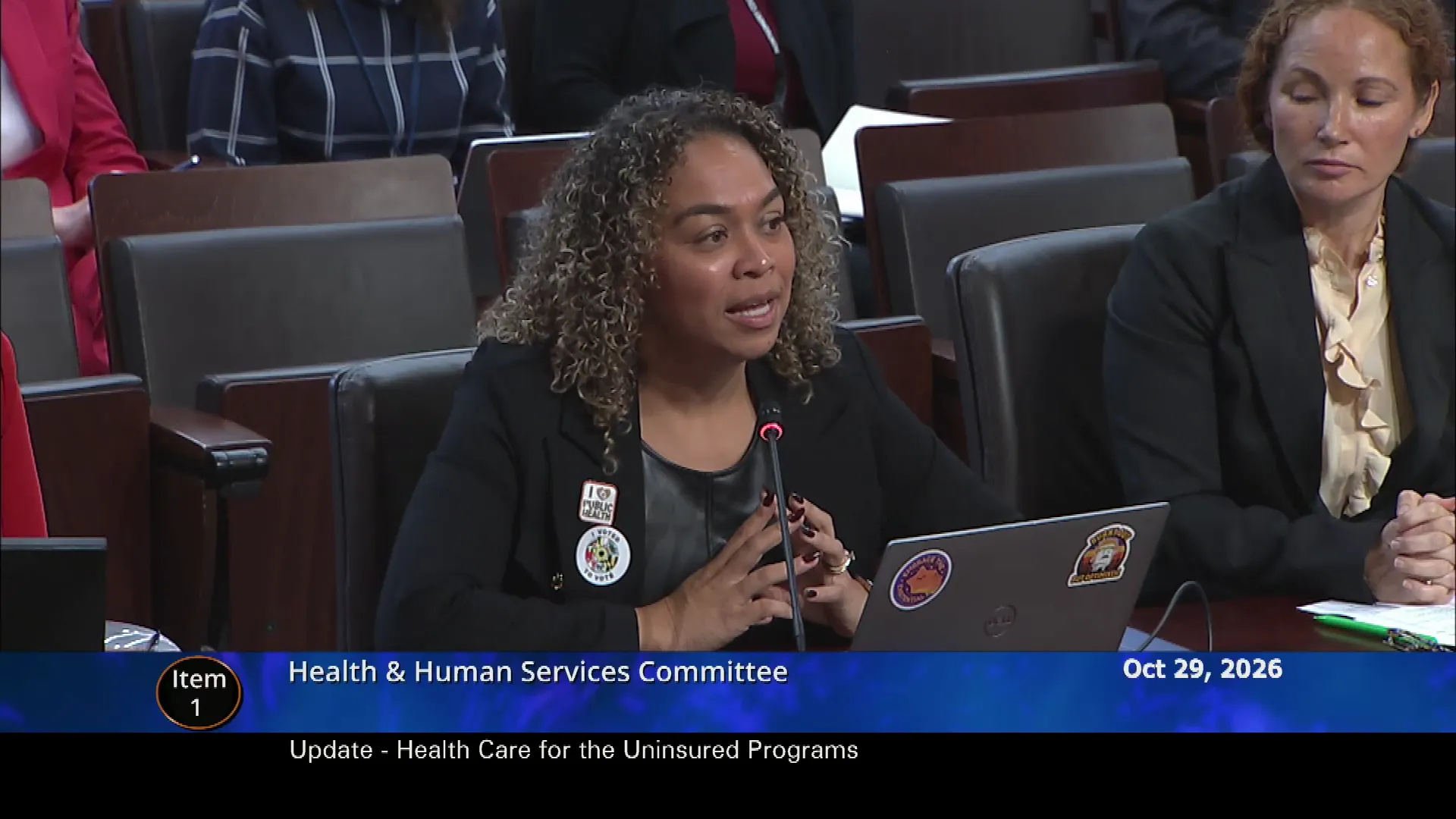
STREAMING COPY IN PREPARATION — RECORDING AVAILABLE FROM THE ORIGINAL SOURCE
Transcript — Verbatim
Speaker numbers apply only to this recording. Names come from transcript evidence. “Possibly” marks uncertain attribution.
Discussion Breakdown — Share of Meeting
Healthcare Access52%
Public Health35%
Food Security11%
Youth Programs1%
Mental Health Awareness1%
Summary of Proceedings
Montgomery County HHS Committee Reviews Uninsured Care and H.R.1 Impacts – October 29, 2026
The Health and Human Services (HHS) Committee of the Montgomery County Council met on October 29, 2026, from 2:00 p.m. to 4:30 p.m. to review updates on health care programs for the uninsured and the implementation of H.R.1, focusing on October Medicaid eligibility changes. Chair Laurie-Anne Sayles led the session, with Councilmembers Andrew Friedson and Dawn Luedtke participating. Staff from the Department of Health and Human Services (DHHS) and the Primary Care Coalition (PCC) presented data and fielded questions. No formal votes were taken; the committee instead identified follow-up actions and priorities.
Health Care for the Uninsured Programs
- Dr. Nina Ashford, Chief of Public Health Services, presented an overview of three programs: Montgomery Cares (adults), Care for Kids (children), and the Montgomery Perinatal Program (formerly Maternity Partnership). The programs are funded by Montgomery County and administered by PCC, except the perinatal program, which is county-run.
- Dr. Veronica Vella, Senior Director of Healthcare Access at PCC, provided utilization data:
- Montgomery Cares encounters increased from 61,000 in FY23 to 82,000 in FY26. The county pays a rate of $130.82 per encounter in FY27.
- Care for Kids enrollment declined from 3,928 to approximately 3,000 between 2025 and 2026. Dr. Vella attributed this to parents' fear of visiting government offices due to the political climate and the loss of a community health worker program (Point of Entry) that helped enroll children during school registration.
- Average appointment wait time across the network is 10.5 days, ranging from 1 to 21 days; the longest waits are at Federally Qualified Health Centers (FQHCs). Wait times have been consistent over the past few years.
- Quality metrics show high performance in hypertension control (99.7%) and diabetes A1C testing (90.4%), but lower rates for breast cancer screening (only women 45+ are covered) and diabetic retinal exams. PCC recently added retinopathy screening at two practices.
- Behavioral health services, funded by a supplemental appropriation, served over 2,000 patients, including case consultations for 475 and social needs support for over 400.
- The Montgomery Perinatal Program served 1,870 clients in FY26, a 20% increase from 1,500 in FY25. The first quarter of FY27 was strong with 480 clients. The program is transitioning to an integrated “One MCH” model to align with the 2025 OLO report on racial disparities.
- Councilmembers raised concerns about declining enrollment in Care for Kids and the impact of clinic access barriers. Dr. Vella noted clinics have adapted by rearranging wait areas and increasing telehealth use. Councilmember Friedson requested comparison data on FQHC wait times versus national standards, and asked whether wait times are business or calendar days.
- Councilmember Sayles asked about outreach and coordination with community partners such as VITA and libraries. Staff committed to sharing the new client guide and to reach out to VITA.
H.R.1 Implementation
- Tara Clemons Johnson, Council staff, reviewed the policy changes. State data indicates 1,082 Montgomery County residents have lost Medicaid eligibility due to H.R.1 changes, down from earlier estimates of 4,000. The county estimates 700–1,200 may be affected. County-wide, an estimated 33,000 Temporary Protected Status (TPS) holders will lose ACA subsidy eligibility beginning January 2027, with most residing in Montgomery and Prince George's counties.
- Sean Gibson, Health Insurance Manager at OESS, described mitigation efforts: referral to Montgomery Cares, Care for Kids, and Qualified Health Plans (QHP) during open enrollment (November 1 through January 15). He highlighted the new rule eliminating the cap on advanced premium tax credit repayments, which could cause large tax bills. Refugee medical assistance will expand from 8 to 12 months in January. SSI recipients will face new immigration-related eligibility requirements starting January.
- Dr. Patrice McGee, Chief of Aging and Disability Services, reported nine county residents lost Medicaid waiver services (emergency Medicaid waivers) as of October 1, affecting their home-based care and residential support. She noted DDA has not provided continuity plans or funding; county providers are trying to fill gaps, but a supplemental appropriation is being requested.
- Yvonne Iskandry of OESS discussed SNAP changes: work requirement age range expanded from 18–54 to 18–64, and veterans and foster youth under 24 are no longer automatically exempt. The county is helping recipients comply, and so far few have lost benefits in October.
- Councilmember Luedtke expressed concern about the lack of proactive planning by DDA, and questioned the adequacy of work requirement exemptions for people with disabilities. Staff affirmed that individuals with disabilities may be exempt if they provide medical documentation.
Key Outcomes
- Staff agreed to provide follow-up data comparing the county's 10.5-day average appointment wait time with state and national benchmarks for FQHCs and other systems, and to clarify whether the wait time is in business or calendar days.
- The committee will receive updates on the supplemental appropriation requests, including those for the Montgomery Perinatal Program (nurse and health educator positions) and support for individuals who lost waiver services. These supplementals are scheduled for committee consideration on November 18.
- Councilmembers requested continued coordination with community partners, including VITA and libraries, to disseminate information about coverage options and safety net programs.
- Future reports will include outcomes of the new reproductive health services program and further analysis of Care for Kids enrollment trends.
Meeting Transcript
All right, good afternoon, and welcome to the Health and Human Services briefing. We are going to have a work session today. I want to welcome my colleagues, council members Andrew Friedson and Dawn Lukey. Council staff, our DHS leadership, community health partners, and everyone joining us in chambers or online. Our two briefings connect the capacity of our health care safety net with the consequences of HR 1. When federal policy takes away health coverage, the need for care remains. Residents still need prescriptions, treatment, and trusted guidance. County agencies and community providers must respond with finite resources. The staff reports identify pressures that warn our attention, declining care for kids participation, growing Montgomery Care's utilization, and an estimated 700 to 1,200 county residents who may be affected by the October Medicaid eligibility changes. Today I want us to move from identifying risk to establishing responsibility for addressing them across both briefings. We should clarify what we know, what action is underway, who is responsible, and when we will assess progress. Communicate local impacts, and pursue available assistance. Our goal is to anticipate gaps before residents experience a crisis and identify decisions the council needs to make. So item one health care for the uninsured programs. We will begin with care for kids, Montgomery CARES, and the Montgomery Perrinatal Program. Our focus is whether residents are reaching care and whether providers have the capacity to meet current and emerging needs. Declining participation warrants investigation, just as increasing demand requires preparation. Ms. Tara Clemens Johnson, please introduce the item and if you can summarize the staff findings as well. Thank you. Good afternoon. Thank you, Chair Sells, and hello to our other DJS Committee members. We are starting with item number one, which is the health care for the uninsured programs update. I just want to clarify for the millions watching at home that there are two separate staff reports and two presentations that will be given on the different items. The health care for the uninsured report includes the HR1 as part of the update for this item, but we will discuss that with the next item. So in going through the staff report, uh, one thing that I wanted to highlight is the health care for the uninsured programs also includes the health care for the homeless program. Because that program lives in the services to end and prevent homelessness area of the department. The HHS committee received an update on that program on October 15th when we met a few weeks ago. If there's any follow-up from that meeting, please let me know and we can provide that for you. In going through the packet, I just wanted to call attention to just a few items. On page number two, uh the care for kids visits. Historically, we have not been able to get visit encounter data from the school-based health centers or Kaisers. So that is a significant portion of the children that are seen within the program. So it's great to have these numbers, but it does not represent the full number of visits that are happening in those programs. I think Kaiser alone sees 700 to maybe a thousand care for kids kids, and then the vast majority of our children are seen at school-based health centers. So significantly underreported, and it's always been a data concern, but they're they've always been working on it in terms of the department. I wanted to call attention to the reproductive health program on page three. It was funded in for the first time in FY26. However, the program is just ramping up to being able to see clients just by the time the budget was approved and trying to establish contracts, um, you know, um medication that would be needed, that there was not uh the ability to spend the funds, my understanding, in FY26. So 180,000 was approved for that program, and they are working to begin providing services. And then on page four and five, we uh received an update on the maternity partnership program. I just want to note that the committee discussed um maternity partnership and the other maternal health programs within DHHS February 16th earlier this year. Uh, that was more so related to the OLO report on racial disparities in maternal and infant help. And there was some follow-up that occurred after that. So that we will hear from the department today on any um changes to MPP. Also want to note that there was related to MPP, um, is the babies born healthy program during the budget. There was a one and a half FTE that was not able to be funded, which was a nurse and a health educator. So we have received a supplemental request from the department for that position, those positions to be considered for funding because uh the program is not able to see as many women as they were previously due to the loss of staff. And then we'll just touch on Montgomery Care as the last item on page six of your packet. I want to note that the number of encounters that have increased over the last four years.
SUMMARIZED BY OPENPUBLICA AI
TRANSCRIPT VIA PUBLIC VIDEO
openpublica.com
openpublica.com