OPENPUBLICA · PUBLIC MEETING RECORD
Record of Proceedings
Joint Oversight Hearing on Older Adult Centers at NYCHA Facilities - October 27, 2026
City Council — Tuesday, October 27, 2026
BodyNew York City, New York
SessionCity Council
DateTuesday, October 27, 2026
StatusNEW · FILED
Video Record
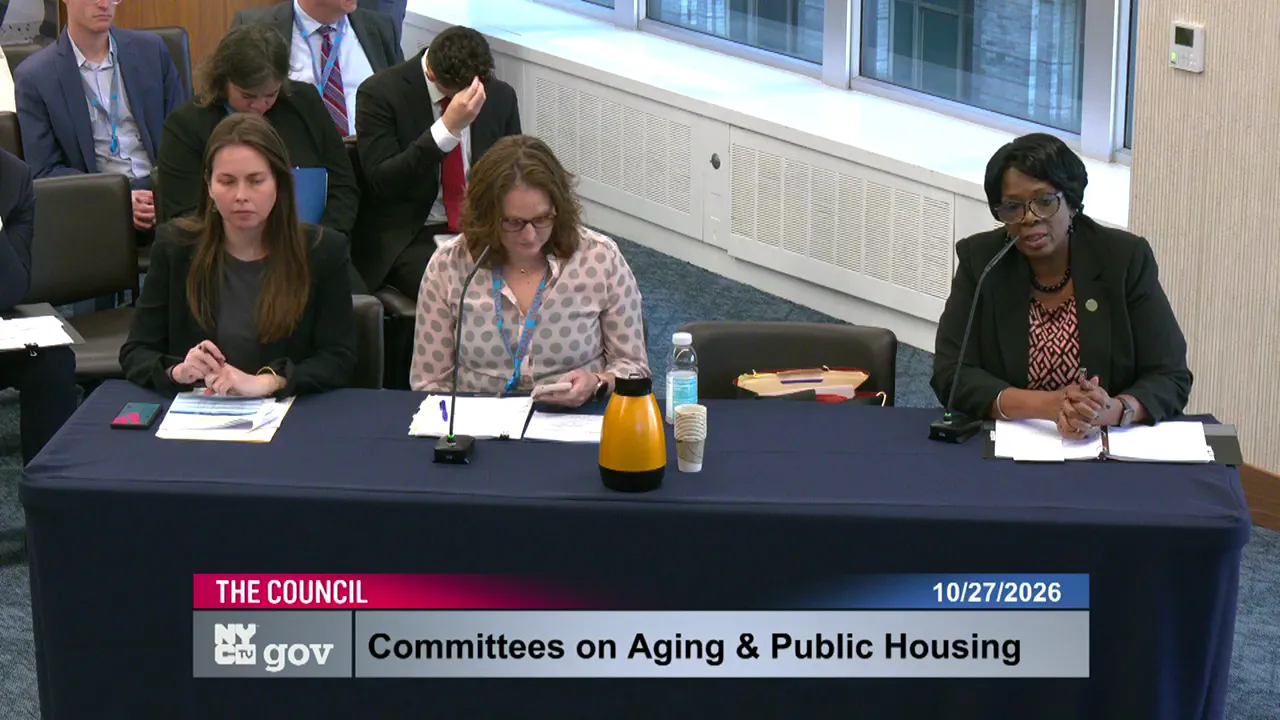
STREAMING COPY IN PREPARATION — RECORDING AVAILABLE FROM THE ORIGINAL SOURCE
Transcript — Verbatim
Speaker numbers apply only to this recording. Names come from transcript evidence. “Possibly” marks uncertain attribution.
Discussion Breakdown — Share of Meeting
Public Housing37%
Senior Services34%
Interagency Coordination12%
Public Safety7%
Procedural3%
Public Engagement2%
Mental Health Awareness2%
Budget2%
Elder Justice1%
Summary of Proceedings
On October 27, 2026, the New York City Council Committees on Aging (Chair Susan Zhuang) and Public Housing (Chair Chris Banks) held a joint oversight hearing to examine the conditions of Older Adult Centers (OACs) located in New York City Housing Authority (NYCHA) facilities, and to hear testimony on Introduction 1083, which would require financial literacy advisors in OACs. The hearing featured testimony from two panels of OAC provider representatives, an administration panel of NYC Department for the Aging (DFTA) Commissioner Dr. Lisa Scott McKenzie and NYCHA Chief Operating Officer Eva Trimble, and public testimony. A central theme was the breakdown in communication and unclear division of maintenance responsibilities between NYCHA, DFTA, and OAC providers, exacerbated by aging infrastructure and the RAD/PACT conversion process.
Public Comments & Testimony
- Sarah Morgridge (Riverstone Senior Life Services): Morgridge detailed severe problems following her center's NYCHA building converting to RAD/PACT with a private landlord (PRC). She stated the landlord caused them to lose their property liability insurance twice (first by demanding they claim PRC's water damage on their policy, and second due to illegal fire panels PRC refused to remove). PRC is pressuring them to sign a license agreement containing an eviction clause for failure to maintain insurance, a situation PRC themselves caused. She characterized non-profit providers as an afterthought in the RAD program.
- Patricia Lynch (Millennium Development): Lynch described struggling to provide basic services amidst unresolved leaks, lack of heat, and broken elevators. She stated that when issues are reported, responsibility is often passed between agencies, leading to significant delays. She noted that many OACs lack formal MOUs or lease agreements, impairing their ability to make improvements and leading to FDNY citations. She called for clear ownership and urgency in resolving building issues.
- Bridget Lee (Weinberg Center for Elder Justice): Expressed support for Int. 1083 but urged the council to strengthen it by requiring advisor training in elder abuse and financial exploitation red flags.
- Anita Kwok (United Neighborhood Houses): Testified that the promised interagency coordination between DFTA and NYCHA has not materialized effectively, leading to prolonged repair timelines and providers being asked to undertake maintenance without funding or site control.
- Rosemary Salazar (University Settlement): Described a specific case where NYCHA refused to connect a fire panel to the FDNY alarm system, deferring responsibility to the provider despite historical practice.
Discussion Items
- Repair Protocols & Coordination: DFTA Comm. McKenzie and NYCHA COO Trimble described the repair workflow (provider calls NYCHA CCC, ticket assigned, NYCHA fixes building systems, providers fix interiors). They reported bi-weekly and quarterly meetings to review open tickets. Chair Zhuang raised a specific example of a leak at LaGuardia/Dykeman OAC that providers reported as ongoing for two years. Chair Banks questioned the effectiveness of the process, noting the absence of a formal written maintenance agreement between NYCHA and DFTA, which he argued contributes to responsibility being passed between agencies.
- Infrastructure & Capital Needs: NYCHA stated it received 1,700 work orders from OACs in the past year, with approximately 250 still open and an average 12.8-day response time. NYCHA identified 60 current FDNY violations and 2 DOB violations at OACs. Officials acknowledged the closure of Latimer Gardens OAC due to a roof leak, stating the required roof replacement is an unfunded capital project with roughly a 4-year timeline if funded. DFTA stated they rely almost entirely on discretionary funding from elected officials for capital improvements, having completed 56 projects in FY26 thanks to a $5M Council grant. Councilmember Restler highlighted stalled $6M in capital funds from the Brooklyn Borough President, which NYCHA attributed to past staffing shortages now resolved.
- RAD/PACT Conversions: Chair Banks queried whether OAC rehabilitation is guaranteed in PACT deals. COO Trimble noted that while it is always the intent, Section 8 funds cannot be used for community spaces, making such renovations dependent on available city subsidy. She confirmed that Council capital funds allocated for OACs in developments that later convert to PACT are evaluated on a case-by-case basis.
- Financial Literacy Bill (Int. 1083): Councilmember Hudson, the bill's sponsor, discussed implementation with the administration. DFTA supports the intent but estimates the cost for an advisor at every OAC for 20 hours per month to be between $2-3 million. Comm. McKenzie suggested shared or mobile advisors could be an alternative. Public testimony supported the bill while requesting amendments for specific elder abuse training.
- Safety, Compliance, and Security: Councilmember Ossé raised ADA compliance. The agencies could not provide a count of non-compliant centers or a total cost estimate but committed to surveying the 105 OACs. Chair Banks stressed that the 60 open FDNY violations are unacceptable and providers should not face penalties for NYCHA's infrastructure failures. NYCHA and DFTA committed to working actively to cure the violations.
Key Outcomes
- Legislative Status: Introduction 1083 (Financial Literacy Advisors) was heard and laid over by the committee. Oversight Resolution T2026-2463 (OACs in NYCHA Facilities) was heard and filed.
- Data Commitments: NYCHA and DFTA committed to providing the committees with a comprehensive breakdown of open repair tickets, a list of needed capital projects across the 105 OACs, an assessment of ADA compliance status and costs, and a follow-up report on specific facilities like LaGuardia/Dykeman and William Hodson.
- Directives for Agencies: Chair Zhuang and Chair Banks directed the agencies to develop clearer protocols for maintenance responsibility to ensure providers are not fined or forced to close due to unresolved NYCHA infrastructure problems. They emphasized the need for a formalized repair agreement.
- Future Policy: The committees expressed intent to explore dedicated capital funding streams for OACs in upcoming budgets and to continue refining Int. 1083 based on testimony submitted.
Meeting Transcript
Okay. Start. This hearing is called order. And out. Good morning and welcome to next council hearing on committee on public safety joint with agents. At this time we're asking everyone to sign all electronic devices. And at no point in time, no one should approach it. If you do which testify today's hearing and have the appearance card, please just look at it at the back or at the reception table. Thank you. And we know we have a tradition. Start this year. We're gonna have a picture showing some situation in all the senior centers. Unfortunately, we are not able to get new pictures. A lot of senior centers are afraid to submit the pictures. Um that's still ongoing issues. Okay, good morning. I'm council member Susan Zwang, chair of the New York City Council's Committee on Aging. I want to thank you all for being here today for this important oversight hearing on other adults, seniors, older adult centers in NYCHA facilities. I want to thank my co-chair, council member banks of the committee of public housing for agreeing to hold this hearing with me for thousands of other adults in New York City. Older adult centers or OACs provide vital services. Provide a sense of community and promote physical and mental well-being. Beyond that, the delegated staff and caseworkers employed at OACs assist older adults in assisting services, provide education on DTF and other abuse, and they ensure that each other adults they work will equip equipped with knowledge they need to live safely and securely. However, OACs face a number of unique challenges. When things break, when aging infrastructure finally begin to fail, repairs can often take substantial time. In that time, OACs may struggle to provide services older adults rely on. If they are able to remain open at all, and for OACs that operate in NYCHA property, this issue especially accurate. I know NACHA has long-standing infrastructure challenges, which I'm sure my co-chair will touch on. These issues often extend to the facility provided by NACHE to OAC providers, leaking roof, failing pipe, failing HVAC system, or even fire panel, which are not maintained. All those issues cause disruption, and extremely cases can even present a direct threat to service recipient safety. OAC providers have told us when those issues rise, the process for addressing this issue addressing them is unclear. The division of labor between NACHE and DIFTA is blurry. And that they are sometimes left to deal with those issues, such as damage from burst pipe on their own through. They have to do their own fundraising. Furthermore, OAC providers can even find themselves facing fines from agencies like FDNY because failing infrastructure, which they are often not allowed to repair on their own, has left their facility fundamentally unsafe. And that is a big issue. I'm sure we can all agree that an OAC provider should never be struggled on an old court, on old court hearing because NYCHA and DIFTA have not remained a critical infrastructure fake failure. We are here today to provide clarification for OAC provider located in NATO facility on the process for getting those such needed repairs and to hear from agencies themselves where collaboration has failed, where this is working, and what improvement can be need to be made. The council and the committees look forward to here hearing how we can assist the agency in clear whatever hurdles they are facing, and I want to thank both Commissioner Dr. Lisa Scott McKinsey and the Chief Operator Officer Eva Trimble for being here today. Before I pass a mic to my co-chair, I also want to highlight the bill we are hearing today. Sponsored by Councilmember Hudson could require commissioner of eight commissioner of agent to designate at least one financial literacy advisor to serve in each OAC for at least 20 hours a month. This advisor would provide older adults general information about financial literacy and the life preparation, tax preparation, and how to avoid and handle legal issues and a scam, which can only affect older adults. This is often overlooked the issue, and I want to thank my colleague, Councilmember Hudson, for her leadership on this issue. Marguerite Bursley and Kobe Porter for their work in preparing for today's hearing. If I'm mispronounced anyone's name wrong, please forgive me. I would also like to recognize the following council members who have joined here today. Councilmember Anna Sun and Canarsi and Councilmember
SUMMARIZED BY OPENPUBLICA AI
TRANSCRIPT VIA PUBLIC VIDEO
openpublica.com
openpublica.com