Browse by city
Date range
Search help

Search titles, summaries, topics and stored transcripts together. Keywords may match separately; put the whole query in double quotes for a phrase. Matching follows word analysis, so punctuation is not exact. Both dates are included. Documents are not searched.

SHOWING 1–10 ENTRIES
01
NEWNOV 2, 2026 · NEW YORK CITY, NEW YORK · CITY COUNCIL
New York City Council Sanitation Committee Oversight Hearing on Snow Removal and Plow Data Legislation (Nov. 2, 2026)

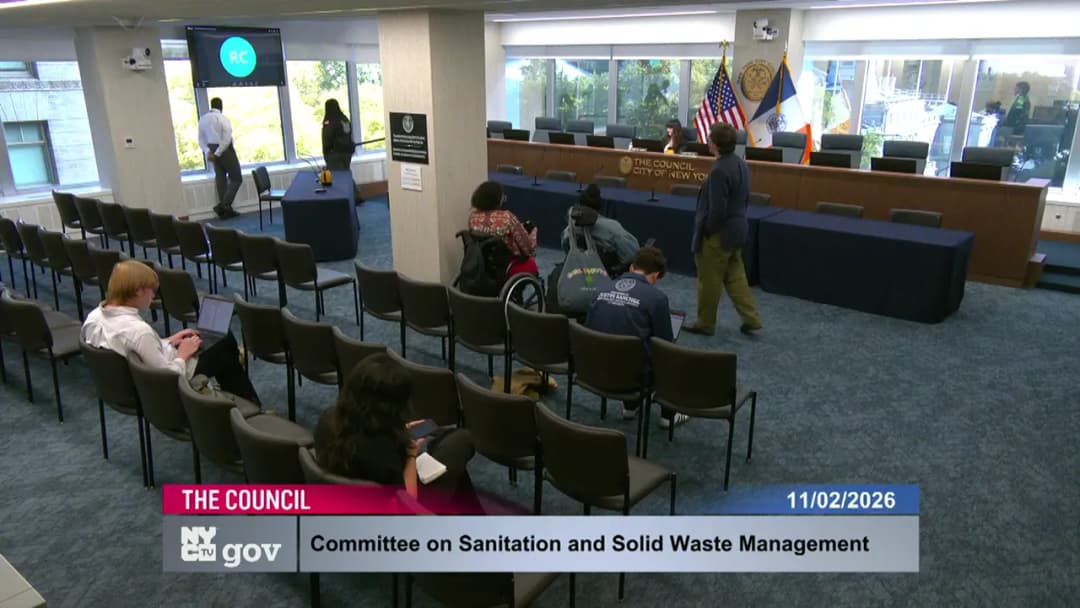
The New York City Council Committee on Sanitation and Solid Waste Management, chaired by Justin E. Sanchez, held a hearing on November 2, 2026, to review the City's snow removal and winter storm response plans and to discuss Introduction 1042-2026, which would require the publication and visualization of snow plowing operations data. Chair Sanchez opened the hearing by acknowledging a recent tragic death of a constituent involving a sanitation truck in his district and thanking the Commissioner for their proactive outreach. Department of Sanitation (DSNY) officials, including the Commissioner, fielded questions on new prioritization strategies, equipment, enforcement, and interagency coordination. Multiple members of the public testified regarding disability access and environmental justice concerns. Public Comments & Testimony - Iman Ramawi Doster (New York Lawyers for the Public Interest): Stressed the severe difficulties disabled New Yorkers face during snowstorms. Proposed assessing fines for non-compliant property owners, eliminating fines for seniors and disabled people unable to clear snow, prioritizing curb cuts and crosswalks, and establishing a DSNY alert system. Argued the lack of accessible streets is a violation of rights. - Elizabeth Valdez (Brooklyn Center for Independence of the Disabled): A wheelchair user, described being trapped by impassable snow. Supported the intent of Int. 1042 but urged it be amended to specifically track and resolve barriers impacting people with disabilities. Called on the city to take ultimate responsibility for sidewalk and curb cut clearance. - Mary Arnold: Criticized DSNY's waste-by-rail program, citing stench, rats, failure to achieve diversion goals, climate impacts, and environmental injustice. Asserted the program violates state environmental conservation law due to defective, non-leak-proof containers. Discussion Items - Snow Removal Prioritization and Strategy: The Commissioner outlined a new plan to prioritize clearing approximately 20,000 corners based on proximity to transit (within 200 feet), top-tier DOT crosswalk rankings, accessible pedestrian indicators, and neighborhoods with high populations of seniors and people with disabilities. Councilmember Restler urged the department to consider more aggressive timelines and learn from cities like Montreal, and raised chronic issues with DOT's failure to clear BQE bridges and overpasses, suggesting DSNY take over that responsibility. - Bike Lane and Street Infrastructure Clearing: The Commissioner clarified that DSNY treats bike lanes simultaneously with roadways, contradicting outdated 311 language. He stated 47 plow units are dedicated to bike lanes and that the department is planning proactively with DOT for new bike infrastructure. Councilmembers also discussed the impact of permanent street dining sheds on snow removal routes and the need for adequate turning radii for plow vehicles. - Property Owner Responsibilities and Enforcement: Councilmember Thomas-Henry highlighted confusion over alleyway garbage service and fines. The Commissioner committed to proactive mailer and text notifications when alley service is suspended for snow events. Councilmembers questioned the adequacy of current fines ($100-$250). The Commissioner noted over 19,000 violations were issued last winter and that the city can theoretically bill property owners for the cost of city-led shoveling, though it is administratively burdensome. - Data Transparency (Int. 1042-2026): Councilmember Hankerson, the bill's sponsor, questioned why residents cannot access historical GPS plowing data from the Plow NYC website. The Commissioner affirmed the technological feasibility of the bill's goals but stated development resources are needed to build out the functionality. - Fleet Capacity and Equipment: The Commissioner reported the average age of collection trucks is 5.1 years, with 12% of salt spreaders beyond their 12-year service life. The department has 26 snow melters (13 operated last year) and is proactively ordering new equipment through requirements and emergency contracts. A councilmember noted discrepancies in equipment allocation in Bronx Community Districts 1, 2, and 3, which the Commissioner attributed to the smaller geographic size and less hilly terrain of those districts. - ADA Compliance and Disability Access: Councilmember Hanif questioned whether the practice of delegating sidewalk clearance to property owners satisfies the city's ADA obligations. The Commissioner maintained that property owner responsibility remains but expressed openness to a roundtable discussion with the Mayor's Office for People with Disabilities (MOPD) and disability advocates to hear direct input on prioritizing assets and improving communication. Key Outcomes - The committee heard testimony and filed Oversight T2026-2596 on the City's Snow Removal and Winter Storm Response. - The committee held a hearing on Introduction 1042-2026 (Plow Data Transparency) and laid it over for future consideration. - The Commissioner committed to updating 311 guidance to reflect the current policy of clearing bike lanes simultaneously with roadways. - DSNY will explore scheduling a roundtable with MOPD and disability advocates. - The department agreed to improve communication strategies regarding alley service suspensions for snow events.
SANITATION AND SOLID WASTE MANAGEMENT 43% · DISABILITY RIGHTS 24% · PROCEDURAL 10% · TRANSPORTATION SAFETY 10%
02
NEWOCT 30, 2026 · NEW YORK CITY, NEW YORK · CITY COUNCIL
NYC Council Joint Hearing on Office of Community Safety and Violence Reduction (Oct 30, 2026)

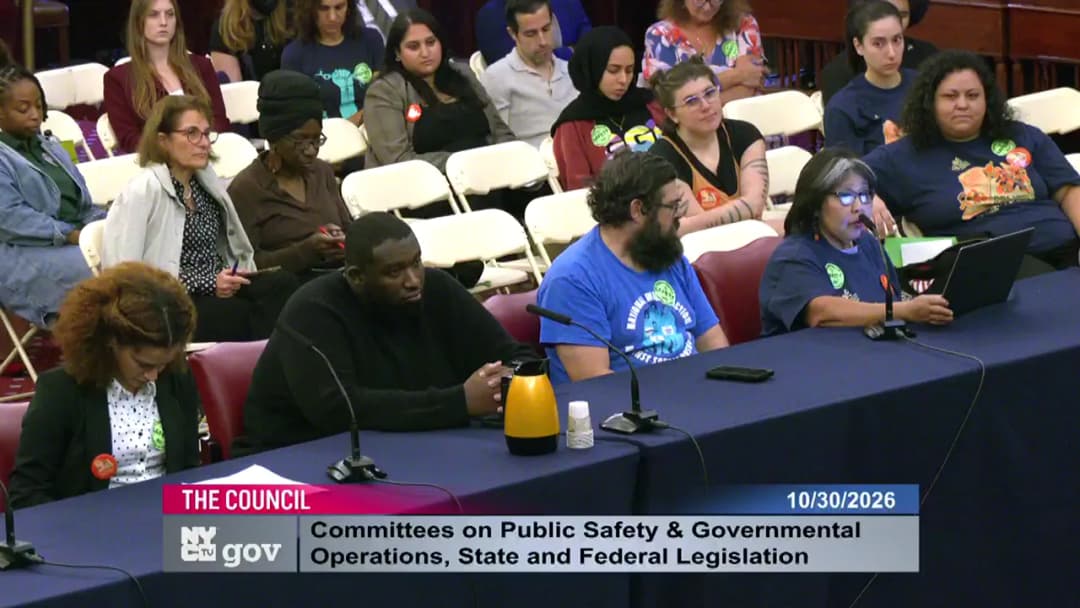
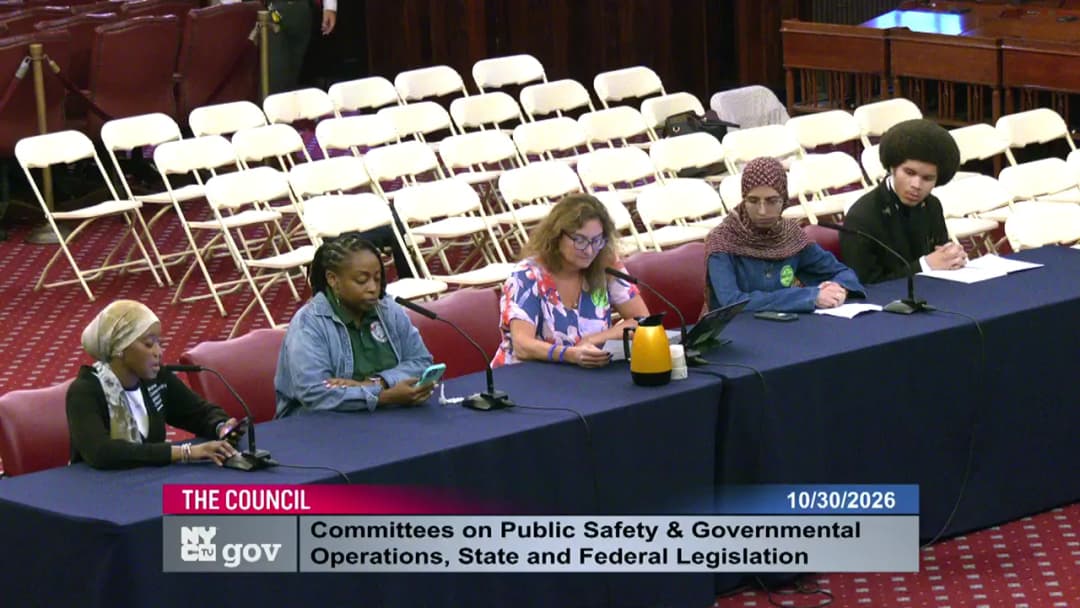
The New York City Council Committees on Public Safety and Governmental Operations held a joint oversight hearing on October 30, 2026, to examine the newly established Office of Community Safety (OCS) and non-police violence reduction strategies. The hearing, chaired by Councilmember Oswald J. Feliz (Public Safety) and Councilmember Gale A. Brewer (Government Operations), included testimony on three proposed local laws: Int. 0403 to create a Department of Community Safety, Int. 0414 to establish a gun violence intervention hotline, and Int. 0667 regarding community service for littering violations. The meeting featured opening statements from Speaker Julie Menon, Public Advocate Jumani Williams, and bill sponsors, followed by a detailed panel with OCS Commissioner Dr. Aisha Delaney Brumsey and her team, and concluded with extensive public testimony. Consent Calendar - No items were approved under a consent calendar. The oversight item (T2026-2701) was "Filed" by the committee, and all three introduced bills were "Laid Over," meaning no vote was taken and they remain under consideration for future action. Public Comments & Testimony Approximately 60 individuals registered to testify in person and via Zoom. The overwhelming majority expressed support for the creation of a permanent Department of Community Safety while offering significant input on its structure. - Community-Based Organizations (Support with Conditions): Groups like the Center for Anti-Violence Education, the People's Plan, the Muslim Community Network, the Rise Project, the Legal Aid Society, the NYCLU, and the NAACP Legal Defense Fund urged the council to ensure legislation (Int. 0403) focused on establishing the department in law rather than prescribing specific operational details like safety patrols or borough offices. They argued for a community-driven planning process. - School and Youth Safety Advocates: Organizations such as the Dignity in Schools Campaign, Girls for Gender Equity, and the YAYA Network called for OCS's mission to explicitly include school safety, youth mental health, restorative justice, and a transition away from school-based policing and surveillance. - Hate Violence Prevention Testimony: The Jewish Community Relations Council (JCRC), the Arab American Association of New York, the Anti-Violence Project, and the Wagner College Holocaust Center detailed the success of community-based hate crime prevention (PATH initiative) and requested sustained investment. - Personal and Constituent Testimony: Speakers including Conrad Blackburn (Bronx Defenders), Christina Sparrich, and Ruth Lohencron shared personal stories of police escalation during mental health crises, emphasizing the need for civilian-led, peer-based crisis response and the passage of Daniel's Law to remove police from crisis response. - Opposition: One speaker, Christopher Leon Johnson, opposed the bills, arguing for increased police presence and questioning the effectiveness of Cure Violence programs. Discussion Items - Oversight of the Office of Community Safety (OCS): Commissioner Brumsey testified that OCS operates on a $271 million budget, with $67 million in new resources, and oversees five offices with about 100 staff. Council members scrutinized the high vacancy rate (25.3%) in the Office to End Domestic and Gender-Based Violence (NGBV) and the initial staffing (3 employees) of the Office for the Prevention of Hate Crimes (OPHC). - Mental Health Crisis Response (BHERD Program): Major focus was placed on BHERD. OCS reported responding to 8,524 out of 10,945 eligible calls in FY26, a fraction of the 150,000 total mental health 911 calls. Council members raised concerns about the lack of 24/7 service, the reliance on EMS, and the absence of comprehensive data tracking repeat calls or long-term outcomes for individuals served. Chair Brewer highlighted the lack of appropriate facilities ("somewhere to go") for patients after crisis stabilization. - Violence Prevention and CMS: OCS reported a 16% decline in shooting incidents year-over-year and that the Crisis Management System (CMS) conducted 14,232 mediations. Councilmember Morano challenged OCS to identify specific public safety improvements directly attributable to the creation of OCS rather than pre-existing programs. Discussion also covered the transfer of CMS contracts from DYCD to OCS and ensuring timely payments to community providers. - Coordination with NYPD: Public Advocate Williams questioned the depth of OCS's integration, noting the lack of regular high-level meetings with the Police Commissioner and non-attendance at CompStat meetings. OCS stated that operational coordination happens daily but acknowledged a need for stronger strategic partnership. - Legislation: - Int 0403 (Department of Community Safety): Councilmember Resler stated the bill has 34 co-sponsors. OCS expressed support for its goal and committed to working with the council on amendments. Public testimony was largely supportive but requested the bill avoid prescriptive details. - Int 0414 (Gun Violence Intervention Hotline): Councilmember Riley provided emotional testimony about a recent youth shooting (15-year-old Javis Frimpong) to urge action. OCS supported the intent but noted federal authorization is required for a new three-digit number and suggested leveraging existing resources like 988 and the Hope Hotline. - Int 0667 (Community Service for Littering): Mentioned in Chair Feliz's opening, this bill received minimal substantive discussion during the hearing. Key Outcomes - Hearing Held: The committees successfully held the hearing and received testimony on the oversight and all three bills. - Bills Laid Over: Int. 0403, Int. 0414, and Int. 0667 were all laid over by the committees, indicating further negotiation and revision before a potential vote. - Continued Oversight and Directives: Council members expressed a strong intent to continue scrutinizing OCS, particularly regarding operational metrics, BHERD expansion, and coordination with NYPD. OCS committed to providing the council with a breakdown of its personnel vs. programmatic budget. Chair Feliz formally requested that OCS consider establishing a field headquarters in a community highly impacted by violence, such as the Bronx.

PUBLIC SAFETY 54% · MENTAL HEALTH AWARENESS 11% · YOUTH PROGRAMS 7% · GUN VIOLENCE 6%
03
NEWOCT 30, 2026 · NEW YORK CITY, NEW YORK · CITY COUNCIL
Joint Committee Hearing on the Office of Community Safety and Non-Police Solutions to Violence (October 30, 2026)

The New York City Council Committees on Public Safety (Chair Oswald J. Feliz) and Governmental Operations, State & Federal Legislation (Chair Gail Brewer) held a joint oversight hearing on Friday, October 30, 2026, beginning at 1:00 PM in City Hall. The hearing examined the newly established Office of Community Safety (OCS), non-police violence reduction strategies, and three related bills. Speaker Julie Menin, Public Advocate Jumaane Williams, and multiple councilmembers participated. Following a lengthy panel of administration officials led by OCS Commissioner Dr. Aisha Delaney Brumsey, the committees heard over two hours of public testimony from more than 60 registered speakers. Public Comments & Testimony - School Safety and Youth Justice Coalition: Organizations including YAYA Network, Dignity in Schools, Girls for Gender Equity, and the UFT urged the council to expand OCS's scope to include schools. They argued the current $400 million school policing model disproportionately criminalizes Black and Brown students (52% of police interventions) and advocated for divesting from school police, investing in restorative justice, hiring school climate coordinators, and passing the Curb Act and Intro 460 (abolish gang database). - Hate and Violence Prevention Coalition: Groups such as JFREJ, CAE, JCRC, Asian American Federation, and Arab American Association of NY praised the OPHC budget increase and PATH initiative. They stressed the importance of community-based, culturally competent prevention work over policing, requesting continued funding and meaningful stakeholder engagement in designing the future Department of Community Safety. - Mental Health Crisis Response Advocates: NYLPI's Disability Justice Program, the Legal Aid Society, and individuals like Christina Spark and Nicholas Pearson delivered powerful testimony demanding police removal from mental health crisis response. They pointed to the near-fatal police shooting of Jabez Chockboardy and 24 police-involved deaths since 2015, calling for the full implementation of Daniel's Law. They urged that new legislation specifically bar police from being the primary responders. - Community Members and Opposing View: A resident (Crystal Glover) expressed feeling disconnected from the city's process, advocating for respect and resources for low-income Black communities. Christopher Leon Johnson testified virtually in opposition, arguing the city needs more police, not violence interrupters. - Direct Service Providers: Organizations including the Korean American Family Service Center and Muslim Community Network testified to the effectiveness of community-based safety nets, particularly for immigrant survivors of domestic violence, asking for continued sustainable funding. Discussion Items Office of Community Safety (OCS) Structure and Oversight - Commissioner Brumsey testified that OCS was created by Executive Order in March 2026 to coordinate five existing mayoral offices: Neighborhood Safety, Community Mental Health, End Domestic & Gender-Based Violence (NGBV), Prevention of Hate Crimes (OPHC), and Crime Victim Services. Its stated goal is a "whole of government" public health approach to safety. - The OCS budget is approximately $271 million, including $67 million in new investments. Staffing is around 100 people. Councilmembers expressed concern about a new layer of bureaucracy, with Councilmember Wong comparing it to the troubled Thrive NYC program. Commissioner Brumsey argued the consolidation enables a comprehensive strategy and better coordination. - A 25.3% vacancy rate in NGBV was flagged. The administration attributed this to prior hiring freezes, while councilmembers noted reported rapes are up nearly 4% year-to-date. BHERD (Behavioral Health Emergency Response) Program - BHERD pairs 2 EMS workers with 1 social worker to respond to low-acuity 911 mental health calls. - In FY 2026, BHERD responded to 8,524 of 10,945 eligible calls (77.8%). Of those served, 42% received care in the community rather than an ER. The program runs 9 AM to 1 AM in 31 precincts with a $35.3 million budget. - Councilmembers Morano and Feliz pressed for data on long-term outcomes and repeat calls. Commissioner Brumsey acknowledged gaps in tracking what happens after an initial contact but cited an interagency working group and ongoing expansion plans. - Councilmember Brewer noted the critical lack of step-down facilities (e.g., 24-hour observation) for individuals who don't need an ER but cannot be left in crisis. Violence Prevention and Crisis Management System (CMS) - CMS providers conducted 14,232 mediations and de-escalations in FY 26. Commissioner Brumsey cited evidence supporting the model, including a 34% reduction in low-level offenses related to Denver's STAR program. - Councilmember Morano questioned the independent verification of CMS metrics beyond contractor self-reports. OCS cited regular site visits and plans for third-party evaluations. - Councilmember Banks asked about the transfer of CMS contracts from DYCD to OCS and ensuring stable, on-time funding for providers. OCS committed to a new RFP and improved contracting processes. Hate Crimes and Domestic Violence - Hate crimes are up 13% in 2026. Speaker Menin noted OPHC had only 3 employees in June. OCS stated a $26 million budget increase is enabling significant hiring and program expansion (e.g., the PATH program was doubled). - Councilmembers expressed concern over the removal of the NGBV Commissioner's standalone authority. OCS argued the restructuring allows better integration, noting a $15.7 million investment in NGBV programs. Legislation - Int 0403-2026 (Councilmember Restler): Would create a permanent Department of Community Safety. Supported by a supermajority of 34 co-sponsors and the Public Advocate. OCS supports the goal. Public testimony was largely supportive but urged specific amendments, including removing prescriptive language about patrols and NYPD coordination, and ensuring the department is designed collaboratively with community. Councilmember Morano pointed out a discrepancy where the Fiscal Impact Statement claims zero cost, contradicting the significant new resources discussed by OCS. The administration committed to working on amendments. - Int 0414-2026 (Councilmember Riley): Would create a 3-digit gun violence intervention hotline. OCS supports the intent but suggested leveraging existing 988 and Hope Hotline infrastructure. Councilmember Stevens raised questions about data privacy from NYPD. - Int 0667-2026 (Councilmember Williams): Would allow community service in lieu of fines for certain littering violations. Received less public discussion but was laid over. Key Outcomes - The oversight hearing (T2026-2551) on the Office of Community Safety was held and filed by the committee. - Int 0403-2026 (Department of Community Safety), Int 0414-2026 (Gun Violence Hotline), and Int 0667-2026 (Community Service for Littering) were all heard and laid over by the committees, meaning no votes were taken. - Councilmembers clearly signaled several expectations for OCS: develop a concrete BHERD expansion plan and 24/7 feasibility study, improve public reporting on long-term outcomes (e.g., repeat crisis calls), and enhance its physical and strategic presence in high-need communities like the Bronx. - Commissioner Brumsey committed to collaboratively amending Intro 0403 with Councilmember Restler and incorporating peer workers into the BHERD program.

PUBLIC SAFETY 47% · MENTAL HEALTH AWARENESS 16% · MISCELLANEOUS 8% · YOUTH PROGRAMS 5%
04
NEWOCT 29, 2026 · NEW YORK CITY, NEW YORK · CITY COUNCIL
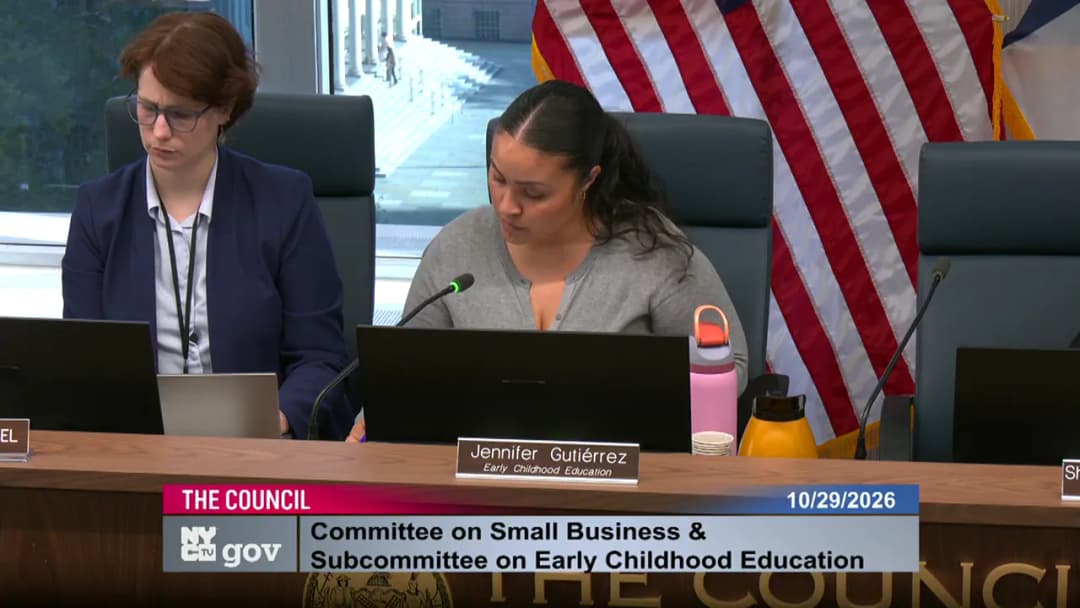
Joint Hearing on the Business of Child Care: Early Childhood Education & Small Business Committees - October 29, 2026

On October 29, 2026, the New York City Council's Subcommittee on Early Childhood Education (Chair Jennifer Gutierrez) and Committee on Small Business (Chair Chanel Thomas Henry) held a joint oversight hearing to examine the business of child care, focusing on the financial viability of child care small businesses and the impact of regulatory burdens. The hearing also covered Introduction 0445-2026, which would expand the Business Pathways Program. Administration officials from the Mayor's Office of Child Care and Early Childhood Education (MOCCEE), the Department of Small Business Services (SBS), and the New York City Housing Authority (NYCHA) testified, followed by extensive public testimony. Discussion Items Administration Testimony & Agency Updates - Emmy Liss (MOCCEE) detailed the administration's progress on universal child care, including a $1.2 billion state investment, a new provider permitting portal, a $43 million overhaul of DOE contracting to address payment delays, a $3 million emergency microgrant program, and the expansion of 2K. She reported over 10,000 licensed child care programs in NYC, mostly small businesses operating on thin margins. - Horace Khan (SBS) outlined agency support through the NYC Business Express Service Team and the Open for Small Business reform agenda. - Shauna Castillo (NYCHA) reported 365 graduates in food and 149 in child care since 2015, with 57 child care businesses launched. Introduction 0445-2026: Expansion of Business Pathways - Chair Thomas Henry questioned the program scope. NYCHA stated a baseline cost of $100,000 per cohort and confirmed no cost analysis for expansion had been completed. Councilmember Questioning: Key Challenges - Payment Delays: Councilmembers Felder and Morano highlighted late payments, with IBO data showing contract registration delays averaging 247 days in FY24. The administration acknowledged the issue and cited historic disinvestment. - Voucher System: Councilmembers Joseph and Gutierrez pressed on the 30,000-family voucher wait list. MOCCEE confirmed 3,000 families had been invited off the list. - 2K Rollout: Councilmembers Santosuosso and Gutierrez raised concerns about independent providers feeling pressured to join networks and the destabilization of the infant/toddler market. - Private Equity: Councilmembers Hanif and Gutierrez expressed concern about private equity in child care. The administration discussed cooperative and employee-owned models. - Liability Insurance: Multiple councilmembers flagged the insurance crisis. MOCCEE is exploring city-level interventions. - NYCHA Providers: Councilmembers Joseph and Riley questioned MWBE certification access and support for resident businesses. Public Comments & Testimony - Provider Financial Struggles: Elena Knigna Colson, Shelby Lohr (Daycare Council), and Shanita Bowen (ECE on the Move) testified to razor-thin margins, late payments (64% unpaid in a 2023 survey), payment reversals, and the resulting reliance on personal loans. Providers expressed strong support for increased and timely reimbursement. - Christ the King Daycare Closure: Multiple parents and residents from Middle Village (including Katie Johnston, Joanne Lamart, Ethan Chan) strongly opposed the announced closure of Christ the King Daycare, which serves over 200 children, advocating for Council intervention to save the program. - Advocacy for System Change: Ingrid Matias Chungata (Nuestros Ninos) called for predictable contracts and equitable funding. Rosa Martinez and Debbie Kinonez expressed fear that the 2K system marginalizes non-network providers without fixing core rate issues. Key Outcomes - The oversight hearing (T2026-2559) was held and filed. - Introduction 0445-2026 was heard and laid over by the subcommittee. - Councilmembers directed follow-up requests on late payments, the Christ the King closure, and potential expansion costs for the Business Pathways Program. - The hearing record remains open for written testimony for 72 hours.

CHILD CARE 57% · EARLY CHILDHOOD EDUCATION 18% · SMALL BUSINESS 8% · PUBLIC HOUSING 5%
05
NEWOCT 29, 2026 · NEW YORK CITY, NEW YORK · CITY COUNCIL
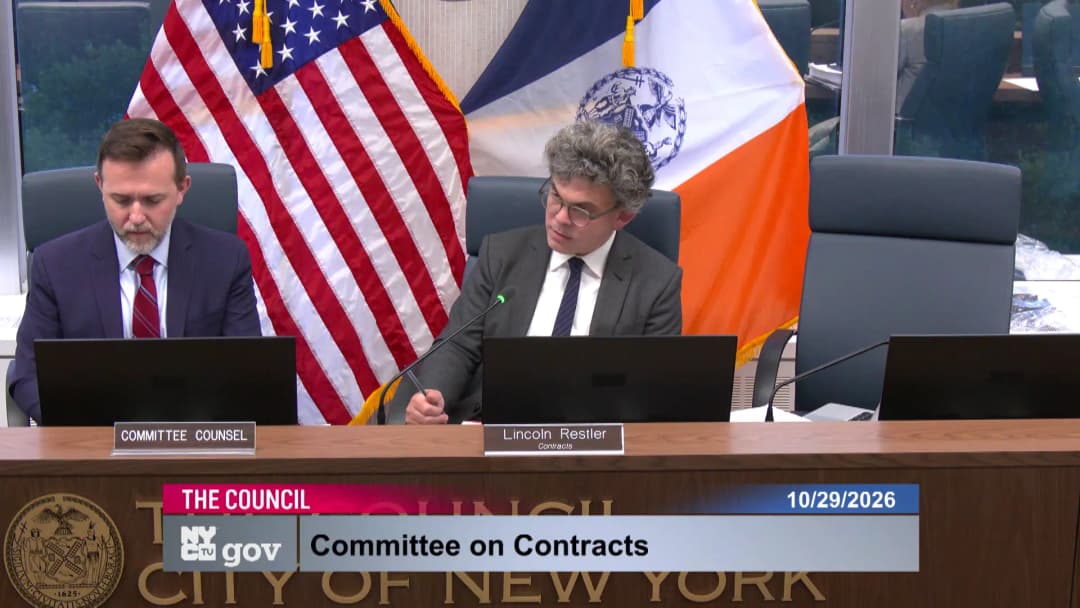
Committee on Contracts Hearing on PASSPort and Small Capital Projects - October 29, 2026

The New York City Council Committee on Contracts, chaired by Councilmember Lincoln Restler, held a hearing on Thursday, October 29, 2026, at 2:00 PM. The meeting focused on oversight of the city's procurement system, PASSPort, and considered three pieces of legislation and a resolution related to small capital projects. Testifying were Department of Design and Construction (DDC) Commissioner Paul Ochoa and Mayor's Office of Contract Services Director Kim Yu. Public Comments & Testimony - Charles Diamond testified that the city is spending too little on maintaining the PASSPort system given it processes an estimated $40 billion in transactions annually. He urged the council to push the administration to invest more in procurement staffing and system management. He expressed strong support for Ballot Question 2 regarding procurement reforms. - Jesse Faye Parrott, Policy Analyst for the Human Services Council (representing over 180 human services providers), testified that PASSPort is inaccessible and inefficient. She stated that the system often creates cash flow crises for non-profits, specifically noting that submitting a budget modification blocks the submission of invoices. She voiced cautious optimism about the upcoming Release 7 but emphasized the need for deeper policy changes. Discussion Items PASSPort Oversight (T2026-2682) Director Kim Yu provided a detailed update on PASSPort. As of October 23, 2026, the system had over 87,000 active users. The Mayor's Office of Contract Services (MOCS) reported reducing the average service desk resolution time from 21 days in 2025 to 8 days in 2026, handling over 16,000 requests this year. The total investment in PASSPort to date is $151.4 million, with annual costs for software licensing and systems integration around $10 million. The upcoming Release 7, costing $6.5 million and slated for early 2027, is designed to allow invoice submissions to proceed concurrently with budget modifications. MOCS acknowledged significant user experience issues, including reports from vendors that submitting a single invoice can take half a day due to a lack of bulk upload and poor interface design. Chair Restler raised questions about the limited role of the Office of Technology and Innovation in managing this critical system and the difficulty in generating custom reports from the platform. Councilmembers Hanks, Stevens, and Brewer questioned MOCS on how it collects feedback from smaller non-profits, system usability for human service providers, and the status of the payment backlog. Standard Designs, Timeframes, and Cost Benchmarks (Ints 0991, 1064, 1065) Councilmember Carl Wilson introduced three bills aimed at improving small capital project delivery. Int 0991 required a catalog of standard designs for small recurring capital projects, Int 1064 required timeframes for agency approvals and change orders on projects $10 million and under, and Int 1065 required cost benchmarks for small capital structures. Commissioner Ochoa expressed strong reservations about all three bills. He argued that every project and change order is unique due to site conditions, agency requirements, and market volatility, making rigid timeframes and standard designs impractical. To illustrate, he used the example of a $3.6 million bathroom in a Queens park, explaining the cost was driven by the need to build a half-mile of deep sewer and electrical infrastructure, not the structure itself. He stated DDC prefers design guidelines over standard designs and that market conditions, rather than pre-set benchmarks, dictate final costs. He noted that change orders are often delayed by disagreements over scope with contractors, rather than the city's internal review process. Resolution on Alternative Delivery (Res 0619-2026) Commissioner Ochoa strongly supported the resolution calling on the New York State Legislature to amend the NYC Public Works Investment Act. He advocated for a long-term or permanent extension of the city's authority to use Design-Build and CM Build methods, which are set to expire on December 31, 2027. He argued these methods deliver better value than the traditional lowest-bidder approach. Key Outcomes - Hearings Held and Laid Over: The oversight item (T2026-2682) was held and filed. All four pieces of legislation (Int 0991, 1064, 1065, and Res 0619) had hearings held and were laid over by the committee for future action. No final votes were recorded. - Fundamental Disagreement on Capital Bills: A clear policy divide emerged between Councilmember Wilson's push for standardization and predictability in capital projects and DDC's position that construction is inherently site-specific and volatile, making rigid rules counterproductive. DDC did not support the bills in their current form. - PASSPort Strategic Pivot: MOCS confirmed it is nearing a critical decision point. Following the Release 7 upgrade, the agency plans to pause and evaluate whether to continue adding functions to PASSPort or to simplify it by removing functions ("addition by subtraction"). - Contract Renewal Looming: The core contracts for PASSPort (Ivalua and Accenture) expire in April 2027. MOCS plans to pursue a negotiated acquisition, providing a major opportunity to re-evaluate the city's procurement technology strategy. - Albany Advocacy: The committee advanced a resolution urging the state to expand the city's use of alternative project delivery methods, a key infrastructure priority for the administration.

TECHNOLOGY AND INNOVATION 41% · PROCUREMENT 26% · CONTRACT MANAGEMENT 8% · PROCEDURAL 6%
06
NEWOCT 29, 2026 · NEW YORK CITY, NEW YORK · CITY COUNCIL
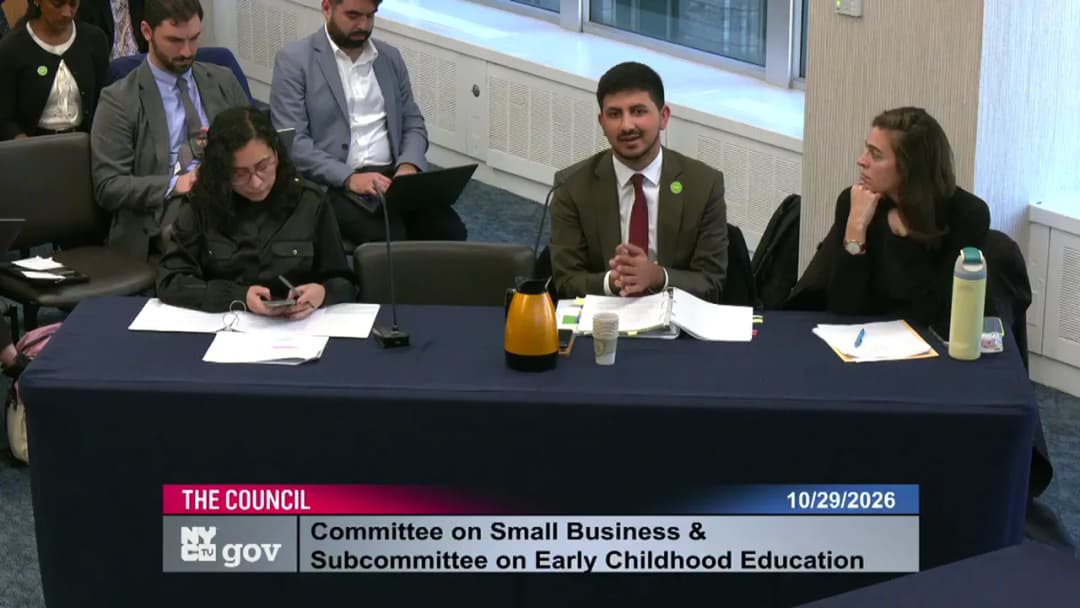
NYC Council Joint Small Business/Early Childhood Hearing on Child Care and Int. 0445-2026, October 29, 2026

The New York City Council Committee on Small Business, chaired by Shanel Thomas-Henry, met jointly with the Subcommittee on Early Childhood Education, chaired by Jennifer Gutiérrez, on Thursday, October 29, 2026 at 1:00 PM in Hearing Room 1, 250 Broadway. The hearing examined the business of child care and considered Introduction 0445-2026, which would require the Department of Small Business Services (SBS) to expand the Business Pathways Program to creative fields, retail, and cosmetology, with supports including business education, mentorship, licensing, health and safety training, provider applications, and commercial space help. Roll call: Thomas-Henry, Brooks-Powers, Hanif, Maloney, Morano, and Santosuosso were present; Salaam was absent. Other council members attending included Gutiérrez, Riley, Brewer, Joseph, and Felder. The oversight was heard and filed; the introduction was heard and laid over. Discussion Items - Chair Thomas-Henry opened by citing a 2024 U.S. Small Business Administration report finding that nearly all child care firms are small businesses, that small child care firms have exited the market disproportionately, and that child care prices grew by 230% from 1990 to 2022. She described the regulatory and cost burden on child care small businesses and introduced Int. 0445-2026. - Co-Chair Gutiérrez called child care a textbook example of a broken market, noting most providers are women, often women of color, and that for-profit child care facilities operate on margins below 1%, far below the 15% healthy margin seen across most industries. - Emmy Liss, Executive Director of the Mayor's Office of Child Care and Early Childhood Education, testified that the Mamdani administration and governor committed over $1.2 billion to universal child care. She cited state licensing data showing more than 10,000 licensed child care programs in New York City: over 2,200 licensed daycare centers, more than 1,500 licensed school-age child care centers, close to 5,600 group family daycares, and about 740 family daycares. More than half of child care programs employ fewer than five people; only 3% employ more than 50. She highlighted the new permitting portal, a $43 million overhaul of New York City Public Schools early childhood operations, a $40 million rate investment including a 5% rate increase for family child care providers and a 2% increase for networks and center-based providers, a $3 million emergency microgrant fund, and planning for a shared-services cooperative for home-based providers. - Harris Khan, SBS Chief of Staff (the transcript also identifies him as Horace Khan), testified about SBS supports, the Open for Small Business reform agenda, and the Business Pathways Program operated by NYCHA. NYCHA Vice President Shana Castillo reported 448 residents enrolled in food business pathways since 2014 and 189 in child care business pathways, with 365 food graduates and 149 child care graduates; 57 child care businesses launched and 27 currently operating as of August 2026. - Councilmembers' questions and concerns included: the roughly 5,000 family child care providers not in networks; voucher waitlists with 30,000 families and 3,000 invitations issued toward the mayor's 10,000-child commitment; prioritization of families under 300% of the federal poverty line, unhoused families, and children with disabilities; MWBE certification and language access; pay parity and wage gaps; liability insurance increases reported by 80% of child care owners nationwide; private equity entry into child care; microgrant timing; late and reversed payments; contract registration delays, including Independent Budget Office data showing the average early childhood contract registration went from 83 days after its start date in fiscal 2021 to 247 days after its start date in fiscal 2024; whether the city reimburses interest costs for late payments; lack of systematic notification of provider closures; and the need for cost and economic impact analyses for universal child care expansion. - SBS and NYCHA described services including commercial lease assistance, worker cooperative support, contract financing loan funds, Workforce1 recruitment, NYCHA resident training, and Business Pathways cohorts with a 15-week child care track, roughly 25 residents per cohort, and about $100,000 in baseline costs per cohort. Officials committed to following up on specific provider complaints and providing additional data to the council. Public Comments & Testimony - Elena Knigna Colson, an educational director at a DOE-contracted preschool, described a $914,000, 10-month budget, $30,000 monthly rent, and low assistant-teacher wages of about $30,000 for full-time work, and called for pay parity and recognition of early childhood educators as educators. - Abigail Leonard, of Children's Aid, reported that Children's Aid's core liability premiums doubled from 2022 to 2026, with primary general, professional, and sexual abuse coverage rising from about $594,000 to $1.2 million, and umbrella coverage from $206,000 to nearly $630,000. She urged support for a forthcoming council resolution on state insurance legislation and review by the new Office of Insurance Affordability. - The owner-director of Supermoon Art Space, a small center-based program in Ridgewood, said the center was underenrolled for the first time because middle- and lower-income families can no longer afford care. She described applying for 2K, concern that 2K funding would cover only minimum staffing, and difficulty connecting with voucher families. - Ingrid Matias Chungata, of Nuestros Niños, and Shanita Bowen, of ECE on the Move, called for predictable contracts, timely payments, transparent systems, equitable per-child funding, and an end to payment reversals and late reimbursements for family child care educators. - Drew Weber, of the Consortium for Worker Education, described union and provider convenings supporting a shared-services cooperative, pay ladders, care for workers with non-traditional hours, and child care benefits negotiated into union contracts. - Shelby Lohr, of the Daycare Council of New York, cited a 2023 survey of more than 250 early care and education providers in which 64% reported they remained unpaid for the prior month's services; among providers forced to bridge gaps, 25% obtained business loans and 26% took out personal loans. - Lynn Fredericks, of Family Cook Productions, expressed support for the bill and highlighted a resource gap for community- and family-based child care operators, including lack of training funds for program quality. - Carmelita Lopa, a group family daycare educator in East Flatbush, described voucher payment reversals, payments arriving three to four weeks late, and lost enrollment due to 2K and 3K hour changes. She also described receiving a COVID-related violation despite passing inspection. - Multiple virtual speakers, including Joanne Lamart, Katie Johnston, Mariella Perez, Ethan Chan, Jesse Guido, Sarah DeSena, Sean Plunkett, Annie Lindenberg, and Kylie Chan, testified about the announced closure of Christ the King Community Daycare and Preschool in Middle Village, Queens. They said the center serves more than 200 children from six weeks through pre-K and is scheduled to close by July 1, 2027, and they asked the council to intervene and to scrutinize a charter school expansion on the same campus. - Sheba Kapoor and Anne Rita Wentworth, of the New York State Montessori Alliance, asked the city to recognize median age for determining predominant age in mixed-age classrooms and to recognize accredited Montessori credentials as a qualification pathway for lead teachers in 3K and pre-K programs. - Mary Ayinde, of St. Nick's Alliance and Small World Early Childhood Center, called for strengthening the early childhood workforce, paying providers the real cost of operating centers, and investing in regulatory agencies. - Diana Diaz, of the Committee for Hispanic Children and Families, and Mercedes Mulhola, a home-based educator, raised concerns about destabilization from universal pre-K expansion, workforce compensation, and pressure on family child care providers to join networks. - Debbie Kionis, a non-network group family daycare provider in Bushwick, said she and other providers feared the 2K rollout would force them to close without a clear pathway for non-network providers. - Rosa Martinez, representing Shining Angels group family daycare in the Bronx, supported universal child care but said 2K is building on unresolved 3K problems, including unfair rates, delayed contracts and payments, and pressure on family child care providers to join networks. Key Outcomes - The Committee filed oversight T2026-2560 after hearing testimony. - Introduction 0445-2026 was heard and laid over; no vote was taken. - Committee staff will accept written testimony for up to 72 hours after the hearing via testimony@council.nyc.gov. - Administration representatives committed to following up on the list of unpaid providers raised by Councilmember Felder, voucher-family and provider matching, specific provider cases involving payment reversals and permitting, data on contract registration and payment timelines, provider openings and closures, and updates on the early childhood management system and microgrant launch. - The hearing was adjourned after public testimony; no additional legislative action was taken.

CHILD CARE 41% · EARLY CHILDHOOD EDUCATION 13% · EDUCATION 10% · PUBLIC ENGAGEMENT 9%
07
OCT 28, 2026 · NEW YORK CITY, NEW YORK · CITY COUNCIL
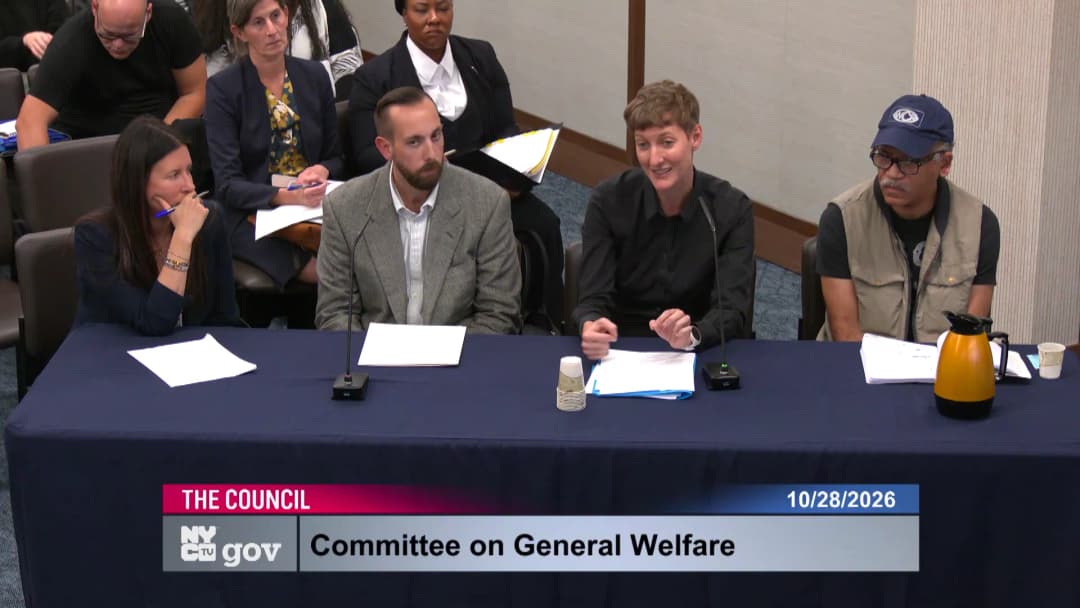
NYC Council General Welfare Committee Hearing on Shelter Safety and Reporting Bills, October 28, 2026

The New York City Council Committee on General Welfare, chaired by Crystal Hudson, met at 1:00 PM on Wednesday, October 28, 2026, in Hearing Room 3 at 250 Broadway for an oversight hearing on shelter safety and to consider two transparency bills. Members present included Hudson, Avilés, Morano, Nurse, Ung, and Wilson; Councilmember Brewer and Public Advocate Williams also attended. The committee heard from a formerly homeless panel, public witnesses, and Department of Social Services and Department of Homeless Services leadership, then laid over both proposed bills. Oversight Overview - Chair Hudson said more than 83,000 people slept in New York City shelters the prior Sunday, across more than 500 shelters serving single adults, adult families, and families with children, mostly operated by contracted nonprofits. She framed safety as including physical security, facility conditions, trauma, and dignity, citing the multi-year repair delay at the Borden Avenue veterans residence as an example of administrative barriers. - Public Advocate Williams said 83,000 people resided in shelters as of October 2026, including 51,000 families with children. He cited a women's shelter where priority-one incidents rose from 123 in 2019 to 208 in 2024 and said its FY25 priority-one rate was more than double the citywide average for single adult shelters. He urged passage of Intro 387 and supported Intro 99. - Councilmember Brewer, sponsor of Intro 99, said the bill would require the Department of Homeless Services to report annually on how often families with children are placed in shelters in the same or an adjoining zip code as their last address, broken down by borough and whether the family has children under age three. She emphasized keeping children near their schools to reduce absenteeism. Public Comments & Testimony - Former shelter residents with the Coalition for the Homeless Community Leadership Collective described staff disrespect, ignored medical emergencies, forced exposure to cold, mice and flooding, lack of privacy, unsafe commutes, and grievances going unanswered. Francisco Insfran recounted staff failing to intervene in a fight and ignoring requests, and said he often had to translate for Spanish-speaking residents. A panelist suggested an independent grievance lockbox. - Coalition for the Homeless government affairs director Alison Milke said DHS oversight is failing and that residents file twice as many complaints to the coalition hotline about staff mistreatment as about safety concerns. She said DHS's roughly 31,000 complaint count is a vast undercount because evening and weekend non-urgent complaints are routed to 311 and are not reported to the ombudsman's office. - WIN vice president Chris Mann, whose organization shelters nearly 7,000 people including 3,800 children each night, said about 40% of families were placed in a different borough from their youngest child's school. He strongly supported Intro 99 and also urged the council to address PATH intake delays and pass Intros 816 and 232. - NYLAG director Deb Berkman said safety transfers usually require legal intervention and that some clients are forced into street homelessness rather than remain in unsafe shelters. She supported Intro 99 and stronger provider accountability. - Richard Flores, a shelter resident, alleged unreported crimes at shelters and called for federal investigations. - Additional witnesses included Viviana de Jesus, Jorge Jimenez, Lauren Napier, Clifton Williams, Calvin Michael, Wendy Bruno, Hannah Mercurious, Helen Strom, and Grace Busser. Their testimony described abusive or retaliatory staff, unresponsive grievance processes, theft, unsafe physical conditions, lack of on-site medical personnel, absence of air conditioning, stalking victims being unable to access domestic violence shelters, and police or ACS involvement deterring residents from seeking help. Several witnesses supported Intro 99 and housing-first approaches. Bronx Defenders attorney Grace Busser raised concerns that Intro 387 as written would emphasize policing; she said the organization could support it if reporting distinguished allegations from substantiated findings, separated resident-vs-staff incidents, and identified which incidents led to police response. Agency Testimony and Discussion - DSS Commissioner Aaron Dalton, joined by DHS First Deputy Commissioner Christine Fellini and Deputy Commissioner for Shelter Security Bavante Priester, outlined safety operations: around-the-clock security, risk-based assessments, cameras and access controls, 352 DHS peace officers, provider assistance unit training, and trauma-informed customer service training for over 15,000 staff under Local Law 49. Dalton cited 2,654 safety transfers in FY26, up from 2,625 in FY25. - Agency data: serious violent incidents in single-adult shelters fell to 2.8 per 1,000 residents in FY25 from 4.8 in FY22, and family shelter rates remained below 1 per 1,000. Complaints about discrimination, assault, and harassment rose 19%, and complaints about staff-client interactions rose 46%. The shelter death rate fell from about 11 per 1,000 in FY22 to 3.5 in FY25; deaths fell from 512 to 305 while the shelter population nearly doubled. Overdoses accounted for 40% of all deaths and 42 of 73 shelter deaths in FY25. - Facilities: 365 standard shelters averaged fewer than four open violations each, with only one in ten high-priority. Approximately 169 flexible-capacity sites, mostly commercial hotels, averaged about 42 open violations each; DHS said that number partly reflects residential code standards applied to non-residential buildings and does not always indicate an active safety hazard. DHS has 55 city- and state-owned buildings, with a FY27 capital budget of $106 million for 102 projects across 38 shelters; eight projects were complete and 31 were in active construction. - On Intro 99, DHS said it already tracks borough-level school continuity: 62.9% of families were initially placed in the borough of their youngest school-age child, and over 80% were in that borough over the duration of their stay. DHS said it would work with the council on zip-code-level reporting and noted that domestic violence cases may require placement away from a prior address. - On Intro 387, DHS said it shares the goal of transparency and already reports to state oversight bodies and through the Mayor's Management Report, but it cannot publish some security information disaggregated by individual shelter because of confidentiality concerns. - Member questions covered flexible-capacity shelter violations, Tillery Street Women's Shelter improvements under its new operator BRC, grievance and ombudsman procedures, training compliance, staffing ratios, mental health staffing, housing specialist ratios, air conditioning reporting, peace officer retention, and Rikers release planning. Key Outcomes - Oversight hearing T2026-2629 on shelter safety was held and filed by the committee. - Intro 0099-2026, requiring DHS to report on family shelter placements by zip code, was heard and laid over by the committee. - Intro 0387-2026, requiring annual critical incident and security reporting, was heard and laid over by the committee. - DHS committed to follow up in writing on multiple data requests, including shelter demographics, older adult and substance-use population data, grievance and incident breakdowns, training compliance, language-capability tracking, and FY26 security budget figures. - Written testimony was accepted for 72 hours after the hearing by email to testimony@council.nyc.gov.

HOMELESSNESS 47% · PUBLIC SAFETY 16% · PUBLIC ENGAGEMENT 7% · PERSONNEL MATTERS 6%
08
OCT 28, 2026 · NEW YORK CITY, NEW YORK · CITY COUNCIL
Oversight Hearing on NYC Care Program and Health Care Access for Uninsured New Yorkers - October 28, 2026

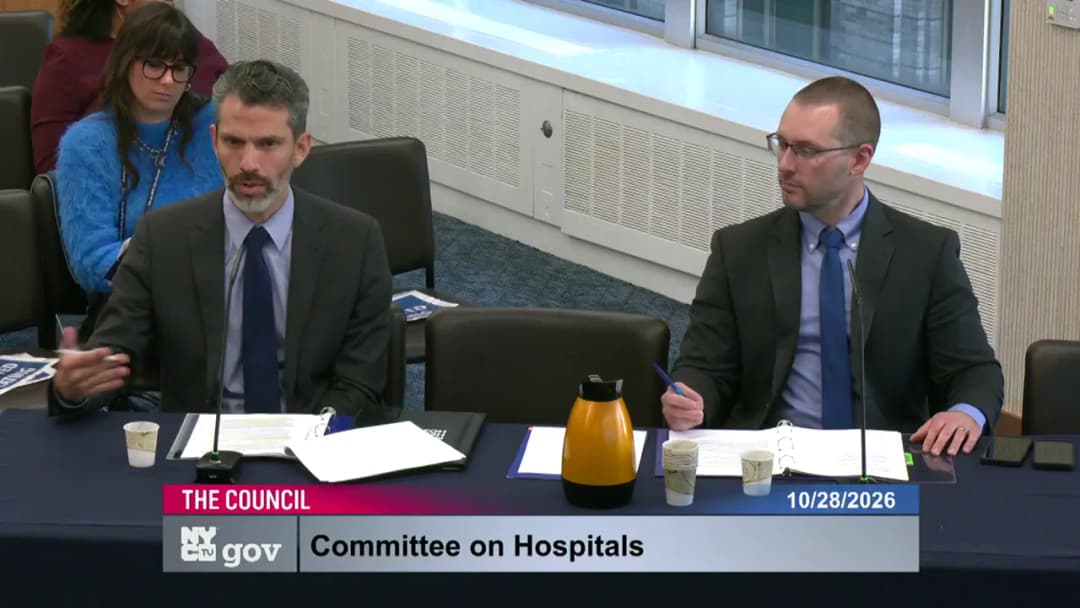
The New York City Council Committee on Hospitals, chaired by Council Member Mercedes Narcisse, held an oversight hearing on Wednesday, October 28, 2026, at 1:00 PM to examine Health + Hospitals’ NYC Care program and access to health care for uninsured New Yorkers. The hearing featured testimony from Dr. Ted Long (Chief Medical Officer, NYC Health + Hospitals) and Dr. Jonathan Jimenez (Executive Director, NYC Care), followed by public testimony. Key topics included enrollment trends, operational barriers, chronic disease outcomes, the impact of federal HR1 cuts, and capacity planning. The hearing was held and filed; no votes were taken. Public Comments & Testimony - Jane Mee (Director of Policy, Community Health Care Association of New York State - CHCANYS): Representing federally qualified health centers (FQHCs), Ms. Mee noted that New York City health centers provided 631,000 uninsured visits in 2025, incurring $92 million in uncompensated care. She projected a tripling of uninsured patients due to HR1 and urged the Council to accelerate implementation of Int. 1668-A to expand NYC Care to FQHCs and dedicate resources to affordable coordinated care. - Carmen Garcia (Community Health Worker Supervisor, Make the Road New York): Ms. Garcia described her organization’s role as a NYC Care navigator, having helped over 1,000 enrollees. She highlighted a case of a patient who accessed care through NYC Care and was diagnosed with diabetes. She called for strong internal policies at H+H to protect immigrant patients and emphasized the importance of community-based organizations as trusted messengers. Discussion Items - NYC Care Enrollment and Decline: Dr. Long reported 125,766 members as of October 23, 2026, down from a peak of 150,000. The decline was attributed to New York State expanding Medicaid to low-income individuals aged 65+ regardless of immigration status, allowing many to transition from NYC Care to Medicaid. Dr. Long stressed that these patients remain in H+H care. - Enrollment Process and Barriers: Three enrollment pathways were described: phone (via MyChart), in-person at H+H facilities, and through 20 contracted community-based organizations. Barriers include lack of phone/internet access and missing documents. The call center number 646-NYC-CARE was repeatedly highlighted. - Primary Care Access: More than 90% of new NYC Care enrollees have been offered a primary care appointment within 14 days since 2019. Dr. Long detailed efforts to reduce no-shows through timed SMS reminders and 10-day appointment releases. - Chronic Disease Outcomes: A peer-reviewed study (Journal of General Internal Medicine, 2025) found no difference in diabetes and hypertension control between new NYC Care enrollees and new Medicaid enrollees. Within six months, 73% of new hypertensive enrollees and 53% of new diabetic enrollees showed significant improvement. NYC Care was estimated to have saved 1,569 lives. - Impact of HR1 and Essential Plan Changes: Approximately 450,000 New Yorkers lost Essential Plan coverage on July 1, 2026. Of these, about 60% found alternative insurance, including thousands who enrolled in NYC Care. Dr. Long warned that Medicaid work requirements and recertification starting January 1, 2027, could cause a crisis, with up to 900,000 New Yorkers at risk of losing Medicaid. H+H has sent 400,000 emails to patients and is bolstering financial counseling and care teams. - Budget and Capacity: The NYC Care program has a $100 million annual budget, unchanged since a few years after launch. Dr. Long stated that H+H could immediately absorb 15,000–20,000 new patients across primary care, but capacity is not infinite. He noted ongoing communication with OMB about funding needs. - Language Access: The 646-NYC-CARE line provides telephonic interpretation in 300+ languages. Most commonly requested languages are Spanish, Chinese dialects, French, and Polish. H+H monitors no-show rates by population to identify language barriers but reported no notable trends. - Specialty Care Access: Top five specialties after primary care are OB/GYN, eye care, dental, cardiology, and podiatry. Wait times vary by specialty; H+H uses e-consults (20% resolved without an in-person visit), workforce planning, and contact center optimization to manage demand. - Outreach and Awareness: Top referral sources are friends/family, healthcare providers, CBOs, and online ads. H+H uses a branded truck, social media influencers, and consulate partnerships. Drs. Long and Jimenez requested continued support from Council Members to spread the word and host enrollment events. - Transportation and Social Needs: Transportation is not a covered benefit, and H+H does not currently track no-show reasons attributable to transportation. Dr. Jimenez highlighted the DME benefit launched in 2025 (over 2,500 members used it). Social needs screening is integrated; about 25% of NYC Care members screen positive for food/housing instability and are connected to care coordination. - Integration with Other H+H Programs: Dr. Long mentioned the SHOW (Street Health Outreach and Wellness) program (expanding 50% this year), safety net clinics (Bellevue, Lincoln, Woodhull, Elmhurst), and Housing for Health (housed 1,800 patients, built 400 units on H+H land). He also noted that H+H is exploring a system-wide volunteer program to help patients meet Medicaid work requirements. - Maimonides Takeover: Council Member Felder questioned the financial viability of absorbing Maimonides Medical Center given enhanced Medicaid rate assumptions and potential enrollment declines. Dr. Long acknowledged the concern and promised to provide written projections. Key Outcomes - The committee held the oversight hearing; the matter was filed for further action. - H+H committed to providing the Council with data on telehealth utilization, NYC Care distribution by geography, specialty wait times, and the impact of HR1. - Drs. Long and Jimenez encouraged Council Members to help promote NYC Care at community events and via communications, with a focus on the 646-NYC-CARE hotline. - No legislative votes were taken; the hearing served as fact-finding in advance of anticipated coverage disruptions in 2027.

HEALTHCARE 55% · PUBLIC HEALTH 26% · PUBLIC ENGAGEMENT 9% · PROCEDURAL 5%
09
OCT 28, 2026 · NEW YORK CITY, NEW YORK · CITY COUNCIL
Oversight Hearing on Ethnic & Community Media Advertising and Good Government Bills – October 28, 2026

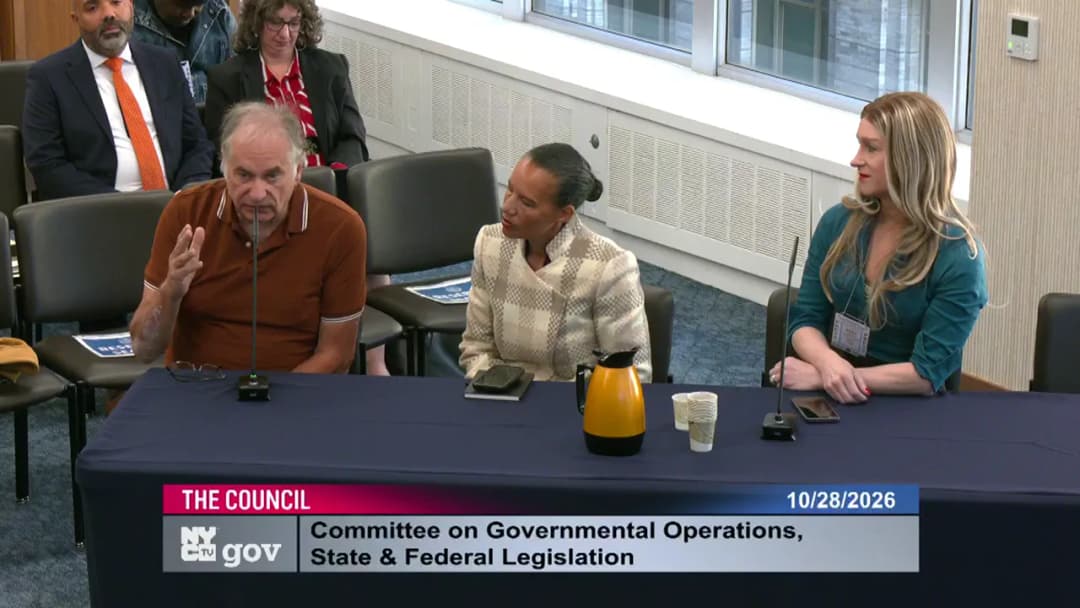
The Committee on Governmental Operations, State & Federal Legislation, chaired by Council Member Gale A. Brewer, convened on October 28, 2026, to conduct an oversight hearing on the Mayor's Office of Ethnic & Community Media (MOECM) and city advertising spending. The committee also heard testimony and voted to lay over a package of good government bills (Intros 1127-B, 1128, 1129) sponsored by Council Member Williams and pre-considered legislation (T2026-2722) by Chair Brewer regarding a working group on communication technologies. Public Comments & Testimony - Mona Davids (NY Coalition of Ethnic and Community Media): Stated publishers endured nine months without leadership or a point of contact in MOECM. Proposed extensive amendments to Local Law 83, including making the office independent, mandating quarterly public reporting, prohibiting political favoritism in ad allocation, and strengthening enforcement of the 50% spending mandate. - Eleanor Tatum (New York Amsterdam News): Attributed the decline in ethnic media advertising to the six contracted advertising agencies, whom she accused of ignoring local print and web outlets in favor of easy placements. She underscored that the new Executive Director is not responsible for the failures of the prior eight months. - Esmitra Khalida (URL Media / Epicenter NYC): Noted that advertising spending has fallen dramatically since the law was passed and that counting out-of-scope spending inflates compliance figures. Requested clear implementation plans, quarterly outlet-level reporting, and modernization of how the city measures campaign value beyond simple impressions. - Bob Henley (WBAI Pacifica Radio): Detailed severe financial struggles for his station, alleging a preference by the administration for paid influencers over established community media. - Abu Sidjahate (Staten Island Immigrant Council): Stated that African ethnic media outlets are being overlooked for city advertising funding and urged the city to publish clear, accessible data on advertising allocations. - Walter Sanchez (Queens Ledger / Wave of Rockaway): Argued that advertising agencies do not know local publishers and favor outlets that do not represent genuine community journalism. - Rachel Faust (Reinvent Albany) and Ben Weinberg (Citizens Union): Urged the Council to pass records retention legislation for instant messaging, hold a dedicated hearing on FOIL compliance, and require disclosure for all government-funded influencer campaigns. They supported the good government bills on the agenda. - Terry Wisdom (Harlem Network News): Expressed frustration at the lack of access to funding and requested to be actively involved in planning how ethnic media is supported. Discussion Items - Oversight of MOECM and Government Advertising Spending (T2026-2608): The committee extensively questioned the newly appointed Executive Director of MOECM, Mazin Sidahmed. Chair Brewer, Speaker Menin, and committee members expressed deep concern over the drastic drop in city advertising spending from $260 million (FY22) to $28.8 million (FY24), and that spending on ethnic media fell from a peak of $23.1 million (FY22) to $7 million (FY24). Council Member Restler highlighted a discrepancy in the FY25 report, stating that while 57% of in-scope spending went to ethnic media, $18 million of the $31 million total was out-of-scope (social media, bus shelters), making the actual percentage 24%. Council Member Morano questioned the inherent conflict of MOECM being housed under the Mayor's Director of Communications and the loophole allowing out-of-scope spending (influencers, social media) to circumvent the 50% mandate. Mr. Sidahmed stated he was the sole staff member, had no data immediately available on current ad spending, and committed to updating the website and publishing the FY26 report by the end of the calendar year. - Legislative Package (Intros 1127-B, 1128, 1129) – Council Member Williams: Council Member Williams presented a set of good government reforms. Intro 1127-B amends or repeals 25 reporting provisions in the City Charter and Administrative Code. Intro 1128 establishes a uniform default date for agency reports. Intro 1129 creates a process for agencies to certify compliance with operational requirements. The committee heard testimony and laid over all three items. Intro 1127 was amended by the committee prior to the layover. - Pre-Considered Legislation (T2026-2722) – Chair Brewer: Chair Brewer introduced a bill requiring DORIS to form a working group to study city agencies' use of instant messaging platforms and make recommendations on record retention. The bill was heard and laid over. Key Outcomes - The committee filed the oversight hearing on MOECM and government advertising spending (T2026-2608). - Intro 1127-2026 was amended by the committee and laid over as Intro 1127-2026-B. - Intros 1128-2026 and 1129-2026 were heard and laid over by the committee. - Pre-considered Intro T2026-2722 was heard and laid over by the committee. - Executive Director Sidahmed committed to immediately updating the MOECM website, aggregating FY26 advertising data, and reporting back to the Council with a plan. - Several Council Members committed to working with the new director to strengthen enforcement of Local Law 83 and address loopholes in advertising spending transparency.

COMMUNITY ENGAGEMENT 34% · PUBLIC ENGAGEMENT 28% · ETHNIC AND COMMUNITY MEDIA 10% · MEDIA AND ADVERTISING 8%
10
OCT 27, 2026 · NEW YORK CITY, NEW YORK · CITY COUNCIL
New York City Council Joint Committees Hearing on Maternal Health and Criminal Justice – October 27, 2026

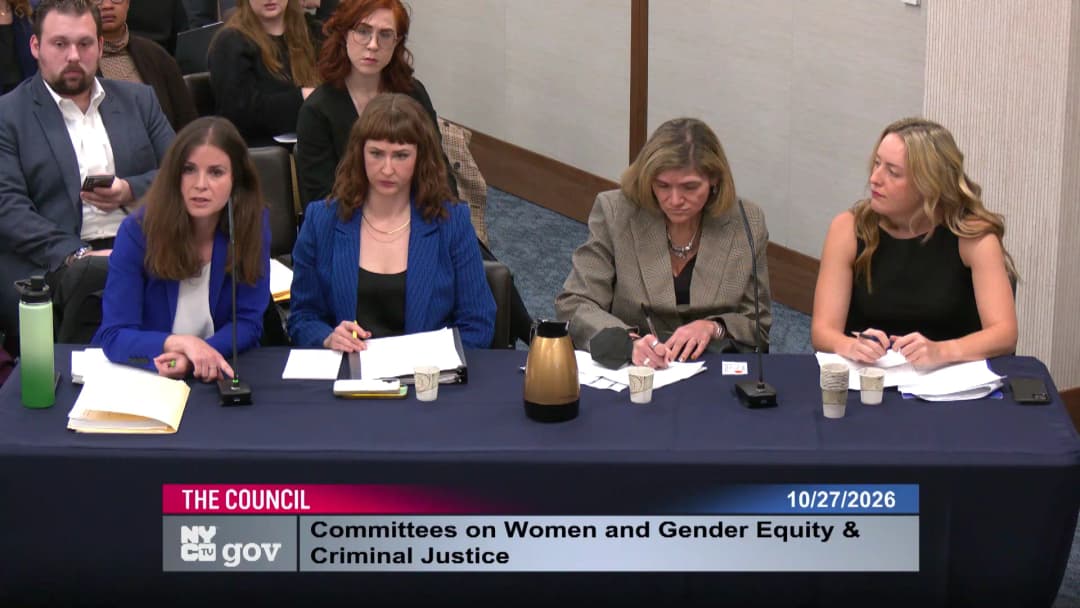
On Tuesday, October 27, 2026, at 10:00 a.m. in Hearing Room 2 at 250 Broadway, the Committee on Criminal Justice, chaired by Selvena N. Brooks-Powers, met jointly with the Committee on Women and Gender Equity, chaired by Amanda Farías, for an oversight hearing on maternal health and criminal justice. The committee heard testimony from Correctional Health Services (CHS), the Department of Correction (DOC), the Board of Correction, public advocates, and community witnesses. No votes were taken; the legislation considered was laid over by the committee. The roll call for the Committee on Criminal Justice was: present – Brooks-Powers, Cabán, Feliz, Morano, and Narcisse; absent – Salaam; conflict – Brewer. Also attending were Councilmembers Farías, Hudson, Aldebol, Santosuosso, Gutiérrez, and Public Advocate Williams. The agenda and minutes identify the matters considered as Oversight T2026-2617, Int 0902-2026, Int 1144-2026, Res 0464-2026, Res 0497-2026, and Res 0498-2026. Opening Statements - Chair Farías opened by describing the crisis at the intersection of maternal health and incarceration. She stated that three out of four incarcerated women are of childbearing age, that communities of color make up almost 90% of New York City jail admissions while comprising 52% of the city’s general population, and that Black women are three times more likely than white women to die because of pregnancy. She also cited a 2025 Arnold Institute report finding that 52 incarcerated people were reported pregnant by correctional health services last year and that interviews revealed gaps in mattresses, nutritious food, outdoor time, safety from hazards such as mace and mold, lactation support, and pregnancy information. - Chair Brooks-Powers stressed that pregnancy, childbirth, and the postpartum period require consistent care that does not disappear upon incarceration. She outlined the hearing’s focus on intake screening, coordination between CHS and DOC, mental health screening for perinatal mood and anxiety disorders, borough-based jail planning, and data on maternal health care in custody. - Public Advocate Williams testified that incarcerated pregnant and postpartum people must receive timely, dignified care consistent with standards from the American College of Obstetricians and Gynecologists. He voiced support for Int 902 and Res 497 and Res 498, noted that New York banned shackling during labor in 2009, and referenced cases including a woman who gave birth while shackled in a Brooklyn courtroom and a woman restrained on Rikers Island. He added that these incidents overwhelmingly involve Black and brown women. - Councilmember Hudson spoke in support of her resolutions, Res 497 and Res 498, saying no one should be shackled in labor and no one should be forced into a courtroom days before giving birth. Agency Testimony and Discussion - CHS Chief of Nursing Nancy Arias testified that CHS has been the direct provider of physical and mental health services in DOC custody since 2016. She reported that women are about 8% of the patient population; as of September 2026, 82% of women in CHS care were enrolled in mental health services, 47% were diagnosed with serious mental illness, and 34% had an opioid use disorder. She stated that there were 52 pregnant individuals in CHS care last calendar year. CHS described pregnancy testing and reproductive health histories at intake, referrals to a CHS obstetrician, prenatal care at Rose M. Singer Center, coordination with Elmhurst Hospital for labor and delivery, mental health screening for perinatal mood and anxiety disorders, and discharge planning. On Int 902, CHS said the bill largely aligns with current practices but should be refined so it does not legislate clinical decision-making, and CHS asked to discuss the provision requiring procedures to identify postpartum status when a patient does not proactively disclose it. - DOC Assistant Commissioner Valerie Graysock and Deputy Commissioner Nell Cologne testified about DOC’s doula program and nursery. Through a contract with the Caribbean Women’s Health Association, doulas provide non-medical support twice weekly; from January through June 2026, the program served 20 women and provided over 400 hours of support. DOC operates a voluntary residential nursery at Rose M. Singer Center where eligible mothers may remain with infants until the child’s first birthday. - In response to questions, DOC and CHS reported: 53% of initially scheduled on-island obstetric appointments were non-productions in calendar year 2025 and 40% off-island, compared with 37% and 43% in 2024, and 27% and 69% in 2023. Fifteen individuals gave birth while in DOC custody between 2023 and 2025. DOC reported zero incident reports involving restraints on pregnant or postpartum people in the past three years. The nursery has a maximum occupancy of about 15; one infant currently lives there, and eight infants have lived there since 2022. DOC said there were 482 women in custody and that the borough-based jail plan currently places about 450 beds for women and gender-expansive people at the Queens detention complex; Chair Brooks-Powers challenged the decision to concentrate women in one borough. - Chair Brooks-Powers also raised concerns about deadlocking and involuntary individual lock-ins, following a September 23, 2026 committee hearing. DOC referenced a Department of Investigation review that did not substantiate deadlocking allegations, said reporting obligations for emergency lock-ins remain, and committed to follow up on questions about white paper tags on cell door switchboards and related discipline. - Councilmember Narcisse, a former nurse, stressed the importance of rapid response when a pregnant person goes into labor, noting that delays can create complications and risk to the baby. Board of Correction Testimony - Marisa Singdon Hernandez, interim executive director and general counsel of the Board of Correction, testified alongside Katrina Blackman and Chen C. Augustin. The board described monitoring of maternal and mental health care in city jails, complaints received from pregnant and postpartum people, and concerns about housing in general population. Director Augustin reported that two pregnant women told the board they were present when chemical agents were deployed in their housing area, and one woman with asthma was in the shower during an incident. - The board recommended that DOC designate a dedicated dormitory for pregnant people, review the nursery application process to reflect current procedures and remove outdated language, expedite the interdisciplinary review process, and update minimum standards to explicitly address infant clothing and materials for children in the nursery. The board also said expanding state law to give it broader access to medical records for vulnerable populations would strengthen oversight. Public Comments & Testimony - Hannah Mae Powers, health and safety policy analyst for Brooklyn Borough President Antonio Reynoso, expressed support for Int 902, Res 464, Res 497, and Res 498. She cited data that approximately one in five perinatal women experience maternal mental health disorders, and that among women of reproductive age in carceral populations, 43% meet lifetime criteria for serious mental illness, 53% for PTSD, and 82% for substance use disorder. - Rachel Bronstein, senior director of policy at Her Justice, expressed support for Int 1144 and urged the city to take an expansive view of gender-based violence data, including data from service providers and legal systems rather than law enforcement alone. She also encouraged analysis of survivors seeking divorce and noted the opportunity presented by Intro 1175. - Jillian Majoleschi, director of the Women’s Defense Project at Brooklyn Defender Services, strongly supported Res 497 and noted that the state Senate and Assembly had passed the anti-shackling bill. She called for trauma-informed gynecological care, because many of her clients have experienced sexual violence and are fearful of exams. - Isabella Seda, social justice community organizer at New Hour, supported Res 497 and asked that no chapter amendments be made, supported Res 498, and asked that Res 464 be broadened beyond postpartum psychosis to include the range of perinatal mood and anxiety disorders. On Int 902, New Hour agreed data collection is needed but said health protocols should be established by health care professionals, not DOC. - Olivia Picard, staff attorney with the Vols Incarcerated Mothers’ Law Project, strongly supported Int 902 and described clients who have experienced separation from newborns and fears about parental rights while in custody. - Liz Suavola, chief impact officer at the Women’s Prison Association, supported the legislation, urged passage immediately, and called for reducing the footprint of incarceration and closing the Rose M. Singer Center. She said it costs about $500,000 per person to incarcerate someone at Rikers and that the number of women incarcerated at Rikers recently surpassed 500, nearly double what it was five years ago. - A speaker identifying as Ziata, a member of the Center for Equity, Health and Justice, called for closing Rikers Island and the Rose M. Singer Center, reducing the jail population, and holding the mayor accountable to the closure law, saying that incarceration is putting a bandage on a wound that must be aggressively treated. - Khalil Tucker testified on behalf of a family member who has been detained on Rikers Island for 3,000 days. He urged the committee to conduct a full audit of DOC and CHS, freeze funding, hold a hearing on Rikers Island, and subpoena DOC and CHS leadership, saying people are not being held accountable. Key Outcomes - No legislation was voted on. Int 0902-2026, Int 1144-2026, Res 0464-2026, Res 0497-2026, and Res 0498-2026 were heard and laid over by committee; Oversight T2026-2617 was filed by committee. - DOC and CHS committed to follow up in writing on several requests, including DOC’s written restraint policy, data on white paper tags and deadlocking allegations, the racial demographic breakdown of pregnant people in custody, the age of pregnant people in custody, and nursery-related data. - The Board of Correction recommended updated minimum standards, a dedicated housing area for pregnant people, and a revised nursery application process, and the council indicated it would pursue follow-up information. - A discrepancy was noted in the transcript: Chair Brooks-Powers’ opening remarks at one point referred to “resolution numbers 467, 497 and 498,” while the agenda and minutes identify the resolutions as 464, 497, and 498.

MATERNAL HEALTH AND INCARCERATION 52% · CRIMINAL JUSTICE REFORM 14% · PUBLIC HEALTH 12% · MENTAL HEALTH AWARENESS 8%
0102
NEXT →
OPENPUBLICA · PUBLIC MEETING INDEXUPDATED DAILY · openpublica.com