OPENPUBLICA · PUBLIC MEETING RECORD
Record of Proceedings
New York City Council Joint Committees Hearing on Maternal Health and Criminal Justice – October 27, 2026
City Council — Tuesday, October 27, 2026
BodyNew York City, New York
SessionCity Council
DateTuesday, October 27, 2026
StatusNEW · FILED
Video Record
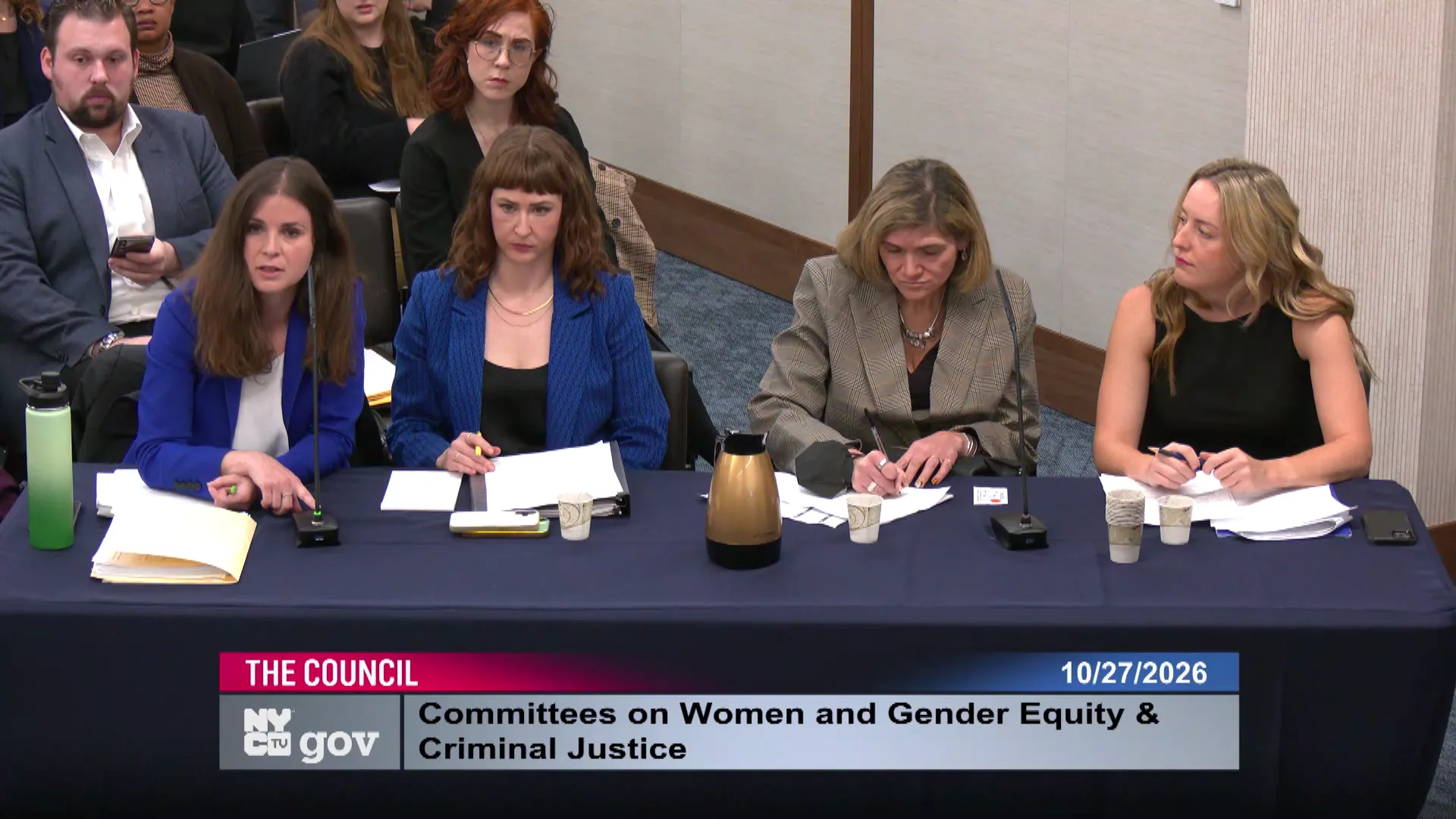
STREAMING COPY IN PREPARATION — RECORDING AVAILABLE FROM THE ORIGINAL SOURCE
Transcript — Verbatim
Speaker numbers apply only to this recording. Names come from transcript evidence. “Possibly” marks uncertain attribution.
Discussion Breakdown — Share of Meeting
Maternal Health and Incarceration52%
Criminal Justice Reform14%
Public Health12%
Mental Health Awareness8%
Public Safety5%
Procedural3%
Harm Reduction Services2%
Gender Based Violence2%
Data Privacy and Security1%
Summary of Proceedings
New York City Council Joint Committees Hearing on Maternal Health and Criminal Justice – October 27, 2026
On Tuesday, October 27, 2026, at 10:00 a.m. in Hearing Room 2 at 250 Broadway, the Committee on Criminal Justice, chaired by Selvena N. Brooks-Powers, met jointly with the Committee on Women and Gender Equity, chaired by Amanda Farías, for an oversight hearing on maternal health and criminal justice. The committee heard testimony from Correctional Health Services (CHS), the Department of Correction (DOC), the Board of Correction, public advocates, and community witnesses. No votes were taken; the legislation considered was laid over by the committee.
The roll call for the Committee on Criminal Justice was: present – Brooks-Powers, Cabán, Feliz, Morano, and Narcisse; absent – Salaam; conflict – Brewer. Also attending were Councilmembers Farías, Hudson, Aldebol, Santosuosso, Gutiérrez, and Public Advocate Williams. The agenda and minutes identify the matters considered as Oversight T2026-2617, Int 0902-2026, Int 1144-2026, Res 0464-2026, Res 0497-2026, and Res 0498-2026.
Opening Statements
- Chair Farías opened by describing the crisis at the intersection of maternal health and incarceration. She stated that three out of four incarcerated women are of childbearing age, that communities of color make up almost 90% of New York City jail admissions while comprising 52% of the city’s general population, and that Black women are three times more likely than white women to die because of pregnancy. She also cited a 2025 Arnold Institute report finding that 52 incarcerated people were reported pregnant by correctional health services last year and that interviews revealed gaps in mattresses, nutritious food, outdoor time, safety from hazards such as mace and mold, lactation support, and pregnancy information.
- Chair Brooks-Powers stressed that pregnancy, childbirth, and the postpartum period require consistent care that does not disappear upon incarceration. She outlined the hearing’s focus on intake screening, coordination between CHS and DOC, mental health screening for perinatal mood and anxiety disorders, borough-based jail planning, and data on maternal health care in custody.
- Public Advocate Williams testified that incarcerated pregnant and postpartum people must receive timely, dignified care consistent with standards from the American College of Obstetricians and Gynecologists. He voiced support for Int 902 and Res 497 and Res 498, noted that New York banned shackling during labor in 2009, and referenced cases including a woman who gave birth while shackled in a Brooklyn courtroom and a woman restrained on Rikers Island. He added that these incidents overwhelmingly involve Black and brown women.
- Councilmember Hudson spoke in support of her resolutions, Res 497 and Res 498, saying no one should be shackled in labor and no one should be forced into a courtroom days before giving birth.
Agency Testimony and Discussion
- CHS Chief of Nursing Nancy Arias testified that CHS has been the direct provider of physical and mental health services in DOC custody since 2016. She reported that women are about 8% of the patient population; as of September 2026, 82% of women in CHS care were enrolled in mental health services, 47% were diagnosed with serious mental illness, and 34% had an opioid use disorder. She stated that there were 52 pregnant individuals in CHS care last calendar year. CHS described pregnancy testing and reproductive health histories at intake, referrals to a CHS obstetrician, prenatal care at Rose M. Singer Center, coordination with Elmhurst Hospital for labor and delivery, mental health screening for perinatal mood and anxiety disorders, and discharge planning. On Int 902, CHS said the bill largely aligns with current practices but should be refined so it does not legislate clinical decision-making, and CHS asked to discuss the provision requiring procedures to identify postpartum status when a patient does not proactively disclose it.
- DOC Assistant Commissioner Valerie Graysock and Deputy Commissioner Nell Cologne testified about DOC’s doula program and nursery. Through a contract with the Caribbean Women’s Health Association, doulas provide non-medical support twice weekly; from January through June 2026, the program served 20 women and provided over 400 hours of support. DOC operates a voluntary residential nursery at Rose M. Singer Center where eligible mothers may remain with infants until the child’s first birthday.
- In response to questions, DOC and CHS reported: 53% of initially scheduled on-island obstetric appointments were non-productions in calendar year 2025 and 40% off-island, compared with 37% and 43% in 2024, and 27% and 69% in 2023. Fifteen individuals gave birth while in DOC custody between 2023 and 2025. DOC reported zero incident reports involving restraints on pregnant or postpartum people in the past three years. The nursery has a maximum occupancy of about 15; one infant currently lives there, and eight infants have lived there since 2022. DOC said there were 482 women in custody and that the borough-based jail plan currently places about 450 beds for women and gender-expansive people at the Queens detention complex; Chair Brooks-Powers challenged the decision to concentrate women in one borough.
- Chair Brooks-Powers also raised concerns about deadlocking and involuntary individual lock-ins, following a September 23, 2026 committee hearing. DOC referenced a Department of Investigation review that did not substantiate deadlocking allegations, said reporting obligations for emergency lock-ins remain, and committed to follow up on questions about white paper tags on cell door switchboards and related discipline.
- Councilmember Narcisse, a former nurse, stressed the importance of rapid response when a pregnant person goes into labor, noting that delays can create complications and risk to the baby.
Board of Correction Testimony
- Marisa Singdon Hernandez, interim executive director and general counsel of the Board of Correction, testified alongside Katrina Blackman and Chen C. Augustin. The board described monitoring of maternal and mental health care in city jails, complaints received from pregnant and postpartum people, and concerns about housing in general population. Director Augustin reported that two pregnant women told the board they were present when chemical agents were deployed in their housing area, and one woman with asthma was in the shower during an incident.
- The board recommended that DOC designate a dedicated dormitory for pregnant people, review the nursery application process to reflect current procedures and remove outdated language, expedite the interdisciplinary review process, and update minimum standards to explicitly address infant clothing and materials for children in the nursery. The board also said expanding state law to give it broader access to medical records for vulnerable populations would strengthen oversight.
Public Comments & Testimony
- Hannah Mae Powers, health and safety policy analyst for Brooklyn Borough President Antonio Reynoso, expressed support for Int 902, Res 464, Res 497, and Res 498. She cited data that approximately one in five perinatal women experience maternal mental health disorders, and that among women of reproductive age in carceral populations, 43% meet lifetime criteria for serious mental illness, 53% for PTSD, and 82% for substance use disorder.
- Rachel Bronstein, senior director of policy at Her Justice, expressed support for Int 1144 and urged the city to take an expansive view of gender-based violence data, including data from service providers and legal systems rather than law enforcement alone. She also encouraged analysis of survivors seeking divorce and noted the opportunity presented by Intro 1175.
- Jillian Majoleschi, director of the Women’s Defense Project at Brooklyn Defender Services, strongly supported Res 497 and noted that the state Senate and Assembly had passed the anti-shackling bill. She called for trauma-informed gynecological care, because many of her clients have experienced sexual violence and are fearful of exams.
- Isabella Seda, social justice community organizer at New Hour, supported Res 497 and asked that no chapter amendments be made, supported Res 498, and asked that Res 464 be broadened beyond postpartum psychosis to include the range of perinatal mood and anxiety disorders. On Int 902, New Hour agreed data collection is needed but said health protocols should be established by health care professionals, not DOC.
- Olivia Picard, staff attorney with the Vols Incarcerated Mothers’ Law Project, strongly supported Int 902 and described clients who have experienced separation from newborns and fears about parental rights while in custody.
- Liz Suavola, chief impact officer at the Women’s Prison Association, supported the legislation, urged passage immediately, and called for reducing the footprint of incarceration and closing the Rose M. Singer Center. She said it costs about $500,000 per person to incarcerate someone at Rikers and that the number of women incarcerated at Rikers recently surpassed 500, nearly double what it was five years ago.
- A speaker identifying as Ziata, a member of the Center for Equity, Health and Justice, called for closing Rikers Island and the Rose M. Singer Center, reducing the jail population, and holding the mayor accountable to the closure law, saying that incarceration is putting a bandage on a wound that must be aggressively treated.
- Khalil Tucker testified on behalf of a family member who has been detained on Rikers Island for 3,000 days. He urged the committee to conduct a full audit of DOC and CHS, freeze funding, hold a hearing on Rikers Island, and subpoena DOC and CHS leadership, saying people are not being held accountable.
Key Outcomes
- No legislation was voted on. Int 0902-2026, Int 1144-2026, Res 0464-2026, Res 0497-2026, and Res 0498-2026 were heard and laid over by committee; Oversight T2026-2617 was filed by committee.
- DOC and CHS committed to follow up in writing on several requests, including DOC’s written restraint policy, data on white paper tags and deadlocking allegations, the racial demographic breakdown of pregnant people in custody, the age of pregnant people in custody, and nursery-related data.
- The Board of Correction recommended updated minimum standards, a dedicated housing area for pregnant people, and a revised nursery application process, and the council indicated it would pursue follow-up information.
- A discrepancy was noted in the transcript: Chair Brooks-Powers’ opening remarks at one point referred to “resolution numbers 467, 497 and 498,” while the agenda and minutes identify the resolutions as 464, 497, and 498.
Meeting Transcript
Good morning and welcome to the New York City Council hearing, joint hearing for the Committee on Women and Gender Equity and the Committee on Criminal Justice. At this time, I'm gonna ask that everyone in the room silence all cell phones and electronic devices. If you uh wish to testify, you need to fill out an appearance card. If you haven't done so but want to testify, see the sergeant at arms at the desk right outside, and we'll get you signed up. Most importantly, at this time, no one is allowed to approach the datas. Chair, you may begin. Good morning, everyone. I'm Councilmember Amanda Farias, Chair of the Committee on Women and Gender Equity. I'm excited to be joined by Chair of the Committee on Criminal Justice, Councilmember Sylvina Brooks Powers for today's hearing on maternal health and criminal justice. First, I'd like to acknowledge my colleagues who are present, including Council Members Morano and Caban. Thank you both for being here today. The intersection of maternal health and the criminal justice system represents a critical public health and human rights crisis in the United States, where women are the fastest growing segment of the incarcerated population. National data shows that among incarcerated women, three out of four are of childbearing age. Incarcerated pregnant individuals face severe systemic barriers, including inconsistent prenatal care, high rates of untreated substance use, and mental health conditions, and the use of shockling during labor and delivery. Whether an incarcerated pregnant person decides to carry their pregnancy to term or have an abortion, they have a constitutionally protected right to obtain appropriate medical care. It's important to note that mass incarceration and the maternal mortality crisis disproportionately impact black and low-income women. Communities of color are disproportionately represented in New York City jail admissions, making up almost 90% of admissions, despite only compromising 52% of the city's general population. When compounded with the fact that black women overall are three times more likely than white women to die because they were pregnant, and three times more likely to suffer severe complications like fibroids, the added risks for black pregnant people of being incarcerated during pregnancy are high. In New York City, 52 incarcerated people were reported last year as pregnant by correctional health services in a 2025 report produced by the Arnold Institute for Global Health, New York City's partnership, interviews with individuals who gave birth while incarcerated in New York City revealed gaps in both the medical and correctional systems. The systems often lack mattresses sufficient for pregnancy support, nutritious foods, outdoor time and fresh air, safety from hazards such as mace and mold, and supplies and support for lactation. Participants also shared that they had limited access to the type of information about pregnancy and childbirth that would be available in the community, such as pamphlets, books, classes, and groups. So today, we'll ask what correctional health services and the Department of Correction are doing to address these gaps, and how are they delivering maternal health services to pregnant individuals while incarcerated. Now I'd like to invite Chair Brooks Powers to deliver her opening statement. Pregnancy, childbirth, and postpartum period require consistent medical care, appropriate nutrition, access to reproductive health care, and support for both physical and mental health. These needs do not disappear when someone enters the criminal legal system. Pregnant and postpartum people who are incarcerated need the same timely access to appropriate care to protect their health and the health of their children as any other New Yorker. People who are pregnant while in custody face additional challenges in accessing health care. They rely on correctional health providers and facility staff to identify pregnancies, coordinate prenatal appointments, respond to medical complications, and provide care after delivery. Interruptions in treatment, delays in referrals or gaps in communication can have serious consequences. Mental health needs also require attention throughout pregnancy and after childbirth, including screening for perinatal mood and anxiety disorders, and ensuring that people experiencing serious symptoms receive appropriate treatment. New York City has taken steps to establish requirements and services for pregnant people in custody, including requirements related to reporting pregnancy outcomes and access to prenatal and postnatal care. However, it is important to understand how these requirements are implemented in practice, how care is coordinated between the Department of Correction and Correctional Health Services, and whether people in custody are consistently receiving the services they need. Today, the committee will examine how correctional health services identifies and supports pregnant and postpartum people, including the procedures used during intake to identify pregnancy, recent childbirth, and breastfeeding. The committee will also consider the health care needs of pregnant and postpartum people in the city's planned borough-based jail facilities. As the city develops these facilities, it is important to understand how they are designed, medical spaces, staffing, and service arrangements will accommodate pregnancy, childbirth recovery, breastfeeding, and the needs of parents and their infants. Planning for these needs requires more than providing medical space. It requires clear procedures and appropriate resources to ensure continuity of care. This hearing will provide an opportunity to understand what data are available on pregnancy and maternal health care and custody, how the city monitors the quality and timelines of care and what challenges remain in ensuring that pregnant and postpartum people receive appropriate treatment. In addition to today's topic, the committee will be hearing introduction number 902, sponsored by councilmember Lee in relation to mental health protocols for pregnant and postpartum individuals in the custody of the Department of Correction. We will also be hearing resolution number resolution numbers 467, 497 and 498. The resolution 464, also sponsored by Councilmember Lee, would call on the state to pass legislation recognizing postpartum mental illness as a mitigating factor in criminal sentencing. Resolution 497, sponsored by councilmember Hudson, recalling the state to pass Senate Bill 2667C and Assembly Bill 1670, which would prohibit the use of restraints and limit other uses of force on pregnant and postpartum individuals in the custody of law enforcement.
SUMMARIZED BY OPENPUBLICA AI
TRANSCRIPT VIA PUBLIC VIDEO
openpublica.com
openpublica.com