OPENPUBLICA · PUBLIC MEETING RECORD
Record of Proceedings
Oversight Hearing on Ethnic & Community Media Advertising and Good Government Bills – October 28, 2026
City Council — Wednesday, October 28, 2026
BodyNew York City, New York
SessionCity Council
DateWednesday, October 28, 2026
StatusNEW · FILED
Video Record
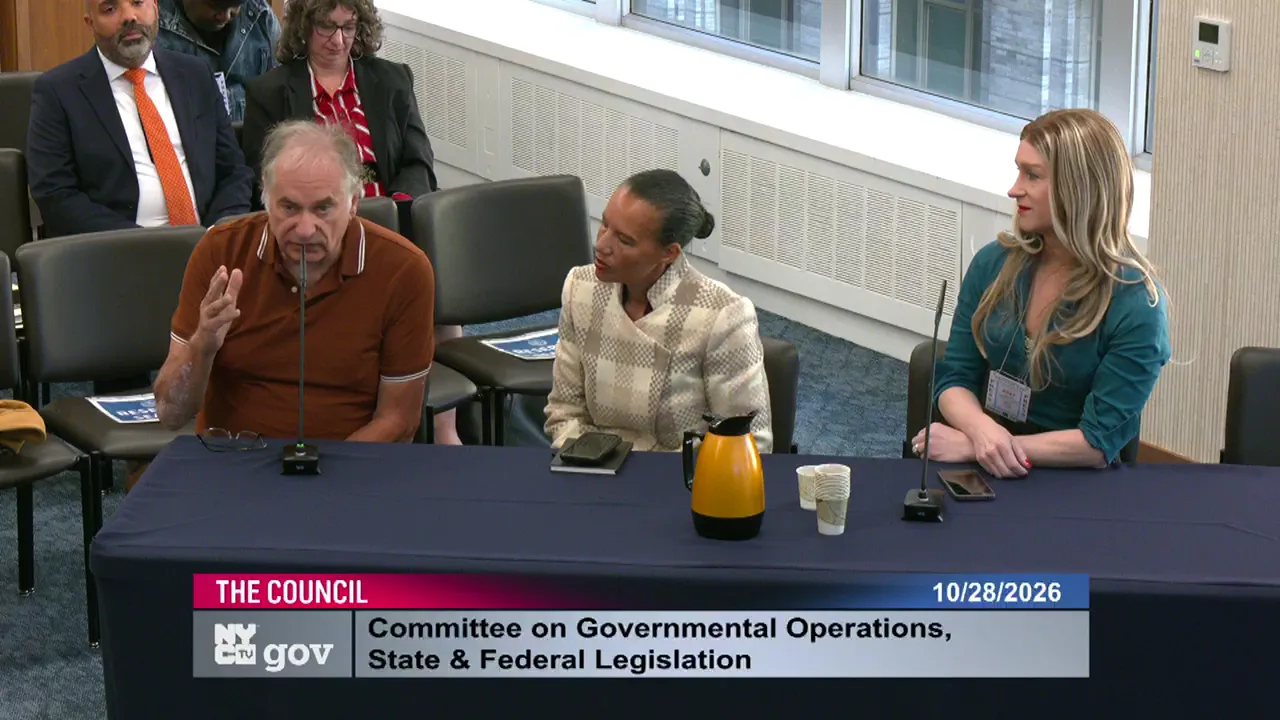
STREAMING COPY IN PREPARATION — RECORDING AVAILABLE FROM THE ORIGINAL SOURCE
Transcript — Verbatim
Speaker numbers apply only to this recording. Names come from transcript evidence. “Possibly” marks uncertain attribution.
Discussion Breakdown — Share of Meeting
Community Engagement34%
Public Engagement28%
Ethnic and Community Media10%
Media And Advertising8%
Procedural4%
Data Privacy and Security4%
Public Safety3%
Technology and Innovation2%
Public Health2%
Summary of Proceedings
NYC Council Committee on Governmental Operations: Oversight of Ethnic & Community Media and Government Advertising – October 28, 2026
The Committee on Governmental Operations, State & Federal Legislation, chaired by Council Member Gale A. Brewer, convened on October 28, 2026, to conduct an oversight hearing on the Mayor's Office of Ethnic & Community Media (MOECM) and city advertising spending. The committee also heard testimony and voted to lay over a package of good government bills (Intros 1127-B, 1128, 1129) sponsored by Council Member Williams and pre-considered legislation (T2026-2722) by Chair Brewer regarding a working group on communication technologies.
Public Comments & Testimony
- Mona Davids (NY Coalition of Ethnic and Community Media): Stated publishers endured nine months without leadership or a point of contact in MOECM. Proposed extensive amendments to Local Law 83, including making the office independent, mandating quarterly public reporting, prohibiting political favoritism in ad allocation, and strengthening enforcement of the 50% spending mandate.
- Eleanor Tatum (New York Amsterdam News): Attributed the decline in ethnic media advertising to the six contracted advertising agencies, whom she accused of ignoring local print and web outlets in favor of easy placements. She underscored that the new Executive Director is not responsible for the failures of the prior eight months.
- Esmitra Khalida (URL Media / Epicenter NYC): Noted that advertising spending has fallen dramatically since the law was passed and that counting out-of-scope spending inflates compliance figures. Requested clear implementation plans, quarterly outlet-level reporting, and modernization of how the city measures campaign value beyond simple impressions.
- Bob Henley (WBAI Pacifica Radio): Detailed severe financial struggles for his station, alleging a preference by the administration for paid influencers over established community media.
- Abu Sidjahate (Staten Island Immigrant Council): Stated that African ethnic media outlets are being overlooked for city advertising funding and urged the city to publish clear, accessible data on advertising allocations.
- Walter Sanchez (Queens Ledger / Wave of Rockaway): Argued that advertising agencies do not know local publishers and favor outlets that do not represent genuine community journalism.
- Rachel Faust (Reinvent Albany) and Ben Weinberg (Citizens Union): Urged the Council to pass records retention legislation for instant messaging, hold a dedicated hearing on FOIL compliance, and require disclosure for all government-funded influencer campaigns. They supported the good government bills on the agenda.
- Terry Wisdom (Harlem Network News): Expressed frustration at the lack of access to funding and requested to be actively involved in planning how ethnic media is supported.
Discussion Items
- Oversight of MOECM and Government Advertising Spending (T2026-2608): The committee extensively questioned the newly appointed Executive Director of MOECM, Mazin Sidahmed. Chair Brewer, Speaker Menin, and committee members expressed deep concern over the drastic drop in city advertising spending from $260 million (FY22) to $28.8 million (FY24), and that spending on ethnic media fell from a peak of $23.1 million (FY22) to $7 million (FY24). Council Member Restler highlighted a discrepancy in the FY25 report, stating that while 57% of in-scope spending went to ethnic media, $18 million of the $31 million total was out-of-scope (social media, bus shelters), making the actual percentage 24%. Council Member Morano questioned the inherent conflict of MOECM being housed under the Mayor's Director of Communications and the loophole allowing out-of-scope spending (influencers, social media) to circumvent the 50% mandate. Mr. Sidahmed stated he was the sole staff member, had no data immediately available on current ad spending, and committed to updating the website and publishing the FY26 report by the end of the calendar year.
- Legislative Package (Intros 1127-B, 1128, 1129) – Council Member Williams: Council Member Williams presented a set of good government reforms. Intro 1127-B amends or repeals 25 reporting provisions in the City Charter and Administrative Code. Intro 1128 establishes a uniform default date for agency reports. Intro 1129 creates a process for agencies to certify compliance with operational requirements. The committee heard testimony and laid over all three items. Intro 1127 was amended by the committee prior to the layover.
- Pre-Considered Legislation (T2026-2722) – Chair Brewer: Chair Brewer introduced a bill requiring DORIS to form a working group to study city agencies' use of instant messaging platforms and make recommendations on record retention. The bill was heard and laid over.
Key Outcomes
- The committee filed the oversight hearing on MOECM and government advertising spending (T2026-2608).
- Intro 1127-2026 was amended by the committee and laid over as Intro 1127-2026-B.
- Intros 1128-2026 and 1129-2026 were heard and laid over by the committee.
- Pre-considered Intro T2026-2722 was heard and laid over by the committee.
- Executive Director Sidahmed committed to immediately updating the MOECM website, aggregating FY26 advertising data, and reporting back to the Council with a plan.
- Several Council Members committed to working with the new director to strengthen enforcement of Local Law 83 and address loopholes in advertising spending transparency.
Meeting Transcript
He just said wait, sorry. Okay. Good morning. And welcome to today's uh hearing government operations, state and federal. At this time, please everyone silence all in any electronic devices. Also, there is no eating food or beverages here in the hearing room. Also at this point moving forward, no, and I repeat, no one is to approach the dais. Finally, if you wish to submit an in-person testimony, please see one of the sergeant at arms. Thank you so much. Uh Chair and Speaker, we're ready to begin. Thank you very much. I'm Gail Brewer, Chair of Communion Government Operations, State and Federal Legislation. I want to thank everyone for joining us today for our hearing on the mayor's office of ethnic and community media. Members of the public and everyone who joins us today, I think I see Councilmember Ruan. I don't know where he went, but he was here. I'll now turn it over to Speaker Menon for her opening remarks. Thank you, Speaker Menon. Thank you so much, Chair Brewer, and I really want to thank the chair for holding this important hearing. I'm Julie Menon, Speaker of the New York City Council, and we want to thank members of the public for being here today for this hearing. So this issue that we are discussing today around uh the mayor's office of community and ethnic media is not new to the city council, and it's certainly not a new issue for me. I've long recognized the importance of ethnic and community media, which led me to start investing in that over a decade ago. In 2016, when I served as commissioner of the mayor's office of media and entertainment, we announced a million dollar grant to CUNY's journalism school to create new programs that would help New York City's community and ethnic media outlets stay competitive and bring them further into the digital age. And we were really proud to announce that program. At that announcement, here is what I said. The diversity and breadth of New York City's community and ethnic media reflects the diversity of our city as a whole. And it is crucially important to keep these outlets thriving. These publications add key perspective to our local news landscape, and they keep New Yorkers in the know, whether their native language is English or Bangla. We look forward to collaborating with the journalism school on this important initiative which builds on their history of providing excellent excellent training for journalists at com ethnic and community publications. So that quote that I mentioned almost a decade ago still rings incredibly true today. That is why the council passed local law 83 in 2021 to formally establish the mayor's office of ethnic and community media, codifying former Mayor de Blasio's Executive Order 47. Local law 83 also requires mayorial agencies to spend at least 50% of their advertising budget on ethnic and community media outlets. The council passed this bill because we recognize the crucial role that community and ethnic media plays in our city and to address the difficult media climate for small publications. So I do want to say that when former Mayor de Blasia made that change in policy and the council passed that law, it had a significant impact. Prior to the implementation of Executive Order 47 and local law 83, 82% of the city's advertising spending went to large mainstream media outlets, whereas ethnic and community media outlets only received 2.7 million dollars in the city's advertising budget. By 2020, the first full year of implementation, that amount increased to 9.9 million dollars. City spending on ethnic and community media peaked in 2022 when it reached a high of 23.1 million dollars. In fiscal year 2025, 57% of city agencies' overall advertising spending went towards ethnic and community media. It was 51% for fiscal year 24 and 40 percent for fiscal year 23. However, that has not translated into greater monetary benefits, because overall advertising spending has decreased significantly. In fiscal year 2022, the city spent 260 million dollars on advertising across all media outlets. However, that number dropped to 70.4 million in fiscal year 2023, 28.8 million in fiscal year 24. In 2024, just 7 million of those dollars went to ethnic and community media, less than a third of what it was two years before that. So what has changed and why is the city's spending on media so much lower than it was just a few years ago? Um, over the past summer, the council convened a series of forums to better understand this issue. Between June and July of this year, we hosted round tables with black, Asian, and Latino community media outlets at City Hall, bringing together journalists and publishers. And I know many of you came to that, and we really appreciate that. In these meetings, we heard firsthand concerns about the city's drastically decreased media spending and investments in ethnic and community media. Furthermore, participants expressed concerns about not having a point of contact within the city, and they felt that they didn't know how to contact the administration and that lines of connections that they had during previous administrations are now not existent. Many also conveyed that their outlets are facing unprecedented financial troubles in this very challenging media environment for local media across the country, and significant decreased advice from the city have just exacerbated those difficulties. I know many are concerned about the moving and staffing of the mayor's office of ethnic and community media.
SUMMARIZED BY OPENPUBLICA AI
TRANSCRIPT VIA PUBLIC VIDEO
openpublica.com
openpublica.com