OPENPUBLICA · PUBLIC MEETING RECORD
Record of Proceedings
Oversight Hearing on NYC Care Program and Health Care Access for Uninsured New Yorkers - October 28, 2026
City Council — Wednesday, October 28, 2026
BodyNew York City, New York
SessionCity Council
DateWednesday, October 28, 2026
StatusNEW · FILED
Video Record
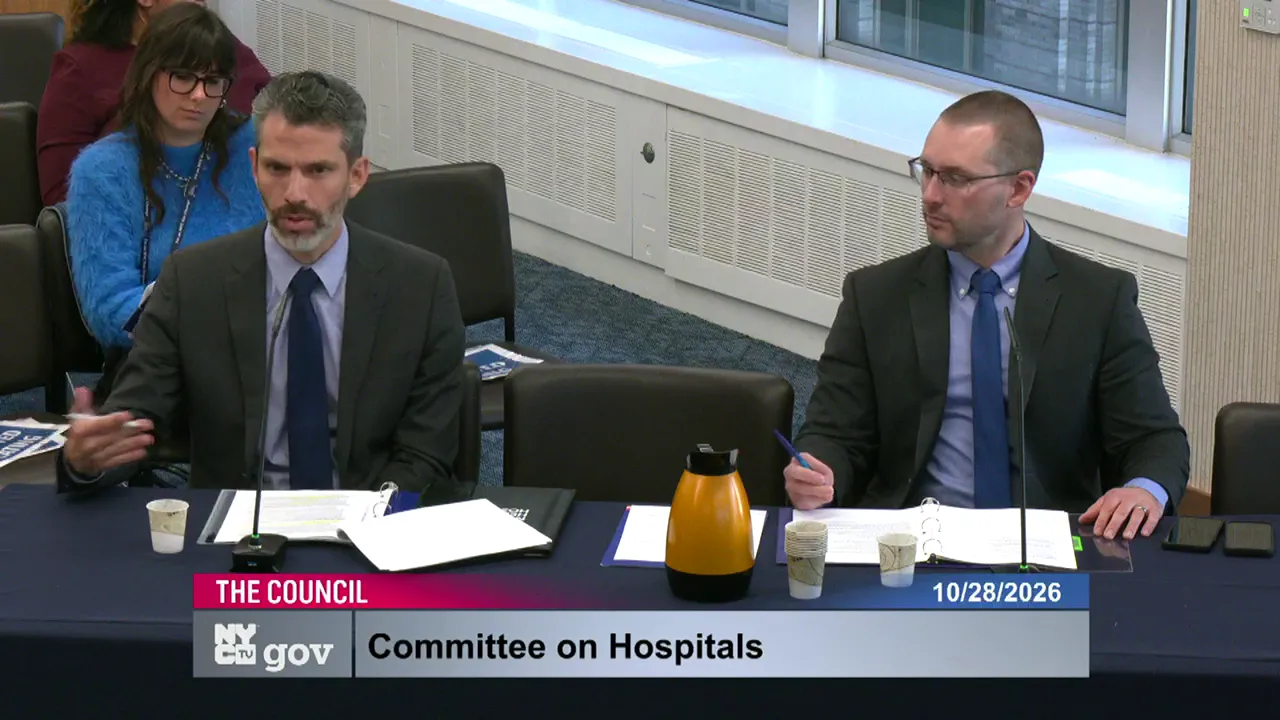
STREAMING COPY IN PREPARATION — RECORDING AVAILABLE FROM THE ORIGINAL SOURCE
Transcript — Verbatim
Speaker numbers apply only to this recording. Names come from transcript evidence. “Possibly” marks uncertain attribution.
Discussion Breakdown — Share of Meeting
Healthcare55%
Public Health26%
Public Engagement9%
Procedural5%
Homelessness2%
Language Access1%
Mental Health Awareness1%
Technology and Innovation1%
Summary of Proceedings
Oversight Hearing on NYC Care Program and Health Care Access for Uninsured New Yorkers - October 28, 2026
The New York City Council Committee on Hospitals, chaired by Council Member Mercedes Narcisse, held an oversight hearing on Wednesday, October 28, 2026, at 1:00 PM to examine Health + Hospitals’ NYC Care program and access to health care for uninsured New Yorkers. The hearing featured testimony from Dr. Ted Long (Chief Medical Officer, NYC Health + Hospitals) and Dr. Jonathan Jimenez (Executive Director, NYC Care), followed by public testimony. Key topics included enrollment trends, operational barriers, chronic disease outcomes, the impact of federal HR1 cuts, and capacity planning. The hearing was held and filed; no votes were taken.
Public Comments & Testimony
- Jane Mee (Director of Policy, Community Health Care Association of New York State - CHCANYS): Representing federally qualified health centers (FQHCs), Ms. Mee noted that New York City health centers provided 631,000 uninsured visits in 2025, incurring $92 million in uncompensated care. She projected a tripling of uninsured patients due to HR1 and urged the Council to accelerate implementation of Int. 1668-A to expand NYC Care to FQHCs and dedicate resources to affordable coordinated care.
- Carmen Garcia (Community Health Worker Supervisor, Make the Road New York): Ms. Garcia described her organization’s role as a NYC Care navigator, having helped over 1,000 enrollees. She highlighted a case of a patient who accessed care through NYC Care and was diagnosed with diabetes. She called for strong internal policies at H+H to protect immigrant patients and emphasized the importance of community-based organizations as trusted messengers.
Discussion Items
- NYC Care Enrollment and Decline: Dr. Long reported 125,766 members as of October 23, 2026, down from a peak of ~150,000. The decline was attributed to New York State expanding Medicaid to low-income individuals aged 65+ regardless of immigration status, allowing many to transition from NYC Care to Medicaid. Dr. Long stressed that these patients remain in H+H care.
- Enrollment Process and Barriers: Three enrollment pathways were described: phone (via MyChart), in-person at H+H facilities, and through 20 contracted community-based organizations. Barriers include lack of phone/internet access and missing documents. The call center number 646-NYC-CARE was repeatedly highlighted.
- Primary Care Access: More than 90% of new NYC Care enrollees have been offered a primary care appointment within 14 days since 2019. Dr. Long detailed efforts to reduce no-shows through timed SMS reminders and 10-day appointment releases.
- Chronic Disease Outcomes: A peer-reviewed study (Journal of General Internal Medicine, 2025) found no difference in diabetes and hypertension control between new NYC Care enrollees and new Medicaid enrollees. Within six months, 73% of new hypertensive enrollees and 53% of new diabetic enrollees showed significant improvement. NYC Care was estimated to have saved 1,569 lives.
- Impact of HR1 and Essential Plan Changes: Approximately 450,000 New Yorkers lost Essential Plan coverage on July 1, 2026. Of these, about 60% found alternative insurance, including thousands who enrolled in NYC Care. Dr. Long warned that Medicaid work requirements and recertification starting January 1, 2027, could cause a crisis, with up to 900,000 New Yorkers at risk of losing Medicaid. H+H has sent 400,000 emails to patients and is bolstering financial counseling and care teams.
- Budget and Capacity: The NYC Care program has a $100 million annual budget, unchanged since a few years after launch. Dr. Long stated that H+H could immediately absorb 15,000–20,000 new patients across primary care, but capacity is not infinite. He noted ongoing communication with OMB about funding needs.
- Language Access: The 646-NYC-CARE line provides telephonic interpretation in 300+ languages. Most commonly requested languages are Spanish, Chinese dialects, French, and Polish. H+H monitors no-show rates by population to identify language barriers but reported no notable trends.
- Specialty Care Access: Top five specialties after primary care are OB/GYN, eye care, dental, cardiology, and podiatry. Wait times vary by specialty; H+H uses e-consults (20% resolved without an in-person visit), workforce planning, and contact center optimization to manage demand.
- Outreach and Awareness: Top referral sources are friends/family, healthcare providers, CBOs, and online ads. H+H uses a branded truck, social media influencers, and consulate partnerships. Drs. Long and Jimenez requested continued support from Council Members to spread the word and host enrollment events.
- Transportation and Social Needs: Transportation is not a covered benefit, and H+H does not currently track no-show reasons attributable to transportation. Dr. Jimenez highlighted the DME benefit launched in 2025 (over 2,500 members used it). Social needs screening is integrated; about 25% of NYC Care members screen positive for food/housing instability and are connected to care coordination.
- Integration with Other H+H Programs: Dr. Long mentioned the SHOW (Street Health Outreach and Wellness) program (expanding 50% this year), safety net clinics (Bellevue, Lincoln, Woodhull, Elmhurst), and Housing for Health (housed 1,800 patients, built 400 units on H+H land). He also noted that H+H is exploring a system-wide volunteer program to help patients meet Medicaid work requirements.
- Maimonides Takeover: Council Member Felder questioned the financial viability of absorbing Maimonides Medical Center given enhanced Medicaid rate assumptions and potential enrollment declines. Dr. Long acknowledged the concern and promised to provide written projections.
Key Outcomes
- The committee held the oversight hearing; the matter was filed for further action.
- H+H committed to providing the Council with data on telehealth utilization, NYC Care distribution by geography, specialty wait times, and the impact of HR1.
- Drs. Long and Jimenez encouraged Council Members to help promote NYC Care at community events and via communications, with a focus on the 646-NYC-CARE hotline.
- No legislative votes were taken; the hearing served as fact-finding in advance of anticipated coverage disruptions in 2027.
Meeting Transcript
Good afternoon. Welcome to the hearing for the committee on hospitals. If you're here for the mass, you're in the right room. Sorry. At this time, one ask, please, everyone please to silence your electronic devices. Also at this point moving forward, no one is to approach the dais. And also there is no food and beverages allowed in the hearing room. Also, if you'd like to make an in-person uh testimony today, please see you on the sermon at arms here today. That being said, Chair, we're ready to begin. Thank you. Good afternoon. I am Council Member Mercedes Narcisse, Chair of the Committee on Hospitals. Thank you for joining us today for our oversight hearing on examining HYC care program and access to health care for uninsured New Yorkers. Over the years, New York State has made significant progress in expanding access to health insurance, and today has one of the lowest uninsured rate in the nation. Through investment in Medicaid, the Essential Plan, Child Health Plus, and other public coverage programs, millions of New Yorkers have gained access to preventive care, primary care providers, prescription medications, and treatment for chronic conditions. Yet, despite this achievements, access to coverage remains uneven. Certain populations, including immigrants, or our new arrival, Hispanic New Yorkers and Black, and many working families continue to experience higher rates of uninsurance and face barriers to enrollment in an maintaining coverage. In New York City, a 2025 report from the Department of Health and Mental Hygiene found that immigrant adults were nearly twice as likely as US born adults to be uninsured. For New Yorkers who fall through the cracks of the traditional insurance system, New York City care by NYC Health Hospitals serve as a critical part of the city's health care safety net. Established under Mayor Bill de Blasio, the program launched in 2019 as a pilot at H facilities in the Bronx, and has since expanded citywide. Providing uninsured New Yorkers with low-cost and no-cost health care services, regardless of insurance income or immigration status, including primary care, specialty care services like cardiology, rheumatology, orthopedics, and podiatry, mental health and substance abuse services, referrals to specialists like social workers, therapists, and psychiatrists, obstetrics and gynaecology, family planning, STI testing and treatment, affordable medications, eye care, dental care, emergency services, and other social support services, and access to durable medical equipment, which is DME by most to eligible New Yorker care patients. However, border cuts to health care eligibility at the federal level have caused approximately one hundred and ninety-seven thousand New Yorkers to lose coverage. Get that number. Besides the recent federal policy changes, there are several other ongoing barriers that prevent eligible city residents from enrolling in or maintaining health insurance coverage. Challenges such as navigating complex eligibility rules, renewal requirements, language barriers, limited familiarity with the health care system, unable, I mean, unstable employment, lack of employer sponsored insurance, housing insecurity, and difficulties accessing enrollment assistance often lead to coverage disruption. These disrupts uh disruptions in care can have detrimental consequences. On insurance individuals are more likely to delay or skip medication and treatment because of cost concerns, leading to higher risk of chronic diseases and early mortality. As a result, New Yorkers may seek care only after their conditions have become more severe. Increasing demand for emergency department services and uncompensated care, which could place additional financial and operational strand on New York City's safety net hospitals, which already serve a disproportionate share of Medicaid and uninsured patients. Preventive care plays a critical role in keeping New Yorkers healthy and reducing the need for costly emergency interventions. We call it pennywise dollar foolish. Last week, during the committee's drawn hearing in ambulance response times, we heard firsthand about the significant strength already facing the city's emergency department and EMS workforce. Ensuring that residents can enroll in and maintenance health coverage is an important part of addressing this challenges. As access to preventive and primary care can help reduce avoidable emergency room visits and ease pressure on the broader health care system. Continued investment in programs that support enrollment and re-enrollment in healthcare coverage will be essential to strengthening New York City's health care safety net. As New York faces a period of uncertainty in health care coverage, understanding how New York City care is serving uninsured residents and how the city can strengthen its healthcare safety net will be more important than ever. I look forward to today's testimony. I know the room is not as crowded as expected because this is a big deal. Testimonies will help us, right? To hear we today we'll be hearing from shareholders, stakeholders and shareholders, of course, opportunity to expand awareness of the program and any policy, operational or outreach investment that may be needed to ensure New York City care continues to meet the evolving needs of New Yorkers. Before I conclude, I would like to thank committee counsel Raina Lee, policy analyst Manure Butt, Financial Analyst Molly Howard, and my staff for all their work they do, especially in the district office. I want to say thanks to Deputy Chief Frank Shea, Drashina Jilo, and of course, my dear fellow, that's Matthew Lee. Thank you for being here. I would like to turn it over to the committee council to administer their oath witness from the administration. Thank you, Raina. Good afternoon. We will now hear testimony from the administration. Before we begin, I'll administer the affirmation. Panelists, if you could raise your right hand, I will read the affirmation once and then ask each of you individually to respond.
SUMMARIZED BY OPENPUBLICA AI
TRANSCRIPT VIA PUBLIC VIDEO
openpublica.com
openpublica.com